The photograph is kept in a sealed archival sleeve in a temperature-controlled room belonging to a private collector whose name, and the location of his collection, have been asked never to be spoken aloud. It is small, roughly the size of a folded letter, and on the surface it is an ordinary wedding portrait from the year 1908. A bride and groom stand against a painted studio backdrop of a garden that does not exist. She wears a high-collared gown of pale lace.
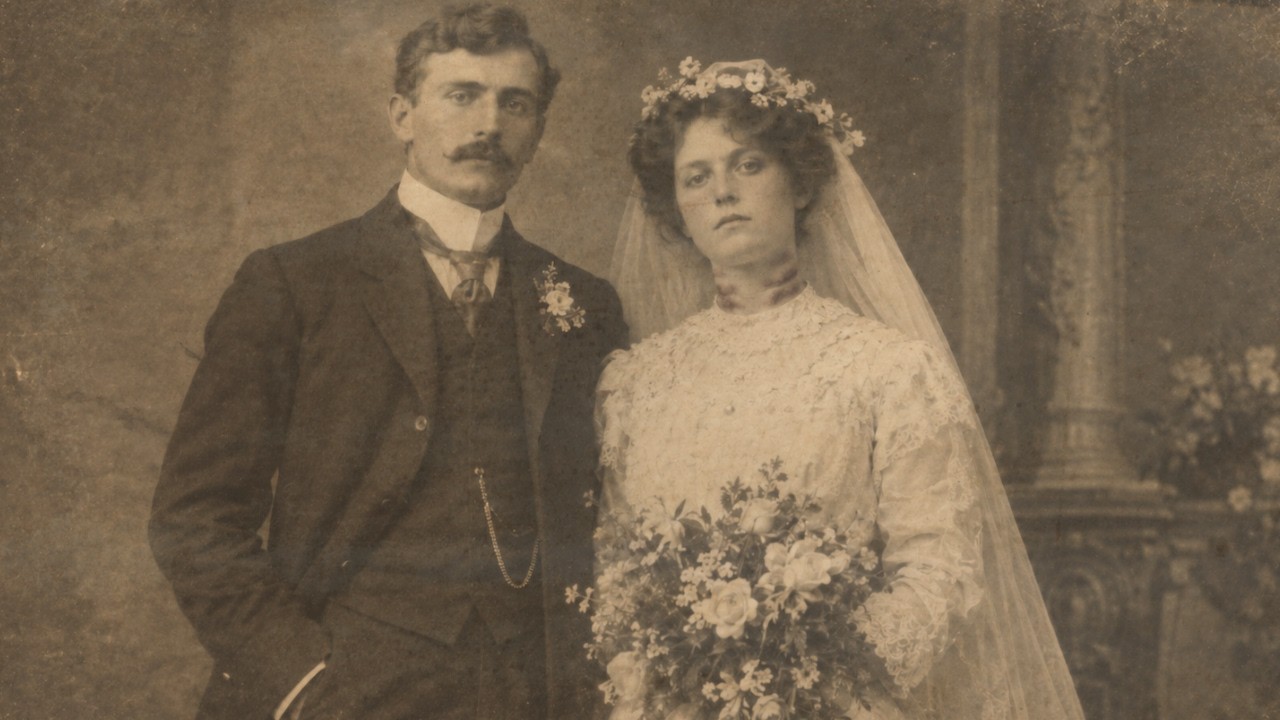
He wears a dark suit that seems a size too large for him, as if it had been borrowed or inherited, or made for a different man entirely. They are not smiling, but almost no one smiled in photographs then, because the exposure took long seconds and a smile could not be held. So at first you see nothing. You see a young couple on the most important day of their lives, frozen in silver and paper for 117 years.
Then you look at her neck. Just above the lace collar, in the narrow band of skin between the fabric and the line of her jaw, there are marks. Four of them on one side, spaced with the terrible evenness of fingers, and a single broader mark on the other side where a thumb would fall. They are not shadows, not a flaw in the emulsion, not a scratch in the negative.
Under magnification they resolve into what any physician would recognize at a glance: the deep pressure bruising of a human hand closed around a human throat. The bride in this photograph was strangled. And whoever strangled her did so in the hours, perhaps the minutes, before she was made to stand beside her new husband, put on her mother’s veil, and hold still long enough for the shutter to remember her face. That alone would be a horror worth an evening of attention.
But it is not the reason the photograph is locked away. The reason is what the collector found when he went looking for the town where it was taken, for the family whose name is written on the back in faded brown ink, and for the church whose spire rises behind the painted garden in a second photograph taken the same day. The town is not on any map drawn after 1912. The family appears in no census, no ledger, no parish record that survived.
And the church, which by every architectural measure should have taken three generations of stonemasons and a fortune no such settlement could have possessed, appears fully built in a photograph dated only four years after the official record described the land it stands on as empty forest. Someone went to enormous trouble to erase this bride, this marriage, and the entire world she belonged to. They very nearly succeeded. What they did not count on was that one photograph would survive, and that the marks on her neck would still be there when we finally learned how to look.
The photograph surfaced the way these things almost always surface: by accident, at the bottom of a box that no one had opened in living memory. In the autumn of 2019, an estate liquidator working in a river town in the upper Vim Valley was clearing the contents of a house that had stood locked and shuttered since its last owner, an elderly woman with no children and no known relatives, had died the previous winter. The house itself was unremarkable: a narrow clapboard structure with a sagging porch and a cellar that flooded every spring. But in the attic, beneath a water-stained mattress and a nest of insulation that the mice had been working on for decades, the liquidator found a steamer trunk banded in iron and fitted with a lock that had long since rusted into a single fused mass.
He broke it open with a pry bar, expecting linens, expecting the usual disappointment of old paper and older mildew. What he found instead was a collection of close to two hundred photographs, wrapped in oilcloth and tied with waxed cord. Beneath the photographs, a bundle of letters. And beneath the letters, a leather ledger with a name embossed on its cover in gold that had gone the color of tarnished bronze.
The name was Vain. Every single photograph in that trunk had been taken in a town called Aldemir, in a county whose name the liquidator did not recognize, in the years between 1896 and 1911. He almost threw them away. Old photographs of strangers have no resale value.
But something made him stop, and that something was the architecture. In photograph after photograph, behind the christenings and the funerals and the market days and the children lined up on schoolhouse steps, there stood a town that made no sense. A domed civic hall of dressed granite with a colonnade of pillars that would not have shamed a European capital. A cathedral of pale stone with twin spires and a rose window fully thirty feet across.
A network of canals lined in cut ashlar, spanned by arched bridges, threading between buildings four and five stories tall. Street lamps of ornate iron in a settlement that should have been lit by tallow and whale oil. And around the entire town, half-buried and softened by grass but unmistakable in the aerial angles taken from the surrounding hills, the low star-shaped ramparts of a fortification, built to a geometry that no American frontier community of the period had any reason, any means, or any knowledge to construct. Aldemir, population by its own ledger fewer than four thousand souls, possessed the public works of a city of half a million.
And then, sometime after 1911, it possessed nothing at all, because it was gone. The ledger is where the collector began once the trunk had passed through two intermediaries and finally reached the man who holds it now. He is not a historian by training. He made his money in shipping and spent it on the past, and he had spent thirty years buying the discarded memory of dead towns before Aldemir ever came to him.
He knew how to read a ledger. And this one, he says, was wrong from the first page. It records the affairs of a single family across three generations, but it does not begin with a birth or a marriage or the purchase of land. It begins in the middle, with an inventory dated the 4th of March in the year 1896, of what the writer calls the restoration.
Not the construction. The restoration, as though the great domed hall and the twin-spired cathedral and the ashlar canals had all been there already, waiting, and the task of the living was merely to bring them back into use. The inventory lists dozens of buildings by function and by condition. Beside each one, the writer has noted whether it was, in his word, sound, or whether it required what he calls reawakening.
A granary, sound. The northern waterworks, requiring reawakening. The hall of records, sound but sealed. The observatory upon the eastern rampart, sound.
The instruments intact. The purpose unknown. A man is standing inside a working observatory that his own community did not build, that no one alive remembers building, containing instruments that still function and that no one can any longer explain, and he writes it down in the flat, unhurried hand of a clerk taking stock of grain. The collector has fixed on one further detail from that inventory, and he cannot let it go.
Beside the entry for the northern waterworks, in a hand different from the rest, someone had written a single line of caution to whoever would read the page next. The line says that the water still ran through those ancient conduits under its own pressure, drawn from a source no one in Aldemir had ever managed to locate, and that on certain still nights, if you laid your ear against the cold stone of the lower streets, the water could be heard moving far beneath the town, slow and deliberate and unhurried, like something very large that was breathing in its sleep, and that no keeper had ever been able to say for certain whether the sound belonged to the machinery of the old world, or to whatever it was the old world had been built to hold. This is the moment, the collector says, when he stopped thinking of Aldemir as a lost town and started thinking of it as a lost world. The ledger describes a community that arrived sometime in the middle of the 1800s at a place that was already a city, already whole, already furnished with a scale of infrastructure that the arrivals could use but could not reproduce and did not comprehend.
They moved into it the way a family moves into a mansion left to them by a stranger, learning its rooms, guessing at the function of its stranger fixtures, keeping the parts that worked and boarding up the parts they feared. And the Vain family, according to their own record, were the keepers. Not the mayors, not the elders, not the founders. The keepers.
Their responsibility, passed from father to son and, the ledger is unusually careful to note, from mother to daughter, was the maintenance of what they called the old order of the town. Which brings us, by a path that took the collector the better part of two years to trace, to the bride. Her name was Cordelia Vain. She was born, according to a single line in the ledger written in a different hand from the rest, on the night of the winter solstice in the year 1889, which would have made her eighteen years old in the spring of 1908 when the wedding photograph was taken.
She was the only surviving child of Ellis and Mahala Vain, and she was, the ledger says, the last keeper of her line. There is a great deal about Cordelia in the trunk, more than about anyone else, and this is the first thing that ought to trouble us, because a family that was so thoroughly erased from every public record somehow left behind an intimate and detailed private account of one particular girl. It is almost as if the trunk itself was assembled deliberately, curated, sealed, and hidden by someone who wanted her remembered when everything around her was being unmade. The letters make this suspicion very difficult to set aside.
There are forty-one of them, and thirty of the forty-one are written to Cordelia by a variety of hands over a period of about six years. But the eleven that matter, the eleven that the collector has read aloud only once and has declined ever to read aloud again, are written by Cordelia herself. They were never sent, because all eleven are addressed to a person who, by the time she was writing to him, everyone in Aldemir insisted had never existed at all. His name in her letters is Thomas.
She never gives a surname. And the town, when she asks about him, when she describes him, when she pleads with her own mother to admit that she had seen him, that they had all seen him, that he had stood in the market square not three weeks before and sold copper wire from a cart, the town closes around her like water over a dropped stone. No one remembers Thomas. There is no Thomas.
There has never been a Thomas. And Cordelia Vain, eighteen years old, the last keeper of the old order of a town that should not exist, begins in her final letters to understand something that she puts into words only once, in a sentence that the collector says he still hears when he cannot sleep. She writes: “I have come to believe that a person can be taken out of the world so completely that the world itself is made to forget the shape of the hole they leave. And I am terribly afraid that I am next.
”
To understand what she meant, and to understand the marks on her neck, you have to go back further than Cordelia, further than her father Ellis, further even than the restoration of 1896. You have to go back to the thing that everyone in Aldemir referred to, always in a lowered voice and never in writing if they could avoid it, as the settling. And to do that, you have to talk about what the collector found when he finally located the ground where Aldemir had stood. Finding the ground was harder than finding the family, and the reason is itself part of the story.
Aldemir does not appear on any map printed after 1912. But the collector reasoned correctly that a town does not simply evaporate, and that whatever had happened to its people, the land they had stood on must still be somewhere, under some name, in some county, in the upper Vim Valley, where every photograph in the trunk had been taken. So he did what a patient man with money does. He bought old maps.
He bought survey records. He bought the fragile hand-drawn plats that county assessors made before the age of aerial photography. And he laid them over one another on a long table in the order of their dates, and he watched a town disappear, one map at a time. On the earliest map he could find, drawn in the year 1871, there is a settlement marked at the confluence of two rivers, labeled in a careful copperplate hand, Aldemir.
Beside the name, the surveyor has written a note: “Extensive stoneworks of unknown origin, occupied. ” On the next map, from 1884, the town is larger, the roads are drawn in, and the star-shaped ramparts are sketched around it with a surveyor’s fascination, annotated with the single baffled word “ancient. ” On the map from 1899, Aldemir is at its fullest extent, a dense grid of streets and canals and civic buildings rendered in loving detail, clearly a place of consequence. And then comes the map of 1913.
And on the map of 1913, at the confluence of the two rivers where Aldemir had stood for at least forty-two years of recorded survey, and if the ledger is to be believed for centuries or millennia before that, there is nothing. Not a ruin, not a marked ruin, not a note, not even the courteous surveyor’s convention of a dotted outline for a former place. There is a river confluence, and there is forest, and across the forest, written where the town used to be, is a single word that the collector says made the hair stand up on his arms the first time he read it. The word is “reclaimed.
” Reclaimed by whom? Reclaimed by what? The map does not say. But it is the same word, the collector realized, that a much older document uses.
That older document is the oldest thing in the entire trunk, older than the ledger, older than the letters. A single sheet of heavy paper folded into eighths and tucked into the lining of the trunk’s lid, where it was very nearly missed. It is not written in English. It is written in a script that the collector has shown to four separate specialists in historical writing systems, and all four have told him the same three things.
First, that the letter forms resemble no alphabet in the standard catalogs. Second, that the document is nonetheless clearly a legal or administrative text, because it has the structure of one: the seals, the columns, the repeated formula. And third, that whoever made it was not a primitive people scratching at bark, but a literate, organized, and technically sophisticated civilization that produced this document on paper of a quality that should not have been achievable in North America before the industrial era. And yet the paper has been dated by its fiber content to a period that predates the earliest official European presence in the Vim Valley by a margin the specialists were not comfortable putting into writing.
One of them returned the document to the collector by courier with no note and has not answered a letter since. So this is where the story stands before returning to Cordelia and to the hand that closed around her throat. There was a town called Aldemir. It stood at a river confluence in the upper Vim Valley, and it was already built, already vast, already impossibly sophisticated, when the first English-speaking surveyors reached it in the middle of the 1800s and found it, in their own word, occupied.
The people occupying it did not build it. A family called Vain served as the keepers of its old order across at least three generations. And then, between the map of 1899 and the map of 1913, in the space of a single human childhood, the entire town—its cathedral, its domed hall, its canals, its star fort, its observatory, and every one of its several thousand inhabitants—was removed from the world so thoroughly that within one generation there was no map that admitted it had ever been there, no census that had ever counted its people, and no record of any kind in the possession of any archive, library, historical society, or government office in the entire region. Except for one iron-banded trunk in an attic, wrapped in oilcloth, waiting.
The people of Aldemir had a word for the removal of a thing from the world. They called it the settling. And the ledger uses the word in a way that took the collector a long time to understand, because it does not mean settling in the sense of pioneers settling a frontier. It means settling in the sense of dust settling, or silt settling, or a house settling into soft ground until the doors no longer close.
It means sinking. It means being slowly and quietly buried by the ordinary weight of time and forgetting until nothing remains above the surface. And the keepers, the Vains, the family into which Cordelia was born on the longest night of the year 1889, existed for one reason and one reason only. Their task across the generations was to hold Aldemir up against the settling, to keep it from sinking, to keep the town and everyone in it remembered, and therefore real.
That was the old order they maintained, and Cordelia was the last of them. The ledger is frustratingly precise about the schedule of the work and almost entirely silent about its nature, the way a man might record every time he wound a great clock without ever once explaining what the clock was for. But between the ledger and the letters, a picture assembles itself, and it is not a comfortable one. The keepers kept records.
That was the visible part of the work, the part an outsider could have watched. Every soul in Aldemir was written down. Every birth, every death, every marriage, every arrival and departure, every name and face, and the small particular facts that make a person a person rather than a number—all of it entered by hand into the great bound volumes that the ledger calls the registers, housed, the collector believes, in the building the earliest inventory calls the hall of records, sound but sealed. But the writing down was only the surface of it, because the registers were not merely archives.
According to Cordelia’s own account, in the letters where she described the duty she had been trained since childhood to inherit, the keepers did not simply record the people of Aldemir. They remembered them, in some active and effortful and continuous sense that she struggles to put into ordinary words. She writes of sitting with her mother in the sealed hall through the long nights near the solstice, the two of them reading the registers aloud, name after name after name. Not for any audience, not for any ceremony that outsiders were permitted to see, but because, she says, the names had to be spoken or they would begin to fade.
And when a name faded from the register, she writes, the person faded from the world, and not only from the future but from the past, so that it was not that they died, but that they were revealed never to have lived at all. It would be easy to hear this and conclude that Cordelia Vain was simply a frightened and imaginative girl raised inside a strange family belief, a superstition dressed up in the vocabulary of duty, the kind of thing isolated communities have always generated to explain their fears. That is the reasonable interpretation. The collector held it himself for the better part of a year.
What broke it for him was the observatory. Because the ledger, it turns out, is not the only thing the trunk preserved from the eastern rampart of the town. Folded inside one of the letters, the one dated the 11th of October 1907, there is a diagram. Cordelia drew it.
She was a careful draftswoman, and the diagram shows in cross-section and in plan the principal instrument of the observatory, the thing her ancestors had found intact and functioning and had never understood. It is not a telescope. Telescopes look outward. This instrument, as Cordelia drew it and as she describes it, looked, in her phrase, along the line of what is kept.
She has labeled its parts in her own hand with names that are clearly translations, and clumsy ones, of terms in another language, the language of that undatable folded document in the lid. There is a component she calls the anchor. There is a component she calls the throat. And that word is not a small thing, because the mechanism at the heart of a town devoted to remembering had a part called the throat.
And there is a great disc marked around its circumference, not with the degrees of a compass, but with what Cordelia labels “the names of the held,” which the collector reads as a roster, a census rendered into some physical and rotating form. Each name a position on a wheel that the instrument turned slowly, continuously, night after night, for as long as the keepers kept it turning. When the wheel turned, the town was held. And Cordelia writes in that same letter, with the flat clarity of someone recording a fact rather than a fear, that her mother had told her the wheel had been slowing for thirty years, and that no one now living knew how to make it turn faster, and that when it stopped, the settling would come all at once, and Aldemir would go the way of the places that had settled before it, the places whose names not even the keepers could any longer recall, because those names had been on wheels that had already stopped.
And this is where Thomas comes in. The man who sold copper wire from a cart in the market square three weeks before Cordelia began to write letters to him that she could not send. The man whom the entire town, her own mother included, insisted had never existed. Because Cordelia did not believe he had never existed.
She believed something far worse, and she was right, and it is the key that unlocks everything else in the trunk, including the photograph, including the marks on her neck. She believed that Thomas had existed, that she had known him, spoken with him, that she had walked with him along the northern canal on three separate evenings in the late summer of 1907, and that Thomas had then settled. That his name had faded from the register. And that when a name fades, the fading does not merely erase the future memory of the person.
It reaches backward. It goes into every other mind that had ever held the memory of him, and it closes the hole, smooths it over, so that those people do not experience a loss. They experience nothing. They simply have never known any Thomas, and they say so with perfect sincerity, and they are not lying, because the version of them that knew him no longer exists either.
Everyone in Aldemir had forgotten Thomas completely and seamlessly, and without pain. Everyone except Cordelia Vain. The question that consumes the last eleven letters, the question she turns over and over as the autumn of 1907 becomes the winter, and the winter becomes the spring of the year she would be photographed with a strangler’s marks on her throat, is a simple and unbearable one. Why do I still remember him?
Why, when the wheel let go of Thomas and the whole town forgot, was one soul left holding the shape of the hole? The answer came to her from her mother, Mahala, and it came in the form of a warning that Cordelia records almost word for word in the letter dated the 2nd of December 1907, on the eve of the girl’s own eighteenth birthday. Mahala had found the unsent letters. She had read them.
And rather than dismiss her daughter’s grief for a man the town had forgotten, she did the thing that finally convinced the collector that whatever else was happening in Aldemir, the people who lived there were not confused about it. She confirmed it. “Yes,” Mahala said. “There was a Thomas.
I remember him, too. ”
And then she explained why. A keeper cannot be held by the register the way an ordinary soul is held. This is the price and the whole meaning of the office.
The instrument on the eastern rampart, the great slow wheel, holds everyone whose name is written on it. And while the wheel turns, those souls are anchored against the settling, kept real, kept remembered, protected from the fate of fading. But someone must turn the wheel. Someone must read the names.
Someone must stand outside the circle of the held and do the holding. And that someone cannot also be inside the circle, because a hand cannot lift the chair it is sitting in. So the keepers are not written on the wheel. The keepers are not held.
Which means that a keeper remembers everything, remembers even the ones who fade, because the fading works only on those the wheel had been holding, and a keeper was never held. And therefore a keeper is never cleaned of the memory when a name lets go. Cordelia remembered Thomas because Cordelia was a keeper, and keepers are the only people in the world for whom the dead and the settled and the erased remain stubbornly and permanently real. Sit with what that means for a moment, because Cordelia did, and it nearly destroyed her.
It means that Mahala, and her mother before her, and every keeper back to the beginning of the office, walked through their lives carrying the complete and uncleaned memory of every single person who had ever settled out of Aldemir. Every name that fell off the slowing wheel, every neighbor who quietly ceased to have ever existed while the rest of the town felt nothing. The keepers felt all of it. They were the town’s grief made into a hereditary duty, the one family cursed to remember the holes that everyone else was mercifully allowed to forget.
And they were not held themselves. When a keeper died, there was no wheel turning their name, no anchor, no protection. A keeper simply ended. And worse than ended, because the ledger contains a passage in Mahala’s hand that Cordelia copied into her letter with a note that she did not fully understand it and was afraid to ask.
The passage says: “We who keep are not kept, and when our turning is done, we do not settle gently as the held do. We are taken, and the taking leaves a mark, and the mark is how the next keeper knows the office has come to them. ”
The mark. The collector read that line, and then he took the wedding photograph out of its sleeve, and he looked at the four even bruises above the lace collar and the single broad bruise where a thumb would fall.
And he understood that he had been looking at the answer to the wrong question. He had been asking who strangled Cordelia Vain. The right question, the question the trunk had been assembled to make someone finally ask, was different. The marks on her neck were not the wound of a murder.
They were the sign of an inheritance. They were the physical evidence pressed into the living skin of an eighteen-year-old girl that the office of keeper had passed to her. That something had come for the previous holder of that office and taken them in the manner the ledger describes, and that the taking had left its handprint on the throat of the one who came next. And the word from the observatory diagram surfaced in his mind and would not leave: the component at the heart of the instrument, the part Cordelia had labeled in her clumsy translation from a language older than the valley, the throat.
But if the marks were the sign of inheritance, then the office had passed to Cordelia. And if the office had passed to Cordelia, then the previous keeper had been taken. And the previous keeper, by every line of the ledger and every word of the letters, was Mahala, her mother. So the wedding photograph taken in the spring of 1908 is not a picture of a bride attacked by some prowler or jealous suitor in the hours before her ceremony.
It is a picture of a girl standing beside her new husband on the day she buried her mother and inherited the impossible burden of holding an entire condemned world up against the dark, wearing on her throat the handprint of whatever it is that comes to collect a keeper when the turning is done. That is why she is not smiling. That is why the groom’s suit does not fit. And that, the collector believes, is why the wedding happened at all, and why it happened so fast, and why it was documented so carefully.
Because the marriage was not a marriage in any sense you or I would recognize. It was a binding. It was the town’s desperate attempt to do to Cordelia the one thing that had never been done to any keeper before. They were trying to get her onto the wheel.
To understand the binding, you have to understand the man they chose to bind her to. Among the forty-one letters there are three written by the groom himself, and they are the letters of a man who did not want what was being asked of him, and agreed to it anyway. His name was Ambrose Halloway. He was twenty-six years old in the spring of 1908, and he was not from Aldemir.
He was, of all things, an engineer, or something close to it, a man who had come up the Vim Valley the previous year in the employ of a company that was surveying the rivers for a hydroelectric scheme. One of the ordinary modern enterprises that were creeping into the valley from the world outside, the world of maps and censuses and copper wire sold from carts. Ambrose Halloway walked into Aldemir as a stranger from the ordinary world, and what he found there frightened him and fascinated him in equal measure, and he wrote it all down. His first letter, dated the 9th of February 1908, is addressed to a brother back east, and it was never sent.
The collector thinks it was never sent because Ambrose realized partway through writing it that no one outside the valley would believe a word of it, and that the attempt to be believed might be dangerous. In it, he describes arriving in a town that his own company’s survey maps did not show, a town of canals and colonnades and a cathedral that, he says in the plain admiring language of a man who builds things for a living, could not have been raised by the people living in it, because the people living in it did not have the tools, the numbers, or the memory of how. He describes being taken in by the Vain family. He describes Mahala, whom he calls a severe and exhausted woman who seemed to be listening always to something just past the edge of the room.
And he describes Cordelia. It is clear from the first mention that whatever the town intended by throwing them together, the thing that actually happened between Ambrose Halloway and Cordelia Vain was not part of anyone’s plan, because he fell in love with her honestly and completely, in the way that engineers fall in love, by trying to understand her and failing and coming back to try again. The second letter is the one that matters. It is dated the 19th of April 1908, which the collector has established was eight days before the wedding, and it is addressed to Cordelia.
Unlike her letters to Thomas, it was clearly delivered, because it bears her annotations in the margin, small penciled replies to his questions, as though she had answered him on the page and handed it back. In it, Ambrose tells her that he knows what they are asking him to do. He knows that the marriage is not what it appears. He knows about the wheel, because she had shown him.
She had taken him up onto the eastern rampart in the dark and let him put his hand on the slowing disc, and he had felt it move. And he writes that the memory of that motion under his palm had ruined him for the ordinary world forever, that he could never again go back to surveying rivers for a company that thought the valley was empty. And he tells her that he understands the plan. The town’s elders, what remained of the old order, had reasoned that if a keeper could not be held by the wheel because a keeper stood outside the circle, then perhaps a keeper could be anchored by a different mechanism, an older and more human one.
Marriage. A binding of two souls, witnessed and recorded and sworn, a name joined to a name. If Cordelia Vain became Cordelia Halloway, if she was written into the register not as a keeper but as a wife, joined to a man who was himself an ordinary held soul from the ordinary world, then perhaps, the elders hoped, the wheel could be made to hold her, dragged inside the circle by the anchor of her husband’s held and ordinary life. It had never been tried.
There was no reason to think it would work. But Mahala was already gone, taken in the manner that leaves the mark. And Cordelia was eighteen and alone and standing at the head of a line of keepers that ended with her. And a thing that had never been tried was better than the certainty of what waited for a keeper who died unheld.
And here is the part of Ambrose Halloway’s second letter that the collector says is the reason he will not sell the trunk, will not donate it, will not let it out of the climate-controlled room, because he has come to feel that he is now, in some way he cannot fully defend, its keeper. Ambrose writes to Cordelia that he does not care whether the binding works to save the town. He does not care about the wheel or the register or the old order or the settling of Aldemir. He tells her that he has done the arithmetic that the elders have not, the cold engineer’s arithmetic, and that he believes the town is already lost, that the wheel is turning too slowly to be saved by any marriage or any mechanism, and that within a few years Aldemir and everyone in it will settle out of the world, no matter what the two of them swear to each other on their wedding day.
He knows this. He is going to marry her anyway, because, he writes, if the whole of Aldemir is going to be taken out of the world so completely that the world forgets the shape of the hole it leaves, then he wants to be inside that hole with her. He would rather settle beside Cordelia Vain and be forgotten by the entire universe than remain in the ordinary world, remembered and held and safe, in a reality that had been scrubbed clean of the fact that she had ever lived. That is the letter of the man standing beside her in the photograph.
That is why his borrowed suit does not fit, because he was a surveyor and not a groom, a stranger who had walked into a dying world eight months before and decided to die in it for love. The wedding took place on the 27th of April 1908, in the twin-spired cathedral that no one in Aldemir had built. The account of it comes from three sources that the collector has laid side by side the way he laid the maps, looking for the places where they agree and, more importantly, the places where they do not. The first source is a single page torn from the register itself, the only page from the register that survives, and it survives because someone—almost certainly Cordelia—tore it out and put it in the trunk.
The second is a letter written the day after the wedding by a woman named Prudence Aldus, a neighbor, to her sister in another town, describing the ceremony as a guest would describe it. It is the most ordinary document in the entire trunk, which is exactly what makes it so useful, because Prudence Aldus did not know she was witnessing anything strange. The third source is the photographer, a man named Josiah Merrick, the last professional photographer in Aldemir. By the spring of 1908 he was, according to the letters, very nearly the last professional anything, because the town was emptying.
Not fleeing, not dying in any way that left bodies or graves. Emptying in the particular way that the settling emptied a place, which is to say that the population was going down not because people were leaving, but because people were, at an accelerating rate, being revealed never to have existed. Prudence Aldus mentions it in passing without alarm, in the flat way that Aldemir had learned to mention such things. She writes that the cathedral was less full than it would have been for a Vain wedding in the old days, and that it was a shame so many of the old families had, in her phrase, gone quiet.
She lists three surnames of families that had gone quiet, and the collector has confirmed that not one of those three surnames appears anywhere in the rest of the trunk, not in the ledger, not in any other letter, as though even the assembled memory of Aldemir could hold them for only the single sentence in which Prudence happened to write them down. Josiah Merrick understood exactly what he was photographing. Merrick was not a studio hack recording a happy occasion. He was, in his own quiet way, a keeper of a kind, because a photograph is a way of holding a person against forgetting.
He had spent his professional life pressing the faces of Aldemir into silver so that even after the wheel let them go, some trace would remain. And Merrick had noticed the thing that no one else in the town could notice, because Merrick had a shortcut around the fading that no one else possessed. He had his old photographs. He could look at a portrait he had taken five years before and count the faces, and compare that count to the town he walked through now.
Where an ordinary resident of Aldemir would see nothing wrong, would have no memory of the vanished and therefore no sense of absence, Merrick could hold the old photograph in one hand and the present in his eyes and feel the difference between them like a draft from a door left open. He wrote, in the one letter of his that the trunk preserves, that he had begun to be afraid of his own archive, that he no longer liked to look at the old plates because the people in them were starting to feel like accusations. And he wrote one sentence that the collector considers the single most important line in the entire collection, more important even than Cordelia’s line about the shape of the hole. Merrick wrote: “I have come to think that the photographs are not merely recording the ones who are held.
I have come to think that a face held firmly enough in an image cannot fully settle. And this is why I am afraid, because if that is true, then I am not preserving the memory of Aldemir. I am trapping its people half in the world and half out of it, and I do not know which is the greater cruelty. ”
Imagine Josiah Merrick on the morning of the 27th of April 1908, setting up his camera in the cold stone light of a cathedral that was already half empty, to photograph the wedding of the last keeper.
He knew what Cordelia was. He knew what the marriage was for. And he knew, because he could not help knowing, that Mahala, who should have been standing in the front pew weeping the way mothers weep, was not there, and had not been there for three days, and that no one in the cathedral except himself and the bride seemed to find her absence strange. Because Mahala had been taken.
The register page that Cordelia tore out records it in Cordelia’s own hand, in an entry she was never supposed to make, because keepers were not written in the register and neither therefore were the deaths of keepers. But Cordelia wrote it anyway. She wrote, on the page she saved from the fire that was coming, a single line beneath the formal record of her own marriage: “My mother was taken on the night of the 24th, and the mark passed to me before dawn, and I have covered it with lace so that Ambrose will not see on this of all days the sign of what I have become and what is coming for me in my turn. ”
So now the photograph can be looked at the way the collector looks at it, which is to say, the way you look at a thing once you know what it cost.
He had it examined discreetly and at considerable expense by a person whose profession is the technical analysis of historical images, and he gave that person no context at all. No story, no ledger, nothing but the print and a single question: what can you tell me about the marks on this woman’s neck? The examiner spent three weeks with it and produced a report. The marks are real.
That is the first finding, and it is the one the collector most wanted, because the easy explanation, the explanation any sensible person reaches for, is that the marks are a defect, a scratch on the negative, a flaw in the emulsion, a trick of the shadow cast by the lace. The examiner ruled out every one of these. The marks follow the curve of the neck, wrapping with the three-dimensional geometry of the throat in a way that a flat scratch on a flat negative cannot. They fall under the collar and emerge from beneath it, which a surface flaw would not do.
And under high magnification, they show the modeled, feathered edges of subcutaneous bruising, the particular way that blood spreads under skin when a vessel is crushed. A pattern that the examiner said flatly no photographic artifact reproduces, and no retoucher of the period could have painted, because the science of what a deep-tissue bruise looks like under magnification was not understood well enough in 1908 for a forger to have faked it correctly. And yet it is correct. It is exactly correct.
It is the bruising of a hand that closed hard around a throat and held. The second finding is the one the examiner flagged as, in the careful language of the report, anomalous and outside my competence to explain. The bruising, the examiner wrote, is inconsistent with a survivable strangulation. The pressure indicated by the depth and distribution of the marks, if sustained long enough to produce bruising of that severity, would have been sufficient to cause unconsciousness and very probably death.
And yet the subject is standing. She is upright, composed, her eyes open and focused on the lens, her posture unsupported, showing none of the physical signs—the petechial hemorrhaging in the eyes, the cyanosis—that a person would display in the minutes after surviving an assault severe enough to leave those marks. The examiner could not reconcile it. A woman with those marks on her neck should not have been able to stand for the long seconds of the exposure.
She should not have been able to stand at all. But she is standing, and she is looking at us 117 years later, out of the silver, with the calm and terrible steadiness of someone who has already understood that the worst thing has happened and that there is nothing left to do but hold still. The collector believes he knows what the examiner could not. The marks were not made by a living hand in the ordinary way.
They were made in the manner the ledger describes, the taking that leaves the mark. The thing that comes for a keeper. Mahala had been taken on the 24th. The mark had passed to Cordelia before dawn on the 25th.
And what the photograph records is not a woman who survived a strangulation, but a woman wearing the wound of an inheritance that no medical science can describe, because it is not in any medical sense an injury at all. It is a claim. It is the physical announcement pressed into her flesh that she now stood outside the circle of the held, that the office was hers, and that the same hand that had taken every keeper before her would, in its own time, close around her throat and finish what the mark had begun. There is a third finding in the report, and the collector almost did not mention it, because it is the one that sounds least like evidence and most like a confession.
The examiner wrote that the longer the print was studied, the harder it became to look away from the woman’s eyes, and that this was not a poetic observation but a technical one, because the focus of the portrait, the single plane where Merrick’s lens rendered the image most sharply, does not fall on the center of the composition, as convention would demand. It falls on her eyes, and only on her eyes, so that everything else in the photograph—the lace, the groom, the painted garden—softens by comparison, and the two points of light caught in her pupils remain, across 117 years, the sharpest thing in the frame. The examiner could not say whether Merrick had done this deliberately, or whether the plate itself had, in the examiner’s uneasy phrasing, decided where it wished to be clear. Either way, the effect is the same.
Whoever looks at the photograph is made to meet her gaze, and having met it, finds it difficult to believe that she is not, in some fashion the report was not equipped to describe, still looking back. There is a second photograph. The collector mentioned it at the very beginning and then deliberately set it aside, because it only becomes bearable to discuss once you understand the first. It was taken the same day by Merrick, on the cathedral steps, and it shows the wedding party such as it was, perhaps two dozen people arranged on the pale stone in the flat spring light.
Behind them rises the cathedral: the twin spires, the rose window thirty feet across. And it is in this photograph, in the background, that the architecture of Aldemir is preserved most clearly: the impossible masonry, the scale, the ornament, all of it captured in a single exposure four years after the surveyor’s note that called the land empty. But that is not why the collector set it aside. He set it aside because of the counting.
If you take the second photograph, the group on the steps, and compare it to Prudence Aldus’ letter describing who attended the wedding, the numbers do not match. Prudence names and refers to 31 guests. The photograph taken the same afternoon at the same event shows 23. And the collector, who has now spent six years learning to think the way Aldemir thought, does not believe that eight guests simply stepped out of frame.
He believes that in the hours between the ceremony and the photograph on the steps, eight of the people who had come to witness the last keeper’s wedding went quiet, settled, fell off the slowing wheel, and that Josiah Merrick, pressing the shutter, caught not a group portrait but a census of the survivors: a photograph of exactly the people who still, at that particular minute of that particular afternoon, happened to have ever existed. It was the counting that sent the collector back to the rest of the trunk, to the other two hundred photographs he had until then treated as background, as texture, as the ordinary photographic litter of a vanished town. He had been looking at the wedding portrait as a single terrible object. He had not thought to ask whether it was the only one of its kind.
It was not. He went through all of them, one at a time, with the loop the examiner had left with him, and he looked at every neck. It took him weeks, because two hundred photographs is a great many faces, and because what he was looking for did not want to be found, hidden, as it always was, beneath high collars and chokers and the lace that Aldemir women seem to favor to an unusual degree, a fashion that the collector no longer believes was a fashion at all. And he found them.
Not in all the photographs, not even in most, but in eleven of the two hundred, spread across the fifteen years the collection spans, there is a woman. Always a different woman. Always alone, or at the center of some family grouping. And always, when you know to look, wearing the same marks: four even bruises on one side of the throat, a single broad bruise where a thumb would fall, partly hidden by the collar, impossible to explain.
Eleven women across fifteen years, each photographed wearing the handprint of the taking. Eleven keepers. Because that, the collector realized, is what he was looking at: a photographic record, assembled and preserved by someone, of the succession of the office. Each time a keeper was taken, the mark passed to the next, and at some point in the days that followed, that new keeper sat for Josiah Merrick, or for whichever photographer preceded him, and had the mark recorded deliberately before the lace went back up and the town pretended not to see.
It was a kind of coronation. It was the only ceremony the keepers had. And the trunk, the collector now understands, was not a family’s random keepsakes. It was the deliberate archive of the office of keeper, assembled across generations, hidden at the last against the settling, so that when Aldemir finally went quiet, one iron-banded box would remain in which the succession was written in silver, name after name, mark after mark, back into a past that the ledger dates further than any of the specialists were willing to sign their names to.
The faces tell a story that the ledger only implies. The collector arranged the eleven marked women in the order of the dates written on the backs of their portraits, and looked at them in sequence, and saw the thing that made him, by his own account, put the loop down and not pick it up again for a month. They are getting younger. The earliest marked keeper in the collection, a portrait dated 1893, is a woman in what looks like her sixtieth year, a broad, calm, heavy-faced woman who wears the marks the way a soldier wears an old scar, without fear, almost with pride.
The next, dated 1897, is perhaps fifty. The next, forty. The intervals between the portraits are shrinking, and the ages of the women in them are shrinking too, because as the wheel slowed and the settling accelerated, the keepers were being taken faster and faster, each one holding the office for fewer years than the last before the hand came for her throat and passed the mark along. By the final portraits, the succession is measured not in decades but in single years.
And the women are young, and then they are very young. And the last of the eleven, the youngest of them all, the end of the line, the one whose portrait the collector had started with without understanding that she was the culmination of everything the trunk contained, is Cordelia Vain, eighteen years old, standing beside a surveyor in a borrowed suit, wearing her mother’s marks under her mother’s lace, the last keeper of a town that had been eating its keepers at an ever-quickening rate for at least fifteen years, and probably for centuries. The way a failing fire burns its remaining fuel faster and hotter as it dies. Which raises the question the collector says he did not want to ask, and asked anyway, because six years in he could not stop himself.
If the keepers were being taken faster and faster, if the mark was passing from woman to woman across shrinking intervals, then what happened after Cordelia? She was the last. There was no twelfth portrait. There was no younger keeper waiting to receive the mark from her throat.
The line ended with an eighteen-year-old girl in the spring of 1908, and the town settled fully out of the world sometime before the map of 1913. And there is no photograph anywhere in the trunk of whatever happened in between. The archive of the office of keeper is complete up to Cordelia, and then it simply stops. The way the wheel stopped.
The way the map went blank. The way the word “reclaimed” was written across the forest where a city used to stand. The last letters are the only witnesses to the end, and they are the hardest part of the trunk to read, and they answer the question of whether the binding worked: whether the marriage to Ambrose Halloway did the thing the elders prayed it would do, and dragged Cordelia Vain inside the circle of the held. The answer, when it comes, is not the answer anyone wanted.
There are four letters written after the wedding, and all four are in Cordelia’s hand, and all four are addressed to Ambrose. Which is itself the first clue that something had gone wrong, because a wife does not write letters to a husband she lives beside unless she has some reason to fear that the ordinary channel between them, the simple act of speaking across a room, has failed. The first of the four is dated the 15th of May 1908, eighteen days after the ceremony, and it is almost hopeful. Cordelia writes that the marks on her throat have faded to yellow, that she has slept without dreaming for the first time in a season, and that she has begun to allow herself to believe that the elders were right, that the binding took, that being written into the register as Ambrose Halloway’s wife has done what no marriage had ever done for a keeper, and pulled her inside the circle where the wheel could hold her.
She writes that she stood on the eastern rampart at dawn and put her hand on the disc and could not feel, for the first time in her life, the difference between herself and the held. She writes that she wept, and that Ambrose held her, and that she thought perhaps they might live. The second letter, dated the 9th of June, is where the hope begins to come apart. It comes apart in a way that is worse than any dramatic reversal, because it comes apart quietly, through a single observation that Cordelia clearly did not want to have made.
She writes that she has been keeping a private count, and that she, who as a keeper had always carried the full uncleaned memory of everyone the town had lost, had noticed that her memory of the settled was beginning to blur. That the names of the ones who had gone quiet, names she had held perfectly and painfully all her life, were softening at the edges, growing indistinct, and that some of the very oldest, the ones from her childhood, she could no longer bring to mind at all. And she understands what it means, and she writes it down in a sentence that the collector says is the moment the whole story turns from a tragedy into something colder. She writes: “The binding is working.
” And that is the horror of it. Because to be held is to be made able to forget. And I am at last becoming able to forget. And so I am at last becoming like everyone else.
And there will soon be no one left in the world who remembers Thomas, or my mother, or any of the taken, because the last keeper is being cured of the only thing a keeper was for. Do you see what she saw? The office of keeper was a curse, the hereditary burden of remembering every hole in a world that everyone else was mercifully allowed to forget. And the binding, the marriage, the anchor that was meant to save her, saved her by taking the curse away.
It pulled her inside the circle of the held, and inside the circle she was safe. She was anchored. The hand would not come for her throat. But inside the circle she was also, for the first time, able to forget.
And a keeper who can forget is not a keeper. So the binding did not preserve the last keeper of Aldemir. It dissolved her. It saved Cordelia Vain the woman by destroying Cordelia Vain the keeper.
And with the keeper gone, with no one left outside the circle to turn the wheel and read the names and hold the town against the settling, the last thing standing between Aldemir and the dark had been removed by the very people trying to save it. The elders had not found a way to keep the wheel turning. They had found a way to make the last person who could turn it stop caring whether it turned at all. The third letter, dated the 2nd of August, is short, and it is frightened, and it is frightened not for herself but for Ambrose.
She writes that the town is emptying faster now, that whole families are going quiet in single nights, that she walks to the market and finds streets she does not remember ever having been built, and cannot say whether they are new, or whether she has simply forgotten the people who used to fill them. And she writes that she has begun to fear for her husband, because Ambrose is not from Aldemir. Ambrose is a held soul from the ordinary world, written on no wheel of this town. And she does not know, she cannot know, whether when Aldemir finally settles, it will take only its own, or whether it will reach out through the binding, through the marriage that tied his name to hers, and take him too.
She begs him in this third letter to leave, to go back down the valley to the ordinary world of maps and censuses while there is still a road to walk and a world to walk back into. And in the margin, in Ambrose’s pencil, there is a reply. Four words, the last words of his that the trunk preserves. The reply says: “I will not go.
”
The fourth letter has no date. It is the last thing in Cordelia’s hand in the entire trunk, and it is not really a letter, because it is not addressed to anyone and does not seem to expect to be read. It is more like a thing set down so that it will exist: the final act of a woman who had spent her whole life understanding that to write a thing down is to hold it against the dark, and who was doing, one last time, the only work she had ever known how to do. The fourth letter begins in the middle of a thought, the way the ledger did, as though whatever came before it had already been forgotten by the time the pen touched the page.
Cordelia writes that she can no longer remember her mother’s face. She writes it plainly, without the grief you would expect, and the absence of grief is the most frightening thing in the whole trunk, because grief requires that you remember what you have lost, and Cordelia had been cured even of that. She writes that she knows in the abstract that she had a mother, that the mother’s name was Mahala, that the mother was taken, and that the marks passed to her before dawn on a day whose date she can no longer summon. But the knowing is like the knowing of a fact from a book.
The face is gone. The voice is gone. The long nights in the sealed hall reading names aloud are gone. And she writes that when she tries to reach for them, she finds only the smooth place where they used to be.
The shape of the hole made seamless. The things she had watched happen to every other soul in Aldemir, now happening at last to the memories inside her own head. And then she writes the passage that the collector reads as the true end of the story, whatever came after in the ordinary sequence of days. She writes that she went up onto the eastern rampart one last time, to the observatory, to the great instrument with the disc marked around its edge with the names of the held, and she found it stopped.
Not slowing. Stopped. The wheel that her family had turned for generations, the anchor that held the town against the settling, had come to rest. And she writes that she stood before it and felt nothing.
No alarm, no duty, no pull, because she was inside the circle now, held and safe and ordinary, and the stopping of the wheel was not her concern any longer. Was not anyone’s concern, because there was no longer anyone in Aldemir who stood outside the circle and could see that the holding had ended. The last keeper had been saved, and because the last keeper had been saved, there was no keeper. And because there was no keeper, the wheel had stopped.
And because the wheel had stopped, the town was going to settle—all of it, all at once: the cathedral and the domed hall and the canals and the star fort and the observatory and every soul still living within the ramparts—down into the smooth forgetting, from which not even a keeper would remain to remember the shape of the hole. She writes that she understood all of this standing before the stopped wheel, and that she felt about it exactly as much as you feel about the weather in a country you will never visit. And that is the last coherent thing in the letter. What follows is a single line, written in a different quality of ink, or perhaps the same ink after some hours or days had passed, and it is written in the careful lettering of someone concentrating very hard on a task that has become difficult.
The way handwriting changes when the hand can no longer quite remember how the letters are made. The line says: “Ambrose asks me each morning what my name is, and each morning I can still answer. And I am writing it here so that on the morning I cannot, this page can answer for me. ” And beneath that line, she has written her name, Cordelia Vain Halloway.
And beneath the name, in the same failing hand, she has written it again. And again. A fourth time, and a fifth, down the page. The same name over and over, growing fainter and less certain with each repetition, the letters coming apart, the shape of Cordelia losing its form, until the final attempt at the very bottom of the page is no longer a name at all, but only a mark, a scratch, the ghost of a word made by a hand that had forgotten what word it was trying to make.
That is the last thing Cordelia Vain ever wrote. That is the last thing anyone in Aldemir ever wrote. And the collector believes, though he cannot prove it and does not want to, that Ambrose Halloway was the one who folded that final page and placed it in the iron-banded trunk, and wrapped the photographs in oilcloth, and tied the letters with waxed cord, and closed the lid over the whole assembled memory of a world that was about to be unmade, and carried the trunk out, down the valley, into the ordinary world of maps and censuses, in the last days before the settling took everything he had stayed behind to be near. Because someone carried the trunk out.
That is the one hard fact underneath all the speculation. The trunk exists. It sat in an attic in a river town in the upper Vim Valley until the autumn of 2019, in a house that had belonged to an elderly woman who died without children or known relatives. And the trunk had to have gotten there somehow, carried by some hand out of a town that every map insists was never there.
The collector has spent a great deal of the last two years trying to trace the chain of that house’s ownership backward, deed by deed, occupant by occupant, into the past, toward whoever first brought an iron-banded trunk full of a dead world into that attic and left it. He has not been able to. The chain of deeds, like the maps, goes back cleanly to a certain point, and then simply stops. Not with a name, but with an absence.
A property that appears in the record fully owned and occupied, with no prior transaction that put it into anyone’s hands, as though the house, like the town, had at some point been reclaimed from a history that no longer admits what came before. And the name of the woman who died in it in the winter of 2018, the name on her death certificate, the name the estate liquidator was given when he was hired to clear the attic where the trunk had waited for over a hundred years, was Halloway. The same name as the surveyor who married the last keeper and refused to leave. The collector does not know what to do with this, because there are only two ways to read it, and both of them are worse than not knowing.
The first way is that Ambrose Halloway did leave at the very end, after all. That, having carried the trunk out of the settling town, he walked back into the ordinary world and lived some remainder of a life, and married again, or already had family, and that the elderly woman who died in that house in 2018 was his descendant, a great-granddaughter perhaps, who had inherited an attic and a locked trunk and had never once in her whole life opened it, and had died without ever knowing that the strange iron-banded box under the water-stained mattress contained the only surviving evidence that an entire civilization had ever existed. That is the bearable reading. In that reading, Aldemir settled, Cordelia was unmade, and Ambrose Halloway survived to carry her memory, sealed and unopened, into the future, where it waited until an estate liquidator with a pry bar happened to be curious about a photograph.
The second way to read it is the one the collector cannot shake, and it is the reason he keeps the trunk in a sealed room and will not let it go. It is the reason he agreed finally to have this story told at all, because he has come to believe that a thing held firmly enough in memory cannot fully settle, and that the only defense left against whatever took Aldemir is to make as many people as possible remember that it was there. The second reading is this. The town was reclaimed.
The maps went blank. The census never counted them. The settling took everyone. But a trunk full of photographs is a wheel of a kind.
And a photograph is a way of holding a face against the dark. And Josiah Merrick wrote that a face held firmly enough in an image cannot fully settle, but hangs half in the world and half out of it. And if that is true of the eleven marked keepers whose portraits fill that trunk, then it is true of Cordelia. Somewhere half in the world and half out of it, held by the silver that Merrick pressed her into on the 27th of April 1908, the last keeper of Aldemir is neither fully unmade nor fully real, suspended in the exact condition she feared most, unable to settle and unable to return, looking out of the photograph with that terrible steadiness at whoever is willing to look back.
And the name in the deed record is not the trace of a survivor who carried her out. It is the trace of the binding. The marriage that tied Ambrose to Cordelia, name to name, held soul to keeper. The elders swore that binding would drag her inside the circle of the held.
What if it worked in the other direction as well? What if it did not only pull her toward him, but pulled him toward her, so that when Aldemir settled and took its keeper down into the smooth forgetting, the binding dragged Ambrose Halloway partway down with her, and left his name, only his name, snagged on the ordinary world like a thread caught on a nail, appearing in a deed with no transaction behind it, attached to a house that no one can trace, sheltering a trunk that no one was ever supposed to open. The collector has one more thing, and he saved it for last. Among the two hundred photographs, after he had found the eleven marked keepers and arranged them by date and understood the shrinking intervals and the younger faces, he did one more count.
He counted all two hundred faces, every person in every photograph: the christenings and the funerals and the market days and the schoolhouse steps, the entire assembled population of a town that no map admits existed. And then he began, slowly, over the months, to notice that the count was not stable. That a photograph he was certain had held nine figures held eight when he returned to it. That a face he remembered clearly from a family group was, on a later viewing, simply not there.
And that the composition of the image had closed around the absence so smoothly that he could not point to where the missing person had stood. He thought at first that he was mistaken, that he had miscounted, that memory was unreliable—all the ordinary and reasonable explanations. And then he understood that the ordinary and reasonable explanations were exactly what every soul in Aldemir had experienced right up until the moment the wheel stopped. And that there was one kind of person, and only one, for whom the fading did not work.
One kind of person who kept the full and unclean memory of everyone the settling took. One kind of person who was cursed to remember the shape of every hole. And he sat in his sealed room with the trunk that he now maintains, and the archive that he now keeps, and the names that he now, some nights, reads aloud, and he asked himself the question that the marks on a bride’s neck have been waiting 117 years for someone to finally ask. If the photographs are still losing people, if the faces are still quietly, one by one, going quiet even now, even sealed in an archival sleeve in a climate-controlled room, then the wheel did not truly stop when Aldemir settled.
It only slowed, and passed to a smaller circle, and found something else to turn upon. And if there is a person left in the world who still remembers the ones the photographs are losing, who carries their faces uncleaned while everyone else forgets, then the office did not end with Cordelia Vain. It only went looking for the next hand to lay the mark upon. The collector does not photograph himself anymore.
He used to. He does not now. And when asked why, he did not answer in words. He drew back the collar of his shirt an inch, no more, just below the line of his jaw.
And then he put it back, and he asked, very quietly, for this story to be told to as many people as would listen, because a face held firmly enough in memory cannot fully settle. And he would like, he said, when his own turning is done, for someone to remember the shape of the hole. So hold them. Say the names.
Keep the wheel turning a little longer. Because the only thing that has ever stood between any of us and the settling is somebody, somewhere, stubborn enough to refuse to forget. The town called Aldemir, at the confluence of two rivers, reclaimed. Cordelia.
Mahala. Thomas, who sold copper wire from a cart. The eight guests who went quiet between the wedding and the photograph.
The last keeper, wearing her mother’s marks under her mother’s lace, looking out of the silver with that terrible steadiness at whoever is willing to look back.
