It was Christmas Day, 25 December 1989. While families across the world gathered around warm tables, an elderly couple was being marched across a frozen military courtyard in Romania. Their wrists were bound behind their backs. The firing squad was already waiting.
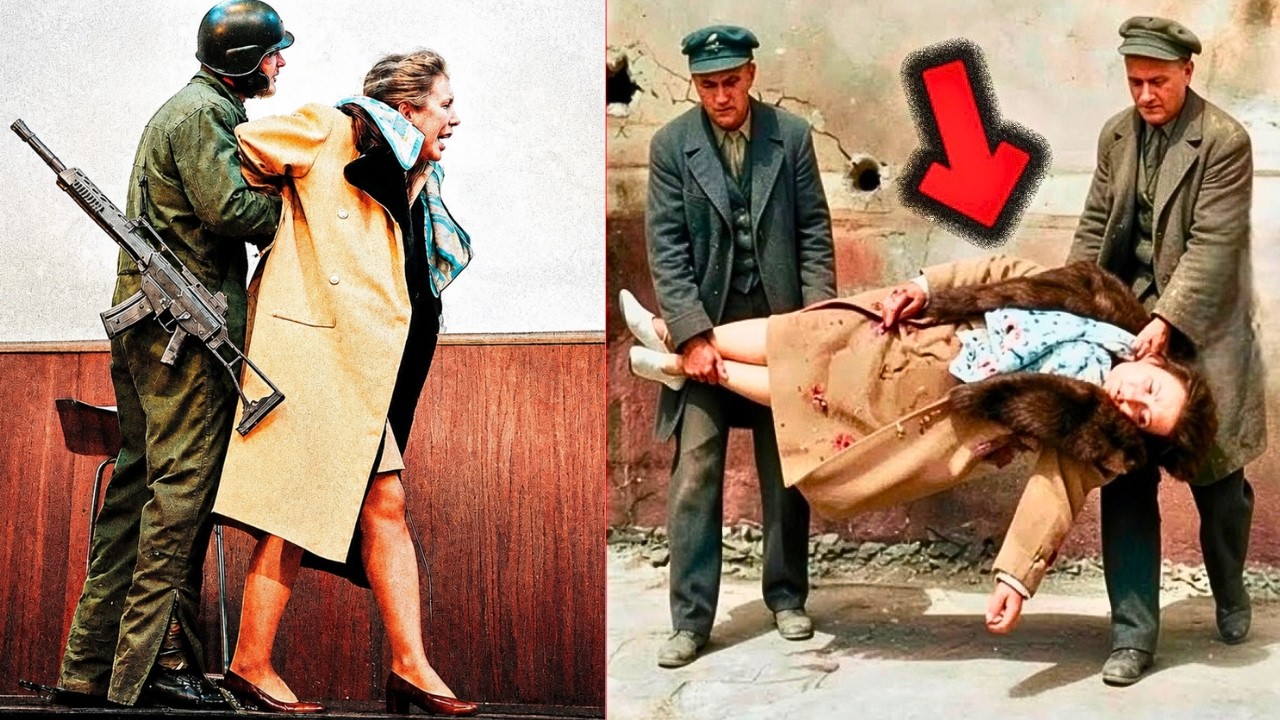
Within seconds, the crack of gunfire would tear through the silence, and the most feared couple in Eastern Europe would be gone. Nicolae and Elena Ceaușescu had ruled Romania for nearly a quarter of a century, living like emperors while their people shivered in the dark and queued for bread. And yet it had taken only days for everything to collapse: a failed escape across a rooftop, an arrest on a lonely country road, a trial shorter than a football match, and, in its final moments, something Elena said that stunned the men standing before her. What happened in that courtyard was filmed, and the whole country watched.
Nicolae Ceaușescu had taken power in 1965, in the middle of the Cold War. At first, he seemed different from the dour Moscow-loyal men who ran the rest of the Eastern Bloc. In 1968, he publicly condemned the Soviet invasion of Czechoslovakia. He kept doors open to the West.
American presidents shook his hand. The Queen of Britain welcomed him as a guest. Western leaders decided they had found a reformer, a communist they could do business with. They were wrong.
Behind the diplomatic smiles, Ceaușescu was building one of the most oppressive police states in Europe. He razed old neighbourhoods in Bucharest to build a colossal palace of marble and gold. He filled the country with informers. He demanded loyalty from everyone and gave nothing back.
Standing beside him, gaining more power with each passing year, was his wife. Born into a poor peasant family in 1916, Elena left school early. When she married Nicolae in 1947, she wanted more than the title of first lady. She wanted power of her own.
By the 1970s, she had it. State propaganda presented her as a world-class scientist with doctorates and hundreds of published papers. In reality, researchers wrote the work while she took the credit, and anyone who objected risked their career or worse. She demanded to be addressed by the title Comrade Academic Doctor Engineer.
She was also famous for her vanity. She hated her profile, so photographers were ordered never to shoot her from the side. Unflattering pictures were destroyed. Behind closed doors, she controlled who was promoted, who was dismissed, and who simply disappeared.
Many Romanians feared her more than they feared her husband. Together, the couple ran the country like a family business, placing relatives in key government positions. They built a cult of personality unmatched anywhere in the communist world. Nicolae was called the Genius of the Carpathians.
Elena was the Mother of the Nation. Schoolchildren recited praise of them every morning. Crowds were herded into stadiums and ordered to cheer on demand. Their portraits hung in every office, classroom, and shop front.
Newspapers printed entire pages of flattery. Television cut its daily broadcast to a few hours, most of it devoted to the leader. Meanwhile, ordinary Romanians were being squeezed to breaking point. In the 1980s, Nicolae became obsessed with paying off the country’s entire foreign debt.
To do it, almost everything of value was exported, including food and energy. At home, shelves went empty. Bread, sugar, meat, and milk were rationed. Power cuts plunged entire cities into darkness.
In winter, families sat in coats and hats inside freezing apartments while the state rationed heating. Parents worried about how to feed their children. Hospitals ran short of basic supplies. Nobody dared speak, because the secret police, known as the Securitate, were everywhere.
Neighbours informed on neighbours. Co-workers reported on co-workers. Families whispered inside their own homes, afraid the walls themselves were listening. A single joke about the dictator could cost you years of your life.
The borders were closed and patrolled. Romania had become a prison of 23 million inmates. By late 1989, communism was collapsing across Europe. Poland had won its freedom.
Hungary had opened its borders. The Berlin Wall had fallen. Czechoslovakia was in the middle of its Velvet Revolution. Yet Ceaușescu believed Romania was different.
Around him, his old advisers whispered that everything was fine, because telling Nicolae the truth was dangerous. He believed his people loved him, or at least feared him enough not to move. He was about to discover how wrong he was. The spark came on 16 December in the western city of Timișoara.
The authorities tried to evict László Tőkés, a pastor of Hungarian origin who had dared to criticise the regime. The congregation formed a human wall around his house to protect him. That small act of loyalty turned into something enormous. Within days, crowds swelled to thousands.
People chanted words no one had dared say aloud for years: Freedom. Down with Ceaușescu. The regime responded with force. Water cannons and tear gas were used at first.
Then security forces opened fire, and the army moved into the city. Dozens were killed and many bodies were removed in secret. Nicolae was travelling in Iran at the time. Accounts suggest Elena helped direct the first crackdown from Bucharest, and reports claim she demanded the harshest measures against the protesters.
It did not work. The news spread across the country anyway, through travellers, whispers on telephones, and foreign radio broadcasts. Protests broke out in Arad, Cluj, Sibiu, and Brașov. Nicolae returned home on 20 December, furious.
On television, he blamed foreign agents and troublemakers. Then he reached for his oldest trick. A massive rally was assembled in the heart of Bucharest to show the world that Romania stood behind him. It was 21 December.
Tens of thousands of workers were bussed to Palace Square and ordered to cheer before the cameras. Nicolae stepped onto the balcony of the Central Committee building, Elena beside him, and began to speak. The live television broadcast carried every word to the whole nation. Then something unthinkable happened.
Some jeers rose from the crowd. Then whistles. Then mockery. Then a chant grew louder and louder, the name of the city where people had died: Timișoara, Timișoara.
Nicolae froze. He raised his hand as if he could silence thousands with a gesture. His face showed complete bewilderment. For the first time in his life, no one obeyed him.
Loud bangs were heard, perhaps firecrackers, perhaps gunshots. Panic swept the square. Elena grabbed her husband and pulled him inside. The broadcast cut off, but millions had already seen the mask of power fall.
That night, Bucharest exploded. Protesters flooded the streets. Gunfire echoed across the city. And the army, the only force Ceaușescu truly needed, began to defect.
A regime built on fear survives only as long as people believe everyone will keep obeying. Once a few voices in that square dared to protest, everyone realised they were not alone. The morning of 22 December. Crowds surrounded the Central Committee building.
The defence minister had died suddenly in circumstances still debated, and the army now stood with the people. Even the loyal guards seemed unsure whether anyone would still fight for the Ceaușescus. Then the crowds surged inside the building. Nicolae and Elena ran toward the roof.
A helicopter was waiting, piloted by Vasile Maluțan. It was designed to carry far fewer passengers than were now aboard. The couple, their guards, and their aides crammed inside, and the aircraft lifted off just as the protesters reached the roof. A few seconds later and they would have been captured on the spot.
Below them, Bucharest was in chaos. Smoke rose from the streets. Crowds waved flags with the communist emblem torn from their centre. The dictator tried to give orders over the radio, but no one was listening anymore.
The helicopter landed briefly near Snagov, then set down later in open countryside. There, the pilot made a decision that sealed the couple’s fate. Afraid of being shot out of the sky, he refused to continue flying. Then he took off and left Ceaușescu and his wife stranded.
The rulers of 23 million people now stood by the roadside, trying to flag down passing cars. A driver finally stopped and agreed to take them. After a while, he claimed the car had run out of fuel and ordered them out. Shortly afterwards, police found the couple wandering and arrested them.
There was no exchange of fire. No dramatic last stand. They were taken to a military base in Târgoviște and locked up. Nicolae remained strictly silent.
Elena, it is said, raged at the guards. “Don’t you know who I am? ” No one cared. Outside those walls, Romania was still bleeding.
Loyalists of the Securitate kept fighting in several cities. Snipers fired from rooftops. Rumours of terrorists and hidden attacks spread through every town. The country was on the brink of civil war.
The new leaders of the National Salvation Front feared that as long as the couple remained alive, they could become a rallying point or the target of a rescue attempt. So they chose speed. On 25 December, a special military court convened in a small room at the base. The charges included genocide, abuse of power, and sabotage of the national economy.
The prosecution claimed that 60,000 people had died under their rule. That figure later turned out to be wildly exaggerated, but it shaped the proceedings. Nicolae refused to recognise the court. He said he would answer only to the Grand National Assembly.
Elena responded sharply that the whole affair was a lie and that she had sacrificed everything for the country. The defence lawyers appointed by the new authorities made little effort to defend them. Many historians describe the proceedings as a show trial: swift, biased, and predetermined. The entire hearing lasted less than an hour and was filmed.
The verdict was death, to be carried out immediately. According to witnesses, Nicolae said history would judge them. Elena’s reaction was pure fury. Reports say she called the judges murderers and insisted she was being punished because she loved her people.
Outside the room, soldiers argued over who would do the job. Dozens volunteered. The anger toward the couple ran so deep that taking part seemed an honour to many of them. In the end, a small group of paratroopers was chosen.
The couple was led outside, hands bound behind their backs. Elena struggled and screamed as the rope was tied. Nicolae walked stiffly, trying to preserve his dignity. A priest was offered to both, and both refused.
The distance was short. Soldiers lined the walls and watched them pass. Some looked with hatred. Some with grim curiosity.
Others just wanted it over. The courtyard was small and cold, with a crumbling brick wall and puddles of melting snow on the uneven ground. Nicolae and Elena were placed side by side in front of that wall. Reports say Nicolae began to sing “The Internationale,” the old anthem of the communist movement.
Elena kept protesting. By many accounts, one of her last words was a bitter reminder that she had been a mother to those about to end her life. One soldier later said she did not stop talking even in her final seconds. Then came the order.
The soldiers fired. It was over in seconds. A single volley turned into a storm of bullets, far more than was needed. When the shooting stopped, the two people who had ruled Romania with absolute power were gone.
The whole episode, from the courtyard to the confirmation of death, took only a few minutes. A military doctor examined the bodies and officially pronounced death. Hours later, Romanian television broadcast footage of the trial and its aftermath to the whole country. Some viewers wept with relief.
Others were stunned. Many still argue today over whether it was justice, revenge, or a hasty political move to stop the fighting. The Ceaușescus were buried quickly in unmarked graves at Ghencea Cemetery in Bucharest. In later years, headstones were placed on their graves.
Today, people visit them: curious tourists and some nostalgic loyalists. The Romanian Revolution cost around a thousand lives, and the debate over what exactly happened in those chaotic days has never fully ended. Investigations, unanswered questions, and conflicting theories continue to this day. The vast palace Nicolae built still stands in Bucharest as one of the largest buildings in the world, now housing the parliament.
Millions of Romanians remember the cold, the hunger, and the fear. What remains clear is the speed of the fall. One day, Nicolae and Elena Ceaușescu stood on a balcony above a crowd ordered to cheer. Nine days after the first protest, they were gone.
Their story stands as a warning that even the most powerful rulers can lose everything in a single week when fear finally evaporates.
