In the fall of 1858, on a cotton plantation in the low country of South Carolina, a man named Augustus Veyne did something his overseers could not understand and his records would not explain. He ordered his workforce to stop the harvest—the two most important weeks of the year, the weeks that funded everything. Instead, he set them to work on a low brick building along the western edge of his property. A building that did not appear on his land surveys.
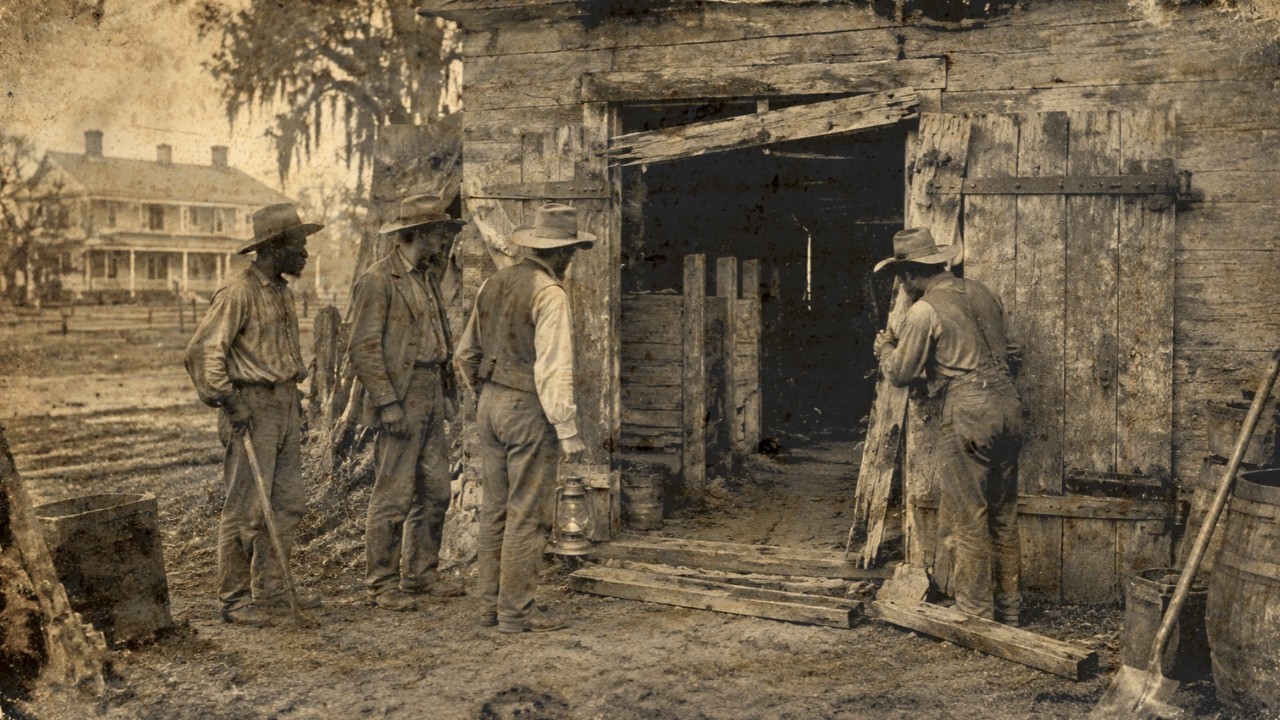
A building that, according to every deed and survey that existed, no man Veyne ever paid had constructed. He ordered them to bury it, not demolish it. They filled it brick by brick, cartload of earth by cartload of earth, until the entrances were sealed and the narrow windows were plugged, and the entire low structure vanished beneath a mound of red clay, which grass covered within a single season, and which any passerby would have taken for a small rise in the ground. Then Augustus Veyne, a man described by everyone who knew him as harsh, ordinary, and unremarkable, sold the plantation for less than half its value, packed what his family could carry, and left the state.
He never returned. He never wrote about it. And in the letter he left for the buyer, one line survived, copied into the county register by a clerk who did not understand it either. The line read: “Do not open Westfield, and do not let your people speak of what lies beneath it.
”
This is the story of that sealed building. What it was, who built it, and what the demolition crew found when, 166 years later, the earth that Augustus Veyne spent the remainder of his fortune and good name to keep closed was finally broken. Because a brick building buried in a cotton field is curious. But a pattern of buildings that no one claims to own, sealed within the same suspicious window of time, on land far older than the men who supposedly owned it—that is something else entirely.
That is a record, and someone somewhere has been keeping it in deficit for a very long time. The official narrative of the American South is one everyone believes they know. Land was cleared, plantations were built, and enslaved people were forced to construct the big houses, the barns, the low brick dependencies, and the slave quarters where human beings were held like livestock. That story is brutal, and it is true, and softening it would be a kind of lie.
But there is a gap in that narrative, and the gap sits in the same place every gap in these narratives sits: in the buildings that are too old, or too fine, or too strange for the timeline they are placed into. The sealed structure on Veyne’s land sat directly over that gap. Because whatever it was, the men who built it were not the men named in the deeds. And the reason it was buried was not shame.
It was fear. Let us begin with what can actually be verified, because that is where the ground is firmest. The plantation that appears in county records as Veyne’s Reach was founded, according to its own founding documents, in 1841. That is not disputed.
Before that, the land was open pine forest and river bottom, barely used if used at all, and the deed that transferred it to Augustus Veyne describes it as unimproved. Unimproved. That word matters, because it is the first point of unease in a story almost painfully full of them. The land, according to the men who sold it in 1841, was free of any structure worth mentioning.
And yet, seventeen years later, Veyne was spending the last of his money to bury a building that no record anywhere said had ever been built. Seventeen years fits these calculations because it is not ancient history. It is not the fog of centuries where anything could happen without being recorded. It is a span a man could hold in his memory from the middle of his life.
Augustus Veyne signed the deed himself in 1841. He walked that land. If there had been a low brick building on its western edge, sealed or open, ruined or standing, he would have known it, and the men who sold it to him would have known it, and it would have been listed in the survey. It was not listed.
And seventeen years later, the building existed and was full of something. A sane man spent his fortune to ensure it would never be full again. Note the cruelty of these calculations, because it is the same cruelty that runs through all these stories. A quarter century is not enough time to lose a building.
It is barely enough time to lose a memory. Many of the men who sold Veyne the land in 1841 were still walking the county roads in 1858. Any one of them could have been asked, simply and directly, who built that low brick structure on the western line. No one asked, in any record that survives, or if they asked, the answer was never written down.
There is a dull explanation, and it deserves serious consideration because dull explanations in these stories are usually the true ones. The dull explanation is that Veyne built the structure himself after 1841 as a place to hold enslaved people—his own or those he traded—and that something terrible happened inside it. A fire, a disease, a killing, a mass death that made the building a place of horror and liability, and that he sealed it and fled because he could not bear to look at it and could not bear the scandal of its discovery. That is a complete, reasonable, and very sad explanation, and the record does not forbid believing it.
But there is a problem with it. The problem is the brickwork. When the county surveyor, Elihu Card, surveyed the bounds of Veyne’s Reach with his measuring chain in the winter of 1847—six years after the founding and eleven years before the burial—he recorded a note in his field book that still survives. The note has nothing to do with a slave pen.
Card was tracing the western boundary, and he wrote: “Low brick building on western line; dressed stone foundation without mortar; not of present construction; origin unknown to owner; not of present construction. ”
A surveyor, a man whose profession was reading land and recording what stood upon it, looked at a building on Augustus Veyne’s own property and wrote that it did not belong to the construction that everything else on that plantation belonged to, and that its foundation, the stone it rested on, was dressed, squared, tight, and laid without mortar. Consider the character of Elihu Card. His four words are the cornerstone of this entire story.
He was not a fool, and he was not a dreamer. He spent his life holding a chain, a compass, and a field book, and he earned his living by the accuracy of his boundary lines, because an error there could get men killed in that country. When a man like that writes that a structure is not of present construction, he is not exaggerating for effect. He is saying, in the dry language of his trade, that the building before him is older than everything around it, built by hands and methods that have nothing to do with the plantation it now stands on.
That is harder to wave away than a puzzled farmer staring at old ruins. Card’s field book contains more than that single line. Researchers who examined the archive found that Card returned to the western line a second time later that same winter and recorded a second note, and the second note is stranger than the first. He wrote that he had come back to measure the foundation more precisely because the first measurement troubled him, and that when he returned, he found the foundation continuing beneath the brick in both directions, running past the ends of the building and into the earth.
The stone footings did not stop at the end of the wall. They went on, buried in the pine forest, as if the low brick building were only the surviving portion of something far larger that had once stood on the same foundation. Card, being a practical man with clear limits and no time for mysteries, recorded it and moved on. But that note is among the most important things in the entire account, because it tells us that the brick building Augustus Veyne eventually buried was never the original structure at all.
It was a small building raised on the foundation of something much older and much larger, built by people who found the foundation already there and simply used it. The plantation was not built on empty land. It was built on ruins. And the ruins were of dressed, solid stone, laid by hands that were quarrying and dressing rock in the low country before any deed in that county called the land unimproved.
Now the span of that foundation means something. Card noted that the low brick structure ran about ninety feet along the western line, and that its surviving highest point stood well above the height of a man reaching up to hold other men. Ninety feet. Consider that number against the dull explanation.
Slave pens, buildings for holding people treated as cargo, were small and mean because meanness was their only purpose. No one spent brick, stone, and skill to build a ninety-foot structure on solid foundations to hold people who were going to be sold within the season. The dimensions do not fit the story. They are the dimensions of something built to last, for a purpose far above the small, cruel use the plantation finally put it to.
There is one more detail in Card’s measurements, one that researchers value because it is as close as this entire account comes to the strangeness of star forts and domes that dominate the wider theory. The doors. Card noted that the openings in the western wall were low and square, set into the same dressed foundations, so that a grown man had to stoop to pass through them; and that the openings did not face the plantation house, or the fields, or the road, as the doors of working buildings did. They all faced west, toward the boundary, toward the pine barrens, toward nothing the plantation had any reason to build toward.
Doors a man had to bend to enter, all of them facing away from the world of the plantation, toward the empty land beyond the western line. Low square entrances no adult man could pass through without bending. Read that phrase to yourself and note where you have heard it before. It is the same phrase road workers used on the Tennessee Ridge in 1941.
The low square entrances no adult man could pass through without crawling. It is the shape of the entrances, and the mountain tradition attached to the deep places, the rock houses, the sealed chambers where the pale people were said to have gone when they were driven down. The overseer who told the story of the burial was a man named Rance Petty, who worked at Veyne’s Reach in those final years and who, decades later, told the tale to an interviewer from the Works Progress Administration, which was collecting the memories of old people across the South in the 1930s. Petty was elderly by then, and his memory was a memory of a memory, and it must be treated on those terms.
But he was there, he had no reason to invent, and what he described has the particular exactness that invention rarely produces. He said that in the fall of 1858, Augustus Veyne came back from Westfield one evening a changed man. That was the word Petty used: changed. Veyne, who had walked that land a hundred times, who had used the low brick building to hold enslaved people waiting for sale for years, went out one evening to that building and came back a different man.
By morning he had stopped the harvest and devoted every resource he had to filling it in. Petty said the strangest thing was that Veyne would not let them demolish the building. Any sane man wanting to be rid of a terrible place would tear it down, sell the brick, level the foundations, and plow the ground, and no one would ever know it had been there. But Veyne would not allow a single brick to be removed.
He ordered them to fill it, pack it, block the low western doors with earth, fill its ninety-foot length up to the roofline, and then heap dirt over the whole thing until it was a mound, not a building, as if the goal was not destruction. As if the goal was to preserve it exactly as it was—intact, whole, sealed. Petty said it was buried alive, and he would not say more about what he meant. The interviewer, to her credit, recorded in the margin that the old man’s hand was shaking when he said it, and that he asked to stop.
Petty told the interviewer one last thing before he asked to stop, the detail that has kept researchers awake at night since the WPA documents were rediscovered. He said that in the days before the burial, in the weeks of that autumn, while people were still going to Westfield, some of the enslaved people forced to work near the building began to fall ill with a sickness the plantation doctor could not diagnose. It was not a fever, not the flux. Petty said they went quiet, and they stopped sleeping.
They talked, some of them, to people who were not in the room, and two of them, a man and a boy, were found one morning at the low western doors of the building, standing, having walked there in the dark, facing the sealed brick wall as if they were waiting for it to open. Petty said he saw them there. And that morning the harvest was stopped. That morning Veyne decided to seal the building.
Not demolish it, but seal it, as if what was inside could not reach out and take, but could only call and be answered—and the only defense against it was to make sure no living thing ever stood at those low doors again. Consider the difference between destruction and sealing, because it is the difference between the two interpretations, and it is everything. You destroy something you are ashamed of. You seal something you are afraid of.
You tear down a slave pen where men died, but you bury, intact and unbroken, never to be reopened, something you believe is still inhabited in some way. A sealed door is not a wall. It is a vessel. Augustus Veyne did not build a wall over Westfield.
He built a lid. The buyer who purchased Veyne’s land at half its value honored the line in the letter. So did the man who bought it from him, and the man who followed. Westfield went unplowed, generation after generation.
When the plantation broke up after the war, and the land passed through dozens of hands, the mound at Westfield remained a mound, overgrown with broomsedge and pine. Every deed that passed through those many hands carried, in one form or another, a strange restrictive covenant forbidding the disturbance of that corner of the property. A clause that baffled lawyers, honored without understanding. Just as an entire county of men honored a rule whose reason they had forgotten.
The discipline held. The silence held. And a story maintained by the discipline of keeping something closed held until the moment that discipline inevitably failed. Westfield was good land, cotton land, low ground on the western edge of a working plantation, in a region where every acre was contested and priced to the penny.
For 166 years, owner after owner chose to leave that land alone, to lose its income, to pay taxes on ground they could neither work nor sell except with the clause attached to the next deed. That is not sentiment. Sentiment does not last 166 years, through dozens of owners, a civil war, the breakup of an estate, and the sale of the land to strangers who had never heard of Augustus Veyne. Something stronger than sentiment kept that ground.
A rule, inherited, honored, and enforced by the land itself through a clause in the deed, at a real and measurable cost, contract after contract, paid by people who mostly never knew why they were paying it. And a rule that costs this much, lasts this long, and is honored by people who have forgotten its reason is not superstition. It is the residue of a real fear, refined by time but never quite erased. It collapsed last spring.
The land, long since divided into a few hundred acres and sold to a housing development, was being cleared to lay foundations for new homes. The young project manager who drew up the site plan pulled the county’s modern maps—the clean digital maps, free of any 160-year-old superstition—and those maps showed Westfield as ordinary ground. There was no clause in the GIS. The clause lived in old paper deeds no one had read in a lifetime.
So the clearing crew walked into Westfield with a bulldozer. On the second day, while cutting through the low rise that everyone had always assumed was a natural feature of the land, the machine’s blade hit brick. Note the mechanism of the failure precisely, because it is the mechanism of the whole theory in miniature. The clause did not lose its power because someone decided to break it.
It lost its power because the record was copied, once again imperfectly, into a new medium. The old paper deed carried the clause. The clean digital map did not. The knowledge did not survive the transfer from one generation of records to the next.
And so a young man holding a screen full of ordinary ground sent a machine into a field that 166 years of paper had forbidden. The operator, a local man named Delroy, told the story afterward to the few who would listen. His account is the closest thing we have to an eyewitness report of what Augustus Veyne sealed. He said the blade lifted brick, then more brick, and then, as he worked, it lifted the top of a wall, and he climbed down to look, because in that country a man does not demolish what might be a grave without going to see.
He found the roofline of a building. A complete building. Ninety feet of it, by the survey. Its low west-facing doors still packed with the earth they had been buried in 166 years before.
Its dressed foundations still solid and true in the clay. And when he cleared enough from the top to look down into the enclosed space where the soil had not fully packed, he found the inside of the building dry. Dry in a way the ground of the Carolina low country should not be. Dry and clean, the way Tennessee road workers in 1941 found the chambers of the Ridge dry and clean.
And on the inner face of the western wall, above the buried low doors, there were marks cut into the brick and stone. Delroy did not describe those marks in detail to anyone. This is the point where honesty is required, because it is the point where these stories always lose their shine. There is no photograph.
The site was closed within days. Delroy said only that the marks were not letters he knew, and not pictures of anything—just marks cut into the stone with a precision that did not fit the rough brick around them, and that looking at them too long gave him the feeling you get when someone is standing behind you in an empty house. He said the crew stopped working. He said every man on that machine, none of whom knew the story of Augustus Veyne, none of whom had read the clause in the deed, reached the same silent conclusion the Depression-era road workers had reached at the entrance of the Tennessee layer.
That they had opened something that was not theirs, something that was not empty, and that it wanted them gone. So they gave it what it wanted. The development work was rerouted around Westfield. The official reason in the county file is ground instability.
The building was refilled by hand within a week, no machines, frightened men shoveling the clay back against the low western doors, restoring the lid exactly as Augustus Veyne had described. And the corner of that field is again a mound, overgrown with broomsedge, forbidden, sealed, closed. Delroy said one more thing near the end, something he will never repeat. He said that during that frantic week of hand-shoveling, one of the young men on the crew, a nineteen-year-old who had been fine, who had been laughing at the older men’s anxiety, began to change the way Rance Petty said Augustus Veyne changed.
He went quiet. He stopped sleeping in the trailer with the others. And on the last night, before the lid was fully replaced, the boy was found standing at the low western doors of the half-buried building, facing the packed clay in the dark, having walked out to it on his own. They took him home.
They finished the refill without him. Delroy said the boy left the county shortly after, that he will not answer calls from the crew, that he refuses to work on that side of the project, and that he will not explain why to anyone who was not raised knowing that some ground in that county has been forbidden since before their grandparents were born. Now the skeptic’s argument, and it is a strong one—perhaps the strongest in this entire account. Every anomaly recorded has a documented and simple explanation, and taken individually, each of these explanations is true.
The dressed foundation was the work of skilled enslaved builders, and there were many of them, and their labor was not itemized in the plantation books. The foundation running into the ground was the remnant of a larger building by some earlier settler. The building was older than the plantation only in the ordinary sense that many buildings were raised by earlier settlers and reused by later ones. Card’s phrase “not of present construction” meant only that.
The building’s dimensions were large because it had an older, forgotten use. The low west-facing doors followed the weather. The illness among the enslaved that autumn was disease or exhaustion, or the ordinary terror of their condition, and the walking to the doors was sleepwalking, or despair, or an old man’s memory rearranging tragedy into a pattern after fifty years. Veyne sealed it instead of demolishing it because he was a broken man, heavy with guilt, who wanted the century but could not bear to profit from its bricks.
The letter and the claw marks are the residue of one man’s private torment, passed down and misread by generations. The marks Delroy saw were tool scars or old writing, or the ordinary strangeness of very old brick in dim light, magnified by the fear of men doing hard work in a place they already knew held the dead. The boy who changed was an impressionable nineteen-year-old frightened by a terrified crew. The dryness of the sealed chamber is physics, not mystery.
Every brick has a mortar of fullness, and looked at alone, the mortar of fullness holds. No one bothers to fake a surveyor’s notebook. The dull facts are usually true because they are dull. That is a strong answer, and if you find it more persuasive, you are not alone—you are with nearly every professional historian alive.
But here is the strength of the other theory, even for those who know all that. The skeptic answers each brick individually. The theory asks about the wall. Why do all these ordinary anomalies cluster in the same building, in the same suspicious window, on land older than the men who claimed to own it?
Why are the foundations dressed and mortared exactly like the mountain walls the Cherokee attribute to an extinct race, exactly like the star forts, exactly like the buried lower stories of old fine buildings that sit a full story lower in the earth than they should? Why do the foundations run down into the ground in both directions, exactly as tradition says the older builders went down into the depths? Why do the low square entrances match the shape reported from the Tennessee Ridge and from mountain rock-house tradition in places that never communicated with each other? Why did the burial happen in 1858, in the same decades the name disappeared from maps, when the great world’s fairs exhibited plaster fantasies that imitated weathered stone and then were demolished within a year?
Coincidence is real, and unrelated processes can overlap in time. But the human mind is wired to distrust such convenient coincidences, and it is not always wrong to do so. And here the theory stops being about construction and becomes about money, the only thing that truly matters in economic history. Follow the money.
Who benefited from a ninety-foot building on worked foundations never being properly examined? Ask this question in 1858, on the eve of a war fought over the ownership of human labor, in a society whose entire wealth rested on the claim that some people were property and some land was empty until the right men improved it. If it could be proven that someone was on that land first, working stone with a skill the plantations could not match, building to last on a scale the plantations never paid for, what happens to the deed that calls the land unimproved? What happens to the founding date of 1841?
What happens to the comfortable story that the wilderness was empty and the men who took it made it valuable? A deed is a legal claim to ownership, and its power rests on a chain of title, on the story of that land passing from empty and unowned into the hands of its first improver, and from him to you. The full value of the grant rests on the word unimproved. Now imagine you hold the deed to a thousand acres of cotton land, and imagine that your wealth, and the wealth of every planter around you, and the wealth of the banks that lent against the land, are all priced on that word.
What is the one piece of evidence on earth that can defeat your claim? Not a competing deed. A competing deed can be challenged or bought. The one thing you cannot challenge is a finished building on a stone foundation as old as your founding date.
That building does not prove someone else has a better right. It proves the idea of your claim itself is a fiction. The land was owned, built on, and worked before anyone wrote the word unimproved across it. It was not a tamed wilderness.
It was a house built by someone else. No lawsuit repairs that. Only a lid, and silence. And that is exactly what Augustus Veyne did.
The building was dangerous, not because it was haunted, but because it was evidence of prior claim. Evidence that someone was here first, built here first, owned this ground first, on land whose economy and justification rested on the claim that no one had. And in an economy built on that claim, evidence to the contrary is not a curiosity. It is a liability.
Augustus Veyne may never have understood a word of terms like Tartary or reset or vanished empires. Perhaps he walked out to Westfield one evening, looked long at the marks on the inner wall of a building he thought he owned, and understood, in his bones, that what stood inside had been made by people who came before him and might remain after him, and that the founding date printed on his deed was a lie standing in its own heart. A man who understands that has two choices. He can expose it to the world, and ruin his fortune and every fortune like it.
Or he can bury it whole, seal it tight, leave the order not to open Westfield, take what money remains, and flee the state, never speaking of it again. He chose the burial. And they usually do choose the burial. The hand that buried that building was not the last.
The buyer honored the clause. The next buyer honored it. Lawyers carried it into dozens of deeds without understanding it. The modern developer broke it only because it never made it onto the clean digital map.
And the crew that found the building replaced the lid the moment they saw the marks. The county wrote down “unstable ground. ” That corner of the field remains closed to this day. The burial was never really one guilty man’s act.
It was a discipline handed down, the way the mapmakers of the world quietly stopped recopying a name. One addition at a time, each silently agreeing to forget the same word at the same time. No need to hunt down and destroy the evidence of the old world. It is enough to stop allowing it to be looked at.
Keep the lid on for one generation, and then the story protects itself, because the people who might have asked are gone, and those who remain were raised from childhood on the knowledge that the land was always empty and the founding date was always correct. Follow that thread and it leads to a specific place, and that is why the economic version of this story is strong. The unofficial version can never trace the ownership of the land. The men who bought Veyne’s plantation for half its value, who got a working farm cheap in exchange for honoring a strange condition.
The banks that lent against the big plantations of that county, whose only collateral was the documented value of unimproved land improved by the right men. The men who, in those same decades, were consolidating the ownership of everything—land, labor, and the printing presses that produced the textbooks teaching the next generation that the South was wilderness before the planters came. The building that proved prior claim was a threat to every one of those ledgers. And a threat to a ledger is something that gets bought, and closed, and quietly written off by men who need only one field and one floor to remain unexamined.
You do not need a conspiracy of villains for that. You need only a large number of rational men, each protecting his own claim, each finding it easier to honor the clause than to open the question, each passing the lid to the next owner along with the deed. It is a theory of motive without evidence of action, and honesty requires admitting that. There is no confession.
There is no document saying the building was sealed to protect a founding date or a chain of title. There is only a filled vessel, a strange clause, and a pile of anomalies. The economic analysis is an inference, not proof. But the historian is allowed to notice what a court is not allowed to notice.
The historian is allowed to notice a pattern of gaps. Not just this field, kept under a clause no one understands, but the mountain walls no one claims, the empty mounds whose contents are lost, the cities that vanish from the maps, their names erased edition by edition. When the same absence appears again and again in the same window, at some point the absence itself becomes the entry in the record. Look at it from the other side.
Who did not teach you any of this? Not the theory. The simple question that can be answered. You spent years in school.
You learned that the plantations were built by the men named on the deeds, on land that was wilderness before them. No one, at any point, paused to say: wait, look at the foundation. Look at the stone. Ask who dressed it and where the quarry was and why no price for it appears in the ledgers, and why a sane man spent his fortune to bury it whole rather than demolish it for brick.
That silence around the question is itself a kind of evidence. The theory argues because sound history is not afraid of arithmetic. Only history hiding something teaches you the founding date and hopes you never count the buildings. And the people who could have taught you to count are the same people who own the printing presses.
This is the core of it. The decades that fixed the old historical pages, carved the founding dates, erased the maps, and closed the doors of Westfield are the same decades that saw the birth of mass newspapers, the universal textbook, and the concentration of a few owners’ power to decide what millions of children would read about where they came from. Control the story of the past, and you control the questions the next generation is able to ask. The best way to bury a building forever is not to cover it with earth.
It is to raise a generation that was never taught to wonder why Westfield is never plowed. In the fall of 1858, Augustus Veyne walked out to a low brick building on a dressed foundation that a surveyor had already noted was not of present construction, its footings running into the earth past the walls in both directions. He came back changed. The people he forced to work near it fell sick and walked toward its low west-facing doors in the dark.
He spent the last of his fortune, not to tear it down, but to seal it, packed dry and marked, under a mound of red clay. He wrote: “Do not open Westfield. ” Then he left the state and never returned. For 166 years the lid held, honored at real cost by men who did not understand the clause they were honoring, owner after owner leaving good cotton land unplowed—until a machine that had never heard his name broke the ground.
The clean map swore it was empty, and found the building exactly as he left it: dry, clean, marked, its low doors still facing west toward the pine barrens, toward nothing beyond the boundary line. And the men who found it, knowing nothing, replaced the lid, because they reached the same silent certainty he had reached: it was not theirs, it was not empty, and it wanted them gone. One of them, a nineteen-year-old who had mocked the older men’s fear, went quiet, stopped sleeping, and was found one night standing at the buried doors, facing the packed clay, waiting. Perhaps none of it is true.
Perhaps the foundation was the fine work of an enslaved mason, the marks the scars of tools, the fear nothing but the fear of hard men in a place they knew held the dead, and Augustus Veyne merely a shattered man with a horror he could not bear to profit from. The illness that autumn was illness, and the walking was despair, and the boy was only afraid. That is entirely possible, and it must be taken as a real option. The people who tell these stories are not always honest either, and some of them are selling a scarcity of their own.
The comfortable feeling of being among the few who see the truth. And in a story that touches the real, undeniable horror of enslavement, the supernatural explanation can become a kind of evasion, a way of turning documented human cruelty into a spooky tale. Be wary of anyone, including me, who lets mystery soften the weight of fact. But perhaps—only perhaps—there is a layer beneath the layer.
A building beneath the plantation. A ground older than the deed. A foundation set by hands that were dressing stone in the low country before any European wrote the word unimproved across it, running into the earth in both directions, as the old traditions say the builders went down, and away. And perhaps the reason you have never heard its name is not that it never existed, but that someone standing at Westfield on a changed evening in 1858 decided it would be safer for everyone, and more profitable for the men whose fortunes rested on empty ground, if you never did.
Either way, the question remains after the answer. Who laid the foundation under the oldest building on the plantation? Where is the quarry that has no record? Who was on that land before the deed declared it empty?
And where did they go when they left? Why does the founding date always fall after the old history goes silent? The clay will not answer. It never has.
But you will ask. And in a story that survives thanks to the silence of a sealed field, the question is the one thing that is never buried. So the next time you pass an old farm—one of those with a rise in the far corner that the tours never take you to—do not look only at the grass. Look at the foundation beneath it.
Look at the low doors facing the world. Count the founding date. Ask who laid the stone, and where the quarry was, and why the cost of the building never appears in the ledgers. And ask who this was really built for, and who feared the answer so much that he spent everything he had to keep the lid on, teaching a whole county for 166 years to keep it there.
The mound at Westfield still stands. The doors still face west onto the pine barrens. The foundations still run into the earth past the walls in both directions, to a distance no living man has measured. The lid is closed again, and the county has forgotten why.
And forgetting is the one thing the men who built the world we live in never had to protect. Because we do it for them, every day, as long as we read the plaque and never begin to count the buildings.
