In 1980, the name Raleigh stood at the summit of the cycling world. Its professional racing team, managed by the formidable Peter Post, had just won the Tour de France with Dutch rider Joop Zoetemelk, taking eleven stages along the way. At home in Nottingham, the factory that had made Raleigh the largest bicycle manufacturer on Earth hummed with the work of seven and a half thousand people, exporting bikes to 140 countries. The children of Britain were still begging their parents for the Chopper, the outrageous, high-handled, gear-sticked machine that had saved the company a decade earlier.
From the outside, it seemed nothing could touch the firm that had survived the Great Depression, two world wars, and the near-death of British cycling itself. Within twenty years, the lines would fall silent. Within twenty-five, the factory would be gone entirely. Raleigh’s story began long before the Chopper, in a modest workshop on Raleigh Street in Nottingham in 1885.
Three men—Richard Morris Woodhead, a Frenchman named Paul Euen Lou Anga, and William Ellis—all tradesmen rooted in the city’s lace industry, began making the new safety bicycles with their equal-sized wheels and chain drives. They built well but could not make the world notice. That task fell to Frank Bowden, a Devon-born lawyer who had made a fortune in Hong Kong and San Francisco. Returned home on doctor’s orders to take up cycling as exercise, Bowden toured on the workshop’s machines, and in the autumn of 1888 he walked in and bought his way into the business, founding the Raleigh Cycle Company that December.
He kept the name of the street, not the names of its founders. Under Bowden’s capital and marketing drive, the firm detonated. By 1896 it was described as the largest bicycle manufacturer in the world, spread across 72 acres. A century later, this habit of preferring one clean name to the complicated truth would still define the company.
Bowden died in 1921, handing the firm to his son Harold, who steered it through the Depression and a second world war, converting the lines to munitions and renaming the budget range Robin Hood before returning to bicycles. By the early 1950s, the plant sprawled across some 60 acres, employed over 6,000 people, and could produce up to five million bicycles a year. It was woven into the fabric of Nottingham. Its workers included a growing Caribbean community, for whom the factory became one of the city’s great and defining employers, a place of belonging as much as wages.
But the ground beneath this unkillable institution was quietly shifting. By the 1960s, rising car ownership cut Raleigh’s sales in half. The company needed a hit, and it looked, as everyone did, to America. In California, children were rebuilding their bikes to imitate chopped-down motorcycles, with high-rise ape-hanger handlebars and long banana seats.
Schwinn had bottled this craze in 1963 with the Stingray, selling millions. Raleigh’s first answer, the Rodeo, flopped. Then came the bike that mattered, and with it a quarrel that would never be fully settled. The company’s legend held that chief designer Alan Oakley, returning by air from America in 1967, sketched the new bike’s shape on the back of an air mail envelope.
The designer Tom Karen, a Viennese-born industrial designer who ran the Ogle design house, spent the rest of his life insisting the story was a lie, claiming his studio supplied the styling and concept. The Victoria and Albert Museum eventually catalogued the bike as designed by Karen around 1969, with Oakley doing the engineering. Both men had been in the room; the clean single name had obscured a shared truth. Whatever its origins, the bike itself was extraordinary, and it nearly died in the wrong market.
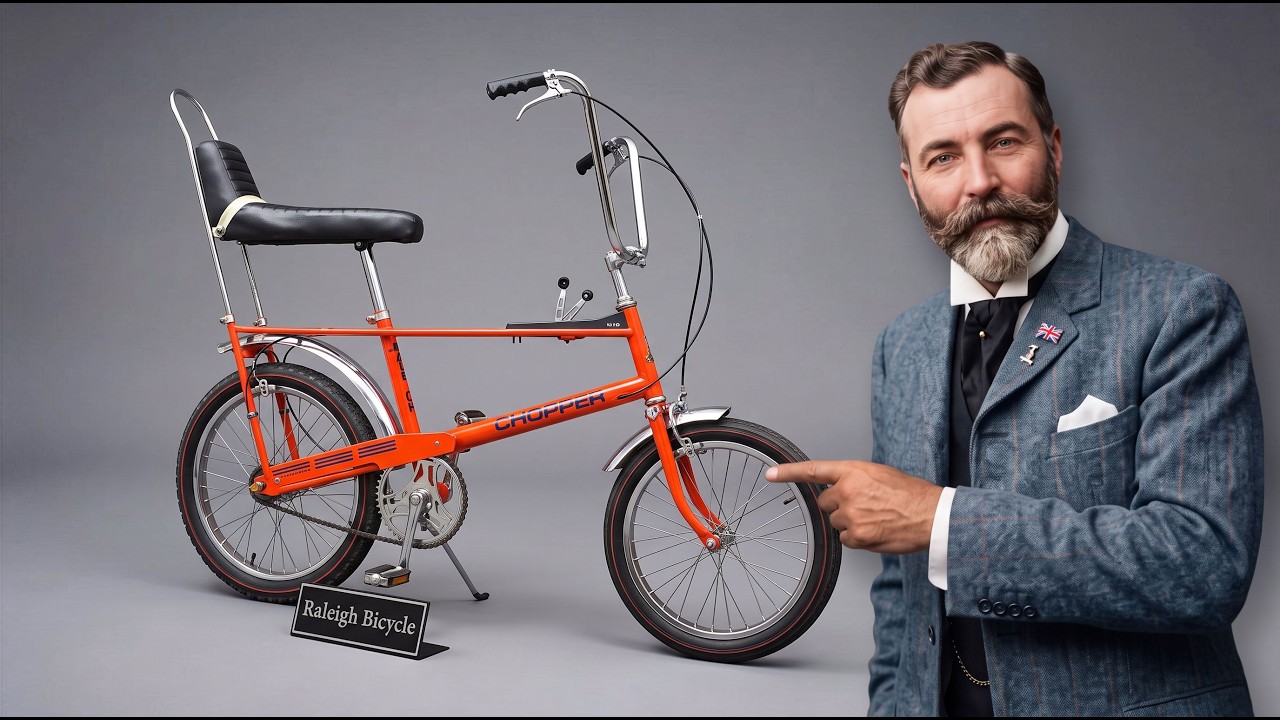
Taken to America first, it flopped against the cheaper, established Stingray. Brought home and released for the 1970 model year, it detonated. The Chopper was not a bicycle; it was a status symbol with pedals. Its ape-hanger bars, long padded banana seat, mismatched 16-inch front and 20-inch rear wheels, and a gleaming chrome gear shifter mounted on the crossbar made a nine-year-old feel like they were piloting a sports car.
It was heavy, slow uphill, and awkward, and every child in Britain wanted one with a hunger parents still remembered decades later. At 31 guineas, it cost more than double Raleigh’s previous children’s models, a family sacrifice negotiated for months. Across its run, around a million and a half were sold in the UK alone, outselling rivals six to one and almost single-handedly rescuing the company. The Chopper’s most famous flaw, the crossbar gear lever, was a styling choice that sat exactly where a child’s body would slide forward in a sudden stop.
Thousands of men remember the injury, though it remains essentially undocumented in any medical record specific to the bike. The real, demonstrable fault was a backward-tipping tendency in the early MK1, which Raleigh fixed for the MK2 in 1972. There was also an unprovable folklore of parliamentary questions and safety reports that no archive supports. The legend and the truth fused into a single reputation the bike never shook off.
What actually killed the Chopper was not its gear lever but a new craze from the same California soil. BMX was a stripped-down, light, welded-frame bike built for dirt racing and punishment. Raleigh, the company that had read the youth market so brilliantly a decade earlier, misread it almost completely. Their answer, the Grifter, launched in 1976, was heavier and tougher but still brazed in the old Nottingham way, a cart horse compared to the American racehorses.
The reason was money. A single-speed BMX needed no three-speed Sturmey-Archer hub gear, the little sealed marvel Raleigh had absorbed in 1902 and protected for generations. The board looked at a bike that made less profit and starved its beloved gear division, and, in the historian Tony Hadland’s unsparing phrase, hoped BMX would prove a passing fad. It was not.
As Raleigh hesitated, its biggest customer, Halfords, began importing American BMX bikes, and the market turned. Raleigh did adapt, years too late. The push came from a product manager named Iven Ricks, who had joined the company as a secretary in 1962 and risen through ability. Sent to America to understand the craze, she returned and drove the creation of the Burner, launched in early 1982.
It was a genuine BMX and it worked spectacularly, selling over a million units and restoring Raleigh’s market share. But the lost years were fatal. While the board protected Sturmey-Archer and hoped the tide away, the Chopper aged out of relevance. The last genuine Choppers came off the line in 1982, and Alan Oakley left the company that same year.
Sturmey-Archer, guarded so fiercely, made 400 workers redundant in 1982 and dropped its famous Dynohub two years later. The deeper tide was imports. In 1970, Britain imported just 27,000 bicycles and exported over a million. By 1981, imports overtook exports for the first time in the history of the trade.
Under its parent company, Tube Investments, which had taken full control in 1960 when Raleigh commanded 75% of the UK market, that dominance drained away. TI treated Raleigh as one small division among many, more interested in five-year plans than decisions. The firm that had detonated under Frank Bowden became a line item. After three consecutive years of losses and a workforce already cut from seven and a half thousand to 1,800, TI sold Raleigh on the 1st of April 1987 to a Luxembourg concern, Derby International, for £18 million plus £14 million in debt.
A 102-year-old institution changed hands across a boardroom table, recording everything about the money and nothing about the people on the floor. The 1990s were a long goodbye. Derby sold the historic Triumph Road site to the University of Nottingham in 1999 without securing a replacement factory. One account called the decision flatly disastrous.
Sturmey-Archer, the gear division the board had once sacrificed the future to protect, was sold for a nominal sum and closed. The frame-welding robots installed as recently as 1996, the capability the company had lacked so fatally when BMX arrived, were auctioned off that December. The end came on the 28th of November 2002, a Thursday. At 3:00 in the afternoon, the last wheel came off the line at Triumph Road, with 280 people left to see it.
They went to the pub, a crawl around Radford, and drank together to the end of Raleigh. Behind them, the vast building fell silent, holding no one. Nothing of the factory remains now. The University of Nottingham built its Jubilee campus over the ground, with low elegant buildings and a long serpentine lake.
Students walk past where 6,000 people once made the nation’s bicycles, with no reason to feel the absence. The trade that once flowed outward from Nottingham to 140 countries reversed entirely; the bikes Britain rides now are mostly made in China, and the university that rose on the factory’s ruins even runs its own campus in Ningbo, China. The Raleigh name survives under Dutch ownership, the making moved elsewhere. The Chopper itself became what it had always secretly been: not transport, but treasure.
Original examples sell for thousands, and when Raleigh relaunched the bike in 2004, the crossbar gear lever, the thing that made it magnificent and infamous, was quietly removed. In 2023, they brought back the faithful MK2 shape in the original colors at £950, and the stock sold out within hours. The company that survived everything—the Victorian fads, the Depression, two wars, the rise of the car—was undone not by catastrophe but by caution trusted just a little too long, by a bicycle for children, and by the very craft that had carried it safely through absolutely everything else.
