On the night of 6 May 1910, Alexandra sat at the bedside of her dying husband in Buckingham Palace, holding his hand as his breathing grew shallower. The King of the United Kingdom, Edward VII, was slipping away at sixty-eight, his lungs worn out by decades of heavy smoking and a heart that could no longer keep pace with his duties. As he lost consciousness, Alexandra, the Queen Consort, administered oxygen to him with her own hands, but nothing could be done. Edward died that same evening, and with him ended an era that had carried her from a modest Copenhagen attic bedroom to the very summit of the British Empire.
Her story had begun sixty-five years earlier, on 1 December 1844, in the Yellow Palace, an eighteenth-century residence near the Amalienborg complex in Copenhagen. She was named Alexandre Caroline Marie Charlotte Louise Julia, though everyone who knew her called her Alex. Her father, Prince Christian, belonged to a secondary branch of European nobility, and her mother, Princess Louise of Hesse-Kassel, came from a family that had once been royal but had fallen on harder times. Despite their titles, the family lived on a military allowance of barely £800 a year, in a house granted rent-free by the Crown.
Alexandra shared an attic bedroom with her younger sister, Dagmar, who would one day become Empress of Russia, and together with her siblings she helped with household chores, sewing their own clothes and setting the table. The celebrated writer Hans Christian Andersen was a frequent visitor, telling bedtime stories to the children, a memory Alexandra would cherish for the rest of her life. The family’s fortunes changed in 1852, when King Frederick VII of Denmark found himself without direct heirs. The European powers intervened to resolve the succession crisis, and through the London Protocol it was agreed that Prince Christian would be named heir presumptive to the Danish throne, even though the king was still alive.
The arrangement was in part a diplomatic move to prevent disputes between Denmark and the German duchies of Schleswig and Holstein. Christian received the title of Prince of Denmark, and the family moved to Bernstorff Palace, a residence more befitting their elevated status. Yet the social advancement brought no increase in income, and the family remained distant from official court life, in part because they refused to associate with King Frederick’s morganatic wife, Countess Danner, a controversial figure in Danish society owing to her humble origins and her relationship with the monarch. At Bernstorff, Alexandra grew into an educated, discreet, and deeply religious young woman.
She learned languages, particularly English, which she studied with an Anglican chaplain, and was confirmed in the Lutheran faith at Christiansborg Palace. Her education included court etiquette, sewing, drawing, and music, all preparing her for a future role in European aristocracy. Though still far from the great international spotlight, she began to stand out for her beauty, her gentle nature, and her distinguished presence, qualities that soon attracted the attention of Europe’s royal houses. In the early 1860s, the House of Glücksburg began to gain ground on the European dynastic chessboard.
Christian’s position as heir presumptive to the Danish throne had improved the family’s reputation, though their financial standing remained modest. It was then that Alexandra, without a notable dowry or sovereign status, caught the attention of the most powerful royal court in Europe: the British. Queen Victoria and her husband, Prince Consort Albert, were searching for a suitable bride for their eldest son, Prince Albert Edward, the Prince of Wales. Although Victoria favored a German daughter-in-law for cultural and political reasons, the German candidates failed to convince her.
The young heir, known for his restlessness and undisciplined behavior, did little to ease the process. It was his elder sister, Princess Victoria, married to the Crown Prince of Prussia, who discreetly suggested Alexandra of Denmark as a serious possibility. She had met the young princess at the Danish court and had been impressed by her beauty, sweetness, and education. In the summer of 1861, Queen Victoria began to consider Alexandra more seriously, albeit with some reservations.
Denmark had strained relations with Prussia over the Schleswig and Holstein duchies, which caused discomfort for a royal family so closely tied to Germany. Nevertheless, in the absence of better options, Victoria agreed to arrange a meeting between her son and the young Danish princess. The first meeting took place in September 1861 in the German city of Spa, with Princess Victoria present. The atmosphere was cordial, and the British heir was clearly impressed by the young Dane.
However, the engagement did not proceed immediately. Soon after that meeting, Prince Albert died in December of the same year, and Queen Victoria entered deep mourning. Her son’s matrimonial affairs were temporarily suspended. In 1862, discussions regarding the Prince of Wales’s marriage resumed more formally.
Alexandra, then seventeen, was invited to meet Queen Victoria in Belgium at the Château de Laeken, residence of King Leopold I, the Queen’s uncle. It was there, on 9 September 1862, that Prince Albert Edward proposed marriage to Alexandra. She accepted graciously, and the engagement was officially announced shortly thereafter. The arrangement was celebrated in both Denmark and the United Kingdom.
Though not a union between houses of equal power, Alexandra was considered an ideal choice: a Protestant princess of impeccable manners, good reputation, and no scandalous family background. Queen Victoria, still deep in mourning, accepted the match with resignation, and later with growing affection. In early 1863, Alexandra prepared to leave her home and embrace her role as the future Princess of Wales. She departed Copenhagen accompanied by her father and several family members, a journey closely followed by both the Danish and British press.
She traveled across part of the European continent and crossed the Channel aboard the Royal Yacht Victoria and Albert. Her arrival at the port of Gravesend on 7 March 1863 was a public event of great anticipation. Thousands gathered to see the future princess, and an official reception filled with cheers and greetings was organized. The British public was charmed by her bearing, her shy smile, and her natural elegance.
Composer Arthur Sullivan wrote a special musical piece in her honor, and the Poet Laureate Alfred Tennyson penned the ode “A Welcome to Alexandra,” in which he proclaimed: “Saxons, Normans, Danes are we, but all of us are Danes in welcoming Alexandra. ”
On 10 March 1863, in St. George’s Chapel at Windsor Castle, Alexandra married Prince Albert Edward. The ceremony was officiated by the Archbishop of Canterbury and attended by prominent members of royalty.
The tone remained subdued, as the court was still in mourning for the death of Prince Consort Albert. The ladies wore muted tones, and no triumphant entry into London was held. Some critics remarked that choosing Windsor over a grand public ceremony in the capital deprived the people of a celebration befitting the occasion. Nevertheless, the wedding was received with widespread enthusiasm.
For the British, Alexandra represented a romantic ideal: young, beautiful, foreign yet approachable, unpretentious, and deeply devoted to her new country. Her Danish accent, gentle manners, and reserved demeanor evoked immediate sympathy. After the ceremony, the couple spent their honeymoon at Osborne House, the royal residence on the Isle of Wight. During those days, the newlyweds began to form a bond that, through ups and downs and challenges, would endure for nearly five decades.
From her arrival in the United Kingdom, Alexandra undertook her role as Princess of Wales with discipline and modesty. She would hold that title for thirty-eight years, the longest in British history at the time. Shortly after the wedding, Alexandra and Albert Edward settled at Marlborough House, their official residence in London. Their married life began under the watchful eye of Queen Victoria, who, although she did not express particular affection for Alexandra in her early impressions, valued her devotion to family and obedient disposition.
On 8 January 1864, Alexandra gave birth to her first child, Prince Albert Victor, Duke of Clarence and Avondale, whom the family affectionately called Eddie. The birth came earlier than expected, which led some contemporaries and later historians to suspect that the princess had deliberately concealed the true date of her pregnancy to avoid Queen Victoria’s presence at the birth. Five more children followed: George, born in 1865, who would become George V of the United Kingdom; Louise, born in 1867, who held the title of Princess Royal; Victoria, born in 1868, who remained unmarried and devoted herself to royal duties; Maud, born in 1869, who became Queen consort of Norway; and the youngest, Alexander John, born and deceased in 1871 only one day after birth. Alexandra was a deeply devoted mother and often took personal care of her children, something unusual for women of her rank.
Royal nannies recounted that the princess would bathe, dress, and cradle them to sleep herself. Despite her dedication to the home, her relationship with the Prince of Wales was not without difficulties. Albert Edward was a man of worldly interests, fond of hunting, travel, gentlemen’s clubs, and social engagements, some involving women who would become his mistresses. Though Alexandra was aware of these infidelities, she always faced them with reserved and dignified composure.
The prince’s relationship with Alice Keppel, begun in the 1890s, was particularly notable. While there was no public scandal due to the self-censorship of the press at the time, the affair drew public comment and created evident tensions. True to her nature, Alexandra never reacted angrily nor lost her composure, preferring to focus on her duties as a mother, benefactress, and institutional figure. In 1867, while expecting her third child, Alexandra fell ill with rheumatic fever, a serious illness that affected her health for months.
She was at risk of death, and the press of the time reported on her condition with concern. Although she recovered physically, the illness left a permanent mark: a slight limp that altered her gait. Rather than evoking pity, this trait was imitated by some women of the British upper class, who adopted a similar walk out of fashion or solidarity. In the following years, Alexandra also began to experience progressive hearing loss, later attributed to hereditary otosclerosis.
This auditory disability was not officially acknowledged for a long time, but those around her knew she avoided prolonged conversations and increasingly relied on lip-reading. Her deafness influenced her character: she became more reserved, more selective in public appearances, and deeply dependent on her trusted circle. Alexandra became an essential figure in the Victorian monarchy, especially as Queen Victoria, following the death of Prince Consort Albert, withdrew from public life for years. In that void, Alexandra assumed many representative functions.
She presided over bazaars, visited hospitals, attended concerts, inaugurated charitable events, and represented the royal family in countless public engagements. She had a special interest in medical and social causes, particularly in helping disabled children, retired sailors, and women in need. While she did not found hospitals, her work was crucial in raising funds for medical centers in London. She frequently visited the London Hospital, where she personally met notable patients such as Joseph Merrick, the Elephant Man.
Queen Victoria herself publicly praised her dedication, stating: “She relieved me of the strain and fatigue of many duties. She opens bazaars, attends concerts, visits hospitals in my place. Not only does she never complain, but she strives to show she has enjoyed what for another would be an exhausting duty. ”
The British people adored Alexandra.
Her beauty, with Nordic features, expressive eyes, and a long neck, was widely commented on in the illustrated press. Her dresses, hairstyles, and jewelry were imitated broadly. Even small personal details became trends. To conceal a scar on her neck, the result of an operation in her youth, Alexandra wore tight-fitting chokers, which became an essential fashion accessory among society ladies.
Beyond appearance, her warmth and serenity made her particularly close to the people. At a time when royalty was still revered as an almost sacred symbol, Alexandra embodied a maternal and accessible figure. As Princess of Wales, Alexandra accompanied her husband on several official trips within and beyond the United Kingdom. In 1868, they visited Ireland as a gesture of goodwill toward a population showing increasing signs of discontent.
In 1869, they embarked on a tour of the Middle East and the Eastern Mediterranean, visiting Egypt, the Holy Land, Greece, and Constantinople. In Egypt, Alexandra was received in the Khedive’s harem, something exceptional for a European woman. In Constantinople, she dined with Sultan Abdulaziz, breaking an Ottoman tradition that excluded foreign women from official banquets. In Greece, she had the opportunity to reunite with her younger brother, King George I of Greece, who had been elected monarch of that country only a few years earlier.
That international tour strengthened Alexandra’s image as an ambassador of the British monarchy and allowed her to reconnect with her continental family roots. The 1890s brought painful episodes. In 1892, Alexandra’s eldest son, Albert Victor, died at the age of twenty-eight from pneumonia following an influenza outbreak. The death of the heir was a devastating blow.
She kept his bedroom intact for years as a tribute to his memory. Some observers noted her falling into a long period of silent mourning. Despite the sorrow, Alexandra fully supported the engagement of her younger son, George, to Mary of Teck, who had originally been betrothed to Albert Victor. This union was encouraged by Queen Victoria, who trusted in Mary’s good sense.
Alexandra accepted the new match even knowing that Mary would one day take her place as queen consort. During these same years, she had to accompany her sister Dagmar, by then Empress of Russia under the name Maria Feodorovna, after the death of her husband Tsar Alexander III. In 1894, Alexandra traveled to St. Petersburg to offer comfort and to take part in the imperial funerals.
The bond between the two sisters remained deep and constant throughout their lives. During these years, her role within the royal family became that of mediator and mother. She was a consistent link between the various branches of the European monarchy. Despite her increasing deafness, her frailty, and family tensions, she continued to fulfill her institutional duties with courtesy and punctuality.
As the nineteenth century drew to a close, Alexandra, now in her mature years, was viewed with widespread respect and affection. While Queen Victoria remained on the throne, and the Prince of Wales had awaited his moment for decades, Alexandra had become the serene constant of a changing court. The British people no longer saw her merely as the wife of the heir, but as a symbol of continuity, elegance, and charity. On 22 January 1901, after more than six decades on the throne, Queen Victoria died at the age of eighty-one, marking the end of the Victorian era.
That same day, her eldest son ascended the throne as Edward VII, and Alexandra, aged fifty-six, officially became Queen Consort of the United Kingdom of Great Britain and Ireland and Empress Consort of India. Her elevation did not significantly alter her character or lifestyle. She continued residing at Marlborough House, her home for decades, although she also took on additional functions and a higher public profile. The death of Victoria imposed a long period of official mourning at court, but the country needed to see its new monarchs.
Edward and Alexandra began a period of modernization in the image of the crown. The new king abandoned the rigors of perpetual mourning and permitted a more open and less oppressive court. Alexandra, for her part, maintained her elegant style, her charitable works, and her warm rapport with the public. The coronation of the new sovereigns was scheduled for 26 June 1902 at Westminster Abbey, with great pomp and ceremony.
However, just days before the event, Edward VII fell seriously ill with appendicitis, a condition highly dangerous at the time. He underwent emergency surgery on 24 June at Buckingham Palace, performed by surgeon Frederick Treves. The operation was successful, but the coronation had to be postponed. During the critical days, Alexandra took on several of the king’s responsibilities, appearing in public to calm widespread anxiety.
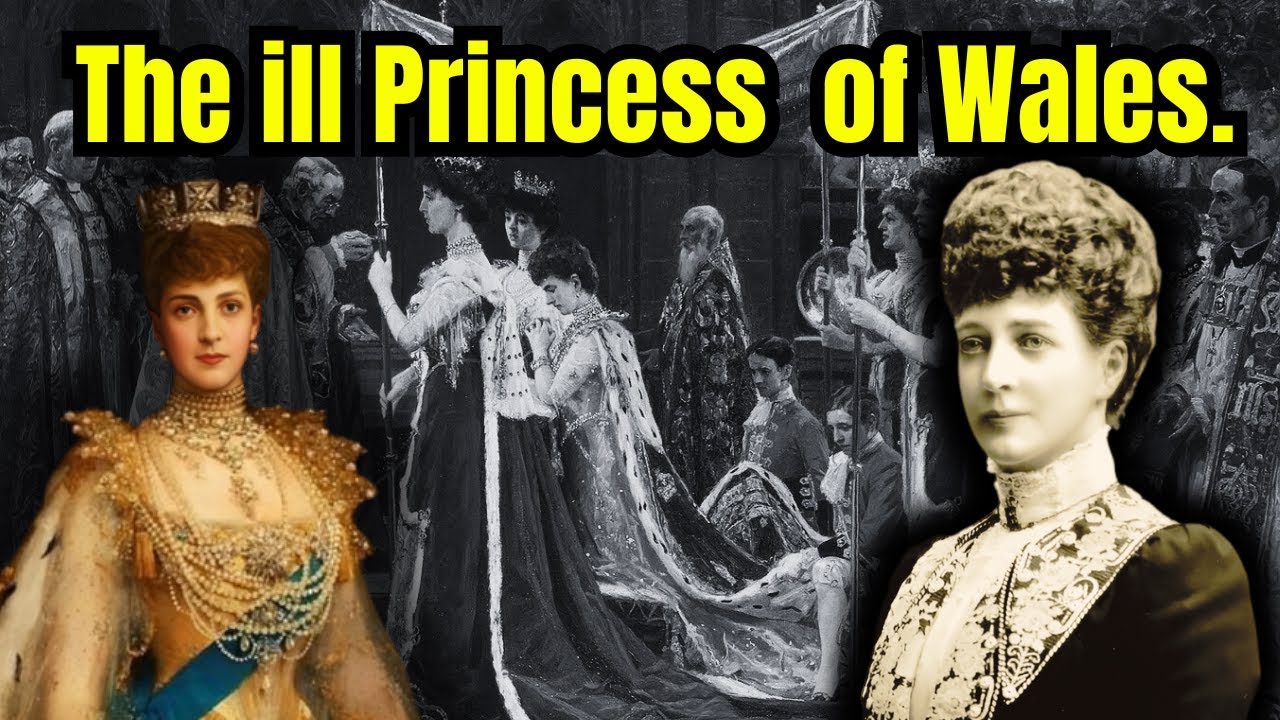
She presided over the military review parade at Aldershot and attended the Ascot races, showing serenity and commitment to duty while Edward recovered. At last, the coronation was held on 9 August 1902, and the ceremony was grand. At Westminster Abbey, Edward VII was anointed and crowned by the Archbishop of Canterbury, and Alexandra, kneeling beside him, received her own crown from the Archbishop of York. The queen wore an elaborate gown embroidered with gold threads featuring the floral emblems of the United Kingdom, roses, thistles, and shamrocks, and a crown specially designed for her, adorned with diamonds and other jewels from the royal collection.
The act was witnessed by kings, ambassadors, and high-ranking dignitaries from all over the world, as well as by representatives of the British dominions. As queen consort, Alexandra maintained her reserved nature regarding matters of state. She did not take part in political decisions but held firm opinions on international affairs. In particular, she harbored a deep resentment towards Germany, a country she blamed for the loss of the Danish duchies of Schleswig and Holstein decades earlier.
This personal aversion towards the House of Hohenzollern, especially towards Kaiser Wilhelm II, her nephew by marriage, was reflected in her private remarks, though never publicly expressed for diplomatic reasons. Edward VII, a natural diplomat, sought to balance his wife’s personal feelings with the demands of foreign policy. Alexandra did not accompany him on all of his official overseas journeys, particularly those involving France, Germany, or Russia, due to health concerns and certain political reservations. However, when circumstances required it, she could fulfill discreet diplomatic duties or appear as a symbolic representative of the nation.
She continued to devote much of her time to charity, especially to medical institutions, hospitals, and assistance programs for sailors, nurses, and war veterans. In 1902, with the king’s support, she founded Queen Alexandra’s Imperial Military Nursing Service, an official military nursing corps that would serve in twentieth-century conflicts and which still exists today under the name Queen Alexandra’s Royal Army Nursing Corps. During Edward’s reign, the royal couple primarily resided between Marlborough House in London and Sandringham House in Norfolk. The latter was especially dear to Alexandra, who considered it her true family refuge.
It was also where she spent her periods of rest and time with her children, grandchildren, and pets. Despite Edward’s past infidelities, their relationship remained stable and mutually respectful. In December 1903, an incident nearly ended in tragedy. One night at Sandringham, a fire broke out in the wing where the queen was staying.
Thanks to the quick action of her loyal lady-in-waiting, Charlotte Knollys, who smelled the smoke and acted without hesitation, Alexandra was evacuated in time. The press barely mentioned it, but the court remembered it as an example of quiet bravery and domestic loyalty. As the years progressed, Alexandra suffered a gradual decline in her hearing, which had already become noticeable since the 1880s. In public, this made her appear even more reserved.
In private, she relied on lip-reading and constant assistance from her personal aides. Despite this limitation, she did not abandon her duties and maintained a constant presence at official engagements, receptions, and hospital visits. In the spring of 1910, the king began to show visible signs of physical exhaustion. Though he continued his duties, his lungs were weakened, partly due to his smoking habit and persistent heart problems.
In April, while Alexandra was on a family visit to Greece, she received an urgent telegram informing her that the king was gravely ill. She returned to the United Kingdom immediately. On 6 May 1910, Edward VII died at Buckingham Palace at the age of sixty-eight. Alexandra, who had remained at his side during his final hours, administered oxygen to him with her own hands as he lost consciousness.
His death shocked the nation. It marked the end of a brief but significant period, the Edwardian reign. With the death of her husband, Alexandra now took on the role of Queen Dowager, or Queen Mother, though by protocol she continued to be known as Queen Alexandra. Her son, Prince George, acceded to the throne as George V.
After the state funeral, one of the most imposing spectacles Europe had witnessed, Alexandra left Buckingham Palace, which was now occupied by her son and her daughter-in-law, Queen Mary. She settled permanently at Marlborough House, her usual London residence since her time as Princess of Wales, and also retained Sandringham House as a country retreat and intimate space closely tied to memories of her husband and family. Although she no longer held constitutional functions or political obligations, Alexandra continued to take part in social events, family ceremonies, and charitable causes. Her public life, however, gradually became more limited due to the progressive deterioration of her health.
The deafness that had affected her since the 1880s was by then almost total, and her eyesight also began to weaken over time. She maintained a respectful relationship with her son George without interference. Alexandra was fully aware that her role as Queen Dowager and former consort was not to intervene in matters of government nor to exert authority within the royal family. On the contrary, she publicly showed her support for George V when in 1911 he faced a major constitutional crisis due to the Parliament Act, which reduced the powers of the House of Lords.
Although privately Alexandra sympathized with the traditional aristocracy, she supported the king’s decision to accept the reform, prioritizing the stability of the country over personal attachment to the old order. Alexandra never abandoned her charitable work. In 1912, she established Alexandra Rose Day, an annual event aimed at raising funds for hospitals through the sale of artificial roses. Thousands of women volunteers participated in the campaign, which gained great popularity and helped finance major medical institutions in London and other cities.
The initiative was so well received by the public that it continued to be held for decades. In 1914, at the outbreak of the First World War, Alexandra was sixty-nine years old. She did not take part in political life but showed herself to be a firm patriot, particularly in her open disdain for the German Empire. Her long-standing resentment towards Germany, stemming from the Prussian invasion of Denmark in 1864, found renewed expression during the conflict.
She personally requested the king to have the banners of the German princes of the Order of the Garter removed from St. George’s Chapel in Windsor, a gesture that was finally carried out in 1915. Although George V also ordered the removal of certain memorials belonging to the late Queen Louise’s relatives, which saddened Alexandra, one of the most painful moments of this period was the tragedy of the Russian imperial family. In 1918, during the final months of the war, her nephew Tsar Nicholas II of Russia, son of her sister Dagmar, was murdered alongside his wife, children, and servants in Yekaterinburg by the Bolsheviks.
Alexandra was deeply affected by the news. Years earlier, she had attempted to use her influence to persuade the British government to offer asylum to the Romanovs, but political circumstances and fears of a negative public reaction led King George V, despite the close family ties and friendship, to decline to receive them in Britain, a decision he would later regret privately. In 1919, Alexandra personally assisted in the evacuation of her sister Dagmar, widow of Tsar Alexander III, who had remained in Crimea. A British warship, HMS Marlborough, was dispatched by order of the king to rescue her.
Dagmar was brought to the United Kingdom and lived for a time under Alexandra’s protection, allowing the sisters to share their grief and reunite in old age after so many years separated by international politics. During her final years, Alexandra began to experience significant vision loss. In 1920, a blood vessel burst in one of her eyes, leaving her almost blind on that side. Though she retained partial sight in the other eye, she could no longer read with ease and came to rely increasingly on her attendants.
Physically and mentally, she became more fragile, but never lost her elegance or sense of dignity. She remained interested in fashion, used white makeup and discreet veils to soften the signs of age. Though no longer part of official life, the British public continued to regard her as a venerable figure, a symbol of an era that had passed, but still inspired affection and nostalgia. On 20 November 1925, at the age of eighty, Alexandra passed away peacefully at Sandringham House.
The cause was a heart attack, and she was surrounded by close members of her family. Her death was respectfully reported by the press, and the nation observed official mourning in tribute to someone who had been a constant presence in British public life for over six decades. She was buried alongside her husband, King Edward VII, in St. George’s Chapel at Windsor Castle.
On their white marble tomb rests a sculpture of them at peace, symbolizing the union that, despite private difficulties, was publicly recognized as enduring and respectful. Alexandra of Denmark was remembered for her elegance, her sense of duty, her empathy for the less fortunate, and her quiet strength in the face of tragedy. She was never a dominant political figure, nor did she seek power, but her influence on culture, fashion, charity, and the public image of the monarchy was remarkable and lasting.
Her legacy lives on in institutions that bear her name, in traditions she began, and in the fond memory of several British generations.
