In the summer of 1889, while Paris glittered beneath the newly lit Eiffel Tower and thirty-two million visitors crowded the Exposition Universelle, a small twenty-year-old woman bought a heavy wooden trunk on Euston Road in London and shipped it home to Paris to help kill a man. Her name was Gabrielle Bompard, and the murder she took part in on the 26th of July became one of the most sensational trials of the Belle Époque, putting not just two killers on the stand but the science of hypnosis itself. Gabrielle had been born in Lille in 1868, the fourth child of a respectable metal dealer. Her mother, suffering from a lung disease, died when Gabrielle was thirteen.
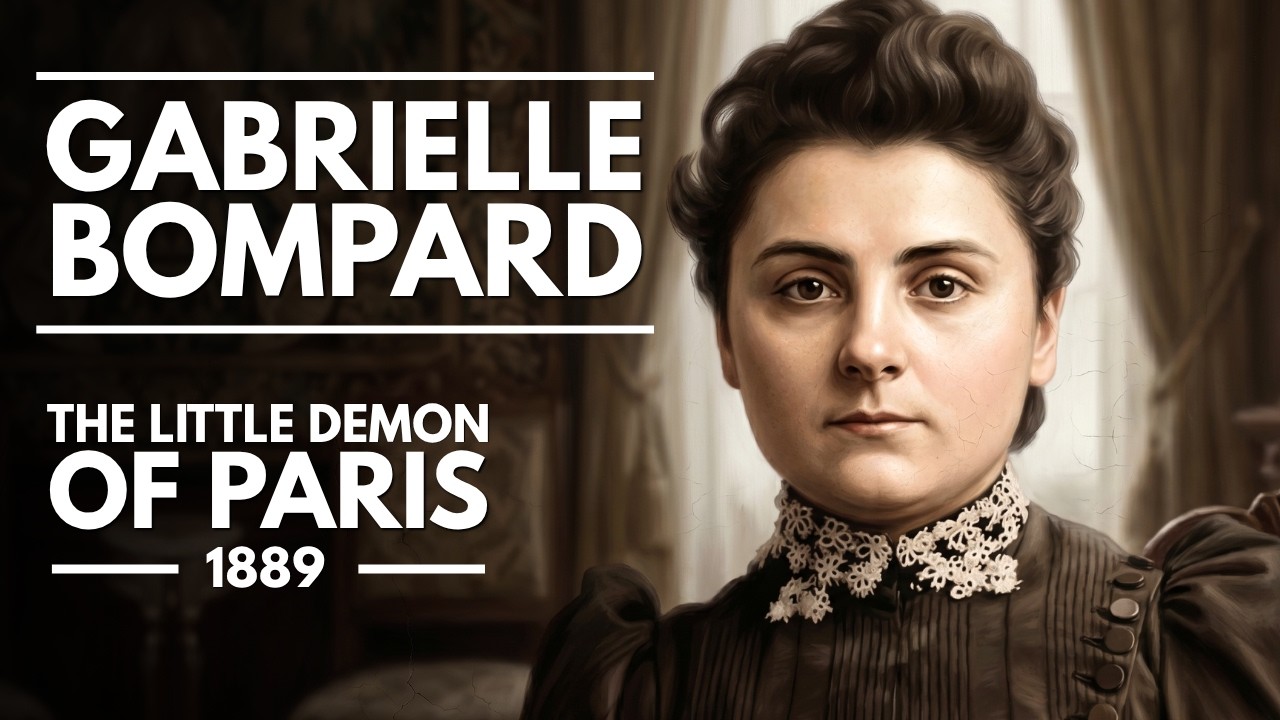
What followed was a childhood documented in unusual detail because so many institutions kept records of her failures. She was expelled from four boarding schools in succession before a corrective institution held her for three years. Doctors of the era called her a lying child with a lewd disposition. One physician, examining her at fifteen, used a stranger word: neuropath.
She could be hypnotized in moments, and her own father once paid a doctor to use that susceptibility to correct her behavior. It did not work. At eighteen she left home for Paris. The man who would become her partner in murder was Michel Eyraud, born in Saint-Étienne in 1843.
He had enlisted in the French army at twenty and served as a corporal of jägers in Napoleon III’s disastrous attempt to place an Austrian archduke on the throne of Mexico. He deserted somewhere in that futile war, spent years in the United States, and returned home under an amnesty in 1870. He married a nineteen-year-old girl the following March, but the marriage collapsed quickly under his violence and infidelity. For seventeen years he drifted through Paris, working briefly as a distiller and a commission agent, but mostly living as a swindler.
He was clever, well-spoken, and fluent in English and Spanish. By the spring of 1889 he was forty-six, deeply in debt, and living one step ahead of the police. In the Paris of the world’s fair, he found Gabrielle. She was four feet eight inches tall, with gray-blue eyes and a face young enough to pass for sixteen.
Eyraud charmed her with stories of Mexico and California, and she moved in with him, becoming his mistress. His debts were unmanageable by the end of June, and he began to plan a robbery that would require her help. The intended victim was Toussaint Augustin Gouffé, a forty-nine-year-old widowed court bailiff with two daughters. He kept his study at 148 rue Montmartre in the busy publishing district of the right bank, where he handled large sums of cash for his clients.
He had a predictable habit: on Fridays he left the money locked in his office and spent the evening in the establishments of the demimonde, what the newspapers delicately called a sexual adventurer. Eyraud knew him from the overlapping circles of bailiffs, swindlers, and women of the evening. He knew about the cash, and he knew that a young woman like Gabrielle would interest Gouffé very much. On the 14th of July, 1889, Eyraud and Bompard crossed to London and bought a large wooden trunk, a heavy cotton sack, seven meters of rope, a pulley, and a length of silk cord.
They returned to Paris on the 20th. Four days later, Gabrielle signed a lease on a ground-floor apartment at 3 rue Tronçon du Coudray in the 8th arrondissement. The ground floor meant no neighbors below to hear a falling body. Inside, Eyraud screwed a pulley into a heavy wooden crossbeam in an alcove, hung a curtain across it, placed a chair behind it, and set a long upholstered chaise in front, positioned exactly where a man invited to sit beside a young woman would sit.
The plan was rehearsed. Gabrielle would bring Gouffé into the room, seat him on the chaise, and playfully wind the silk cord of her dressing gown around his neck. The cord was attached to the pulley above. Eyraud, hidden behind the curtain, would pull, and the man would be lifted off his feet.
It was a killing reduced to mechanical advantage. On the evening of Friday, the 26th of July, Gabrielle met Gouffé at a café near rue Montmartre, as arranged the day before. After a quiet dinner with Eyraud, she walked to a nearby church where Gouffé was waiting, and brought him back to the apartment. She sat him on the chaise, told him smiling that she was no longer with Eyraud, and wound the silk cord around his neck as a tease.
Behind the curtain, Eyraud pulled. The pulley slipped. The cord did not hold. Gouffé struggled, and Eyraud burst from behind the curtain and finished the killing with his bare hands.
They searched the body, taking a watch and chain, a ring with two small diamonds, a tortoise-shell pince-nez, a hundred-franc gold piece, a fifty-franc bank note, and a hundred and fifty francs in loose cash. Then Eyraud put on Gouffé’s coat, walked across Paris to the office on rue Montmartre, and let himself in with the keys taken from the corpse. Fourteen thousand francs sat under a stack of papers inches from his hand. He did not find them.
He left empty-handed. They wrapped the body in the cotton sack and lowered it into the trunk. Gabrielle slept in the room with it that night. The next morning, the trunk was registered at the freight office of the PLM railway, its weight recorded at 105 kilograms, its destination Lyon, 480 kilometers to the southeast.
They followed it that afternoon, collected it from the freight yard, and drove out along the Rhône in a rented open carriage, looking for a quiet wood far from any house. Near the village of Millery, about ten miles south of Lyon, they dragged the trunk off the road. They could not move it far. They lifted the cotton sack out of the trunk and pushed it under a bush at the side of the road.
Eyraud broke the trunk apart with a stone and threw the pieces into a separate stretch of woodland. By the next morning they were on a train back to Paris, and by the 29th they had crossed the Channel from Calais to Dover under the name Monsieur Labordaire and his son. Gabrielle had cut her hair short and worn boy’s clothes to pass as a teenage son. The bag under the bush at Millery was found on the 13th of August, when a road mender named Denis Coffee was sent to investigate a complaint about a stench on a lane near Vernaison.
Inside the oilskin bag was a body bound in seven meters of rope, the head wrapped in a separate black cloth. A forensic surgeon in Lyon, Paul Bernard, conducted the autopsy. His report contradicted the description of the missing bailiff Gouffé in nearly every detail: the corpse was five feet seven, not five feet eight, had black hair rather than chestnut, and the age was estimated at thirty-five to forty-five, not forty-nine. Gouffé’s brother-in-law was sent down from Paris, took one look at the bloated remains, and said it was not his relative.
The body was buried in a pauper’s grave. But before the coffin was closed, a young laboratory assistant named Julien Calmeil scratched his initials into the wood of the coffin and placed an old hat on the corpse’s head. He did not know why. He only knew, he later said, that they might want to find it again.
The chief of the Sûreté in Paris, Marie François Goron, was not satisfied. He had the broken trunk, found a few miles from the body, pieced back together by a carpenter and put on display in the Paris morgue. Twenty-five thousand Parisians filed past it in three days. Someone identified the maker: a small workshop on Euston Road in London.
Detectives crossed the Channel, and the carpenter gave them a name. The trunk had been bought on the 12th of July by a Frenchman named Michel Eyraud, accompanied by a small young woman. On the 29th of November, Goron issued an international bulletin describing both fugitives in English and French, sent to police forces in London, Quebec, New York, and San Francisco. It is recognized as one of the earliest international wanted notices in police history, predating Interpol by thirty-four years.
The case still lacked a confirmed body. Goron persuaded the Lyon prosecutor to have the pauper’s grave opened. The second autopsy, beginning on the 13th of November, was performed by Dr. Alexandre Lacassagne, professor of forensic medicine at the University of Lyon.
He measured the long bones and gave the height as five feet eight. He found the missing molar in the upper right jaw that matched Gouffé’s dental records. He found calcification in the right knee consistent with the chronic limp Gouffé had carried since a back injury. He found a fractured thyroid cartilage, the signature of strangulation by hand.
And then he did something almost no investigator in Europe had done before him. He took a single hair from the body, obtained a hair from Gouffé’s own comb in his rooms on rue Montmartre, and put them under a microscope. They matched. On the 21st of November, the body in the pauper’s grave became Toussaint Augustin Gouffé again, by science alone.
The fugitives had not been idle. From Dover they had crossed to Liverpool and boarded a steamer to Canada under a new name, Monsieur Vannard and his daughter Bertha. They crossed the continent by rail to Vancouver, then sailed down the Pacific coast to San Francisco. On the steamer they met a prosperous French businessman named Georges Garanger.
Eyraud saw a second Gouffé and put the same plan into motion: Gabrielle was to charm him, and they would relieve him of his money on the way to New York. What Eyraud did not predict was that Gabrielle would fall in love. She told Garanger everything, gave him the Paris papers covering the trunk and the search, and he persuaded her to go home. On the 22nd of January 1890, Gabrielle Bompard walked into the office of the Sûreté at the Quai des Orfèvres and asked to make a statement.
Eyraud fled to Mexico and then to Havana. In May he sent three letters to the Paris newspaper L’Intransigeant, blaming Gabrielle for everything. The paper printed them on the front page. A few weeks later, a French merchant in Havana recognized him from Goron’s bulletin and went to the police.
On the 16th of June 1890, Michel Eyraud was put on a ship back to France. The trial began on the 16th of December 1890 at the Cour d’Assises de la Seine and lasted four days. Eyraud blamed Gabrielle. Gabrielle blamed Eyraud and made a claim that turned the trial into something far stranger than a murder case: she had been hypnotized, she said, for months, unable to resist his suggestions.
She was the agent of his will, not her own. For four hours on the third day, Jules Liégeois, a professor from the Nancy school of hypnosis, explained to the jury how this could be true, citing her lifelong susceptibility. The Paris school of the Salpêtrière answered through three expert physicians, who insisted on the opposite: a person can be hypnotized to do many things, but they cannot be hypnotized into committing a murder. On the 19th of December, the jury returned.
Michel Eyraud, guilty, was sentenced to death. Gabrielle Bompard, guilty with extenuating circumstances, was sentenced to twenty years of hard labor. On the morning of the 3rd of February 1891, Eyraud was guillotined at the Place de la Roquette. He was forty-seven.
Gabrielle was sent to the women’s prison at Nanterre, then to Clermont-en-Beauvaisis. She served fifteen years on good conduct and was released in 1905. The newspapers that had once called her the little demon of the Belle Époque barely noticed. She went back to her old profession, danced, and sometime in the early 1920s died in obscurity in a city that had forgotten her.
What the case left behind was larger than the fates of its three protagonists. It helped establish forensic pathology as a science in Europe, produced one of the first international wanted notices in police history, and left a French courtroom that had confronted the question of whether a human being can be made to kill against their own will. The answer it gave on the 19th of December 1890 was almost.
