On December 14, 1863, First Sergeant James Trotter and the other men of the 55th Massachusetts Infantry Regiment gathered to hear an announcement about their pay. The federal government would not give them the promised soldier’s wage of thirteen dollars a month. Instead, they would receive ten dollars, the amount paid to laborers and cooks who worked for the army under a law Congress had passed the previous year. The state of Massachusetts, however, would cover the three-dollar difference.
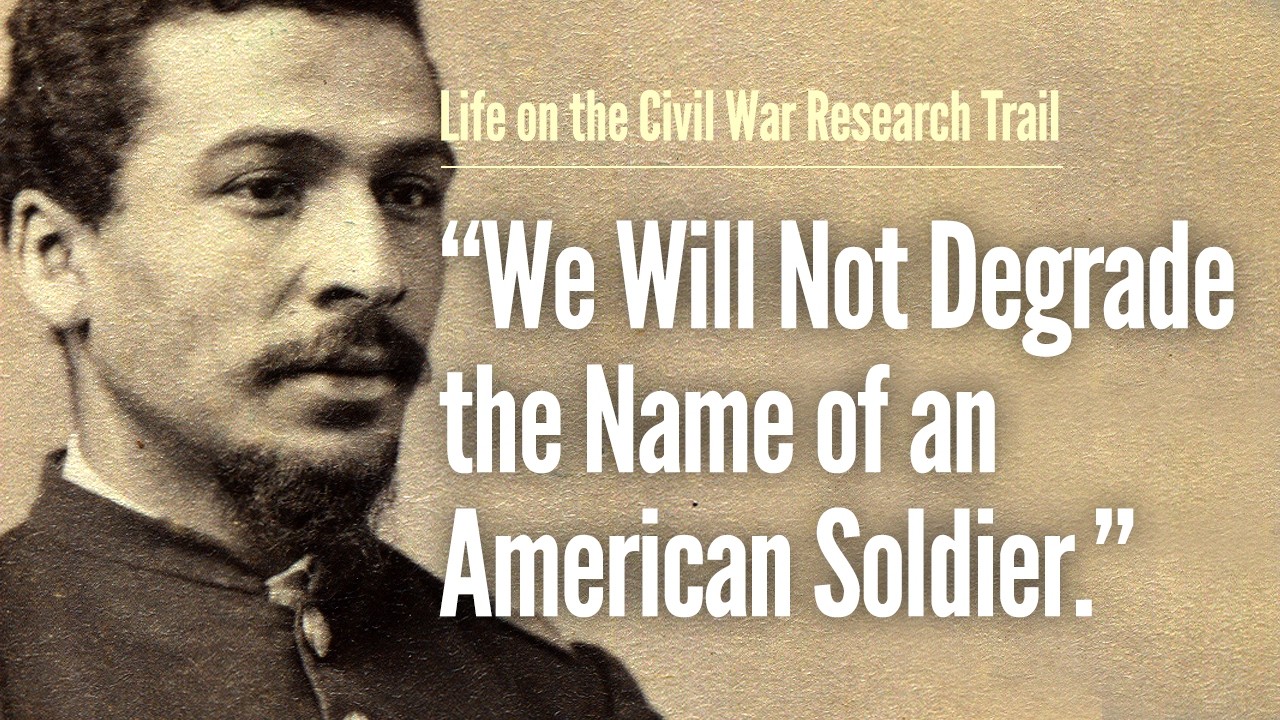
The regimental historian recorded that many non-commissioned officers and soldiers expressed their views and those of their comrades in a quiet and proper manner. Trotter’s remarks were especially well received. He and his fellow soldiers refused the combined offer of federal and state money on principle. One enlisted man remembered Trotter as the first soldier to step forward and tell the paymaster, “No, sir.
We will never accept it. We are soldiers. We will not accept less than a soldier’s pay. We are perfectly willing to accept a soldier’s share, but we will not disgrace the name of the American soldier.
”
Trotter’s outspokenness was no surprise. Throughout his life, he stood at the front of those fighting to secure freedom for African Americans, and he never feared confronting white opinion. He referred to the Southern rebellion as a punishing war, a phrase that hinted at his active nature and his support for those oppressed by slavery and for free men who struggled for equality. Trotter was born into slavery in Grand Gulf, Mississippi, the son of Richard Trotter, a white planter, and Letitia, an enslaved woman.
In 1854, at about the age of twelve, he left the state. One account claims he escaped with his mother and siblings. Another says Richard Trotter freed them after his marriage. Whatever the explanation, the family moved to Cincinnati, Ohio.
Trotter attended a school for free Black children and worked as a hotel bellhop and as a helper on riverboats. He continued his studies in music and art at an academy in nearby Hamilton, and afterward became a teacher. In early 1863, Massachusetts officials began recruiting for African American regiments. Black men from across the Union, including Trotter, hurried to Boston to enlist.
On June 11, he joined the 55th Infantry. Their sister regiment, the 54th, had already been deployed to the coast of South Carolina and would soon distinguish itself at the Battle of Fort Wagner. The men of both regiments denounced the lower pay. The stance Trotter and others took, refusing to accept any wages until the government reversed its policy, had severe consequences.
Their families suffered from the loss of income, and morale inside the regiment declined. While lawmakers in Washington studied the issue, the governor of Massachusetts issued commissions to officers from a select group of Black men in both regiments, including Trotter. This stirred another controversy, because there were no existing provisions for Black officers. Approval of their commissions stalled in bureaucratic procedures.
Worse, the move stirred racial prejudice among some white officers. Trotter called it “color phobia. ”
The government settled the pay issue in favor of Black soldiers in the summer of 1864. The equality in pay came with a condition.
To receive the thirteen dollars, each soldier had to swear that he had been free on or before April 19, 1861. According to one historian, this provision did not trouble many men in the 55th. The historian of the 54th Massachusetts Infantry noted that those who had been enslaved on that day took the oath as free men under the higher law of God, if not under the law of their country. Trotter was among the first men of the 55th to receive his back pay.
He and his comrades had gone ten months without compensation. He later declared that in their struggle for equal pay and recognition, the colored soldiers of Massachusetts had won a full and glorious victory for themselves, for all colored troops, for their race, and for their friends. The regiment fought its first battle after the pay dispute was settled on November 30, 1864, at Honey Hill, South Carolina. The battle proved that the 55th could fight, just as the 54th had proved at Fort Wagner.
Like Wagner, Honey Hill was a Union defeat despite the good performance of its soldiers. The regiment suffered 144 casualties, including Trotter, who received a slight wound to his neck and another undisclosed injury. The 55th remained in service in South Carolina and Georgia for the rest of the war. Trotter was commissioned a second lieutenant in June 1865, fourteen months after receiving his commission and two months before the regiment’s service ended.
After the war, he settled in Boston and worked as a postal clerk. In 1868, he married Virginia Isaacs, whom he had met in Ohio before the war. They started a family that grew to five children, three of whom lived to adulthood. His lifelong interest in the arts culminated in his 1878 book, “Music and Some Highly Musical People,” described as a sincere tribute to the overwhelming power and noble beauty of music, whose divine harmony should always serve to promote harmony among mankind.
Trotter also took an active interest in politics. As a loyal Republican, he became disgusted with the party after President Rutherford Hayes withdrew the last federal troops from the former Confederate states in 1877. A few years later, the Republicans who dominated the post office denied him a promotion. He turned to the Democratic Party.
As one biographer noted, he was “independent by nature,” a Black Democrat in an era when most Black Americans remained fiercely loyal to the party of Lincoln. He worked in the successful gubernatorial campaign of former Major General Benjamin Butler in 1883. Four years later, he received a lucrative political post as Recorder of Deeds in Washington, D. C.
, succeeding Frederick Douglass, the first African American to hold that office. According to one historian, Trotter’s activity among Black Democrats earned him the Washington appointment despite the objections of Republicans who hated his politics and fellow Democrats who hated his color. In 1889, Republican Benjamin Harrison entered the White House. Trotter returned to Boston.
His health began to decline around that time. He died of tuberculosis three years later at the age of fifty, leaving behind his wife and children. His son, William Monroe Trotter, became a prominent publisher and political activist on the national stage.
