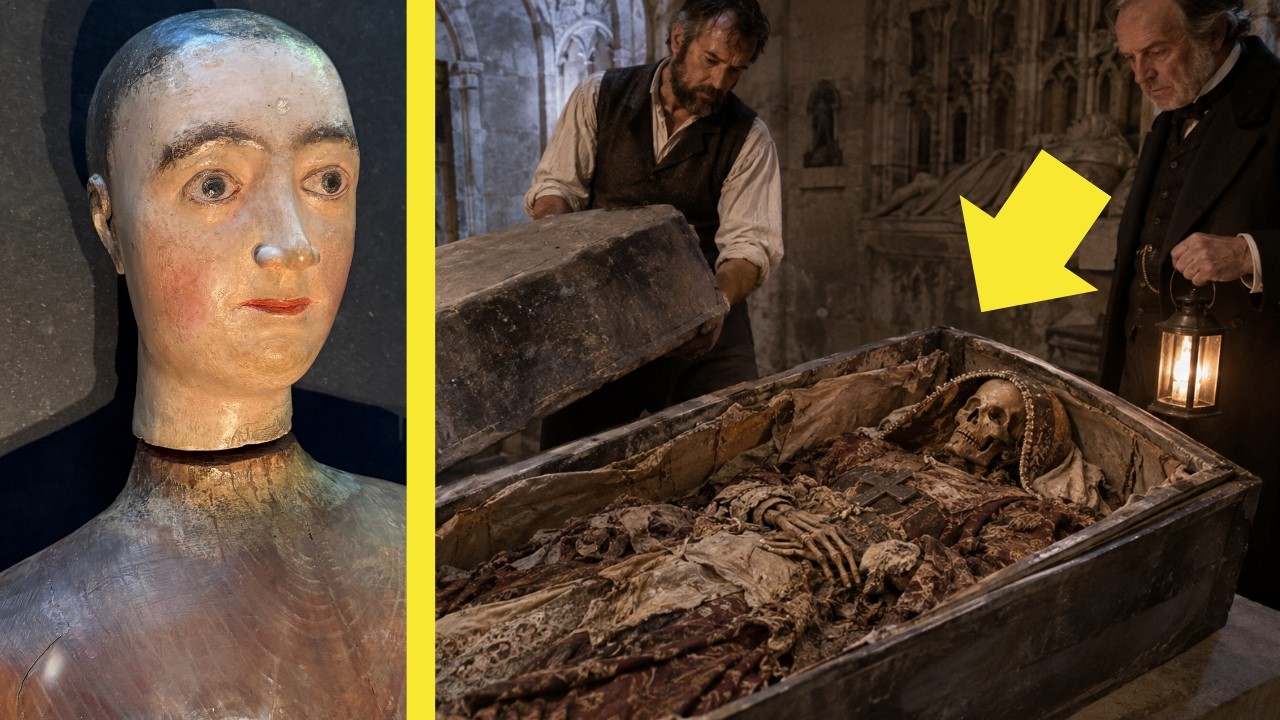
For nearly four hundred years, Catherine of Valois, a medieval English queen, lay unburied in the way most would understand the term. Her coffin was not sealed in a vault but left exposed within Westminster Abbey, where visitors could sometimes glimpse her remains. At various times, the coffin was opened, and the queen’s body became a curiosity for tourists. This was not the result of any deliberate insult, but a chain of accidents, building work, and shifting attitudes toward royal burials over the centuries.
Born in 1401, Catherine was the daughter of King Charles VI of France and grew up during the bitter Hundred Years’ War between England and France. In 1420, she married the English king Henry V as part of a peace agreement following his military victories in France. The marriage was politically immense, intended to unite the English and French royal families. It did not last.
Henry V died suddenly in 1422, likely from illness, leaving Catherine a widow at just twenty-one. Their only child, the infant Henry VI, became king under regents. Catherine lived quietly at court for years but later secretly married a Welsh nobleman named Owen Tudor, a union that would have enormous historical consequences, as their descendants eventually founded the Tudor dynasty. Catherine died on 3 January 1437, only thirty-five years old, probably from illness after childbirth.
As Henry V’s widow and the mother of the reigning king, she received an honorable burial. Her body was taken to Westminster Abbey, the traditional resting place of England’s monarchs, and interred near the shrine of Edward the Confessor. Initially, nothing was unusual about her funeral. Some forty years later, however, everything changed.
During major construction work in the abbey in the late fifteenth century, Henry V’s tomb was being redesigned and expanded into an elaborate chantry chapel built over his burial place. This required rearranging neighboring graves. Catherine’s tomb lay close to the works, and to clear space, her grave was dismantled and her coffin lifted out. Instead of being reburied carefully, it was simply placed above ground near Henry V’s chapel.
Wooden medieval coffins do not last forever. Over the centuries, the wood decayed, the lid eventually broke open, and the remains inside became visible. Because Catherine had originally been wrapped in burial cloth and sealed in a tight coffin, parts of her body had dried and been preserved, becoming partially mummified. By the sixteenth and seventeenth centuries, the strange sight of Catherine of Valois’ body was well known among visitors to Westminster Abbey, a place people came to see royal relics and historical wonders.
One famous description comes from the English diarist Samuel Pepys, who visited in February 1669. According to Pepys, the abbey keeper showed him Catherine’s coffin and remains. Pepys wrote that he could see the queen’s face and that parts of her body were still preserved. He even noted that he kissed the queen’s mouth, remarking that this was the first time he had kissed a queen and that it happened to be his birthday.
Today such a story seems shocking and disrespectful, but seventeenth-century attitudes toward historical remains were entirely different. People were often fascinated by the physical remains of famous figures. For decades, Catherine’s coffin stayed where it had been left near Henry V’s chapel. Visitors in the seventeenth and eighteenth centuries sometimes reported seeing bones and pieces of cloth.
By the eighteenth century, attitudes began to change. People increasingly believed that the remains of historical figures should be treated with dignity rather than curiosity. In 1778, the abbey authorities collected the queen’s remains, placed them in a new coffin, and reburied her beneath the abbey floor near Henry V’s chapel, finally ending a strange situation that had lasted nearly four hundred years. Catherine of Valois played an important part in the story of the English monarchy.
Through her secret marriage to Owen Tudor, she became the grandmother of Henry VII, the king who founded the Tudor dynasty. She was therefore an ancestor of some of the most famous monarchs in English history, including Henry VIII and Elizabeth I. Today, she rests quietly beneath the abbey floor, properly buried and protected, though her story remains one of the strangest episodes in royal burial history. Elizabeth I and Mary I, two of the most significant queens in English history, were half-sisters, both daughters of Henry VIII, and the first two women to rule England in their own right for a sustained period.
Religion, family history, and politics divided them. Mary was a committed Roman Catholic, while Elizabeth established a Protestant religious settlement that shaped England for generations. Given their differences, it seemed unusual that their coffins should rest together in the same vault in Westminster Abbey. Even more striking, Elizabeth’s coffin was placed directly on top of Mary’s.
This arrangement is sometimes described as a final insult to Mary, but the truth is more complex. Mary I died at St James’s Palace on 17 November 1558, aged forty-two, after ruling for just over five years. Her reign was dominated by her determination to restore Roman Catholicism after the Protestant reforms of her father and half-brother. She married Philip of Spain and hoped for a Catholic heir, but her pregnancy was false and her health declined.
Because Mary had no children, the crown passed to Elizabeth, the Protestant daughter of Henry VIII and Anne Boleyn. Mary and Elizabeth had a difficult relationship. During Mary’s reign, Elizabeth was suspected of involvement in Protestant rebellions, imprisoned in the Tower of London in 1554, and kept under guard. Mary found insufficient evidence to execute her, but Elizabeth remained in danger for most of her sister’s reign.
Despite these tensions, Elizabeth arranged a proper royal funeral for Mary. The dead queen’s body was embalmed, wrapped, placed in a lead shell, and then inside a wooden coffin. Mary was buried in Westminster Abbey on 14 December 1558 in a vault on the north side of the magnificent Lady Chapel built by their grandfather Henry VII. Her funeral was dignified, but her grave remained without the grand monument expected for an English monarch.
For the next forty-five years, Mary remained beneath the abbey floor without a visible tomb of her own. Elizabeth’s reign proved far longer, from November 1558 until March 1603. During that time, England defeated the Spanish Armada, experienced an extraordinary flowering of literature and theater, and began developing greater ambitions abroad. Elizabeth never married and had no children.
When she died at Richmond Palace on 24 March 1603, the Tudor dynasty effectively ended. The crown passed to James VI of Scotland, son of Mary, Queen of Scots, who became James I of England, uniting the English and Scottish crowns under one monarch. Elizabeth’s funeral took place at Westminster Abbey on 28 April 1603, with thousands reportedly lining the streets. Her coffin, draped in purple velvet, was carried on a hearse drawn by four horses, topped by a lifelike funeral effigy of the queen.
Elizabeth was not immediately buried with Mary. Her lead-wrapped body was initially placed inside the vault of her grandfather Henry VII, beneath his grand monument in the center of the Lady Chapel, as a temporary arrangement. James I commissioned a magnificent marble monument for Elizabeth in the north aisle of the Lady Chapel, created by the sculptor Maximilian Colt. In 1606, when work was complete, Elizabeth’s coffin was moved to the vault beneath her new monument, where Mary’s coffin already occupied the space.
Elizabeth’s coffin was placed directly on top. The two Tudor queens have remained in this position ever since. The simplest explanation for this arrangement is practical. Mary was buried first, so her coffin naturally occupied the lower position.
Elizabeth died forty-five years later and was added afterward. Coffins are sometimes stacked due to limited space, and placing Elizabeth’s coffin above Mary does not necessarily prove anyone intended an insult. There was also an important dynastic reason for burying the sisters together. Mary and Elizabeth were Henry VIII’s only daughters, and both had worn the English crown.
Their reigns represented different religious visions, but together they formed the final chapters of the Tudor dynasty. James I needed to present himself as the legitimate heir of both queens. By creating a shared burial place, he could suggest continuity between the Tudors and his own Stuart line. James was in a sensitive political position.
His mother, Mary, Queen of Scots, had been executed on Elizabeth’s orders in 1587. Yet James owed his English crown to Elizabeth’s death without an heir. He could not insult her memory, and erecting a splendid monument to Elizabeth allowed him to portray himself as a respectful heir who inherited her kingdom and virtues. At the same time, James was the son of a Catholic queen and wanted to reduce some of the inherited religious bitterness of the Tudor period.
Placing Mary and Elizabeth together presented the half-sisters as members of the same royal family rather than eternal enemies. The Latin inscription on the monument expresses this idea, translating to: “Partners in throne and grave, here lie two sisters, Elizabeth and Mary, in hope of one resurrection. ” These words are especially powerful because Mary and Elizabeth followed different forms of Christianity. Mary believed England should return to Roman Catholicism, and during her reign nearly three hundred Protestants were burned for heresy, earning her the later nickname “Bloody Mary.
” Elizabeth rejected papal authority and reestablished the Protestant Church of England. Catholics faced increasingly severe restrictions during her reign, especially after the pope excommunicated her and Catholic plots threatened her life. The inscription attempted to move beyond these divisions, referring to the shared Christian hope of resurrection despite religious differences. Still, it is understandable that people see symbolism in Elizabeth’s position above Mary.
Elizabeth’s monument dominates the burial place while Mary has no separate effigy. Anyone looking at the tomb sees Elizabeth, not Mary. Elizabeth enjoyed a reign of nearly forty-five years while Mary ruled for just over five. Protestant England celebrated Elizabeth’s achievements, while Mary’s reputation became associated with religious persecution, failed pregnancies, and the loss of Calais.
Yet there is no reliable evidence that Elizabeth’s coffin was placed above Mary as a deliberate Protestant insult. The official message of James I was reconciliation and dynastic continuity. The physical arrangement was confirmed during an investigation of the vault in the nineteenth century, when investigators found the two queens’ coffins resting one above the other, Elizabeth’s on top and Mary’s below. This reinforced the popular image of Elizabeth overshadowing her sister even in death.
In reality, Mary’s lower position resulted primarily from the order of the sisters’ deaths and placement in the vault. The shared grave came to mean much more than a practical arrangement, uniting the Catholic Mary and Protestant Elizabeth, two rival daughters of Henry VIII whose lives shaped the same turbulent dynasty. The decision was made during the reign of James I as part of constructing Elizabeth’s monument, a decision both practical and politically useful, carrying deep symbolic power. Beneath the splendor of Westminster Abbey, the sisters remain together, separated in life by religion and power but joined in death by blood, royalty, and hope of resurrection.
King Henry VIII died on 28 January 1547, and his body began the same natural process of decomposition that occurs after every human death. Despite being one of the most powerful monarchs in English history, Henry could not escape decay. His body was prepared for an elaborate royal funeral and eventually buried beneath St George’s Chapel at Windsor Castle. Today, thousands of people walk through the chapel each year, often passing near the place where Henry lies, without any odor of a rotting corpse seeping through the floor.
The explanation is straightforward. Henry’s body certainly decomposed, and his burial vault may once have contained unpleasant smells, but decomposition does not continue at the same rate forever. Henry was fifty-five when he died at Whitehall Palace in London. In his final years, he had become massively overweight and suffered serious physical problems.
Preparing such a large body for burial was extremely difficult. Tudor royal funerals were complex ceremonies, and the king’s body had to last long enough for the funeral rites to be completed. Henry’s body was prepared using techniques available to the wealthy and royal. Tudor embalming was very different from modern embalming.
It was not necessarily intended to preserve the body permanently but to slow decomposition, reduce odors, and allow the body to remain presentable before burial. The body was washed, treated with aromatic substances, and wrapped in specially prepared materials. Internal organs were sometimes removed during preparation of important individuals. One of the most important protective measures was the coffin itself.
Royal and aristocratic burials often used lead because it created a much stronger barrier between the decomposing body and the outside world than an ordinary wooden coffin. Henry’s remains were placed inside a lead coffin or lead shell, which was then enclosed in an outer wooden coffin. Lead could contain decomposition fluids and reduce the leakage of gases and odors, though it did not magically stop decay. Inside that coffin, Henry’s body remained subject to decomposition.
Almost immediately after death, cells begin to break down, and bacteria already inside the body contribute to tissue destruction. As the process advances, gases accumulate and soft tissues decompose, producing the foul-smelling chemical compounds associated with a decaying corpse. A coffin could contain much of this material, but historical coffins were not necessarily completely sealed. This means Henry’s burial place may have smelled unpleasant in the years after his interment.
However, the vault was not an ordinary room people visited easily. It was a sealed burial chamber beneath the chapel. Once the king’s funeral was complete and the burial space closed, almost no one had any reason to enter it. Any smells rising from the vault were largely isolated from the congregation above.
There are dramatic stories surrounding what happened to Henry’s body before it reached Windsor. One famous account claims his coffin leaked during an overnight stop at Syon Abbey on the way to Windsor, and that a dog was seen licking fluids that had seeped from beneath it. This story was later connected to a sermon allegedly delivered by the Franciscan friar William Peto, comparing Henry to the biblical King Ahab, whose blood was licked by dogs. It is a memorable tale, but it must be treated with caution.
It became part of the hostile legends surrounding Henry VIII after his death, and historians cannot simply accept every dramatic detail as fact. Henry was eventually buried in St George’s Chapel beside Jane Seymour, his third wife and the mother of his only legitimate son, Edward VI. Jane had died in October 1537 shortly after giving birth to Edward. Henry had planned a magnificent tomb for himself and Jane, but it was never completed.
Instead, their coffins remained in the vault beneath the chapel, a burial place far less impressive than the grand monument Henry had imagined. The vault gained greater historical significance a century later. After the execution of King Charles I outside the Banqueting House in London on 30 January 1649, his body was taken to Windsor and eventually buried in the same vault containing Henry VIII and Jane Seymour, along with a small coffin of an infant child of Queen Anne. For many years, the exact location of Charles I’s burial became confused, and the vault was virtually forgotten.
It was rediscovered in 1813 during restoration work at St George’s Chapel. The Prince Regent, the future King George IV, authorized an investigation. Inside the vault were coffins believed to belong to Henry VIII, Jane Seymour, and Charles I. Henry VIII’s coffin was found in poor condition.
The outer wooden parts had deteriorated significantly, and the lead had been damaged. It was believed some damage may have occurred when Charles I’s heavy coffin was placed into the already crowded vault in 1649. This is especially interesting because it means Henry’s remains were not necessarily protected by a completely intact coffin throughout the period after his death. However, by the time the vault was examined in 1813, Henry had been dead for about 266 years.
Even if his coffin had been damaged, the period of intense decomposition had passed generations earlier. A body does not continue producing the same quantity of foul-smelling gases indefinitely. The odor associated with death is primarily linked to the decomposition of soft tissue. Once most of that material has decomposed, dried out, or changed, gas production drops significantly.
Charles I’s coffin was actually opened during the 1813 investigation. His remains were preserved well enough for observers to recognize important features. The severed head was examined, and remaining facial hair could still be seen. The physician Sir Henry Halford later published a report on the examination.
Charles’s condition illustrates how unpredictable decomposition inside coffins can be. A body does not always become a clean skeleton quickly; depending on moisture, temperature, oxygen levels, coffin construction, and chemical conditions, some tissue can survive for surprisingly long periods. Henry VIII’s coffin was not subjected to the same thorough examination, so we do not actually know precisely what his remains look like today. Popular descriptions sometimes imagine a huge, perfectly preserved body inside the coffin, while others imagine nothing but a skeleton.
Neither image can be presented with confidence as fact. Without a modern examination, no one can say exactly what remains. The key point is that whatever remains inside Henry’s coffin is no longer undergoing the rapid decomposition that occurred shortly after his death. Nearly 480 years have passed since 1547, and most easily decomposed soft tissue would have disappeared or undergone significant chemical and physical changes.
Therefore, there is no continuous production of the massive quantities of decomposition gases associated with a recently deceased human body. The structure of the burial place provides another barrier. Henry is not buried directly beneath an unsealed floor slab. His coffin rests in a closed vault beneath St George’s Chapel, surrounded by masonry and other construction materials.
Even if a tiny amount of gas or odor were produced inside, it would not simply leak continuously into the chapel above. If Henry VIII’s vault were opened today, it might still have a distinctive smell. Old crypts and burial chambers can smell of moisture, dust, earth, or mold. But this odor would be very different from the pungent smell produced by a body undergoing active decomposition.
This is also why medieval churches generally do not smell of corpses despite containing hundreds of burials. Westminster Abbey, St George’s Chapel, and countless old churches across Europe contain enormous numbers of human remains. If bodies continued emitting the smell of active decomposition indefinitely, entering many historic churches would be nearly impossible. Instead, decomposition is a process that passes through different stages, and that particularly foul stage is temporary.
Henry VIII’s burial place reminds us that even monarchs were subject to ordinary biological processes. His crown, wealth, and royal status provided a magnificent funeral, an expensive coffin, and a prestigious burial site, but they could not stop his body from eventually decomposing. Today, visitors can stand inside St George’s Chapel near where Henry VIII was interred in 1547 without smelling his decaying body. The reason is not that Henry somehow escaped decomposition but quite the opposite.
Enough time has passed for the most active and putrid stages of decomposition to have ended centuries ago. Beneath the chapel floor lie the remains of one of England’s most famous kings, but after nearly 500 years, Henry VIII is no longer a freshly decomposing corpse. What remains is an old, isolated burial inside a vault, while the extraordinary story of the man within still fascinates people almost half a millennium after his death. King Henry III was born on 1 October 1207 in Winchester, the son of King John, often considered the worst king in English history.
Henry was only nine when his father died, and the country was controlled by rebellious barons led by Prince Louis, son of the King of France. Henry did not actually take control of government until 1234. Numerous problems emerged during his reign. Barons objected to Henry’s relatives, and a marriage arranged in 1238 between Henry’s sister and a prominent English noble named Simon de Montfort caused further trouble.
In 1242, Henry’s half-brothers launched a disastrous campaign in France that cost a great deal of money. Henry was an unpopular king, threatened with excommunication by the pope, lost battles in Wales, and faced growing problems throughout England. Decisions were made to hold Parliament three times a year and reform the royal court, but matters deteriorated further as baronial disputes escalated into civil war. Simon de Montfort won and established a new government, but Henry’s eldest son escaped captivity, gathered his forces, and eventually killed de Montfort before taking control of the government from his greatly weakened father.
Henry III died on 16 November 1272 at Westminster, with his wife beside him. He had requested burial inside Westminster Abbey, specifically before the high altar and in the former resting place of Edward the Confessor. Henry was a devoted worshipper at the shrine of Saint Edward the Confessor and had substantially rebuilt Westminster Abbey. While work was underway on his own grand tomb, his body was placed to rest in the former grave of Edward the Confessor.
He wanted his tomb to resemble a saint’s shrine and believed his body would hold various holy relics. Henry III was reburied in his new tomb in 1290, built by his son Edward I, north of the Confessor’s shrine. His bronze effigy was added two years later. Reports of miracles at the tomb circulated.
Henry’s oak coffin, measuring 1. 87 meters in length, was lowered into place using chains, which remained inside the elaborate tomb. The coffin was covered with cloth of gold. After his death, his heart was removed and his entrails placed in separate vessels.
In 1292, his heart was taken from the tomb and moved to Fontevraud Abbey in Anjou to rest with the bodies of the Angevin kings. His tomb is large and distinctive. The effigy is actually hollow due to its great weight, and there was once a canopy over the tomb that has since disappeared. Jewels on the effigy’s crown and robe were stolen, as was the scepter in its hands.
Over the centuries, many royal tombs and burial sites within Westminster Abbey were opened. Henry III’s tomb was opened and examined in 1871. The coffin was said to be over six feet long, made of polished oak, and extremely heavy. It required nine men using pulleys and their physical strength to reveal the coffin inside.
They had difficulty opening the effigy, but when they did, they made the decision not to open Henry III’s coffin. The reason is unknown, especially considering that years earlier, the coffins of other kings such as Edward I had been opened and their remains examined for the first time in centuries. Perhaps there was no reason to open it. Even today, Henry III’s coffin has not been opened.
Henry III was not among England’s greatest kings. His reign was dominated by warring barons fighting for power and control of England. He was a weak king, but he spent enormous sums on Westminster Abbey for its expansion, equivalent to fifteen million pounds today. He cared more about religious devotion and being remembered as a saint than about governing effectively or helping the people of England.
Yet to this day, Henry III remains buried in his tomb in the heart of Westminster Abbey. Edward the Confessor was the last king of the House of Wessex to rule England. He was known for his intense piety and for building Westminster Abbey. He ruled during a very turbulent time, with many wars and conflicts over the succession before and after his reign.
He was a reserved man who did not participate in much of the turmoil, waiting until many other rivals to his throne were killed or died, eventually emerging as the sole survivor. His reign was peaceful and prosperous to some extent. He was the younger son of Ethelred the Unready and his second wife Emma, raised in France at the court of his uncle, the Duke of Normandy. His mother later married Cnut, the Viking conqueror, restoring her position as queen and giving Edward a claim to the throne.
When Cnut died after a twenty-year reign, he intended his successor to be Harthacnut, his son by Edward’s mother. Edward ultimately took the throne, known for his patience and gentle nature. He was aided in ruling by one of the most powerful men in Europe, the Saxon baron Earl Godwin, or Harold Godwinson. Edward is believed to have promised the throne to Godwinson, a wealthy man who knew England well, but he is also believed to have promised the throne to William, Duke of Normandy, and to the Viking leader Harold Hardrada.
One of the most memorable things about Edward the Confessor’s life and reign is his death, for what followed was an immense struggle for the crown. Ultimately, William the Conqueror, Duke of Normandy, emerged victorious after defeating Harold Godwinson at the Battle of Hastings. The day after Edward’s death, he was buried inside Westminster Abbey, the great church he had ordered built. His burial site was opened repeatedly over the centuries.
The king’s tomb was first opened by King Henry I, then later during the reign of Henry II, when the pope canonized Edward as a saint in 1163. During this second opening, his remains were discovered to be perfectly preserved, his body appearing as fresh as the day he was buried. His ring and priestly vestments were removed. During rebuilding work at Westminster Abbey under King Henry, Edward’s body was buried in a shrine with a wooden upper structure over a stone base, and his body was placed inside a new coffin.
Also placed inside this coffin was the heart of another man, a grandson of King John, Henry of Almain, who wanted his heart to rest with the saint. To place the heart in the coffin, it had to be opened again around 1271. Edward’s old coffin was then used for the initial burial of King Henry III. Further desecration and damage befell Edward’s remains and shrine.
After the dissolution of the monasteries, the king’s coffin was removed from the shrine by dismantling stones at the end of the shrine, and the body was buried nearby. Agents and forces of Henry VIII stole the wealth of thousands of churches and did not stop at Westminster Abbey. The shrine was completely dismantled and removed, but during the reign of Henry’s eldest daughter, Mary I, it was reassembled and restored on 20 March 1557. A colored inscription was added telling people who was buried there.
But the rebuilding was done quickly and poorly, and some pieces of the shrine were reportedly missing. Although Edward’s body had been remarkably preserved when the coffin was opened in 1163, less than a century after his death, the king’s remains did not withstand the following centuries. Decomposition set in and decay spread through his remains. A hole was made in the coffin lid through which air entered, causing a great deal of damage to the body and remains.
When people looked inside the coffin through the hole in 1685, more than 600 years after his death, they found the king’s remains were nothing but a skeleton. The coffin lid was raised, and the head was said to be intact and held together, with complete upper and lower jaws full of teeth, and a gold circlet about an inch wide surrounding the temples. White linen and flowers colored with gold made of silk were also found inside. All his bones were present along with a good deal of tissue.
One official, Charles Taylor, used a ladder to reach into the coffin and removed from beneath the bones a richly enameled cross and a gold chain twenty-four inches long. He also moved the skull to analyze certain parts of the body. The cross was later shown to the king. After this examination, a new outer coffin was made to try to preserve the remains for future centuries, sealed tightly with iron clasps to ensure it would not be opened again.
In 1916, however, Edward’s tomb was opened once more after the wooden upper structure was removed during the First World War for protection. The coffin was left untouched on that occasion and has not been opened since 1685. Today, Edward’s shrine chapel can only be visited on a guided tour and is closed to the general public due to the fragile floor. His coffin still rests in the tomb at the top of the marble structure within the shrine, considered the center of the abbey.
Five kings and four queens are buried in Edward the Confessor’s chapel within the very church he founded. Edward the Confessor was known for his piety and devotion to God, the only king of England ever to be canonized. The end of his reign marked the end of Anglo-Saxon rule across the kingdom, and with the Norman victory at the Battle of Hastings, Norman rule was imposed across England, changing the face of the nation forever. But his tomb was broken into many times over the centuries.
On the morning of 19 May 1536, Queen Anne Boleyn walked quietly across the Tower of London courtyard to the execution platform where she would meet her death. Within minutes, the second wife of King Henry VIII was dead, executed with a single stroke of a French swordsman’s blade. Her dramatic rise from lady-in-waiting to queen of England changed English history, and her equally dramatic fall permanently altered the course of the Tudor dynasty. Yet although millions know the story of her execution, few know what happened to her body afterward, or why her coffin was opened more than 340 years later.
The opening of Anne Boleyn’s coffin was not the result of planning or an attempt to satisfy public curiosity. It happened by accident during major restoration work inside the Chapel of St Peter ad Vincula within the Tower of London during the reign of Queen Victoria. The discovery helped solve one of England’s greatest historical mysteries and confirmed the final resting place of one of its most famous queens. Anne’s execution was carried out with astonishing speed.
After being convicted of adultery, incest, and high treason, she was given only a short time to prepare for death. Most modern historians agree the charges were either exaggerated or entirely fabricated by Thomas Cromwell and Anne’s political enemies. Henry VIII was determined to end the marriage so he could marry Jane Seymour, and Anne’s execution cleared the way. Immediately after her execution, Anne’s body was treated with very little ceremony.
Unlike most queens of England, who received elaborate funerals and grand tombs, Anne was denied all royal honors. There was no grand funeral procession, no magnificent coffin, no burial in Westminster Abbey. Instead, officials hastily searched for something suitable to hold her remains and found a plain elm wood chest originally used for storing arrows. Her head, severed by the swordsman’s blade, was carefully placed beside her body before the lid was closed.
The simple funeral reflected Anne’s sudden fall from power. Just three years earlier, she had been crowned queen of England in one of the most magnificent coronation ceremonies the country had ever seen. Now she was buried in complete secrecy with only a few witnesses present. Later the same day, Anne’s coffin was taken to the nearby Chapel of St Peter ad Vincula, the parish church within the Tower of London, long a burial place for prisoners and important figures executed within the Tower’s walls.
She was interred beneath the chapel floor near the main altar. Because everything happened so quickly, no permanent monument or elaborate grave was placed to mark her burial. Over time, the exact location of her grave was forgotten. Over the centuries, many distinguished people were buried within the chapel, including nobles, queens, and statesmen who had been executed, all resting beneath its stone floor.
As new burials and building restorations took place, knowledge of the original locations gradually faded. Visitors continued to believe Anne Boleyn lay somewhere beneath the chapel, but no one could identify the precise spot. Stories and legends circulated for generations, with some claiming her remains had been moved and others believing they were lost entirely. By the nineteenth century, the chapel itself was showing signs of age.
Hundreds of years of wear had left the building in need of major restoration. Queen Victoria took a strong interest in preserving Britain’s historic buildings, and in 1876 she authorized extensive renovations within the old chapel. The project involved lifting the old stone floor so repairs could be made beneath it. No one expected the work to reveal one of the greatest archaeological discoveries connected to the Tudor period.
As workmen carefully removed sections of the floor, they began to uncover human remains. Numerous coffins and skeletons appeared beneath the chapel, representing centuries of burials, and it quickly became clear that the restorers had discovered forgotten tombs of many famous Tudor figures. The discovery attracted enormous public attention. Historians, archaeologists, and senior church officials realized this offered a unique opportunity to identify the resting places of some of England’s most famous historical figures.
Among the burials revealed was the coffin believed to contain Anne Boleyn. By the time it was found, almost nothing remained of the original elm wood chest. Wood naturally decays over long periods underground, especially in damp conditions, and more than three centuries had turned most of the coffin into fragments. However, enough evidence remained for investigators to identify the burial.
The skeleton was carefully examined by Victorian-era experts who handled the investigation with great care according to the standards of the time. Unlike modern forensic scientists, they had no DNA tests or advanced imaging techniques. Instead, they relied on historical records, anatomical examination, and the grave’s location. The burial location provided the strongest evidence.
Historical records written shortly after Anne’s execution stated she was buried near the high altar within the chapel. The skeleton discovered during restoration work matched that location precisely. The remains were those of a slender adult woman who appeared to have died in her thirties, matching Anne’s known age of about thirty-five at her execution. Perhaps the most striking observation concerned the head, which was clearly separated from the rest of the skeleton, exactly as historians expected after a beheading.
While decomposition over the centuries had naturally disturbed the bones’ arrangement, the evidence was consistent with someone who had died by execution. Victorian investigators also commented on the woman’s slight physical build, describing delicate hands, small bones, and a graceful figure, characteristics often mentioned by people who knew Anne during her lifetime. Some reports even claimed the skeleton had an unusually long neck, which had become associated with Anne in later legends. Modern historians, however, are cautious about this conclusion.
Human remains can change significantly over hundreds of years, and Victorian observers were sometimes influenced by popular stories rather than strict scientific objectivity. Today, most scholars consider the identification convincing, primarily due to the burial location rather than anatomical features alone. Although the examination generated great excitement, it was conducted with respect. The remains were not displayed publicly or treated as museum exhibits.
The purpose of opening the coffin was simply to identify the individual before ensuring a dignified reburial. After the investigation was complete, Anne’s remains were placed in a new oak coffin and reburied beneath the chapel floor with far greater dignity than she had received in 1536. Queen Victoria ordered appropriate memorial stones to mark the identified graves. For the first time in more than three centuries, Anne Boleyn’s final resting place was clearly identified.
Today, visitors entering the Chapel of St Peter ad Vincula can see the marble inscription marking her grave. Although her remains remain hidden beneath the floor, the memorial ensures her burial place will never again be forgotten. The restoration work also identified the graves of many other famous Tudor figures executed during the reigns of Henry VIII and Mary I, including Catherine Howard, Henry VIII’s fifth wife; Lady Jane Grey; George Boleyn, Anne’s brother; and Margaret Pole, Countess of Salisbury. These discoveries together changed historians’ understanding of the chapel and confirmed its importance as one of England’s most significant royal burial sites.
Anne Boleyn’s coffin has not been opened again since the Victorian restoration. There have been occasional suggestions that modern forensic science, including DNA analysis, might reveal more about her remains, potentially confirming her identity without doubt, estimating aspects of her health, or learning more about her physical appearance. However, such proposals have received no official approval. The Chapel of St Peter ad Vincula remains an active royal church, and there is little enthusiasm for disturbing the graves of those buried there.
Modern archaeology places great importance on respecting human remains, especially those buried in consecrated ground, and any further excavation would require extraordinary historical justification and permission from both church and British government authorities. Most historians believe the Victorian investigation answered the most important questions. Although absolute certainty cannot be achieved without modern scientific testing, the combination of documentary evidence, burial location, and skeletal examination strongly suggests the remains found in 1876 were indeed Anne Boleyn. The opening of Anne Boleyn’s coffin represents an extraordinary moment in British history.
It was not motivated by excitement or treasure hunting but was an accidental archaeological discovery during restoration work. The investigation helped confirm the burial place of one of England’s most influential queens, whose marriage to Henry VIII led to the English Reformation and permanently changed the nation’s religious and political landscape. In death, Anne Boleyn finally received a measure of the dignity denied her after her execution. The hasty burial in an old arrow chest beneath the floor of an unremarkable chapel reflected the determination of Henry VIII’s government to erase her memory.
But history ultimately achieved the opposite. More than three centuries after her secret burial, the accidental opening of her coffin ensured her grave would be located, honored, and remembered. Today, visitors to the Tower of London still pause before the simple memorial marking her final resting place, a reminder that although Anne Boleyn’s life ended on the execution platform, her story continues to fascinate the world nearly 500 years later.






