The letter reached him in the Libyan desert, where the heat pressed down on the British prisoner-of-war camp at Benghazi and the war had, for him, already ended. Harold Quandt was twenty-three years old, a survivor of Crete, the Eastern Front, and the grinding campaign in Italy, and he had been waiting weeks with rumors in his ears. Fragments had filtered through whatever channels existed for prisoners held so far from the collapsing front—talk that his mother was dead, that something terrible had happened in Berlin. Rumors, nothing more, until the two handwritten letters arrived, smuggled out of the besieged capital by one of the last pilots to escape before the Red Army closed the ring completely.
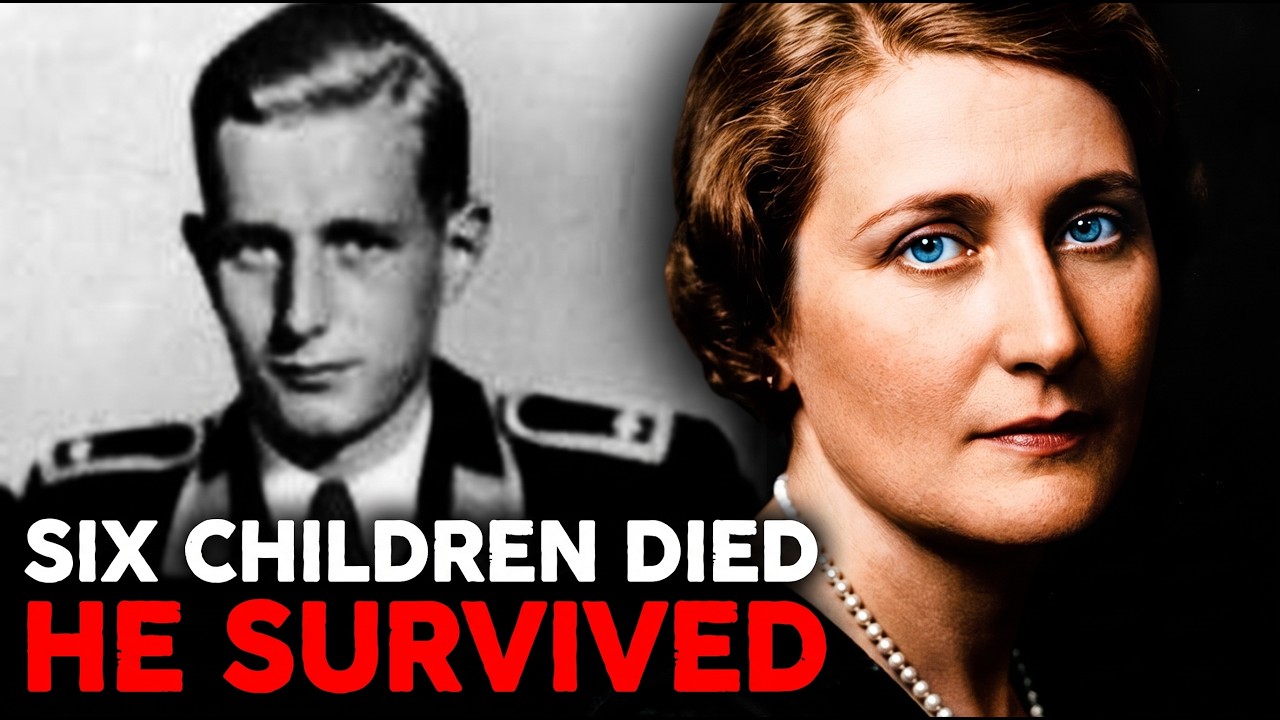
His mother’s letter was calm, almost tender, which made it worse. She wrote that the family had already been in the Führerbunker for six days by the time she put pen to paper. She and his stepfather and his six younger siblings intended, she said, to give their national-socialist lives the only possible honorable ending. She told him plainly that she meant to die alongside her children rather than let them grow up in a world without National Socialism, a world she could not bear to imagine for them.
“My dear son,” she wrote, “I want to give you what I learned in life. Be loyal. Loyal to yourself, loyal to the German people, and loyal to your fatherland. ” She hoped he would remember the family with pride rather than shame.
She was describing the killing she was about to commit as an act of maternal protection. The letter ran onto a second page, and her handwriting grew more urgent. She did not know if she would have time to finish. “It is difficult to start a new page,” she wrote.
“Who knows if I can fill it. I would like to give you so much love and strength and take away all the pain for our loss. Be proud of us and try to remember us with pride and happiness. We all have to die.
Isn’t it more beautiful to live less but with honor and dignity than to have a long life in shameful conditions? ” She told him that Hanna Reitsch was taking the letter and would soon leave the bunker. She embraced him in writing, “with my most sweet, deep, and maternal love,” and urged him one final time: “My dear son, live for Germany. ”
His stepfather’s farewell was shorter and stranger.
“It’s likely that you’ll be the only one to remain who can continue the tradition of our family,” Joseph Goebbels wrote. An acknowledgment, however oblique, of what was about to happen to the six children who shared his blood, and a passing of the torch to the stepson who did not. There was no anguish in the phrasing, at least none he chose to set down in a letter meant to be carried out of a doomed capital. To understand how Harold Quandt arrived at that moment, alone in a desert camp absorbing in minutes the knowledge that his entire family no longer existed, it is necessary to go back to the beginning.
He was born on the 1st of November 1921 in the well-to-do Berlin district of Charlottenburg, the only son of the industrialist Günther Quandt and his second wife, Magda Ritschel. The man whose name he carried had been born on the 28th of July 1881 in the small Brandenburg town of Pritzwalk, the son of a textile manufacturer named Emil Quandt, who had married into a prosperous weaving family and taken control of their firm at the turn of the century. Günther, groomed from boyhood to inherit and expand the family’s holdings, proved a hard, calculating businessman with an instinct for opportunity. His first marriage to Antonie Ewald produced two sons, Helmut in 1908 and Herbert in 1910.
Antonie died in 1918, a victim of the Spanish influenza pandemic, and nine years later Helmut died from complications following an appendicitis operation. Günther was left with one surviving son and an industrial empire that had grown enormously during the First World War, when his factories supplied uniforms to the German army. It was into this household, still shadowed by loss, that a nineteen-year-old woman named Magda Ritschel arrived. Her own early life had been complicated and often obscured.
Born Johanna Maria Magdalena Behrend in 1901, she had used for several years the surname of her stepfather, a Jewish businessman named Richard Friedländer, before reverting to Ritschel, the name of her stepfather from an earlier marriage. She had received a convent education in Belgium and had for a period been engaged to a young Zionist activist named Victor Chaim Arlosoroff, a relationship that would later become one of the more startling footnotes to her biography. Arlosoroff would go on to become a prominent Zionist leader in Mandatory Palestine before his unsolved assassination in Tel Aviv in 1933. The future First Lady of the Third Reich had once been engaged to a man who would help build the institutions of the future state of Israel.
Magda met Günther Quandt through Berlin society circles, and despite the considerable age gap, they married on the 4th of January 1921 in Bad Godesberg. Ten months later, Harold was born. For a brief period, the family lived the life befitting one of Germany’s wealthiest industrial dynasties, moving between Günther’s properties and enjoying a level of material comfort that most Germans, still reeling from the economic chaos of the Weimar Republic’s early years, could scarcely imagine. But the marriage was not happy.
Günther was frequently absent, consumed by business, and the age difference combined with his controlling temperament placed increasing strain on the relationship. In 1929, after eight years of marriage, they divorced. Harold, not yet eight, spent his earliest years shuttling between his father’s formal, business-focused household and whatever measure of warmth and attention his mother, still in her twenties and increasingly restless, was able to offer. Contemporary accounts describe a home defined more by material comfort than emotional closeness, with domestic staff and governesses handling much of the boy’s daily care.
Remarkably, given the bitterness that so often accompanied divorces among Germany’s elite, the two remained on cordial terms. Günther retained close ties to his former wife, and crucially, the divorce settlement included a clause that would later prove significant: should Magda ever remarry, Harold would be sent to live with his father. Following the divorce, Magda moved into an apartment in Berlin’s fashionable Reichskanzlerplatz, supported by a generous settlement. It was there in the early 1930s that her life took its decisive turn.
She joined the Nazi Party on the 1st of September 1930, drawn by most accounts less by fervent ideological conviction at the outset than by the magnetic energy of the movement and the men around it. She began volunteer work at a local party branch, and her evident intelligence and organizational skill soon brought her to the attention of party headquarters. She was invited to take charge of organizing the private papers of Joseph Goebbels, the fiery, club-footed propagandist who had become one of the most important men in Adolf Hitler’s inner circle. The working relationship quickly became something more.
Magda and Goebbels first grew romantically involved during a short trip to Weimar in February 1931, and by the end of that year, the relationship had progressed to marriage. On the 19th of December 1931, Magda Ritschel became Magda Goebbels, marrying the Reich’s future propaganda minister in a wedding held, in a detail that still strikes historians as almost too strange to be true, on a property belonging to her former husband, Günther Quandt. Adolf Hitler himself served as a witness at the ceremony. Ten-year-old Harold Quandt was present that day, standing near his mother as she married the man who would in every meaningful sense become his second father.
Photographs from the period show young Harold dressed formally for the occasion, flanked by adults whose names would come to define one of history’s darkest chapters. He was, in the language later used to describe him, the child who not only attended his mother’s wedding to Goebbels but also formed quite an attachment with him, sometimes accompanying his new stepfather to public gatherings and standing on speaking platforms near “Uncle Joseph,” dressed in the black and brown uniform of the Hitler Youth. Under the terms of the 1929 divorce settlement, Harold was initially meant to remain with his father following his mother’s remarriage, and for several years he split his time between the two households. But Goebbels, ever attentive to appearances and eager to consolidate the family unit that made for such effective propaganda imagery, pressed Günther Quandt to release Magda from the custody obligations of their old settlement.
Quandt agreed, and by 1934 Harold had moved permanently into the Goebbels household, living with his mother, his stepfather, and the growing brood of half-siblings his mother had begun bringing into the world. He would remain there continuously until he passed his school-leaving examination in 1940. In 1934, seeking greater privacy, Goebbels purchased an imposing property on Schwanenwerder, a small, exclusive island in the river Havel on the western edge of Berlin, connected to the mainland by a narrow causeway and populated almost exclusively by the wealthy and the politically connected. Goebbels supplemented the estate with a motor yacht named Baldur, used for leisurely trips along the river.
Here Harold spent much of his adolescence, with his own private nursery on the first floor of the house, a small measure of separation from the rooms shared by his younger half-sisters as they were born one after another. Between 1932 and 1940, Magda gave birth to six children with Goebbels: Helga in 1932, Hildegard in 1934, Helmut in 1935, Holdine in 1937, Hedwig in 1938, and Hedrun in 1940. All six names began with the letter H, a detail that later gave rise to persistent speculation that the children had been deliberately named in tribute to Adolf Hitler. Historians have generally dismissed this theory, noting that the practice had in fact originated with Günther Quandt, who had selected H names for his own sons, and Magda’s mother later described the approach to naming as an innocent private tradition.
Harold grew up as the eldest of what eventually became a household of seven children, the only one who remembered a life before Schwanenwerder, before the black Mercedes convoys and the security details. His relationship with his younger half-siblings, by every surviving account, was warm. Interviews given decades later by Harold’s own daughters would confirm what family members had long privately understood: that Harold loved the six children his mother bore with Goebbels. This detail matters enormously for understanding the tragedy that would eventually engulf the family.
The loss of those six siblings in the spring of 1945 was not an abstract historical footnote to him. They were people he had watched grow from infancy, people whose nursery he had once shared a floor with, people he had likely taught to ride bicycles and play in the gardens of Schwanenwerder. Even as a teenager living under Goebbels’s roof, Harold displayed flashes of independent thinking. He became, somewhat surprisingly for a boy raised in the highest circles of Nazi Germany, an enthusiastic supporter of the Indian nationalist leader Subhas Chandra Bose and his rallying cry, “Give me blood and I will give you freedom.
” Bose, who would later collaborate with both Nazi Germany and Imperial Japan in his campaign against British rule in India, had a magnetism that appealed to the same instincts for dramatic, uncompromising nationalism Harold had been steeped in since childhood. His enthusiasm for a non-German political figure was unusual enough to be remembered and remarked upon by those around him. The comfortable if strange rhythms of life at Schwanenwerder were disrupted in the late summer of 1938 when the marriage between Magda and Joseph Goebbels nearly collapsed entirely. Goebbels had embarked on an intense and increasingly public affair with the Czech actress Lída Baarová, and by the summer of 1938 the relationship had become an open scandal serious enough that Adolf Hitler personally intervened.
Hitler, unwilling to tolerate a scandal that threatened to embarrass one of his most visible ministers, demanded that Goebbels end the affair. For a time it appeared he had, and the couple reached an uneasy truce. But by the end of September the crisis flared again, and once more Hitler was forced to step in, this time brokering a formal arrangement to hold the marriage together. Baarová was to be banished from Germany.
The Goebbelses would maintain the appearance of a united public front, and Magda was granted the right to impose whatever conditions she saw fit, including a stipulation that Goebbels could only visit Schwanenwerder and see his children with her express permission. Hitler further promised that if after a year Magda still wished to divorce, he would allow it, with Goebbels publicly designated as the guilty party, leaving Magda with the house, custody of the children, and a substantial income. It is difficult to imagine that a teenage Harold, sixteen or seventeen and living under that roof, remained entirely insulated from the tension that gripped the house during those months. In 1939, at eighteen, Harold passed his school-leaving examination.
That same year, Germany invaded Poland. Harold joined the German army in the aftermath of the invasion, and a year later, in 1940, he volunteered for one of the most physically demanding and dangerous branches of the Wehrmacht available to him: the paratroopers, the Fallschirmjäger. In May 1941, German forces launched Operation Mercury, the invasion of the island of Crete, a campaign that would become infamous for the catastrophic casualties suffered by Germany’s elite paratrooper corps. Wave after wave dropped from the sky into a hail of Allied and Cretan resistance fire, many killed before they even reached the ground.
The German victory, when it finally came, was achieved at such a staggering cost that Hitler himself would later declare the age of large-scale airborne assault over for the German military. Harold Quandt survived the battle, one of the fortunate ones among a unit bled nearly white. He was nineteen years old. From Crete, his war carried him to Russia, where the German invasion of the Soviet Union ground into the vast, freezing expanse of the Eastern Front, a theater that would eventually consume millions of German soldiers.
Details of his specific unit assignments during this period remain less thoroughly documented than the more famous Crete campaign. What is clear is that he continued to serve, moving eventually to the Italian theater following the Allied invasion of Sicily and the subsequent campaign up the peninsula, one of the grinding mountainous fronts where German forces fought a stubborn defensive war through 1943 and into 1944. It was in Italy that his war came to its end. In 1944, he was wounded and captured by Allied troops.
He was transported far from the European battlefields, interned in a British-run prisoner-of-war camp in the port city of Benghazi on the coast of Libya. While Harold sat in his POW camp, his biological father was navigating his own increasingly precarious position. Günther Quandt’s businesses had grown enormously during the Nazi years, expanding through the acquisition of firms and assets, some obtained through what would later be identified as Aryanization, the forced, undervalued sale of businesses owned by Jewish Germans. Quandt was named a Wehrwirtschaftsführer, a leader of the armament economy.
His companies, including the battery manufacturer AFA and the metalworking and armaments firm that would later become IWKA, produced components for German U-boats, ammunition, rifles, and artillery, using thousands of forced laborers, including prisoners transported from concentration camps. At the AFA factory in Hanover alone, the company maintained its own dedicated camp with capacity for some fifteen hundred forced laborers, complete with an execution site on the grounds. By late April 1945, Berlin was a city under siege. Deep beneath the Reich Chancellery, Adolf Hitler prepared for the end, and alongside him, having refused repeated opportunities to flee the capital with their children, were Joseph and Magda Goebbels.
Magda had made the fateful decision to bring all six of her children into the bunker rather than send them to safety. On the 1st of May 1945, the day after Hitler and Eva Braun took their own lives one floor above, Magda moved through the rooms where her six children slept. Helga, the eldest, was twelve. Hilda ten.
Helmut nine. Holdine seven. Hedwig six. Hedrun just four.
Working with the assistance of an SS doctor, most accounts hold, the children were given a sedative before Magda administered, or had administered, cyanide capsules to each of them. All six died that day. Shortly afterward, Joseph and Magda went up into the Chancellery Garden, where they too took their own lives, reportedly by a combination of gunshot and cyanide, their bodies partially burned in a hasty attempt at cremation. Goebbels had technically served as Chancellor of Germany for a single day, having been named Hitler’s successor in his last will and testament.
Harold heard rumors of his mother’s death in the weeks before the letters reached him. But it was their arrival that transformed rumor into confirmed, devastating fact. He was the only one of Magda’s children to survive the Second World War, a distinction that would shape every year of the rest of his life. He remained in British captivity for roughly two more years, finally released in 1947 at the age of twenty-six.
He returned to a Germany that bore almost no resemblance to the country he had left. His father had not escaped the reckoning unscathed. In 1946, Günther Quandt was arrested, specifically because of his family’s connection to the Goebbels name, and interned by Allied authorities for more than a year at a camp near Munich while investigators sifted through his wartime record. To the considerable surprise of many, he was classified in 1948 as a Mitläufer, a fellow traveler, someone judged to have accepted National Socialist ideology in a passive sense without taking an active personal part in the regime’s crimes.
It was a verdict that decades later, after historians gained fuller access to the documentary record, would come to look remarkably lenient. Benjamin Ferencz, one of the American prosecutors at the Nuremberg trials, would later remark that had the evidence available by the early twenty-first century been presented to the tribunals in the 1940s, Günther Quandt would have been charged with the same offenses as the directors of IG Farben. Instead, he was released without further consequence, reinstalled himself on the supervisory boards of major German companies, including Deutsche Bank, and even received an honorary citizenship from the University of Frankfurt in 1951. For Harold, the path forward lay in rebuilding rather than reckoning.
He first assisted his older half-brother Herbert, ten years his senior, in restoring the family’s shattered industrial empire, then chose to formalize his own technical qualifications, enrolling to study mechanical engineering between 1949 and 1953, splitting his studies between Hanover and Stuttgart. Sometime around the beginning of the 1950s he married Inga Bando, born in 1928, the daughter of a lawyer who worked for the Quandt companies and who had herself worked as a secretary for Harold’s father. Unlike his mother’s lavish, politically freighted wedding to Joseph Goebbels two decades earlier, complete with Hitler standing as witness, Harold’s own wedding was a considerably quieter affair. The marriage produced five daughters: Katarina in 1951, Gabriele in 1952, Annette, Colleen-Bettina, and Patricia in 1967.
In the household Harold and Inga built together, a deliberate and remarkably effective silence settled over his childhood. His daughters grew up knowing in only the vaguest outline that their grandmother had been Magda Goebbels, that six half-aunts and half-uncles they would never meet had died in a Berlin bunker, and that their father had once worn the uniform of an elite Nazi paratrooper regiment. But the details remained almost entirely locked away. A subject the family, in the words one of his daughters would later use to describe it, simply did not discuss.
Günther Quandt died unexpectedly while on vacation in Cairo on the 30th of December 1954 at the age of seventy-three. His will divided his industrial empire equally between his two surviving sons, but the terms of the inheritance came with a binding condition: the half-brothers were obligated to pool their interests permanently. The empire comprised well over two hundred separate companies. Herbert, who had struggled with a serious and worsening eye condition that left him nearly blind, gravitated toward the battery manufacturer AFA and the family’s expanding automotive investments.
It was Herbert who made the decision most responsible for the family’s modern reputation. In 1959 and 1960, as BMW teetered on the edge of bankruptcy and a takeover by rival Daimler-Benz appeared all but inevitable, Herbert increased the family’s stake, eventually acquiring roughly thirty percent and blocking the takeover entirely. His subsequent backing of a restructuring plan is now widely credited with having rescued BMW from collapse. Harold took on a more public-facing role as the family’s representative while concentrating his own attention on mechanical engineering and the armaments-adjacent industrial plants grouped under IWKA.
One small detail would later surface that hinted at how much of the old world Harold had never entirely severed. After the war, he employed at least two men who had previously worked for Joseph Goebbels, including Werner Naumann, a former state secretary in Goebbels’s ministry who had, according to family recollections, been personally infatuated with Magda during the war years. The decision appeared to be a way for Harold to maintain some tangible connection to his mother. After the war, Naumann became entangled in a political scandal, arrested by British occupation authorities in 1953 as the central figure in the “Naumann Circle,” a clandestine network of former Nazis working to infiltrate the Free Democratic Party.
That Harold chose to bring him into his own business orbit says something quietly unsettling about how difficult it was to fully sever the connections forged in the household of Joseph and Magda Goebbels. On the 12th of December 1965, Harold survived a serious aviation accident at Zurich International Airport, walking away from a crash that could easily have ended his life. On the 22nd of September 1967, he boarded a company aircraft, a Beechcraft King Air 90, for a business flight from Frankfurt am Main to Nice. Over the mountainous terrain near Cuneo in northern Italy, the aircraft encountered difficulties, reportedly compounded by electromagnetic interference affecting the plane’s instrumentation, and crashed into a mountainside.
Harold Quandt was killed instantly along with the pilot and any other passengers aboard. He was forty-five years old. The youngest of his five daughters, Patricia, had been born only months before his death and would grow up never truly knowing him. He was laid to rest at the Waldfriedhof, the forest cemetery in Bad Homburg, in a plot alongside his father.
His widow, Inga, was left to raise their five daughters. Negotiations to divide the business empire began in earnest in 1970. The most significant asset that passed to Harold’s heirs was a substantial stake, roughly eleven percent, in Daimler-Benz, which Inga eventually sold to the government of Kuwait in 1974 for approximately one billion Deutsche marks. Inga died on Christmas Eve 1978, and in a further tragedy, her second husband took his own life just two days after her death.
It was only after their mother’s death that the five daughters came into full control of the fortune, managed through the newly established Harold Quandt Holding, which would grow substantially, eventually reaching a value in the tens of billions of dollars by the early twenty-first century. In October 2007, the German public broadcaster ARD aired a documentary titled “The Silence of the Quandts,” produced by journalists Eric Friedler and Barbara Siebert, laying out the full scope of the family’s wartime business conduct for a national television audience. The documentary landed like a bomb. Five days after it aired, four members of the Quandt family announced their intention to fund an independent historical investigation, engaging the respected historian Joachim Scholtyseck to lead a comprehensive study using full access to the family’s private archives.
The resulting work, published in 2011, left little room for ambiguity. “The Quandts were linked inseparably with the crimes of the Nazis,” Scholtyseck stated flatly. The study confirmed that Quandt factories had employed more than fifty thousand forced laborers over the course of the war, that Günther Quandt had personally profited from Aryanization, and that the family’s post-war prosperity rested on foundations built during one of history’s darkest periods. In the wake of the study’s publication, members of the Quandt family sat for a substantive interview about the family’s Nazi-era history, published in the German business magazine Wirtschaftswoche.
The two family members who agreed to speak were Stefan Quandt, Herbert’s son, and Gabriele Quandt, the second of Harold’s five daughters. Asked directly whether her father had ever spoken to her about his mother and about Joseph Goebbels, Gabriele’s answer was unambiguous. “Not at all,” she said, adding that this silence was, in her understanding, entirely typical of fathers of that generation. She recalled knowing only that her father had served as a Fallschirmjäger during the war, and remembered once asking him with the blunt curiosity of a child exactly what that meant.
Did it mean he sat in the bushes and shot at enemy paratroopers as they descended? Her father’s response was simply to say that he did not want to talk about it. She recalled asking him once whether he had so many children specifically because Magda had killed so many of her own. The response was again that this was simply not a topic that would be discussed.
But Gabriele did share one detail that cuts through six decades of silence with real emotional force. “Magda killed her six children in the Führerbunker,” she told the magazine. “Our father loved his half-siblings very much. And when, like me, you have something like this in your family history, you think it can’t be any worse.
” Stefan Quandt offered his own blunt acknowledgment. “It’s a sad truth that forced laborers died in Quandt companies,” he said. The five daughters carried the inheritance forward in strikingly different directions. Katarina built a life around the equestrian world, running a stud farm and sponsoring Olympic-level show-jumping competitors.
Annette settled into a quiet private life in Hamburg. Colleen-Bettina converted to Judaism in her twenties while living in New York and married a German-Jewish businessman whose own father had survived internment in a concentration camp, a union that placed her life in direct, almost pointed counterpoint to the history of her grandmother. The marriage ended in divorce in 1997, and Colleen-Bettina later remarried a Norwegian journalist, continuing to work as a jewelry designer with a studio in Hamburg. Patricia, the youngest, died in 2005, just short of her thirty-eighth birthday.
It was Patricia’s art collection that would eventually place a small, strange coda on the family’s story. In 1997 she had purchased a nearly five-million-dollar Alexander Calder mobile, “Big Horizontal Red,” and when her heirs consigned the piece to auction at Christie’s in 2025, the sale quietly reignited public discussion of the family’s origins. Journalists noting once again that the sculpture was being offered by great-grandchildren of Magda Goebbels. Why did it take the Quandt family sixty-six years after the end of the war to begin publicly reckoning with this history?
Gabriele explained that part of what had kept the subject closed for so long was the simple fact that she and her siblings had witnessed firsthand the pain their own father carried over the loss of his mother. A pain so evidently raw and unresolved that pressing him further felt less like legitimate historical inquiry and more like reopening a wound that had never properly healed. Not a calculated effort to protect the family’s reputation, though that motivation likely played its own role as well, but something closer to a child’s instinct to spare a grieving parent from further pain. There is a real and difficult moral complexity at the heart of Harold Quandt’s story.
He was in the most literal sense a victim of the regime his stepfather had served. A boy raised inside a household built on propaganda and performance. A young man sent to fight and nearly die in three brutal military campaigns launched by that same regime. And finally, a twenty-three-year-old prisoner of war who lost his mother and six siblings to an act of unimaginable violence committed by his own mother’s hand.
And yet he was also the direct beneficiary for the whole of his adult life of an industrial fortune built substantially on the exploitation of forced laborers and the confiscation of Jewish-owned property. He was both shaped and scarred by the regime’s cruelty and quietly enriched by his family’s participation in the economic machinery that made that cruelty possible. It is not a contradiction the historical record allows anyone to neatly resolve. In the end, what did Harold Quandt actually reveal about family life inside one of the Third Reich’s most notorious households?
In his own words, delivered directly and publicly, almost nothing. He gave no interviews. He wrote no memoir. The historical record of his inner life is and will likely always remain thinner and more fragmentary than the record of almost any other major figure connected to this corner of history.
But in the shape of the life he built afterward, in the five daughters he raised, the businesses he steered, the former colleague of his mother’s he quietly kept close, and the single unguarded sentence his own child would one day offer a magazine reporter decades after his death—our father loved his half-siblings very much—Harold Quandt revealed everything that mattered most. Beneath the discipline, the silence, and the carefully managed fortune, there remained for the whole of his life a son who never stopped grieving the family he lost, a grief he carried alone without ever finding, or perhaps ever seeking, the words to share it while he still had the chance.
