The last entry in the register was dated the eleventh of October, 1870. It was written in a different hand from all the entries before it, and it was signed with only two letters, E. C. Beneath those two letters, in a third hand and a different ink, one line had been added.
It read: “They are gone. ” Nothing else. Cassian Marbone closed the register. He carried it back to the shelf and set it down.
He walked out of the pastor’s study, through the church, and out the door, and he did not close the door behind him. He crossed the commons. He did not look at the well. He did not look at the mill.
He climbed the trace to the edge of the hill and sat at his fire, and he did not eat, and he did not write anything in his notebook for two hours. When he finally wrote, he wrote a single line. It said they had not abandoned the town. The town was gone.
By that autumn of 1940, Cassian Marbone had spent eleven years surveying the hills for the government. He was thirty-eight years old, a tall, quiet man, just over six feet, narrow at the waist and broad at the shoulders, with a stoop he had acquired from carrying surveyor’s instruments and chains over broken ground since the age of twenty-seven. His hair was the color of tea that had gone cold. His eyes were gray, pale enough that people in the mountain villages more than once mistook him for a preacher.
He was not. He was a man who made his living drawing lines on paper, and those lines, drawn accurately, made the country legible to men in Washington who would never see it. He had been sent to fill a gap. The Survey had a rough sketch of the hills west of Boone in the high country of North Carolina, made by a party that had passed through in the seventies.
The sketch showed a small valley, and the name of the valley was written in a hand that had trembled by the time it reached the second word. Cricketwell. That was all it said. Cricket well.
And a thin line where a wagon was thought to have passed. No elevations, no dwellings, no church, no mill, no cemetery, nothing to suggest that people had ever lived there. Yet in the county ledger in Watauga, when Cassian searched, he found Cricketwell listed as a settlement with a tax roll of forty-one souls in 1868, 1869, and 1870. Then the list stopped.
There was no mention of why it stopped. In the following year’s ledger, a line was struck through the name, and beside it, in a different ink, was the word “evacuated. ”
Evacuated. That was the word that brought Cassian early, that put him in a rented room at Fairleigh Hinsley’s inn in the town of Finner’s Ford.
He had used the word himself on other assignments, and he knew what it meant on paper. It meant the settlement had ceased to exist, that taxes were not collected, that dwellings had been removed or made uninhabitable. Evacuated meant a decision had been made, made decisively, by someone with the authority to make it. What the word “evacuated” did not mean, in Cassian’s experience, was that forty-one people left a valley between one tax year and the next and left no trace in any other record in the county, or the neighboring counties, or the state.
Mrs. Hinsley was a widow of fifty-four, small and fine-boned, with a mouth that closed the way the mouths of some old women close when they are holding something back behind their teeth. She had grown up in these mountains. She served him beans and salt pork and a piece of cornbread the size of his fist.
She watched him eat. She did not talk much for two nights. On the third night, when he asked her directly and gently whether she had ever heard of a place called Cricketwell, her hand stopped on its way to the coffee pot, and she said, without looking at him, that she had heard the name in her mother’s kitchen and had not heard it since. He asked what her mother had said about it.
She said her mother had said only that there was a hollow above the north fork of the Craven, that a man could enter it if he was determined, and could come out of it if he was determined, and that no one in her mother’s memory had ever gone in and come out the same as when he went in. She said that, then remarked that the coffee was ready, and did not say another word about the matter that evening or the next. On the morning Cassian left for the hills, she gave him a piece of berry pie wrapped in a square of wax paper, and she put her small dry hand on his forearm. She said, “Don’t go past the mill wheel when the light starts to go.
” She said it simply, the way one tells a man not to leave a pot on the stove. Then she drew her hand back and turned away, and he understood that he was not to ask which mill she meant. The wagon trace, when he found it, was where the old sketch placed it. That was the first surprise.
Cassian was accustomed to old wagon traces vanishing completely after thirty years, covered by rhododendron and berry briars, forgotten by deer that had never been born on them. But this trace had not vanished. It was still a road. Grass had grown in the wheel ruts, but the ruts were still visible.
More than that, the grass was cut, not mowed, but cut by hand, and cut short, the way a man levels a strip of ground when he intends to keep a road open without admitting that he intends to keep it open. Someone was tending the trace. He noted that in his book. By noon of the first day he had traveled, by his estimate, four miles up the trace and climbed perhaps seven hundred feet.
The trees closed over him, poplar and oak, some thicker at the base than a man’s arms could reach around. The underbrush thinned the way it thins in old forests where the canopy stays closed long enough to starve the thorny plants of light. Cassian was pleased by this at first. Walking was easier than he had planned.
Then he realized he could not hear anything. Not that he heard no human voices; that was expected on a wagon trace four miles from a town of six hundred people. He meant he heard no forest sounds. No thrushes calling.
No chickadees moving through the mid branches. No squirrels barking at him from the trunks. The wind moved; he could see the tops of the poplars swaying against the light, but the wind made no sound where he stood. He stood still for a long minute and listened to his own breathing, and when he heard it, he was reassured, in the simple way a man reassures himself when he has nothing else.
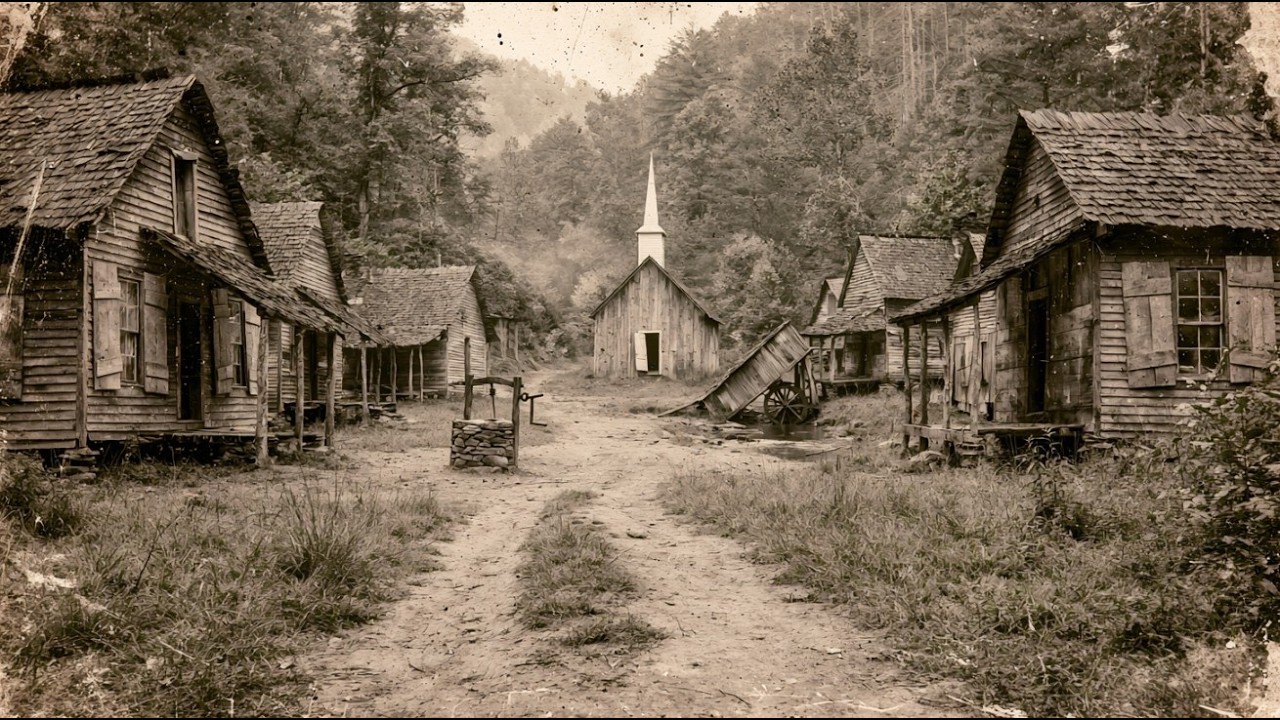
He walked on because he had been sent for this, because he had spent eleven years behind the hills, because he had never once hesitated to finish a road he was paid to draw. The pass curved around the shoulder of the hill and dropped into the valley just as the light turned to the pale gold of mid-afternoon. And there was Cricketwell. There were seventeen houses.
Cassian counted them twice. He counted because the last tax roll contained forty-one souls, and because seventeen houses was a reasonable number for forty-one souls in that country in that decade, and because at bottom he was a man who found comfort in numbers that matched. The houses stood along the trace, which became a small street when it reached the valley floor. There was a commons in the center with a well in its middle.
There was a mill at the lower end of the commons where a small stream ran. There was a church at the upper end with a plain white steeple. And there was a cemetery behind the church, up the slope, inside a low wall of stacked stone. By every standard he could name, it was a typical Appalachian settlement of the mid-sixties.
It looked like a picture from a history book, except that it should not have been standing. Thirty-four years, or close to it, had passed since that ledger fell silent. Thirty-four winters, and thirty-four springs of rain running off the hill. Thirty-four summers of hard tree roots working under floorboards.
In this country, in that time, an abandoned house returns to the earth. Roof boards warp and fall. The chimney pulls away from the wall. Joists sag, the porch drops, windows shatter in the first hard winter.
In thirty-four years, a house in these mountains becomes a rectangle in a pile of leaves and a heap of stones where the hearth was. In thirty-four years, a whole town becomes a shape you only see from the hill in winter when the snow lies differently where the walls stood. Cricketwell was not that. Cricketwell was standing.
Roofs were in place, doors on their hinges, windows in their glass, and the glass was clean. Cassian stood at the edge of the trace and did not descend for a long moment. He took his pack off his shoulder and set it on the ground and sat beside it, his back against a poplar. He drank from his canteen.
He thought carefully about what he was seeing. He could think of three explanations. He wrote them in his notebook, in order. One: someone had rebuilt the town.
Unlikely. There was no reason for it. There was no road better than the wagon trace, no market close enough to make it worth the trouble, and no one in Finner’s Ford or in the county records had claimed any parcel in Cricketwell in the thirty-four years since the tax rolls stopped. Two: someone was tending the town.
That was possible. He had already noted that the trace was kept up. A caretaker, perhaps, or an old man from a nearby hollow, coming each season to repair a roof or mend a window. Possible.
Not likely, for the same reasons the first explanation was unlikely, but possible. Three: the town had never been abandoned in 1870 at all, which meant the tax record was wrong, which meant the word “evacuated” was wrong, which meant something. He closed his notebook. He picked up his pack and walked down the trace into Cricketwell.
The houses were not empty. That was the second surprise, and it stayed with him longer than the first. Not that there were people in them; there were not. He knocked on the door of the first house he came to, and no one answered.
He tried the latch, the door opened, he called “hello,” and no one answered. But there were things inside the house. There was a table set for four people, with four earthenware plates and four spoons and an iron pot in the center, covered with its lid. He lifted the lid.
There was nothing in the pot. It was clean and washed, but set on the table in the middle with its lid on, the way a person sets a pot before calling the family to supper. The beds upstairs were made, not made the way hotel beds are made, but made the way people make beds when they intend to sleep in them again that night. The covers were turned down.
The pillows were fluffed. There was a folded shirt on the chest at the foot of the bed, and the shirt was clean, and it had not been folded in thirty-four years. He could tell by the shape of the fold. Cloth folded for thirty-four years absorbs the crease, dark and permanent.
This shirt had been folded that week. He went to the next house. The next house was the same, set not for four but for two, but it was set. Beds made.
There was a coat on a hook by the door, heavy wool, and the wool was not moth-eaten, and its pockets, when he checked them, held a folded handkerchief and a small tin of chewing tobacco. The tobacco, when he opened the tin, was fresh. He visited seven houses that evening, seven of seventeen. Each was set.
Each was orderly. In each was something a hand had touched, not thirty-four years ago, but recently. In some houses, kettles stood on the stoves with kindling ready in the box beside them. In one house, a loom stood with cloth on it, half finished, and the shuttle sat on the bench beside the loom, and the last thread was still bright, still holding its dye.
He did not enter the church that first evening. He did not climb to the cemetery. He did not go near the mill. He walked back up the trace to the slope of the hill, pitched his tent under the poplar where he had rested, and built a small fire.
He ate the piece of pie that Fairleigh Hinsley had given him, and wrote a single line in his notebook. It said, “The town is not abandoned, but no one lives here. ” Then he closed the notebook and sat with his back against the tree, watching the light leave the valley below him. Then he heard the mill wheel turn.
He wanted to understand what he meant. There was a stream at the lower end of Cricketwell. He had seen it. It was not a strong stream, the kind a man could cross without wetting his boots.
There was not enough water in it that late evening of a dry autumn to turn a mill wheel. Yet from inside the tent, in the last blue light, Cassian heard, quite clearly, the sound of a mill wheel turning, the wet slap of a paddle coming down, the slow gurgle of water carrying it around again, the creak of the axle in its cradle. He heard it turn six times. Then it stopped.
He got up and walked to the edge of the slope and looked down at the valley. The mill was there at the lower end of the commons, where it had been that evening. He could barely make it out in the dim light. The wheel was not turning.
It hung still on its axle. There was no water on it. The stream beside it was as low as it had been at noon. He went back to the fire and sat, and he did not sleep well.
On the second day, he went down early. Dawn broke over the hill behind him and flooded the valley with the color of old copper, and he took his book and his pen and his instrument, and descended. He took measurements. That was the honest work he had come for; that was what he had been sent to do.
He set up the instrument in the middle of the commons beside the well, sighted on the four corners of the settlement, and recorded his angles, his distances, his notes. He measured the well. It was thirty-one feet from the lip to the water, which was clean and cold. When he lowered the bucket, he drank, and it tasted exactly like water.
That was the third surprise. He had expected, given everything else, that the water would taste different. It had no taste at all. It tasted of clean well water, which is barely a taste.
He measured the church. It was a plain box with a plain steeple, twenty-six feet on the long side and eighteen on the short. The door had a wooden latch. The latch worked.
He went inside. The pews were oak. There were nine, four on the left and five on the right, and each one was polished. The wood shone.
There was no dust on the lectern. There was a Bible open on the lectern, open to the Book of Job. A ribbon lay across the page as if placed there by a hand that intended to return. He read the passage beneath the ribbon.
It said, “The earth is given into the hand of the wicked: he covereth the faces of the judges thereof. ” He closed the Bible. He did not know why he closed it. He noticed, after he closed it, that his hand was trembling slightly, so he put it in his coat pocket and stood in the middle of the church and forced himself to breathe until the trembling stopped.
There was a small door behind the lectern. He went through it. It led to a small room that was clearly the pastor’s study. There was a desk.
There was a chair. There was a shelf with three books on it. And there was a register. The register was what Cassian had come to find without knowing he had come to find it.
He took it down from the shelf, sat in the pastor’s chair, set the register on the pastor’s desk, and opened it. It was the settlement’s book. The register held births, marriages, deaths, names, dates, pastoral notes. The hand was neat and slanted forward, the hand of a man who wrote often and without hesitation.
The first entry was dated 1848. The last entry was dated the eleventh of October, 1870. There were three hundred and twelve entries. Cassian read them all.
The entries of 1870 were not the entries of a town preparing to be evacuated. They were the entries of a town going about its usual life that year. A wedding in April, a burial in June, a corn crop in September that the pastor described as average, with a note beside the tithes. Then, in the first week of October, the entries began to change.
The pastor stopped writing about the town. He began writing about a sound. That was what he called it in the register, “the sound. ” He described it as the sound of a mill turning where there was no mill to turn.
He described it as the sound of many footsteps on wood at an hour when the town was in bed. He described it as the sound of a woman singing something faint in the church at three in the morning while the church was locked and the key was on his belt. He described going to the church in the dark on the fourth of October and finding the door open, finding no one inside, and finding the Bible on the lectern open to the Book of Job with the ribbon across the page, although he had left the Bible closed when he locked the door the night before. The last entry was on the eleventh.
It said, “We have decided to go all together before the light. ” It said, “We go of our own accord and with our hands on our own doors, and we go without haste, and we take with us what we can carry of what we know to be ours. ” It said, “If the Lord means for us to come out the other side of this hill, we will come out. And if the Lord does not mean for us to come out, we will not, and either will be a mercy.
”
There were twenty-two stones in that last row, and all twenty-two bore the same date. The eleventh of October, 1870. Cassian stood at the end of the row for a long time. The wind moved in the crowns of the poplars above the wall.
He did not hear it. He counted the stones in the row again. Twenty-two. He read the names.
He wrote them down. Some of the names were in the register. Some were not. That puzzled him at first, and then he understood, and he wrote in the margin of his notebook below the names that the stones did not need to match the register, because the stones had not been carved by the people of the settlement.
The stones had been carved later, by someone else, though he did not know who. And there was something else beneath those twenty-two stones. If you added them to the deaths already recorded in the register, the total came to sixty-three. Sixty-three souls dead in Cricketwell between 1848 and the eleventh of October, 1870.
Forty-one souls on the 1870 tax roll. A surplus of nineteen. Those nineteen fit nowhere. They were not in the register as deaths.
They were not in the tax rolls as souls. They were on stones in the same row bearing the same date as the others. Names Cassian did not know. Names the pastor had not written.
In that moment he was standing on the row. Not beside it; on it. The stones were set flat in the earth, not upright, because the last row had spilled past the bounds of the cemetery and run down along the slope, and someone had laid them flat and heaped earth over them, so that the whole row lay beneath the grass. He had walked across it without noticing.
His feet were standing on the twenty-second name. He looked down at his boots. The grass around them was greener than the grass in the rest of the cemetery. He had not noticed that until he stood on it.
He stepped back, very slowly. He took two steps that brought him back inside the stacked stone wall. He made the wall a barrier between himself and that row. He did not turn his back on it.
He backed away from it, watching the stones until his shoulders met the wall of the church. Then he went around the church, down to the commons, and up the trace. He did not run, because he did not want to run; a man who had spent eleven years in the mountains does not run. But he did not stop either, until he reached his tent.
He did not sit down when he got there. He struck the tent. He packed his gear. He slung the surveyor’s instrument over his shoulder and walked back down the trace toward Finner’s Ford, and he did not stop until dark.
When dark came, he built a small fire in the middle of the trace itself, sat on his pack, and did not sleep. He reached Finner’s Ford at noon on the fourth day. Fairleigh Hinsley took one look at him standing on her porch, and did not ask where he had been, and did not ask what he had seen. She fed him.
She set a bowl in front of him and a spoon beside it, and she sat across the table and watched him eat. When he finished, she took the bowl away, came back, sat down, and looked at him. She said, “Was the cemetery the way they say? ”
He said, “Ma’am, I don’t know what they say, but I don’t think what they say is far from the truth.
”
She nodded. She said, “Did you take anything from it? ”
He understood then why she had asked. He said, “No, ma’am.
I did not. ”
She nodded again. She said, “That’s good. ”
He said, “The register in the church.
There is a register in the church. ”
She said, “I know. ”
He said, “Do you know what is written in it? ”
She said, “I know what is written in it.
My mother read it. My grandmother read it. My grandmother was born in Cricketwell in 1852, and she came out of it in 1870 of her own accord and with her hand on her own door, and she took with her what she could carry of what was hers, and she never went back. ”
He said, “Ma’am,” and did not know what else to say.
“Ma’am, forgive me. There are twenty-two graves in the last row bearing the same date, and there are nineteen more beneath the grass, and your grandmother came out of there. ”
Fairleigh Hinsley looked at him with her small, dry eyes for what he later remembered as a long time. She said, “Some came out, and some did not.
That was the choice that night. Some came out, and some stayed. The ones who stayed are under the grass now. That is what the register does not say.
That is what no one wrote. My grandmother told me in her last week, and my mother told me in her last month. I have never told anyone, because there is no one worth telling. But you were there.
You stood at the row. You have the right to know. ”
He said, “Ma’am, what happened? What made them leave?
”
She said, “I will not answer that. My grandmother would not have answered it. When she was asked, the answer was that whoever was not there had no right to know. ” And she said, when she was asked, that whoever was there did not need to be told.
And she said, when she was asked, that the mountain keeps what the mountain keeps. She stood. She said, “You will not draw the map. ”
He said, “Ma’am, I have already drawn the map.
”
She said, “You will not send the map. ”
He looked at her. She looked at him. He said nothing for a while.
Then he said, “No, ma’am. I will not send it. ”
She nodded. She said, “You may stay the night here.
You must leave in the morning. You must go far away. And you must not come back. ”
He said, “Yes, ma’am.
”
He slept that night in the small back room she had given him. His sleep was troubled. He dreamed of the row beneath the grass. He dreamed of a woman singing on a track in the dark.
He dreamed of a mill turning without water. And in the deep of the night he woke, certain that he had heard, outside, far from the inn, faint singing in the same manner and the same voices as the singing he had heard on the hill. When he sat up and listened, there was only the wind and the creaking of the old house’s beams. After a while, he slept again.
In the morning, he ate what she set before him, took up his pack, took up his instrument, and left Finner’s Ford just before dawn. He caught the bus at the crossroads. He rode it three days to the rail depot, then five days by train to Washington. He sat in a small room at the Survey and was asked what he had found in Cricketwell Hollow.
He said, plainly, that he had been unable to reach the valley because fallen trees had blocked the trace above the second creek, and that his professional assessment was that the settlement had long been abandoned and could be deferred to a later party. He signed a paper confirming that. He was thanked for his time. He was given his next assignment.
He mapped for the government for another twenty-three years, did his work well, and never spoke of Cricketwell again. He never returned to the mountains of North Carolina. Sheriff Bethlake of Watauga County wrote, in the file bearing the name Cricketwell Hollow, a memorandum dated November 1904, stating that a federal surveyor named Marbone had returned from the hill safely and confirmed that the settlement was abandoned. He signed the memorandum.
He placed it in the file. The file was closed. In all subsequent county records, the word “abandoned” stayed beside the name of Cricketwell, and no one corrected it, so far as the records show. Cassian Marbone died in Baltimore in the spring of 1931, at the age of sixty-five.
He was found dead in his bed. He had been a widower for eight years. On his desk in his study he left an open envelope addressed to no one. Inside the envelope were four pages in his hand.
Three of them were the notes he had taken in Cricketwell Hollow, copied out clearly. The fourth was a single paragraph, written in ink that had dried on a different night. The paragraph said this: “I never sent the map. I never wrote what I saw.
I have only returned in dreams, and I have returned most nights. I have counted the stones. I have read the names. I have stood at the row.
I have heard the singing on the trace. I do not know what the mountain keeps. I know it still keeps it. And I know that on some nights, when I lie awake long enough, I hear faintly a mill wheel turning without water, and I do not need to look to know it turns for me.
”
His housekeeper found the envelope. She did not know what to do with it. She gave it to a cousin. The cousin gave it to a small historical society in the town where Cassian had grown up.
It stayed in a folder inside a drawer for forty-one years. In 1972, a young researcher going through the drawer for a thesis on the geological survey found it, read it, and copied the three pages of field notes for her thesis. She left the fourth page in the folder. She, too, did not know what to do with it.
The folder is still in that drawer. Cricketwell Hollow has no name on current maps. The wagon trace is not visible. If you walk the ridgeline above the north fork of the Craven, you will find no sign marking the way, but the trace is still there.
Someone still tends it. The grass in the wheel ruts is still cut short, down to the ruts themselves. And in the hollow, at the end of the trace, stand seventeen houses with sound roofs, clean windows, and doors hanging on their hinges. The pot is on the table in the first house you reach, with its lid on.
The Bible lies open on the lectern in the church at the Book of Job, the ribbon across the page. The row lies beneath the grass behind the church, and the grass above the row is greener than the grass around it. Sometimes, if you are on the height above the hollow when the light is going, and you are quiet, and the wind has stopped among the poplars, you can hear the faint sound of a mill wheel turning without water from the lower end of the commons. You will not hear it long.
It turns six times, always six times, and then it stops. And then, if you are wise, you leave. Cassian was wise, in the way that truly matters. He drew the map and did not send it.
He went and did not return. He heard the calling, understood what it asked, and refused it. And some in Cricketwell, those who did not come out that night in 1870, refused it too. That, he came to believe, was what lay beneath the grass in that row.
Not what the mountain had taken, but what the mountain kept. Because those who stayed did not accept being taken. But that was only his belief.
He had not been there, and he had no right to know.
