The bride’s hands were clasped neatly at her waist, the way studio portraits demanded of brides in 1883. But when the afternoon sun shifted across the glass, David Harper saw that her right hand held something more than the folds of her ivory dress. He reached for the magnifying glass he kept for examining old documents and leaned closer. Between her fingers, partially hidden by the angle of her hand, was a small piece of fabric, and on it, markings that were not decorative.
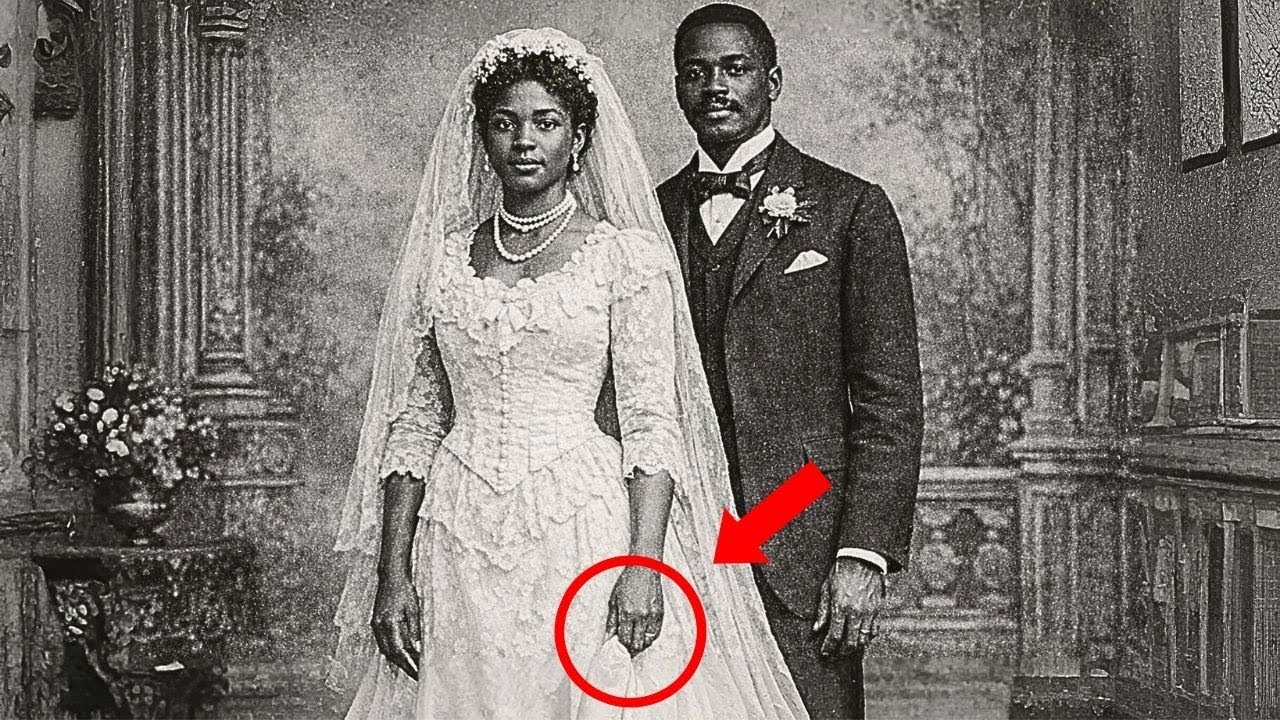
They were deliberate, systematic, almost like coordinates. David had been a historian at the New Orleans Heritage Museum for fifteen years and had seen thousands of photographs, but this one stopped him cold. It was a humid Tuesday afternoon in April 2024 when he unpacked the latest donation, boxes from the estate of Eleanor Rouso, a woman who had died at 103, leaving behind family memorabilia no living relative wanted to claim. The photograph was tucked between layers of yellowed tissue paper in a tarnished but intact silver frame.
The image showed a Black wedding couple. The bride wore an ivory dress with delicate lace sleeves and a long veil, a strand of pearls around her neck. The groom stood slightly behind her in a crisp dark suit, a boutonniere pinned to his lapel, one hand resting formally on her shoulder. They posed before an ornate backdrop typical of professional portrait studios of that era, their expressions fixed in the peculiar stillness that early cameras demanded.
For a Black couple to afford such a formal portrait in Louisiana in 1883, barely eighteen years after the end of slavery, spoke of determination to document the moment, to claim a place in history. David turned the frame over, searching for any inscription. On the back, in faded brown ink, were two names and a date: Clara and Thomas, June 14th, 1883. Nothing more.
As the afternoon sun shifted and lit the glass differently, David noticed what he had missed. He moved the photograph beneath the high-intensity lamp he used for archival work. The additional light revealed more. The fabric in Clara’s hand was white or cream, roughly the size of a man’s pocket square, and it carried tiny, precise markings that looked like embroidery or careful stitching.
He snapped high-resolution photos and transferred them to his computer, then used enhancement software to zoom in, adjusting contrast and brightness. The markings were not random. They formed numbers and directional markers, incredibly small and precise. In 1883, Louisiana was in the brutal aftermath of Reconstruction.
Black communities lived under constant threat from white supremacist violence and the systematic dismantling of civil rights gains, terror campaigns designed to keep formerly enslaved people subjugated. For a Black bride to hide something in her wedding portrait, to carry it so deliberately, suggested far more than a sentimental keepsake. David looked again at Thomas’s solemn expression. There was something in his eyes, not fear exactly, but awareness, a gravity beyond wedding-day nerves.
Clara held the faintest tension around her mouth, as if she were holding her breath, holding something back. The next morning David arrived at the museum an hour early, the photograph in an archival sleeve inside his leather satchel. He had barely slept. Before diving deeper he needed to understand who Clara and Thomas were, where they lived, what their world looked like.
He pulled record books and city directories from the museum’s own archives. Hours passed as he scanned handwritten entries, cross-referencing church records, marriage licenses, and census data. By mid-morning he found a promising lead: a marriage license registered at the Orleans Parish Courthouse. Clara, age 24, and Thomas, age 27, married June 14th, 1883.
Thomas’s occupation was listed as carpenter. They resided in Tremé, one of the oldest Black neighborhoods in America, a community of free people of color even before the Civil War. Tremé had been a center of Black culture, resilience, and resistance for generations. If Clara and Thomas lived there, they were part of a tight-knit community that kept secrets when necessary and understood that survival required strategy, not just endurance.
Property records showed Thomas had purchased a small lot on St. Philip Street in 1881. For a Black man to own property just two years after Reconstruction ended spoke to extraordinary determination. Most Black families in that era rented, sharecropped, or lived in conditions barely better than slavery.
David turned to newspaper archives from the years around the wedding. The papers of that era rarely mentioned Black citizens except in reports of crime or racist stereotypes. He found nothing about Clara or Thomas directly, but he found something else that made his breath catch. Multiple reports throughout 1883 and 1884 described Black families mysteriously disappearing from New Orleans, particularly from neighborhoods like Tremé.
The articles framed these disappearances with suspicion, suggesting criminal activity or irresponsibility. Reading between the lines of racist journalism, David recognized another possibility entirely. He needed expert help to decipher the markings. He contacted Dr.
Angela Freeman, a textile historian and professor at Tulane University who specialized in nineteenth-century American needlework and coded fabrics. They had collaborated before, and David trusted both her expertise and her discretion. Angela arrived that afternoon. She studied the enhanced photographs in silence for several minutes, occasionally zooming in on specific sections.
Then she spoke, her voice barely above a whisper. “David, do you know what you have here? This isn’t decorative embroidery. These are navigational markers.
See these patterns? The way the stitches form specific angles and groupings? This is coded information. ”
She pulled out her tablet and compared the stitching to historical examples she had documented over the years.
During slavery and even after emancipation, Black communities used textiles to communicate secretly. Quilts were the most famous example, the Underground Railroad quilts with their coded patterns. But handkerchiefs, scarves, even dress hems were used to pass information that couldn’t be written down safely. Angela traced the stitched lines on the screen.
“These marks here, if I’m reading this correctly, these are geographic coordinates,” she said. “Not in modern latitude and longitude, but in a directional coding system. See how this cluster of stitches forms what looks like a compass rose, and these longer lines radiating out? Those would indicate directions and distances.
”
Directions to where, they needed to figure out. Angela explained that the Underground Railroad did not end with the Civil War. The network adapted and continued during Reconstruction and especially after it collapsed in 1877. Black people still needed ways to escape violence and find safety.
She pulled up a historical map of Louisiana. “In 1883, this state was a powder keg. White supremacist groups were terrorizing Black communities, burning homes, lynching people who dared to vote or own property or simply exist with dignity. The federal troops had withdrawn.
Black people were left defenseless against organized violence. ”
David thought of the newspaper reports of disappearing families. Clara was carrying a map, a way out, or a way to find others who had already left. Angela pointed to a dense area of stitching near the edge of the fabric.
The pattern repeated three times. In textile coding, repetition indicated emphasis. These were important locations, places you absolutely needed to know about. Over the following days David immersed himself in the history of Tremé in the 1880s.
What he discovered was a community under siege yet fiercely resilient. The neighborhood had been a haven for free people of color since the early 1800s, a place where Black musicians, artisans, and entrepreneurs built lives of dignity despite constant oppression. But by 1883 that world was collapsing. The gains of Reconstruction, voting rights, political representation, land ownership, were being stripped away through violence and legal manipulation.
The Louisiana Constitution of 1879 had disenfranchised most Black voters. White supremacist organizations operated openly, attacking Black families with impunity. The message was clear: Black people would be forced back into submission by any means necessary. David found records of churches in Tremé that had served as meeting places and centers of resistance.
St. Augustine Catholic Church, established in 1841, had been a cornerstone of the free Black community. He wondered if Clara and Thomas had been married there, if the church had played a role in whatever network the fabric coordinates represented. He decided to visit Tremé himself, to walk the streets where they had lived and see if any physical traces of their world remained.
On a warm Saturday morning he parked near St. Philip Street. The address from the property records no longer existed as a standalone structure; the lot had been absorbed into a larger development decades ago. But the surrounding blocks still held buildings from the late 1800s, their weathered facades testaments to survival.
He walked slowly, imagining what these streets looked like in 1883: horse-drawn carts instead of cars, gas lamps instead of electric lights, and always the undercurrent of danger, the knowledge that violence could erupt at any moment without warning or consequence for the perpetrators. At St. Augustine Church, David found the parish office open. An elderly woman named Mrs.
Delacroix, a longtime parishioner and volunteer archivist, greeted him warmly. Her eyes lit up when he mentioned the names Clara and Thomas and the date 1883. “We have marriage records going back to the church’s founding,” she said, leading him to a small room lined with leather-bound ledgers. She pulled a volume from 1883 and carefully turned the yellowed pages.
There, in elegant script, was the entry: Clara, Spinster, and Thomas, Bachelor, united in holy matrimony on the 14th day of June in the year of our Lord, 1883. But it was the notation in the margin that made David’s heart race. Witnesses, Samuel and Ruth, and next to their names, in tiny script almost invisible, the word “conductors. ”
David knew what conductors meant.
They were the guides who helped enslaved people escape along the Underground Railroad. But the Underground Railroad had officially operated before the Civil War ended in 1865. Why would conductors still be identified in 1883, nearly two decades after emancipation? Mrs.
Delacroix saw the question in his eyes. She gestured for him to sit. “Young man, the Underground Railroad never truly ended. It transformed.
My grandmother told me stories. She was born in 1879. Lived through all of this. After Reconstruction failed, after the federal troops left and the violence came back worse than ever, Black people still needed ways to escape.
Even now, they called it different things. The network. The chain. Some people just called it the way through.
It wasn’t about running north anymore. That path was known, watched, sometimes blocked. This was about moving between safe communities, about disappearing when your name got on the wrong list, when your family was threatened, when you had no other choice. ”
David showed her the enhanced photographs, pointing out the fabric Clara held.
Mrs. Delacroix studied it for a long moment, then nodded slowly. “My grandmother mentioned something like this. She called them passage cloths.
Women carried them because women were searched less often, suspected less often. The information was hidden in plain sight, disguised as decoration or sentiment. ”
“Do you know where these coordinates might have led? ” David asked.
Mrs. Delacroix stood and moved to a large map of Louisiana on the wall, its surface marked with pins and notes. In the 1880s, several communities took people in. Some were settlements deep in the bayou where law enforcement rarely went.
Others were farming communities further north near the Arkansas border where Black families had established themselves and looked after newcomers. Then she paused, her finger hovering over a spot near the Gulf Coast. “There were the maritime routes,” she said. Black sailors, fishermen, port workers moved people out through New Orleans Harbor to ports further east and north: Mobile, Pensacola, even as far as Charleston.
From there people could start new lives, sometimes even leave the country entirely. Some went to Mexico, to Caribbean islands, anywhere away from the violence. David felt the pieces connecting. Clara’s fabric might have been more than a map of land routes.
It could have included information about ships, departure times, contact names at various ports. “What happened to Samuel and Ruth? ” he asked, the witnesses listed as conductors. Mrs.
Delacroix’s expression grew somber. “I can check our records,” she began, then trailed off. David understood. Conductors lived dangerous lives.
Many disappeared, were killed, or were forced to flee themselves. Back at the museum, David and Angela worked late into the evening. They enlisted help from Marcus, a cartography specialist in the museum’s geography department. Together they attempted to translate Clara’s stitched coordinates into actual locations.
Marcus brought his collection of 1880s survey maps, shipping charts, and land plot records. “The challenge,” he explained, “is that the landmarks and measurement systems from 1883 are different from what we use now. Rivers have changed course. Roads have been built or abandoned.
Entire communities have vanished. We’re essentially trying to read a map of a world that doesn’t exist anymore. ”
Angela had made detailed sketches of each stitched symbol, numbering them for reference. She laid them out in sequence.
The first cluster seemed to represent starting points, locations in New Orleans itself, meeting places and safe houses where people could gather before beginning a journey. David cross-referenced the directional patterns with street layouts from 1883 Tremé. One coordinate aligned with the intersection near St. Augustine Church.
Another pointed to a location near the French Market, where Black vendors sold goods and crowds provided cover for clandestine meetings. A third suggested a spot along Bayou St. John, where water could provide escape routes into the wetlands. The longer radiating stitches indicated the actual escape routes.
One headed northwest, probably following the Mississippi River. Another went almost due north, toward Mississippi or Arkansas. A third curved southeast, toward the coast. Marcus pulled up a historical shipping chart from 1883.
“If they were using ships, they’d need to know departure schedules, which docks were safe, which captains could be trusted. Look here. There’s a notation about a regular packet service between New Orleans and Mobile. Small ships, mixed cargo and passengers.
That would have been a perfect way to move people without attracting attention. ”
For hours they worked, building a picture of an intricate network that existed in the shadows of 1880s Louisiana. Each coordinate Clara had carried represented not just a location but a lifeline, someone’s only chance at survival, a family’s escape from violence, a community’s determination to protect its own despite impossible odds. As midnight approached, Marcus sat back.
“You realize what this means? Clara wasn’t just carrying this map for herself. She was a conductor. She and Thomas both probably.
This wedding portrait wasn’t just a personal keepsake. It was an insurance policy, a way to preserve critical information in case the original documents were discovered or destroyed. ”
David looked at Clara’s face in the portrait, seeing her now with complete new understanding. This young woman, barely into her twenties, had risked everything.
Simply possessing this information could have gotten her killed. He needed to find out what happened to Clara and Thomas after their wedding. Did they continue their work? Did they survive the violent decades that followed?
He returned to the archives, searching death records, property transfers, census data. He found Thomas first, in a property record from 1891. The St. Philip Street lot had been transferred to Clara’s name alone, with a notation: widow.
David’s chest tightened. Thomas had died sometime between 1883 and 1891, when he would have been only in his mid-thirties. The death certificate, dated March 1889, listed cause of death as “injuries sustained. ” No details, no elaboration.
In 1889 Louisiana, for a Black man involved in helping people escape white supremacist violence, those two words could mean anything: an accident, an altercation, the euphemistic language white authorities used to avoid investigating crimes against Black victims. David sat in the silent archive room, feeling the weight of Thomas’s story. This man who had stood so dignified in his wedding portrait, who had supported his wife’s dangerous work, had been reduced to two words in an official record. But Clara’s story continued.
David found her listed in the 1900 census, still living on St. Philip Street, her occupation listed as seamstress. She lived alone, no children recorded. He found her again in the 1910 census, now sixty years old, still working, still in Tremé.
Then he found something that made everything painfully clear. In a collection of oral histories recorded in the 1930s by the Federal Writers’ Project, a Depression-era program that documented stories from formerly enslaved people and their descendants, there was an interview with an elderly woman identified only as C. R. , aged eighty, New Orleans.
The interviewer’s notes described her as a dignified woman, reluctant to speak in detail about past events. But the fragment she did share painted a vivid picture. She spoke of helping families find their way after her husband’s death. She mentioned sewing special pieces that women could carry.
She talked about the fear, the constant vigilance, the way she had to hide what was most important in plain sight. The interview was brief, barely two pages, but one passage struck David with particular force. “They took my Thomas for helping people get to safety. Said he was causing trouble, interfering with the natural order.
But we knew the truth. Freedom didn’t end with the war. It had to be fought for every single day, in small ways and dangerous ways. The cloth I carried on my wedding day was my promise to him, to our people, to anyone who needed a way out.
I kept that promise long after he was gone. ”
David sat motionless, the transcript in his hands. Clara had continued the work after Thomas’s death. She had carried on alone for decades, using her skills as a seamstress to create and distribute passage cloths, to keep the network alive.
He needed to find her descendants, if any existed. Property records showed Clara had held the St. Philip Street lot until her death in 1932 at age seventy-three. The lot had then been transferred to a woman named Rose, identified in the deed as Clara’s niece.
Following that thread forward, David eventually made contact with Patricia, a seventy-two-year-old woman living in the Gentilly neighborhood of New Orleans. She was Rose’s granddaughter, which made her Clara’s great-great-niece. When David called and explained his research, there was a long pause on the other end of the line. “You found Aunt Clara’s wedding picture?
” Patricia finally said, her voice thick with emotion. “We thought all of that was lost in Katrina. ”
They met the following afternoon at Patricia’s home, a modest house filled with family photographs and memorabilia. Patricia moved slowly due to arthritis, but her mind was sharp and her memory full of stories passed down through generations.
She brought out a worn shoebox filled with documents, letters, certificates, a few photographs. “My grandmother Rose told me about Clara when I was a girl,” Patricia said, handling the documents with reverence. “She said Aunt Clara was the bravest woman she’d ever known, that she’d helped people in ways that couldn’t be talked about openly, even decades later. But so much of the detail was lost.
People were afraid to write things down, afraid to say too much. ”
David showed her the wedding portrait and the enhanced images of the fabric. Patricia stared at them for a long moment, then began to cry quietly. “She was so young, just a young woman, and she took on all that danger, all that responsibility.
”
From the shoebox Patricia pulled a small piece of fabric, yellowed with age and fragile to the touch. “Grandmother Rose said Clara gave her this before she died. Said it was important, that it should be kept safe, but that she’d know when the time was right to share it. ”
The fabric was larger than the piece in the wedding portrait, about eight inches square, and covered entirely with the same kind of tiny, precise stitching.
David’s hands trembled as he held it up to the light. This was another passage cloth, possibly one of the last Clara had made. “There’s something else,” Patricia said. She pulled out a small leather journal, its cover cracked and worn.
“This was Clara’s. Grandmother Rose hid it away for decades. I’ve read it, but I never understood all of it. Maybe it will make more sense to you.
”
The journal was Clara’s daily record from 1889 to 1920, written in careful script. Most entries were brief: weather, work completed, visitors received. But scattered throughout were coded references that David now understood. “Helped three packages move north.
” “New route established to the eastern dock. ” “Lost two travelers to the red shadows,” a phrase clearly referring to people caught by white supremacist violence. One entry from June 14th, 1920, her sixty-first birthday and the thirty-seventh anniversary of her wedding, read simply: “Thomas, I kept my promise. The way through remains open.
— Clara. ”
Three months after discovering the wedding portrait, David stood in the museum’s main gallery, where a new exhibition had just opened: “Threads Through Time: The Hidden Networks of Resistance in Post-Reconstruction Louisiana. ” The wedding portrait held pride of place, displayed alongside the passage cloths, Clara’s journal, and the maps showing the routes she had helped maintain for over forty years. Patricia had agreed to loan the family materials, understanding their historical importance.
She stood beside David now, looking at the portrait of her great-great-aunt, pride and sorrow mingled in her expression. “She deserved to have her story told,” Patricia said quietly. “All of them did. Thomas, the people they helped, the network that kept fighting long after the history books said the fight was over.
”
The exhibition attracted significant attention from historians, journalists, and community members. Many visitors were descendants of Tremé families, and some recognized names or places in the documentation. An elderly man named Jerome approached David one afternoon, pointing to one of the decoded coordinates on the wall map. “That location,” Jerome said, “that was my great-grandfather’s farm up near the Arkansas border.
Family stories always said he took people in, helped them get settled, but we never had proof. He died in 1894, never talked about it openly. ” He paused, his eyes glistening. “Thank you for showing that he mattered, that what they did mattered.
”
David had worked with Angela to create an educational component for the exhibition, explaining the textile coding techniques and the broader historical context. School groups visited regularly, and David noticed how students, particularly young Black students, stood transfixed before Clara’s portrait, seeing perhaps for the first time a reflection of resistance that looked like them, that came from their own communities. One afternoon a teenage girl named Jasmine asked David a question that stayed with him. “Why did Clara keep doing it after Thomas died?
Wasn’t she scared? ”
David thought carefully before responding. “She was probably terrified every single day. But she understood something important: that freedom isn’t just about laws or declarations.
It’s about people choosing to help each other survive, to create paths forward, even when everything seems hopeless. Her fear was real, but her commitment to her community was stronger. ”
The museum began receiving inquiries from other institutions wanting to study the passage cloths, to understand how the post-Reconstruction networks operated. David found himself coordinating with researchers across the country, each discovery adding new layers to Clara’s story and the broader history of Black resistance in the late nineteenth century.
On the anniversary of Clara and Thomas’s wedding, June 14th, 2025, the museum held a special commemoration. Patricia’s entire extended family attended, including relatives who had traveled from other states. They stood together before the portrait, seeing Clara and Thomas not just as historical figures but as family, as ancestors whose courage had helped ensure their own existence. As the day ended and the gallery emptied, David stood alone before the wedding portrait.
Clara gazed back at him across 142 years, her hand still holding that small piece of fabric, that tiny map to freedom. What had seemed at first like a simple wedding photograph had revealed itself to be so much more: a document of resistance, a testament to courage, a reminder that the fight for dignity and justice never truly ends. It simply transforms, carried forward by ordinary people making extraordinary choices. The portrait would remain here, telling its story to future generations, ensuring that Clara and Thomas and the countless unnamed people they helped would not be forgotten.
The threads Clara had stitched so carefully in 1883 now connected past to present, weaving a narrative of survival, resilience, and the quiet heroism of those who risk everything so others might live.
