W Hour came at exactly five in the afternoon, and for a few hours the Polish capital belonged to the resistance again. Underground units of the Home Army struck German positions across Warsaw in a coordinated surprise attack, hoping to liberate the city before the Soviet Red Army could arrive and install a communist government under Moscow’s control. The Poles wanted to present the world with a fait accompli: a free Warsaw, freed by Poles, before the Soviets could claim the credit or impose their rule. But the Nazi leadership saw it differently.
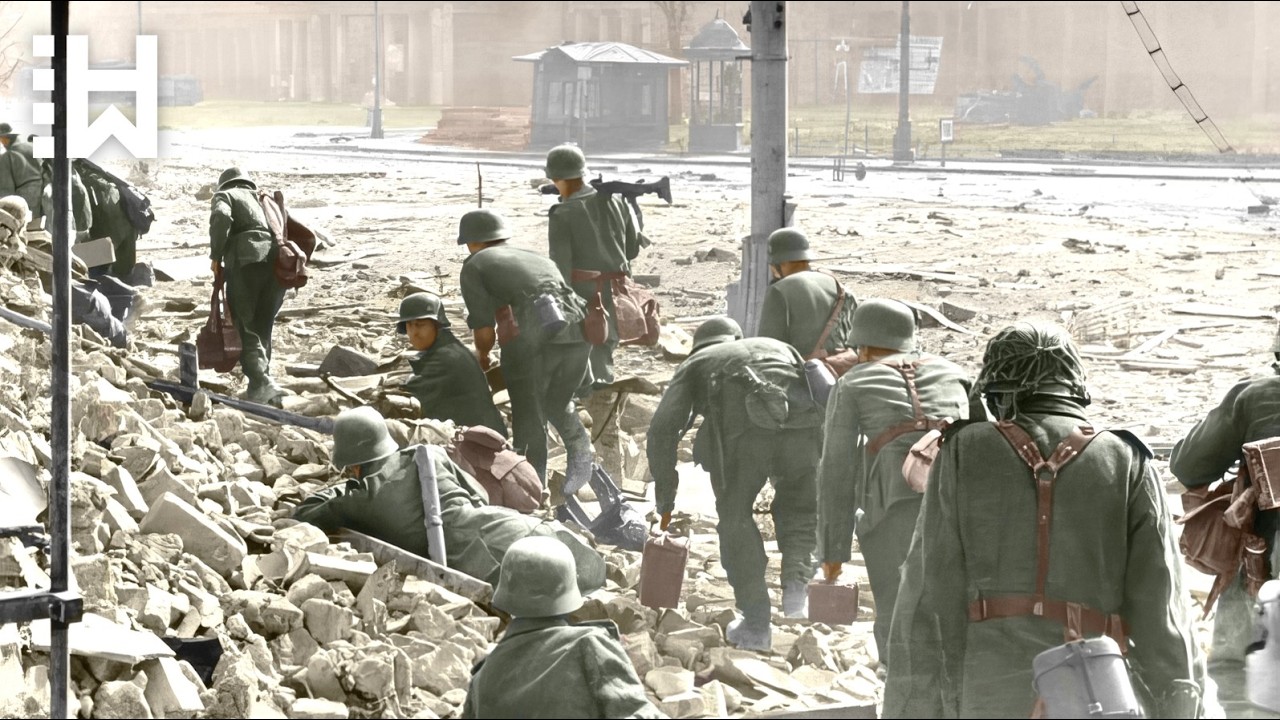
This was not just an armed rebellion. It was the final dangerous outburst of Polish defiance, and it had to be extinguished once and for all. Adolf Hitler’s order was unambiguous: every inhabitant must be killed, no prisoners were to be taken, and Warsaw was to be razed to the ground, creating a terrifying example for all of Europe. To carry out that order, the German command deployed a collection of improvised and often undisciplined units, including collaborationist formations drawn from German-occupied Soviet territory.
Among them was the Waffen Sturmbrigade RONA, commanded by SS-Brigadeführer Bronislav Kaminski. RONA stood for the Russian Liberation People’s Army, and the formation was better known as the Kaminski Brigade, a unit formally incorporated into the Waffen SS, the military branch of the SS, but lacking the discipline and structure of a regular army. On the 4th of August 1944, at around ten in the morning, about 1,700 RONA troops under Major Ivan Frolov entered Warsaw’s Ochota district. Almost immediately, the operation descended into chaos.
Instead of fighting the insurgents, the troops, most of whom were unmarried men, began carrying out rapes, robberies, and murders. They first targeted civilians on nearby Obachevska Street. Groups of soldiers stormed into homes and forced the residents out, shooting some of them, especially those who refused to leave. After being looted, most of the buildings on Obachevska Street were set on fire that same day.
People were also killed in nearby garden plots, and the residents of 104 Grójecka Street were killed with grenades while hiding in the basement. On the 5th of August, as more and more civilians were forced from their homes, the Germans set up a makeshift camp in Ochota to hold people before sending them to a transit camp outside Warsaw. The camp was located at a former vegetable market known as Zieleniak. As residents were driven out, they were stripped of watches, jewelry, and anything of value.
Witnesses later described how soldiers, eager to take rings and valuables, cut off fingers and tore earrings from people’s ears, sometimes with pieces of flesh attached. Anyone who resisted was often shot or beaten to death. On the march toward Zieleniak, the violence continued. Young women and girls were pulled from the crowds and raped in ruins and doorways.
Some victims were shot simply because they could not keep up with the march, while others were dragged from the crowd and shot on the spot. Soldiers fired into the crowds for amusement or threw grenades into them. By the evening of the 5th of August, between ten and twenty thousand residents of Ochota and the surrounding districts had been rounded up and forced into the camp. RONA troops took over the marketplace buildings and used nearby huts as guard posts.
The camp was enclosed by a brick wall, making escape impossible. Inside the camp, conditions were catastrophic. There were no toilets, no medical care, and almost no food. Occasionally the prisoners were given small amounts of moldy bread, but there was no drinking water.
On the 8th of August, RONA soldiers drove several cows into the market and shot them. In the chaos that followed, several Poles were also killed or wounded. Because lighting a fire was punishable by death, the prisoners were forced to eat the meat raw. To protect themselves from rape, women and girls smeared their faces with mud or soot, wore men’s clothes, cut or disheveled their hair, pretended to be pregnant, menstruating, or disabled, or put on fake bandages, hoping not to attract the attention of their tormentors.
Families sometimes hid young women and girls under piles of clothes or blankets. It spared no one, not even little girls, old women, or women who had just given birth. Women were sometimes gang-raped by a dozen or more men. After the war, one witness described in detail the ordeal the women had to go through.
“Evening and night fell, lit by the fires of houses near Zieleniak,” he said. “Everything was red and bloody. A hellish night began. Drunken groups of frenzied brutes trampled over people looking for young women and girls.
Then, they dragged them to the wall. And there, amid inhuman screams, laughter, and howling, they raped them. Sometimes as many as 11 men to one girl. After that, half-naked, they lay there, most often shot in the stomach or breasts.
”
But adults were not the only victims. Some witnesses recalled RONA troops murdering newborns and babies, strangling them or bashing their heads against the wall. Near the gate of Zieleniak, a huge pile of bodies quickly grew. Dozens more lay by the wall or along the roads leading to the market.
Nobody buried them, and in the summer heat they rotted quickly. Eventually the RONA troops ordered that the bodies be buried in shallow graves by the fence, and they burned bodies in the local high school gymnasium. In total, more than a thousand people died at the Zieleniak camp from executions, beatings, starvation, and disease. At least three hundred were killed directly by RONA troops.
At the same time, similar atrocities were unfolding in another part of Ochota. On the 5th of August, German RONA troops broke into the Radium Institute, the hospital founded by Nobel Prize-winning scientist Marie Curie. After looting the hospital and robbing the staff and patients, they set fire to the library and destroyed food supplies, the pharmacy, and much of the medical equipment. At first they intended to execute everyone inside, but then they changed their minds.
Instead, the patients and a small number of staff would remain while the rest were marched to the Zieleniak camp. That evening, drunk RONA soldiers gang-raped not only the nurses who had stayed behind, but also the patients, including those gravely ill with cancer. The next day, the building was set on fire, and some patients were burned alive. About sixty people survived by hiding in the cellar and chimneys.
On the 9th to 10th of August, some survivors were discovered, and the troops set the building on fire again. On the 19th of August, they dragged out the remaining survivors they could find and killed fifty critically ill patients on the spot. The rest were taken to the Zieleniak camp, where eyewitnesses said they were executed with a shot to the back of the head and then burned on a pyre in the gymnasium. About 170 people, patients and staff, were murdered at the Radium Institute.
In total, over ten thousand people were killed during the Ochota massacre. After the war ended in May 1945, justice eventually caught up with those responsible. Hans Frank, the Governor General of the General Government, which had included the city of Warsaw, was executed in October 1946 by American Army Sergeant John C. Woods.
The execution was botched, and Frank died only after eleven minutes of horrible convulsing. Major Ivan Frolov, who had led the regiment of 1,700 killers during the massacre, also faced justice. During interrogation in Moscow, he denied that his men had participated in the executions of civilians during the Warsaw Uprising and claimed to know nothing about mass executions. He justified the civilian casualties by citing the use of air force and artillery during attacks on houses where insurgents were hiding.
Nevertheless, he was executed in the Soviet capital on the 31st of December 1946. Bronislav Kaminski, the leader of the Kaminski Brigade, did not survive the war. In late August 1944, he was executed by the SS, officially for looting, but likely also because his unit had become uncontrollable and had attracted widespread outrage, even among the Nazi leadership. In the final months of the war, many members of the Kaminski Brigade were killed or split up as German forces retreated west.
Others were taken into custody, and those captured by Western allies were later forcibly repatriated to the Soviet Union, where many were sent to forced labor camps in the Gulag system or executed.
