The tarp was down. It was not off. It hung from the two lower stones they had used to weight it, hanging like a sheet on a clothesline, and the two upper stones lay on the ground about ten feet down the slope, as if the tarp had been pushed from the inside. Halston Vreeland stood on the shelf and looked at it and did not go into the chamber.
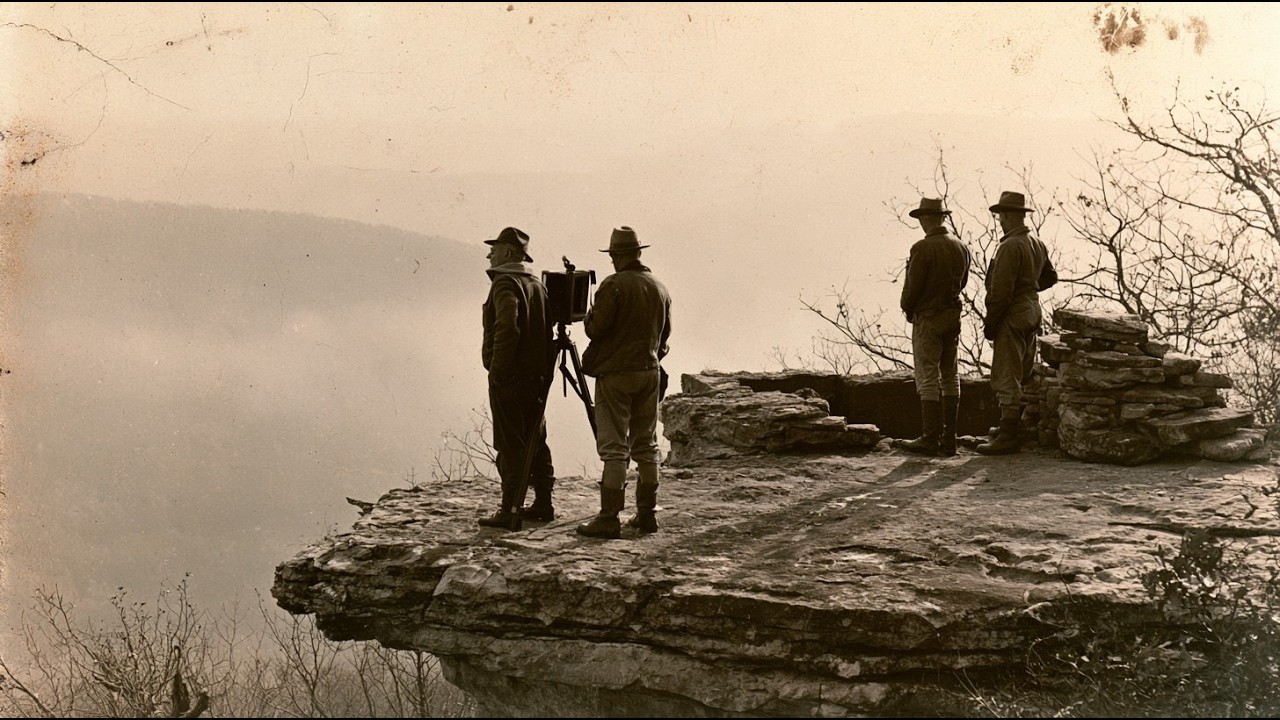
He would not let any of the others go in either. He said they were going to close it now, all the way. They were going to put the stones back the way they had found them, and plaster it, and walk down this mountain, and send a truthful report to Frankfort, and then they were going to forget as much of this as any of them was able to forget. Cordell said, “Halston, the stones.
”
“I know,” Vreeland said. “They’ll want us to bring them in. ”
“They won’t get them. ”
It had begun five days earlier, on a Monday afternoon in October 1954, when the four of them drove into a hollow on the Kentucky side of the Appalachian state line.
The people who lived down in the bottom, in the two houses and the general store that hadn’t sold anything since the war, called the place Greaves Notch. That was not the name on the survey map. The survey map called it Section Seven, Cutter Ridge, elevation 2,700. But the people down in the bottom called it Greaves Notch.
They didn’t remember why. That autumn, the mountain had moved. A stretch of shale and clay about the length of a train car slid down the face of the ridge, taking with it a stand of white oaks that had probably stood there since before Andrew Jackson was president. The slide happened at night, after a hard three days of rain, and when the sun came up on a Wednesday in the second week of October, the shape of the ridge had changed.
Anyone standing at the mouth of the hollow could see the new scar, pale gray where the topsoil had peeled back and exposed rock that had not seen daylight in longer than any person alive. The state got word of it about six days later. The state didn’t much care about a landslide in a hollow with only two houses in it. But there was a road project on the drawing board for the following spring, a little gravel spur the county wanted paved so loggers could get their trucks up onto the ridge in mud season.
And you didn’t pave a road under a ridge that had just decided to slide without sending someone up first to look at what was underneath. So the state sent Halston Vreeland. Vreeland was 43 years old that October, a geological surveyor for the Commonwealth, which meant he spent most of his working life driving a green Chevrolet pickup up dirt tracks in the eastern part of the state looking at rock. He had done the same job for nineteen years.
He was tall, lean the way men get when they walk a lot of miles for a living, with hair that had been black at twenty-five and was now the color of iron filings, cropped close because he didn’t have the patience for barbers. There was a small pale scar across the knuckle of his right thumb where a chisel had slipped when he was still an apprentice. He was married, but not happily. He was a Methodist, but not devoutly.
He believed in the dignity of a job done clean, and in the particular quiet you find on a ridgeline at four in the afternoon in autumn, and in very little else. His team he had worked with before. Emmett Cordell, 38, from Bowling Green, was his topographer, a former Army mapmaker who had served in Italy. Cordell was short and thick, the kind of man whose shirt always seemed a size too tight across the chest, and he laughed easily and often.
He had a wife and a house in Frankfort, and he wrote her a letter every night when they were in the field, even if all he had to report was that it had rained. Barnaby Ordell, 51, was the oldest, a photographer for the State Survey Office, brought along whenever a job involved something that might one day need to be documented for the record. He was thin the way a heron is thin, all angles and long fingers, with a face that was patient without being kind. He spoke very little.
He had never told any of them where he had grown up or if he had a family, and none of them had ever thought it polite to ask. The fourth was Wilford Prewitt, 27, new, just out of the University of Tennessee with a degree in geology and a nervous, eager way of looking at everything like it might sit up and tell him a secret. He was small-boned, with a shock of pale hair he could never quite flatten, and round wire spectacles that made him look ten years younger than he was. They set up in a hunting cabin the county surveyor had arranged for them.
Two rooms, a stove, four bunks. The nearest telephone was seven miles down the mountain at a service station that also sold bologna sandwiches and Coca-Cola. That was fine. Vreeland preferred it that way.
A phone in a survey camp was a thing that only rang when the news was bad. They spent the first two days on the routine work. Vreeland and Cordell walked the base of the slide, taking core samples with a hand auger, measuring the angle of the exposed face. Ordell set up his tripod at three different vantage points and took careful glass-plate photographs of the whole geometry of the thing.
Prewitt catalogued the samples and kept the field notebook current with a schoolboy’s precision. By Wednesday evening they had a preliminary report drafted. The slip had gone deeper than the topsoil, cutting into an older layer of shale that had probably lain undisturbed since the last ice age. The road, if it was going to be built, would need shoring on the north side.
Nothing unusual. Nothing worth staying up on the mountain for. Vreeland planned to send Cordell and Prewitt back to Frankfort with the initial report on Friday morning. He and Ordell would spend one more day on the ridge, taking a final set of photographs of the fresh face, and then they’d all go home.
That was the plan. Then, on Thursday morning, Prewitt found the slot. He was up above the main slide on a shelf of clean rock about forty feet higher than the rest of the team. He had gone up there because the light was better, and he had wanted to sketch the underside of a small overhang.
When he ran his hand along the rock face to steady himself, his fingertips passed over something that wasn’t right. He stopped. He looked. At about the height of his own chest, there was a horizontal seam in the limestone, about the length of his forearm, maybe an inch and a half wide.
And it was too straight. Limestone doesn’t split straight. Limestone splits along its bedding planes, which are only ever approximately level, and along fracture lines, which are almost never level at all. What Prewitt was looking at was a groove cut into the face of the limestone shelf that ran level as a shelf in a kitchen cupboard.
He called for Vreeland. Vreeland came up. Cordell stayed at the base and shouted questions. Vreeland looked at the seam for a long time.
He took off his gloves and pressed the flat of his hand against it. He put his eye down to the level of the rock and looked along the line of it. Then he stepped back and put his hands on his hips, the way he did when a thing was going to become inconvenient. “That was cut,” he said.
Prewitt, standing behind him with his hand still pressed to the rock, said in a voice a little higher than his ordinary voice, “How would anyone cut a slot in the middle of a mountainside? ”
Vreeland didn’t answer right away. He walked along the seam. It ran about eight feet in one direction and about eleven in the other.
When he stood back and let his eye fall on the shape of it, he saw what he should have seen a minute earlier. It was a rectangle. A rectangle about eleven feet wide and four feet high, cut into the face of the limestone shelf. It had been packed with something, some kind of paste or plaster that had aged to almost the same color as the surrounding rock.
But now that the mountain had shifted, part of the plaster had cracked and dropped away, and the seam was visible. Vreeland took a chisel and a rubber mallet from his kit and tapped the exposed part of the plaster. It sounded hollow. He tapped again.
The same sound. A foot to the left, a foot to the right, the same everywhere. Behind the plaster there was empty air. Cordell had climbed up by then.
The four of them stood on the shelf, and none of them spoke for a full minute. Prewitt said very softly, “It’s a door. ”
Vreeland made the call. He said they’d open enough of it to see what was behind, then photograph it, then wire the office and let the office decide.
If it turned out to be some Depression-era moonshiners’ cache, fine. If it turned out to be an old shelter some farmer had walled up in the 1850s, fine. Either way, they’d document it and turn it over. None of them argued.
If any of them had argued, if any of them had said, let’s leave it and come back with more people, this would be a different story, and none of it would have happened. But no one argued. Because it was Thursday, and they wanted to be off the mountain by Saturday, and the smaller and cleaner they made the job, the sooner they’d sleep in their own beds. Cordell and Prewitt went down to the truck for the heavier tools.
Cordell set up his camera. Vreeland waited on the shelf alone with the door. He told a listener later, when he was old and drinking on a porch in a coastal town in North Carolina, and had nothing left to protect, that in those five or six minutes alone with that door, he could hear a sound coming out through the crack. It wasn’t loud.
It wasn’t anything you could put a name to. But it wasn’t the wind, and it wasn’t his own breath, and it wasn’t the settle of the mountain adjusting to its new shape. It was something between those things, like a breath, but taken by something that hadn’t had to breathe in a very long time. And it stopped the moment Cordell’s boots came back up the slope.
They took the plaster down in about forty minutes. It came off in slabs, some as big as a book, some smaller. Behind the plaster were fitted stones, cut and set with care, the way a mason sets a wall. Only these stones were older than any mason’s wall Vreeland had ever seen.
They had a soft, worn look to them, the way river cobbles look, but they weren’t from any river. Each stone was rectangular, and each had, on the face turned outward, a mark cut into it. The mark on each stone was different. Prewitt catalogued them as they came out.
He counted forty-seven distinct marks, and no two were alike, and eleven of them he could not begin to describe. He couldn’t say if they were letters or images or something else. When he tried later to draw them from memory, the pencil moved wrong on the paper, and after two nights of trying, he burned the drawings. But that was later.
On the shelf that Thursday afternoon, all he did was call out the coordinates, and Vreeland set each stone down in a row on the flat rock behind them, and Cordell wrote up a numbered list, and Ordell photographed every stone from three angles. By the time they took out the last stone, the sun was starting to sit down on the ridge across the hollow. They had an opening in the mountain about eleven feet wide and four feet high. A person could crawl through it on hands and knees but not stand.
Beyond the opening, the air was black and cold and smelled of nothing. They didn’t go in that first evening. That was Vreeland’s rule, and Cordell agreed with it. Prewitt, who was almost sick with the wanting to go in, gave way.
Ordell said nothing but nodded once, which for Ordell was consent. They covered the opening with a canvas tarp weighted down with the removed stones. They ate supper in the cabin: cornbread and beans and some kind of tinned ham. None of them tasted any of it.
Cordell wrote to his wife that night. He told her about the weather and about Vreeland’s cough. He didn’t say anything about the door. He sat there for twenty minutes with his pen over the paper trying to figure out how to describe what he had seen, and every sentence he started ended up sounding either like a lie or like something a man would write if he had lost his mind.
So he wrote about the weather. Prewitt didn’t sleep. He sat on his bunk with his notebook, going over the marks on the stones, trying to sort them. He had learned at the university about the mound builders, the peoples who had lived in the Ohio Valley two thousand years before Columbus.
He knew what their carvings looked like. He knew what the old Cherokee marks looked like, and Shawnee, and the earlier Woodland cultures. These were not any of those. At about three in the morning he wrote a single line in his notebook: “None of these are American.
” Then he crossed it out. Then he wrote it again. Vreeland slept badly. He dreamed he was standing in the cabin, only the cabin was much bigger than it should have been, and the walls were made of the same fitted stones as the door, and each stone had a mark on it, and one of the marks was his own name.
They went back up at first light on Friday. Vreeland went in first, carrying a handheld electric lamp that ran on a six-volt battery in a leather satchel over his shoulder, the kind he had used in mine shafts. It threw a good broad yellow light out to about twenty feet. He went in on hands and knees for the first three feet, and then the passage widened and the ceiling rose and he could stand.
He stood. The lamp showed him a chamber. It wasn’t large, maybe the size of a country schoolroom. The walls were natural limestone, but they had been worked.
Not smoothed exactly, but cleared. All the rough places had been chipped away, and the surface had been rubbed to a kind of low sheen, as if with cloth or with palms. It was cool in there, cooler than the passage. The floor was flat.
At the far end of the chamber, along the wall opposite the entrance, there was a bench of cut stone, waist high, about twelve feet long. And on the bench, arranged in a single line, were objects. He counted them from the door before he stepped in. Nine.
Nine objects, each about a hand’s breadth from the next, as if a person had walked along the bench and set each one down with care. And behind the bench, on the wall, there was a design cut into the stone. He would not describe it later. Not to the listener, not to his wife, not to the officer who came from the state office when it was time to write the report.
He would only say that when he looked at the design on the back wall of the chamber, his own left hand, without his willing it, moved up to cover his mouth, and that when he took his hand away, his mouth tasted of copper. He called out to the others. They came in and stood in the chamber, their lamps throwing four separate yellow circles onto the walls and the floor. Ordell set up his camera on its tripod inside the doorway.
He shot a full plate. Then another. Then a third from a different angle. The flash bulbs threw a hard white light for a moment each time, making the objects on the bench jump forward out of the dark, and something about that flash-bulb light made Prewitt say, “Oh.
” Just that. Just “Oh. ”
Vreeland went to the bench. The objects were not, he thought at first, made of stone.
They looked like stone. They were the color of old bone. But when he lifted one at Ordell’s request, so Ordell could photograph the underside, the object weighed almost nothing. Lighter than any stone that size should have been.
It was carved. A small figure, maybe eight inches long, with the outline of a person, but the proportions were wrong. The head was too small. The limbs were too long.
And where the face should have been, there was nothing carved at all, just a smooth oval, unmarked. The next figure was similar, slightly different in proportion, also no face. The one after that, the same. All nine were the same in that they had the outline of a person and no face.
But each was slightly different in size and pose, as if they had been carved to be a set, to be arranged along the bench in exactly the order they were arranged in. Cordell was writing in his field book. His hand was shaking, but he was writing. Prewitt walked the length of the bench and looked up at the design cut into the wall behind it.
He put a hand on the bench to steady himself. He said, “Halston. ” Which was the first time he had ever called Vreeland by his first name. Vreeland heard the tone in his voice and turned around.
Prewitt was pointing at the wall. The design cut into the wall behind the bench was a great circle, wider than a man is tall. Inside the circle were nine smaller circles. And each of the nine smaller circles held a mark.
And each of the nine marks corresponded to one of the nine figures on the bench. If you stood at the door and looked in, you saw a ring of nine faceless carvings, and above and behind them, a ring of nine marks that named them. They were arranged. They were being kept.
You could feel it in the way the room had been made. This was not a tomb. There were no bodies, no smell of a tomb. It was more like a holding cell.
A room where nine things had been put and closed up and left. And in the center of the great circle, in the middle of the ring of nine, there was one more mark. A tenth mark. And under that mark, cut in careful lines, there was a shape that Vreeland could not look at for more than about three seconds without his throat closing.
He turned away. He said to the others, in a voice that was not his ordinary voice, “We’re leaving. Cordell, one more plate on the wall. Prewitt, no cataloguing of the objects.
Don’t touch anything else. Cordell, help me with the tarp. ”
Prewitt said, “But we haven’t —”
“We’re leaving. ”
They came out.
Ordell took his one more plate. Cordell and Vreeland pulled the tarp across the opening and dropped stones on the edges. Prewitt was the last to come out, and he came out slowly. When he reached the daylight, he was crying.
None of them acknowledged it, because to acknowledge it would have made a small thing enormous, and enormous things they were not equipped to carry. They went back to the cabin. That afternoon they agreed not to speak to any other person until they had had a night to think about what to write in the report. It was Vreeland’s idea.
Cordell agreed. Prewitt agreed. Ordell nodded. That night was Friday, October 22nd, 1954.
Cordell went out for firewood at about eight o’clock. He came back inside without any wood, and his face was the wrong color. He sat down on the edge of his bunk and would not tell any of them what he had seen. He drank most of a bottle of rye that Vreeland kept in his kit, went to sleep at nine, and shivered in his sleep in a way none of them liked.
Prewitt sat at the table with his notebook. He drew for two hours, then tore the pages out and burned them in the stove. Then he drew again. Then he did that a second time.
Around eleven he stopped drawing and sat looking at the stove, moving his lips as if he were reading something. Ordell developed his plates. He had a small darkroom kit and had set up a light-proof corner of the cabin with a red bulb and some trays. Around midnight he came out of the corner and stood in the doorway for a long time.
Vreeland asked him what he had. Ordell said, “Nothing. ”
“What do you mean, nothing? ”
“I mean the plates are blank.
”
He had shot fourteen plates that day. Not one of them had held an image. Each one, when developed, came out uniformly gray. Not black, which would have meant unexposed.
Not white, which would have meant overexposed. Gray, as if the light had gone into them and been eaten. Every one. Vreeland asked to see the plates.
Ordell handed them to him one at a time, and Vreeland looked at each under the red bulb. The last plate, the one Ordell had shot as they were leaving, the one of the wall, was not blank. That plate had an image on it. Faint, but there.
Vreeland held it up to the red light and moved it back and forth to catch the exposure right. The image was a face. Not a face of any of the four of them. Not a face he recognized.
Just a face, filling the whole frame, taken from very close, wide-eyed and open-mouthed and looking straight into the lens. He turned the plate over and set it down. He didn’t tell Ordell what he had seen. Ordell, he thought, already knew.
The sun came up on Saturday, October 23rd, at twelve minutes past six in the morning. Cordell was awake before it. He said he had slept a little, but that his sleep had been like being underwater. Vreeland woke.
He was still dressed. He was sitting at the table with his hands folded in front of him, his face without color. His camera lay disassembled on the table, and he was cleaning each part of it with a small square of chamois, which was what he did when he was troubled. Vreeland asked him if anything had happened in the night.
Cordell said, “The tarp came down. ”
“How do you know? ”
“I went and looked. ”
“When?
”
“Around four. ”
The three of them looked at Cordell for a long moment. Then all four of them dressed for the mountain and went up. Now the tarp hung from the two lower stones, and the two upper stones lay ten feet down the slope, as if pushed from the inside.
Vreeland said they were going to close it all the way, and put the stones back, and plaster it, and walk down the mountain, and send a truthful report to Frankfort, and forget as much of this as any of them was able to forget. It took eleven hours. They had to remix a paste from the crumbled original plaster, thickened with water from the creek at the bottom of the hollow and with a little of the clay from the base of the slide. Prewitt worked in silence.
Cordell hummed to himself in the tuneless way of a man trying to keep out a sound that isn’t there. Each stone went back by its number, in the reverse of the order in which they had come out. None of them mentioned the mark on the wall. None of them mentioned the plate.
None of them mentioned that at some point in the middle of the afternoon, as they were setting the fifth stone from the top, all four of them heard, from behind the stones, the very faint, very distant sound of something moving. Vreeland smoothed the last of the plaster with the flat of his hand at seven in the evening, by which time the light was almost gone from the sky. They walked back to the cabin in the dusk and ate cornbread again, and none of them spoke. They drove out on Sunday morning.
The truck ride down the mountain took two hours, and none of them said a word in the truck, which alone, for Cordell, was a thing that had never happened before in his life. Vreeland wrote the report the following week. He wrote that the survey team had found, on the upper shelf of the exposed limestone at Section Seven, Cutter Ridge, evidence of what appeared to be a natural cavity in the rock that had been walled up at some point in the recent past, possibly by moonshiners or by trappers using the space for storage. He wrote that the walling had shown some minor deterioration and had been reset by the survey team to preserve the site until further investigation could be arranged.
He recommended that no further investigation be undertaken, on the grounds that the site presented no meaningful geological interest, and that the disturbance of the local landowners and their traditions would outweigh any historical value that might be recovered. He filed the report on October 29th. The road was never built. The county rescinded the funding request the following spring.
Nobody in Frankfort followed up on the site. The report went into a filing cabinet in the state survey office and was, as far as anyone knows, never read by any person after it was filed. The team never worked together again. Cordell finished out the year on other assignments, then, in February of ’55, wrote to the office asking to be transferred to a desk job in Frankfort.
He never went into the field again. He lived to be 74. He died of a heart attack in his own kitchen in 1990, and his wife said at his funeral that in the last twenty years of his life, he had never once slept a full night through without waking at some point and going to check the front door of the house. Prewitt did not last as long.
He went home to Tennessee that Christmas to see his mother, came back to the state survey office in January, and handed in his resignation. He didn’t take another job in geology. He worked for a time in a hardware store, then in a paper mill, and then he went into a hospital in the winter of 1962, where he stayed for the rest of his life. He was not a violent man.
He never hurt anyone. He just could not stop drawing the marks. The doctors who were kind gave him paper, and he covered the paper, and they gave him more, and he covered that. He died in 1977 at the age of 50.
There was no note. Ordell was strange, and he stayed strange. He kept working until he retired in 1966, then moved out to a coast in Oregon and lived alone in a small house on a bluff over the water. He never married.
He never spoke of the survey to anyone as far as anyone knows, except once. On his deathbed in 1983, he asked the woman tending to him to fetch his old camera bag. She did. He opened it, took out a small envelope, and asked her to burn it unopened in the wood stove.
She did what he asked. Then he closed his eyes and did not open them again. Vreeland was the one the listener knew. He met him in 1987, while researching an entirely different story for a magazine, when someone at the historical society in Bowling Green said there was an old surveyor down on the coast who might have information about a case.
He didn’t, as it turned out, have any information about that case. But he was a man who wanted to talk to somebody, and the listener was a young person willing to sit on a porch and listen. So they sat on his porch four or five times over the course of that summer, and he told the story of Greaves Notch. He was 76 then.
His wife had died the year before. He was living alone in a small house set back from a two-lane highway about a mile from the ocean. He drank steadily, but he wasn’t drunk. He drank the way some people breathe.
It just kept him level. He told the whole story in pieces. He told things that were not put into the telling, because some of them he didn’t believe anyone had the right to say out loud, and some of them no one knew how to say. But he told one thing at the end, on the last afternoon, that he wanted somebody to tell.
He had gone back. Once, in the summer of 1960, six years after they had sealed it. He had driven himself up to the hollow one weekend alone, without telling his wife where he was going. He climbed the ridge to the shelf where the chamber was, to look at the plaster.
He wanted to know if their work had held. It had. The plaster was intact. The stones were where they had left them.
The face of the shelf looked, from a distance of five feet, like an ordinary face of shelf limestone. He put his hand against the plaster. He waited. He said he waited a long time.
Long enough that the sun moved. Long enough that he thought he was being foolish, that he ought to go back to his truck, that whatever had happened in 1954 had been the collective panic of four tired men, and that he had come up here to prove to himself at last that the mountain was only a mountain. And then, under his palm, he felt something press back. Once.
Very lightly. From the other side. He took his hand off the plaster. He walked down the mountain.
He drove home. He never went back. He said he had spent the last twenty-seven years of his life trying to decide what that press had meant. Whether it had been the settling of the rock, or the shifting of the plaster in the heat of the day, or whether it had been what he was afraid it had been.
He said, “I hope, if you ever write this down, that you say I don’t know what it was, because I don’t. And a man ought to be honest at the end. ”
He died the following January. Pneumonia, they said.
He had been eating less and drinking more, caught something at the general store, and it had gone down into his lungs. Nine people came to his funeral. The listener counted. The cave is still up there, as far as anyone knows.
The state has never gone back. The county has never gone back. The hollow called Greaves Notch by the people who don’t remember why they call it that has three houses in it now, all owned by the same family, none of whom, when the listener visited in the summer of 2001, had ever heard of a survey team from ’54. The listener did not go up to the ridge.
Not because he didn’t believe what Vreeland told him. Because he did. And because he was not the kind of person who would test a thing like that alone, at a distance from any help. No one knows what was in that chamber.
No one knows why it was sealed, or who sealed it, or when—though the geologists consulted since suggest the seal itself, if it was made the way Vreeland described, could have been placed there four thousand years ago or more, long before any recorded people in that part of the country, long before the mound builders, long before anything any archaeologist would readily accept. No one knows what Ordell burned in his stove, or what Prewitt was drawing all those years in the hospital, or what pressed back against Vreeland’s palm. What is known is this: in 1954, four men went up a mountain. They opened a door that had been closed for longer than any of them had any way to measure.
They saw what they saw. They put the stones back as best they could. Then they went home and lived out the rest of their lives, the noise of it in them, and did their level best not to pass any of it on. Some doors are not made to be opened.
And if you find one in the wrong year, in the wrong month, on some quiet mountainside, and you have the wisdom to see what you are looking at, the advice from what was learned is this: leave it. Put the plaster back if you must. Cover it with brush. Walk down the hill.
Say nothing to anybody. And do not come back alone in the summer to see if your work has held. Because it may not have. And whatever is on the other side, whatever it was those old stones were placed to keep in, has, if Vreeland’s story is true, been waiting a long time.
And it has learned in that time to be patient. And it has perhaps been listening for someone with a mallet and a chisel and a curiosity that runs bigger than his good sense.
