On the afternoon of January 20, 1906, with her husband away at the Chambre des Députés, Anna Gould put into motion a scheme she had spent weeks preparing. By the time the Comte Boni de Castellane came back to the Avenue Foch that evening, the Palais Rose was dark. The furniture was gone. The telephone line had been severed.
The servants had disappeared, and with them, his wife and children. What awaited him instead was a legal petition for separation. Anna had struck the set while the actor was still onstage. In 1895, Anna Gould had been worth $2,000 a day.
Not earned. Inherited. Her father’s trust disbursed roughly $50,000 each month whether she lifted a finger or not. At twenty years old, five feet tall, and by the honest reckoning of people who actually met her, not especially attractive, none of that had mattered.
In the marriage market of the Gilded Age, Anna Gould carried the largest price tag in America. Most such stories end the same way: the money drains away, the marriage collapses, and the woman is left somewhere in England or France wondering what became of her life. Anna’s story did not follow that pattern. Because Anna, for all her quiet awkwardness, proved to be the toughest person in every room she entered.
She married a man who treated her fortune like a personal bonfire. In eleven years, he burned through the equivalent of $300 million on palaces, yachts, and parties so excessive they made front pages on two continents. When she decided she had seen enough, she did not write a letter or consult a lawyer first. She emptied the house while he was at work.
What happened afterward was stranger than the marriage itself. It began with a boy from upstate New York who became the most despised man in America, and a daughter who inherited his fortune, his stubbornness, and absolutely none of his reputation. Jay Gould once said he knew he was the most hated man in America and did not care. When he died in December 1892, the New York Herald declared that his wealth had been purchased at too high a price.
Other papers were less polite. He had been born Jason Gould in 1836 on a dairy farm near Roxbury in the Catskill Mountains. The family was poor. Jay hated the work.
He taught himself surveying as a teenager, left home at fifteen with fifty cents and a sack of clothes, and by twenty-one had saved $5,000. His reputation was built in the late 1860s. Jay and two partners printed millions in fraudulent stock to block Cornelius Vanderbilt from seizing the Erie Railroad. When Vanderbilt sent authorities, they fled across the Hudson into New Jersey with suitcases of cash.
Jay then bribed enough legislators to make the scheme legal. A year later, he attempted to corner the national gold market. The result was Black Friday, September 1869, a panic that destroyed thousands of investors. Jay kept his profits.
That was the public man. The private one was different. Jay married Helen Day Miller in 1863. They had six children: George the eldest, Edwin, Helen, Howard, Anna, born on the fifth of June 1875, and Frank, the youngest.
At Lyndhurst, their Gothic Revival estate overlooking the Hudson River in Tarrytown, Jay maintained an orchid collection so large it required a full-time gardener. He commuted to Manhattan by private steam yacht. His empire eventually included Union Pacific, Missouri Pacific, Western Union, and the elevated railways above Manhattan’s streets. By the mid-1880s, he controlled approximately one in every six miles of railroad track in the country.
Anna grew up inside that contradiction, adored at home, despised outside it. Mrs. Astor’s register of four hundred acceptable New York families did not include the Goulds. The social doors of Fifth Avenue stayed shut regardless of what their bank accounts held.
Helen Day Miller died in 1889. Anna was fourteen. Three years later, tuberculosis overtook Jay. He died at fifty-six.
His estate was officially valued at $77 million, though estimates closer to the family placed the figure nearer to $125 million. Adjusted for inflation, that approaches $3 billion today. He left every cent to his children, not a dollar to charity. George received $15 million and the burden of managing the trust.
Each of the other five inherited approximately $10 million. Anna was seventeen, orphaned, shut out of New York society, and suddenly among the wealthiest young women in the Western world. Her capital was locked in trust. What she received was the income, roughly $500,000 a year—enormous, steady, and completely beyond her control.
Boni de Castellane arrived in New York in 1894 with excellent manners, no money, and a very specific objective. He came from one of the oldest aristocratic families in France. His ancestors had fought in the Crusades. His father held the title of Marquis, and the family was broke—not genteel poverty, genuinely embarrassingly broke.
When the time came for Boni’s parents to attend his wedding in New York, Anna’s brother George had to pay for their passage across the Atlantic. George refused to pay their return fare. The old Marquis responded by calling Americans a stingy race. Boni was twenty-seven, blond, blue-eyed, and immaculately dressed.
He had fought three duels before the age of twenty-five. He dabbled in politics and moved through the salons of Paris with an ease that suggested old wealth, even when his pockets were empty. The expatriate social circuit had already identified him as a professional charm merchant. He understood instinctively that in the transatlantic marriage market of the 1890s, a French title could be exchanged for American capital with very little friction.
He told the press he had come to America to discover the country, and, as an experienced sportsman, to hunt. He neglected to specify what kind of game. His search ended in Lakewood, New Jersey, at a party hosted by George Gould. Anna was there.
They had crossed paths briefly the year before in Paris, but this was the real introduction. Anna had spent the previous two years fending off gossip columns that paired her with an actor, a society clubman, and at least one European prince. None of it had gone anywhere. She was twenty, socially isolated by her family name, and eager to leave a world that had decided her father’s sins disqualified her from belonging.
Marriage was the exit. A titled marriage doubly so. It would place her in a sphere where the Gould reputation carried no weight and where her money spoke a language everyone understood. The American playwright Natalie Clifford Barney, who had settled in Paris, later offered her assessment of the couple: Anna was the most unwashed and dirty-looking creature she had ever seen, and Boni was the most insipid.
That judgment was cruel and Barney hardly objective, but it captured something real about the mismatch. This was not a romance. It was a negotiation dressed in evening clothes. Boni proposed after a handful of meetings and a family trip to Canada.
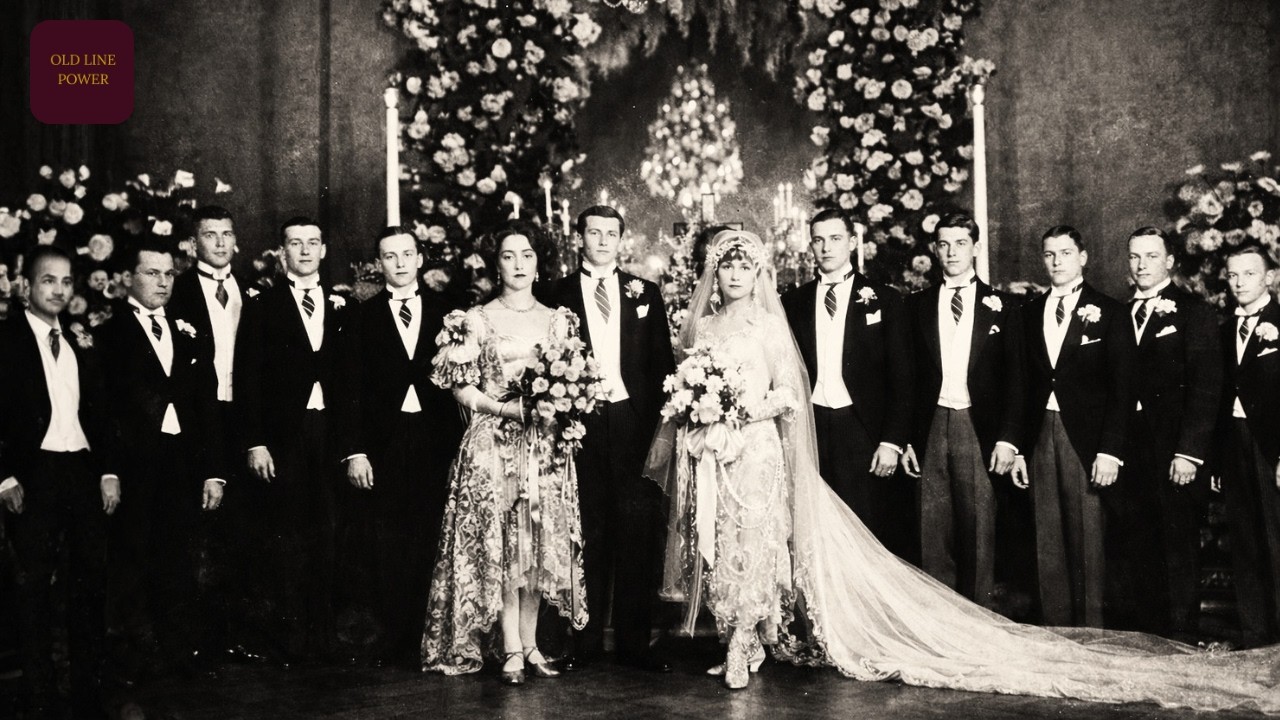
Only he seemed unsurprised by how quickly it happened. The ceremony was held on 4 March 1895 at George Gould’s Fifth Avenue mansion, with Archbishop Corrigan presiding. The newspapers treated the occasion with the gravity of a diplomatic summit.
The dress drew exhaustive coverage, yet the jewels got the real scrutiny. From Anna’s brother came an emerald-and-diamond coronet appraised at $40,000. Boni’s present was a brooch set with 250 large diamonds and two massive emeralds, with double chains trailing to the shoulders. The whole display carried one unmistakable message: a deal had closed.
Not everyone was won over. Will Clements, a reporter in Omaha, called the spectacle little more than cash traded for a coronet. He pictured Jay Gould in his coffin, bony hands hammering at the lid at the prospect of his fortune passing to, in Clements’s words, a French ninny who could not tell a bull market from a bear plunge. The journalist Elia Peattie wished the couple well but confessed she believed Anna was doomed.
Nearly everyone shared that view. Two days after the wedding, the pair sailed for France. Anna was now the Comtesse de Castellane, and every drawing room that had once shut its doors against her lay behind her.
Before a year of marriage had passed, Boni hired out the whole Bois de Boulogne for a celebration—not a section of it, not a single pavilion, but the entire park, roughly two and a half times the size of Central Park. On 2 July 1896, for Anna’s twenty-first birthday, he staged a re-creation of the fifth day of festivities from the wedding of Louis XIV and Maria Teresa of Spain. More than a thousand performers and servants labored through the night.
Three thousand guests rolled up by carriage. Fireworks burst over a lake. Orchestras played from boats. The bill was reported at $300,000—past $9 million in today’s money.
For a birthday party in a public park. That night was no celebration; it was a statement of intent. The couple had first settled into an apartment on Avenue Bosquet in Paris, bought at a price that rattled Anna’s family before the marriage certificate was even dry.
Boni had it redecorated at once, then chafed. Inside their first year he acquired a yacht, the Valhalla—a three-masted steel vessel over 230 feet long, needing a crew of about 100 under a captain and four officers. It cost $200,000.
Refitting her ran another quarter of a million. That same year Anna fell for the Château du Marais, a rambling estate built in 1770 about thirty miles southwest of Paris. Boni saw promise in it, and they bought it.
Next Boni added the Château de Grignon in southern France, an ancestral property he meant to rebuild from the ground up. Two châteaux, a yacht, a Paris apartment, and a staff now numbering in the hundreds. In the spring of 1896 he bought two and a half acres at the corner of Avenue Foch and Avenue Malakoff, one of the most fashionable addresses in Paris. He engaged Ernest Sanson, one of France’s foremost neoclassical architects, with a single directive: replicate the Grand Trianon at Versailles, twice the height, in pink marble.
Sanson worked alongside a younger architect, René Sergent. To guarantee authenticity, they drew marble from the very quarries Louis XIV had used for the original Versailles. Boni went to Italy himself to pick out individual blocks for the facade. When the first exterior failed to please him, he had it refaced.
When the second version also fell short, he ordered a trompe l’oeil painted over the marble so it would resemble what he had imagined the marble ought to look like. A man painting a fake stone surface onto real stone because the genuine article was not good enough. The palace took nearly seven years to finish. Parisians called it the Palais Rose.
When the doors opened around 1902, Boni filled it with Gobelin tapestries; portraits attributed to Rembrandt, Reynolds, and Van Dyck; a thirteenth-century carpet taken from Lisbon Cathedral; and a clock Louis XIV had once given the Pope. Ornate eighteenth-century furniture by the cabinetmaker André-Charles Boulle became a fixation. He later wrote in his memoirs: “I was driven by passion as strong as that of some players for cards. ” Furnishing the Palais Rose was, in his own words, “my slide into the abyss.
”
The palace alone was reported to cost $3 million, and that covered only the structure—before the furnishings, the art, the yacht, the châteaux, the parties, and the small army of servants needed to keep it all going. Anna’s yearly trust income was generous, but it was not without limit. Within the first year of the marriage Boni was complaining of being short of funds and set a team of lawyers on the trust to reach the capital itself. They got it.
The dam burst. Across eleven years Boni burned through an estimated $10 million of Anna’s inheritance—close to $300 million in today’s currency. Her family watched from across the Atlantic with mounting alarm.
Eventually George Gould stepped in and had the French government appoint him trustee of his sister’s money. It slowed the bleeding. It did not stop Boni from spending. By every account, Boni de Castellane was genuinely funny.
That was part of the trouble. Paris adored his wit. He passed around jokes about his own marriage the way other men handed out business cards, and the salons repeated them with relish. He called the conjugal bedroom “the expiatory chapel.
” He described Anna as “beautiful seen from the dowry side. ” Asked about the other side of the medal, he smiled and let the silence answer. Whether he actually invented all of these lines or merely never corrected the attribution is unclear. Either way, they made the public record and remained there.
The humor masked something uglier. Boni kept mistresses openly. His affairs were neither discreet nor meant to be. Contemporary accounts described relationships with women throughout Parisian society, and at least one biographer noted that Marcel Proust, a close friend, modeled the bisexual aristocrat Robert de Saint-Loup in his novel on Boni.
Proust watched the marriage from close range. What he saw fed one of the most intricate portraits of aristocratic vanity in French literature. Anna put up with it for a decade. Ten years of public humiliation, delivered with a smile by a man spending her inheritance while mocking her in drawing rooms.
Her family pressed her to act. She waited—whether from loyalty to the children, dread of the scandal, or some private calculation of her own, she let the years pile up. Then she stopped waiting. On 20 January 1906, while Boni was away on government business, Anna made her move.
When he came back that evening, the Palais Rose stood in darkness. The furniture was gone. The telephone had been cut off. No servants remained.
Anna and the children had moved elsewhere. What awaited him was a legal petition for separation. The divorce case turned into an international sensation. Newspapers in France and America reported on every hearing.
The satirical magazine Puck ran a full-page drawing that turned the case into a circus, casting Boni as a performer and Anna holding a bouquet fashioned from legal indictments. That illustration is now held by the Library of Congress. Journalists on both sides of the Atlantic treated the proceedings as amusement. Yet beneath the cartoons lay a plain legal fact.
Boni had squandered the money. Boni had violated the vows. And French law, unlike British law at that time, offered Anna a clear route to divorce. The court granted it on the fourteenth of November 1906.
Anna was awarded full custody of the three surviving children. Boni got nothing: no settlement, no further access to the trust, no portion of the properties Anna had paid for. The Château du Marais, which she had adored from the first moment she laid eyes on it, stayed in her hands. The Palais Rose technically remained hers too, though its reason for existing had dissolved along with the marriage.
Boni took the ruling with the same theatrical calm he had carried into everything else. He told friends he had seen it coming. He raised no objection to the custody decision. Within a few years, he shifted into dealing antiques, drawing on the expertise he had built up while spending Anna’s fortune to counsel wealthy collectors.
American museums gained a great deal from his discerning eye. He later produced a memoir. The title was The Art of Being Poor. Anna, meanwhile, said almost nothing in public.
She had delivered her statement on the twentieth of January, when she emptied the house. Everything that followed was bureaucracy. The civil courts had settled matters with Boni de Castellane in November 1906. The Vatican moved far more slowly.
Catholic canon law did not acknowledge civil divorce. To the church, Anna and Boni remained husband and wife, whatever a French judge had decided. For Boni, this was more than a doctrinal annoyance. Without an annulment, he was barred from remarrying inside the church.
And by 1908, Anna had already wed his own cousin, which made the whole affair far more personal. He lodged his first annulment petition around 1910, claiming the original ceremony in New York had been flawed. The matter went before the Roman Rota, the Vatican’s supreme matrimonial court. Anna fought it with all her resources.
She engaged canon lawyers. She filed documents. She contested the petition at every procedural step available, and the Vatican provided plenty of them. If Boni prevailed, the legitimacy of her second marriage and the standing of any children born from it could be cast into doubt.
She was determined to prevent that. Boni’s case rested on the 1895 wedding, conducted by the archbishop who had presided at George Gould’s mansion on Fifth Avenue. He argued the ceremony had failed to satisfy the formal demands of Catholic canon law. Anna responded that the marriage had been accepted as valid for more than a decade by every institution that counted.
The case dragged on for years. Lower tribunals ruled for Boni. Higher tribunals reversed them. Decisions were handed down, appealed, struck out, and appealed once more.
Newspapers followed the proceedings with an intensity normally kept for murder trials. Time magazine, reporting in 1925, reached for the grandest parallel it could find: not since Henry VIII had sought to annul his marriage to Catherine of Aragon, the magazine noted, had a matrimonial case lingered so long before the courts of the Roman Catholic Church. Nine cardinals ultimately heard the final appeal. In 1924, they delivered their ruling.
The marriage was valid. The annulment was refused. Boni had devoted fourteen years to chasing a verdict that would never arrive. He met the loss with the theatrical calm he had shown toward everything else in his life.
By the 1920s, he had remade himself as a dealer in fine objects, relying on the eye he had honed while furnishing the Palais Rose with another man’s money. His customers were frequently American collectors, an irony he seemed to relish. He wrote a memoir and gave it, with his usual flourish, the title The Art of Being Poor. His health deteriorated through the early 1930s.
On the twentieth of October 1932, Boni de Castellane died in Paris at the age of sixty-five. He left debts behind, a reputation that had long outlasted his fortune, and three sons he had scarcely been allowed to see since the divorce. The French press covered his funeral with the warmth kept for a man who had been, at the very least, never dull. Prominent mourners packed the church.
The art world conceded that whatever else might be said of him, his taste had been genuine. The Palais Rose survived him by thirty-seven years. During the Second World War, the German military governor of Paris, Carl Heinrich von Stülpnagel, made it his headquarters. After the war, the French government held diplomatic conferences within its walls.
Proposals were put forward to designate the building a historic monument. They were turned down. In 1969, the Palais Rose was torn down to clear the way for an apartment development. Everything Boni had spent a decade choosing, every surface he had agonized over, was scattered or destroyed.
The apartment block that took its place still stands. Anna Gould’s family had watched her first marriage crumble beneath the weight of Boni de Castellane’s appetites. They had weathered eleven years of transatlantic headlines. They had paid lawyers, swallowed humiliation, and watched a substantial slice of the Gould inheritance disappear into French real estate and Venetian glassware.
So when Anna told them, barely two years after the divorce, that she meant to marry yet another titled Frenchman, their response was anything but understated. The man she had picked was Hélie de Talleyrand-Périgord, Prince of Sagan. He was forty-eight. Anna was thirty-three.
He bore one of the oldest titles in France, a name descending directly from Charles Maurice de Talleyrand, the diplomat who had steered through Napoleon’s ascent, Napoleon’s downfall, and three later changes of government without ever losing his balance. The Talleyrand name carried a weight in European history that few surnames could equal. It also arrived with entanglements. Hélie was Boni’s first cousin.
His younger brother had married another American woman and divorced her after only two years. His father, Boson de Talleyrand-Périgord, had ranked among the most celebrated dandies in France, a man whose fame for style and extravagance had plainly left its mark on his nephew, Boni. And Hélie himself had spent a short time in prison earlier in life over forged promissory notes, a matter his family settled by compensating the victims financially. None of this put the Goulds at ease.
The wedding took place on the seventh of July 1908, in London. Not Paris, where the press would have swarmed. Not New York, where the family could have arranged it in proper style. London, in a nearly empty church in Soho.
A newspaper account of the day put it this way: “the empty church where a prince and a millionairess wed.” Guests were all but absent, there was no pageantry, no emerald coronets, no cascades of diamonds. It was the precise opposite of her first wedding in every respect. And perhaps that was exactly the intention.
What came afterward is more difficult to establish. American versions of the marriage, most of them written after Anna’s death, paint it as restrained and dignified, a true partnership, the sort of steady union her family had wanted from the start. The couple made their home at the Château de Marais outside Paris and seemed to lead a comfortable, secluded life. Hélie had money of his own and standing of his own.
He had no need of Anna’s fortune to support a lifestyle, and by every outward sign, he never attempted to. French sources, however, tell it differently. By one account, the marriage was every bit as unhappy as the first. Anna is said to have considered divorce early on, yet chose to stay so she could keep the title of Duchesse de Talleyrand.
If that account holds, it recasts her whole second act: not a woman who found peace after a disastrous first marriage, but one who decided the social standing that came with the Talleyrand name was worth more than her own happiness. Which version is correct cannot be known. It may be that both carry some honesty. A marriage can look steady from the outside while feeling empty within.
What can be stated plainly is that Anna remained for almost thirty years, through personal losses that would have shattered most people. She stayed the Duchesse de Talleyrand-Périgord, and the title she had bought with patience and endurance became as central to who she was as the name she was born with. Hélie suffered a fatal heart attack in Paris on the twenty-fifth of October 1937. He was seventy-eight.
Their marriage had lasted twenty-nine years. Time magazine gave his death a brief notice, identifying him chiefly as the husband of the railway heiress Anna Gould. After three decades together, it was still her father’s money that defined him in the American press. Anna was sixty-two, and a widow for the first time.
The Europe she had known for more than four decades was sliding toward disaster. Within two years, the German army would march into France, and the aristocratic world she had spent her adult life moving through would vanish in any form she would recognize. Howard de Talleyrand-Périgord was born on the sixteenth of September 1909 at the family’s country estate outside Paris. He was the first child of Anna’s second marriage.
His full name was Charles Maurice Pierre Jason Howard de Talleyrand-Périgord, a name that bound together France’s most illustrious diplomatic dynasty with that of a boy from a Catskills dairy farm. The Talleyrand side gave him a title. The Gould side gave him a trust fund. Neither gave him what he needed.
Almost nothing has survived about Howard’s childhood or his adolescence. He never appears in the society pages. He left no letters that have become part of the public record. He carried the courtesy title of Duke of Sagan after his father gave it up in his favor, which meant that a teenager in a country house technically outranked most of the French aristocracy.
What that felt like from within, nobody set down. His younger sister, Hélène Violette, had been born in 1915. She would live into old age. Howard would not.
In the spring of 1929, he was nineteen. He had met a young woman. He wished to marry her. He went to his parents and asked for their consent.
Anna and Hélie said no. They had nothing against the girl herself. Their reasoning was straightforward: he was too young. On the seventeenth of May 1929, Howard shot himself in his parents’ home in Paris.
He did not die at once. He was carried to a hospital on the Rue Puccini. His parents hurried to his bedside. For eleven days, he clung to life.
The press learned nothing of the incident until more than a week had passed. When reporters turned up, Anna was prepared. She issued a statement that was striking for its era—direct, detailed, and, as Time magazine noted, entirely literate, which stopped the tabloids from twisting the story. In it, Anna and Hélie acknowledged that their son had injured himself after being refused permission to marry.
They made clear that their objection concerned only his age, not the young woman. The tone was measured but unsparing. No dodging, no effort to conceal what had happened or why. Howard died on the twenty-eighth of May 1929.
He was nineteen years old. He was laid to rest at Passy Cemetery in Paris. The New York Times put the story on its front page. For a family that had spent decades managing its reputation on two continents, this was a wound that could not be managed.
Anna had endured a husband who mocked her in public, a divorce that filled headlines from New York to Paris, and a Vatican legal battle that dragged on for fourteen years. Painful as those were, they had played out within systems she understood: courts, lawyers, carefully worded statements. This lay outside all of it. A boy asked his parents for something, and when they refused, he decided he could not go on.
Anna was fifty-three. She had buried a daughter in infancy during her first marriage, and now a son who never reached his twentieth year. The public spectacles that had defined her up to this point—the extravagance, the courtrooms, the Vatican—none of it carried the weight this did. Anna and Hélie stayed together another eight years, until his death in 1937.
Howard’s absence pressed what remained of the marriage into something quieter and more private than anything that had come before. Anna never spoke of her son again. In the spring of 1939, Anna Gould boarded a ship and crossed the Atlantic in the reverse direction of the crossing she had made forty-four years earlier. She was sixty-three.
She had departed New York a nineteen-year-old bride with a French title and a fortune. She came back a widow, a duchess, and a woman who had outlived nearly every version of herself the newspapers had sought to fix in place. The America she returned to looked little like the one she had left. The Gilded Age had become history.
The great fortunes had been taxed away, spent, or dispersed. Her brother George had long been dead. Her sister Helen, who had run Lyndhurst for decades, had died the year before. The estate passed to Anna, and with it came a question most returning exiles eventually confront: whether the place you remember still exists, or whether you are moving into a memory.
Lyndhurst had shrunk. The grounds that had once spread across more than 500 acres were now reduced to 67. The mansion itself was as it had been: the Gothic arches, the narrow hallways, the vaulted ceilings Alexander Jackson Davis had designed a century earlier. More than fifty pieces of the original furniture still stood where Davis had set them.
Anna took up residence and, much like her father had done, left the exterior untouched. The house had already outlasted three families and close to a century. She found no cause to improve upon it. And she carried on her father’s other tradition as well.
Jay had stocked the greenhouse with orchids. Anna kept building the collection until, by the middle of the 1940s, it numbered more than 5,000 plants, tended by nine gardeners inside a glass structure that ran nearly 400 feet. In 1945 she put the whole lot up for auction to benefit the Red Cross. The plants were estimated at about $75,000.
Time magazine reported on it, describing Anna as the “chic and spry” seventy-year-old daughter of the late financier Jay Gould. Throughout the war she unlocked the bowling alley her sister had constructed and converted it into a recreation space for wounded soldiers and returning sailors. It tied Anna to the Tarrytown community in a way her father had never managed. Jay Gould had been feared by his neighbors.
His daughter, by contrast, was welcomed by them. By every account, she dressed as though Paris had never ended. Visitors in the 1940s and ’50s described a woman in her seventies and eighties who kept the style of a French duchess no matter the occasion. She preferred the soft colors and feminine silhouettes of the Edwardian era, a look her American contemporaries had given up decades before.
She dressed, as one observer put it, to please herself. In a family defined by what money could buy, that quiet act of private defiance may have said the most. Anna split her later years between Lyndhurst and the Plaza Hotel in Manhattan. She did not entertain on any grand scale.
The woman who had once hosted 3,000 guests in the Bois de Boulogne now kept company with her father’s furniture and the view of the Hudson that had not changed since she was a girl. She died on the thirtieth of November 1961, in Paris. She was eighty-six. She was buried beside her second husband at Passy Cemetery, in the same ground where her son Howard had been laid thirty-two years earlier.
Before her death, she arranged for Lyndhurst to be donated to the National Trust for Historic Preservation. “He had loved the estate,” she said. So had her sister. So had she.
The days of her childhood spent there ranked among the happiest of her long life. It was her wish that the people of Tarrytown enjoy it as a memorial to her father. Jay had been called the most hated man in America. His daughter gave his home to the country.
The property is open to the public today. The furniture Davis designed is still there. The greenhouse is under restoration. Visitors walk the grounds past the bridge Jay built to reach his steam yacht, past the rose garden Helen cultivated, past the bowling alley Anna opened to soldiers during the war.
Sixty-seven acres of what was once 500—enough to remember what it was.
