In September 1882, Thomas Edison flipped a switch at his Pearl Street station in Lower Manhattan, and for the first time in American history, electricity flowed into private homes. Fifty-nine subscribers received something no one had ever experienced before: electric light inside their own living rooms. Newspapers called it a miracle. Investors called it the future.
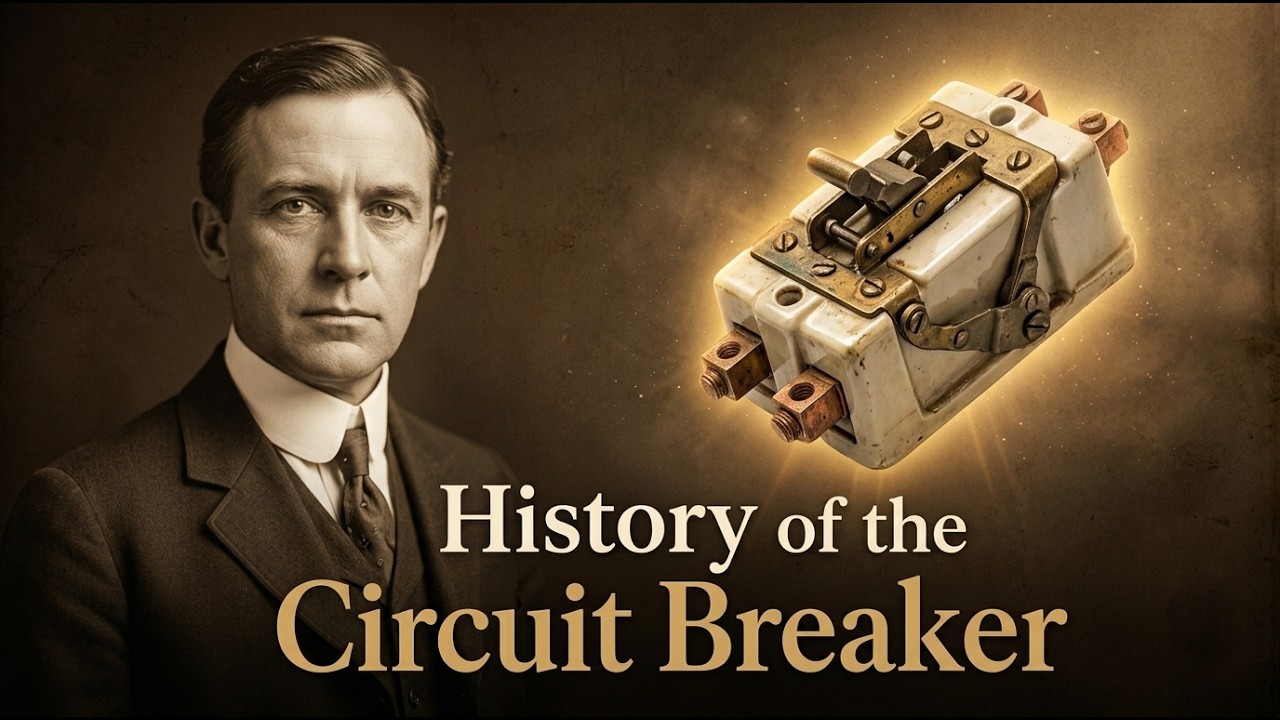
By the following year, wires were already burning inside the walls of those same buildings, and Edison had no reliable way to stop it. The problem was simple and terrifying. Electricity had reached the American home, but the technology to make it safe had not. There were no circuit breakers.
There was no grounding. There were no voltage regulators, so lights dimmed and brightened depending on how many other people on the network were drawing power at the same time. There were essentially no standards at all for installing electrical wiring inside a wooden building full of people. If a live wire got damaged, if a connection loosened behind a wall, if a fault sent current off its intended path, the result was fire, severe electrical shock, or both.
Over the next four decades, homes across the country burned because of it. Edison had been working from his laboratory in Menlo Park, New Jersey, which he called his invention factory. He had already proven the practical incandescent lamp. Now he was racing to build the infrastructure that would deliver electricity to paying customers.
The challenge was immense. No one had ever tried to wire an entire neighborhood. There were no blueprints, no engineering manuals, no safety rules. Edison and his team were writing the rules as they went.
To his credit, Edison had thought about safety. In his 1879 patent application, he described two different approaches to protecting electrical circuits. The first was a fuse, a thin strip of metal designed to melt and cut the circuit if too much current passed through it. The second was a mechanical device, closer to what we now call a circuit breaker, a spring-loaded mechanism that physically opened the circuit when current rose too high.
Edison sketched both ideas in his notebooks. He patented both concepts. Then he made a decision that would cost lives for half a century. He chose the fuse.
The logic made sense at the time. Fuses were cheap. They were simple. They were easy to manufacture and install.
The mechanical circuit breaker concept was expensive, unreliable, and hard to scale across a full power distribution network. Edison needed something that worked immediately, because he was racing not just against time but against other inventors, other companies, and the deep skepticism of a public that still thought electricity was dangerous magic. And frankly, fuses were better than nothing. Before fuses, there was literally no safety mechanism between the power source and the wires inside your walls.
If a wire overheated, if a connection loosened, if a short circuit sent a sudden surge through the system, the only thing preventing a fire was luck. Fuses at least provided a weak point, a place where the circuit would break before the wires themselves burst into flames. Early residential wiring in America relied on a system called knob and tube. Individual copper wires insulated with rubber cloth were strung openly between ceramic knobs nailed to the wooden joists inside walls and ceilings.
Where wires needed to pass through a wooden beam, they were routed through hollow porcelain tubes to keep the hot wire from touching the wood directly. There was no ground wire. There was no protective sheath around the cables. The hot wire and the neutral wire ran separately, sometimes inches apart, sometimes feet apart, through the open cavities of the house.
If a mouse chewed the insulation, if moisture crept into a wall cavity, if the rubber cloth deteriorated over time, which it certainly did, a live electrical wire would end up touching dry wooden framing. The only protection was a small strip of metal in a fuse box that might or might not be the right rating for that circuit. This was the state of residential electricity from the 1880s through the 1940s. Sixty years of homes wired without grounding, with deteriorating insulation, and with a one-use safety device that most homeowners found extremely annoying to replace.
That annoyance was what made things truly dangerous, because fuses blow. That is their entire job. When a circuit draws too much current, the fuse melts, the circuit opens, and the lights go out. Then the homeowner has to go to the fuse box, unscrew the blown fuse, and install a replacement.
If no replacement was on hand, and stores were not open around the clock in 1920, there was a choice to make. Sit in the dark, or get creative. That is where the penny enters the story. A copper penny.
In those days, coins were made of pure copper, not the copper-plated zinc used today. A penny fit perfectly into the standard screw-in fuse socket. So when a fuse blew and no replacement was available, homeowners across America discovered they could unscrew the blown fuse, put a penny behind it, screw the fuse back in, and the lights came back on. Problem solved.
But the problem was not solved at all. It became vastly worse, because the penny was never meant to be the weak point. The fuse was designed to be the weakest link in the circuit. It melts at a specific current so the wiring behind it does not overheat.
The penny does not melt. The penny will happily conduct any amount of current indefinitely, until the wires behind it overheat, the insulation melts, and the wooden framing inside the walls catches fire. By putting a penny behind a fuse, homeowners removed the only safety device between the power grid and the wall wiring. And human nature being what it is, most people who put a penny behind a fuse left it there permanently.
The fuse looked normal from the outside. The lights worked. No one thought about it again until the wiring behind the wall began to glow. If that had been the only problem, early electricity might have been manageable.
But something much larger was happening in the background, something that would accelerate the safety crisis. While homeowners were trying to wire their living rooms, two of the sharpest minds in the history of technology were fighting a war over which kind of electricity would power the entire country. On one side stood Thomas Edison, championing direct current, the system on which he had built his empire. On the other stood George Westinghouse, backed by the genius of Nikola Tesla, pushing alternating current as the future of electrical power.
The technical details matter here because they explain why the safety crisis worsened so quickly. Edison’s direct current system worked fine over short distances, but it could not transmit electricity efficiently beyond about a mile from the power station. That meant a power station was needed in every neighborhood. His Pearl Street station in Manhattan served only a few city blocks.
To electrify an entire city would require dozens of stations, each burning coal and occupying valuable real estate. The economics were brutal. Westinghouse and Tesla’s alternating current solved the distance problem entirely. Alternating current could be stepped up with transformers for long-distance transmission, then stepped down to safe levels for home use.
One power station could serve an entire city. The cost savings were enormous, and the potential reach was almost unlimited. Edison realized he was losing the technical argument. His direct current empire, his power stations, his wiring infrastructure, his patents, were all at risk.
So he did something that would define the public’s relationship with electricity for a generation. He launched a campaign of fear. Edison hired an engineer named Harold P. Brown and gave him access to his laboratory.
Brown organized public demonstrations in which stray animals were electrocuted using Westinghouse’s alternating current equipment. The goal was to convince the American public that alternating current was deadly and too dangerous to bring into their homes. Edison even tried to turn his rival’s name into a verb. He wanted the word Westinghouse to become a common term for death by electrocution.
The propaganda went further. With Edison’s support, the New York State legislature approved electrocution as a method of execution. The first electric chair was deliberately designed to run on Westinghouse’s alternating current. On August 6, 1890, a convicted murderer named William Kemmler became the first person executed in the electric chair.
The execution was botched. It took two shocks and eight minutes to kill him. Witnesses described it as far worse than hanging, which was exactly the point. Edison wanted the public to associate Westinghouse’s electrical system with death.
Meanwhile, real deaths from electricity were happening not in execution chambers but in the streets of American cities. In 1889, a New York lineman named John Feeks was electrocuted when he accidentally touched crossed wires while working on a utility pole. He died in front of a crowd of onlookers in broad daylight. The incident helped coin the word electrocute, a blend of electric and execute, and forced the city to begin burying power lines underground.
The decision seemed simple at the time. It was not. The War of the Currents was creating a climate of genuine public terror around electricity. And that fear was not entirely misplaced.
People were dying, homes were burning, and safety technology was not keeping pace with the spread of electrification across the country. The turning point in the War of the Currents came in 1893 at the Chicago World’s Fair. Westinghouse won the contract to light the fairgrounds after submitting a bid far below Edison’s. The result was stunning.
Hundreds of thousands of alternating current lamps illuminated the fair in a demonstration that proved alternating current was reliable and safe when properly installed. Three years later, in 1896, Westinghouse built the generators at Niagara Falls that sent alternating current twenty-six miles to Buffalo, New York. The war was over. Alternating current had won.
But the type of current had been settled, not the safety infrastructure to protect the people using it. Alternating current was more efficient, but it was also more dangerous in some ways. It could deliver higher voltages, which meant the consequences of a fault or a short circuit were more severe, and the protective technology in most homes was still the one-use fuse Edison had chosen in 1879. For a while, things seemed fine.
Electricity spread across America at an astonishing rate. By the early twentieth century, major cities were largely electrified, and the technology was reaching small towns and rural areas. People began adding more electrical appliances to their homes. Irons, toasters, fans.
Every new device drew more current through wires that had been designed to carry no more than a few lamps and maybe one ceiling fan. The original knob and tube circuits in most homes were rated for about fifteen amps. A single modern hair dryer draws twelve amps. An electric iron in 1910 drew almost as much.
A homeowner running an iron in the kitchen while someone else ran a few lamps in the bedroom could push the circuit to its limit. Add a second appliance, a toaster or a fan, and the fuse would blow. After resetting it enough times, someone would eventually reach for a penny. Factories dealt with the same problem on an industrial scale.
Every blown fuse meant a stopped production line. Workers had to track down the fuse, replace it, and restart the equipment. In a large factory with dozens or hundreds of fused circuits, maintenance crews spent entire shifts doing nothing but replacing blown fuses. These frustrations led to the same dangerous behaviors seen in homes.
Workers and plant managers began bypassing fuses with copper wire, thick nails, or any conductive material they could find. Protection vanished. Wires overheated, and catastrophic structural fires resulted from these shortcuts. The first real attempt to solve the safety problem came in 1898, when the Boston Electric Light Company installed what is generally considered the first commercial circuit breaker.
It was far from the sleek devices in today’s electrical panels. It used an oil tank to absorb the heat generated when the circuit was interrupted, and it had to be operated manually. But it was a beginning. It could interrupt a circuit and then be reset, instead of requiring a new fuse every time.
It was progress, but slow progress. And it was industrial, not residential. The Boston breaker protected a power station, not a family’s living room. The oil tank alone made it impractical for home use.
No one was going to install a device the size of a small barrel in someone’s kitchen. Around 1900, an inventor named Granville Woods developed the concept further. Woods was a self-taught African American engineer who had already patented dozens of inventions, many for the railroad industry. He is the person who gave us the word trolley, from his design for the grooved wheel that connected streetcars to overhead electric lines.
Woods looked at existing circuit breaker designs and saw a fundamental flaw. They were manual. Someone had to physically operate them. If a fault occurred in the middle of the night, or when no one was near the breaker, it did nothing.
So Woods invented the automatic circuit breaker, a device that could detect an overload and cut the circuit on its own without any human intervention. It was a concept that should have changed everything. But it did not. Not yet.
Woods solved the conceptual problem. An automatic breaker could detect a dangerous condition and respond without waiting for a human to notice and act. But the engineering was not ready for mass production. The devices were bulky, expensive, and inconsistent in performance.
They worked well enough for railway applications and large industrial settings, where the cost of one breaker was justified by the value of the equipment it protected. But for a private home, where the entire electrical system might cost fifty dollars to install, no one was going to pay twenty dollars for a single protective device. So the gap persisted. The concept of the automatic circuit breaker existed.
The engineering to make it practical for residential use did not. Homes continued to rely on fuse boxes. Homeowners continued to put pennies behind blown fuses, and homes continued to catch fire. What makes this period so frustrating in retrospect is that everyone involved knew the fuse system was inadequate.
Electricians knew it. Fire departments knew it. Insurance companies knew it, because they were paying electrical fire claims at an increasing rate. But the market had no affordable alternative, and the regulatory framework to mandate one did not yet exist.
Electrical codes were local, inconsistent, and often unenforced. A homeowner in New York might have different safety requirements than a homeowner in Chicago, and a homeowner in rural Kansas might have no requirements at all. By the early 1920s, the electrification of private homes in Europe and America was accelerating faster than safety standards could keep up. More buildings were being wired every month.
More electrical appliances were flooding the market. And the fuse, that simple strip of metal Edison had chosen over the mechanical breaker forty years earlier, was proving woefully inadequate for the task. That is where Hugo Stotz entered the story. Stotz was a German engineer who had founded an electrical engineering company in Mannheim, Germany in 1891.
He spent decades working on electrical safety. By the early 1920s, he and his chief engineer, Heinrich Schachtner, had developed something no one else had been able to build: a miniature circuit breaker, small and cheap enough to install in a private home. Their design combined two different tripping mechanisms in a single device. There was a thermal element, a bimetallic strip that bends when it gets too hot from sustained overcurrent, and a magnetic element, an electromagnet that trips instantly in the event of a sudden short circuit.
The thermal trip handled slow overloads, like plugging in too many appliances. The magnetic trip handled fast faults, like a short circuit that could start a fire in seconds. In 1924, the patent was filed through Brown, Boveri and Company, the Swiss engineering firm that had acquired Stotz’s company in 1918. Schachtner described the invention in the patent application as an automatic electrical circuit breaker in which two contact pieces pressed together by springs are separated by the insertion of an insulating strip.
Then he added the line that changed residential electricity forever. He wrote that when the overload ceases, the device can be reclosed by a simple press of the finger without needing to unscrew it from its socket. That was the entire selling point. No replacement parts.
No spare fuses kept in a drawer. No trip to the hardware store. You just pressed a switch. The breaker tripped when something went wrong, and you reset it with your finger once the problem was resolved.
No pennies required. The irony was almost poetic. Edison had rejected the idea of the mechanical circuit breaker in 1879 because it was too expensive and complex. Forty-five years later, Stotz and Schachtner proved the device could be made small, cheap, and reliable enough for every home in the world.
But the Stotz breaker did not conquer the world overnight. During the 1920s, electrification was booming. More buildings were being wired every month across Europe and North America. Electric refrigerators, washing machines, and radios were entering the market, each adding load to circuits that were already struggling.
Power grids were reaching current levels they were never designed for. Short circuits and dangerous fires were common. In 1928, the Stotz team developed a version of their breaker with what they called K characteristics, meaning it tripped when current reached ten to fourteen times the rated amperage of the circuit. This was designed to handle loads with high starting currents, like electric motors that draw a brief surge of power when first switched on.
The K-rated breaker opened the door to industrial applications. For homes, the original 1924 design already did the job. The problem was not the technology. It was adoption and distribution.
Fuse boxes were already installed in millions of homes, and replacing them was expensive. Electrical codes were local, inconsistent, and slow to mandate the change. And honestly, many homeowners saw no need. Their fuses worked fine, as long as they did not mind replacing them every time an iron tripped the circuit.
Cutter Manufacturing in the United States was among the first companies to produce circuit breakers on a large scale. They made what they called the IT breaker, which stood for inverse time element. These breakers could handle short circuits up to ten thousand amps, protecting most buildings from damage or fire. But they were still installed individually on specific circuits, not in a central panel.
The real shift came in the 1960s. That was when the modern circuit breaker panel finally arrived, gathering all the circuit protection for a home into one box with standardized miniature breakers that could be easily replaced and maintained. The timing was no accident. The 1960s saw a massive wave of home renovation in North America, and electricians seized the opportunity to remove old fuse boxes and install breaker panels instead.
By the 1970s, circuit breakers had become the standard in new construction across most of the developed world. Brown, Boveri and Company continued operating under that name for more than sixty years. In 1988, the company merged with the Swedish engineering firm ASEA to form ABB, which still manufactures Stotz-type circuit breakers today. In 2014, ABB celebrated the ninetieth anniversary of the original Stotz patent.
By that time, the company had produced more than one billion circuit breakers worldwide. One billion breakers from a single patent filed by two engineers in Germany nearly a century earlier. And yet the problem was not entirely solved. Even today, the National Fire Protection Association reports that electrical fires cause more than twenty-four thousand residential fires in the United States every year.
Nearly three hundred people die annually in those fires. Property damage exceeding one point two billion dollars results from home electrical faults. Many of these fires occur in older buildings that still run on electrical systems that predate modern safety standards. Homes built before 1950 may still contain knob and tube wiring hidden inside their walls, the same system that was cutting-edge technology in 1885.
The rubber cloth insulation on those wires has been deteriorating for more than a century. There is no ground wire. And in some cases, a homeowner decades ago put a penny behind a fuse and never removed it. The circuit breaker did not solve every problem.
But it solved the most important one. It gave ordinary people a safety device that worked automatically, could be reset without replacement, and was cheap enough to install in every home on earth. From Edison’s 1879 patent drawing to the Stotz thermal-magnetic design of 1924, to the breaker panel in your basement right now, the story of the circuit breaker is the story of how long a good idea takes to actually save lives. Edison had the concept.
He chose the cheaper option instead. Forty-five years later, after countless house fires and untold deaths, two engineers in Germany finally built the thing Edison had sketched in his notebook and thrown away. Every circuit breaker in every home on the planet is a descendant of that 1924 patent. And every time one trips, the lights go out, you walk to your panel, flip a switch, and the power comes back, you are using a device that exists for that reason.
Because for four decades, the only thing standing between your home and a fire was a strip of metal that melts, and sometimes a copper penny that did not.
