In the autumn of 1916, in the remote hills of Bath County, Virginia, a house that had been sending letters to its absent heirs for nearly two decades finally got a response. The Witmore estate, a sprawling three-story mansion built in 1847, had been writing to Aldrich Witmore since 1897. He had ignored every letter. When his niece finally paid attention, what she found beneath the floorboards of a locked room would pull the county into an investigation that still defies complete explanation.
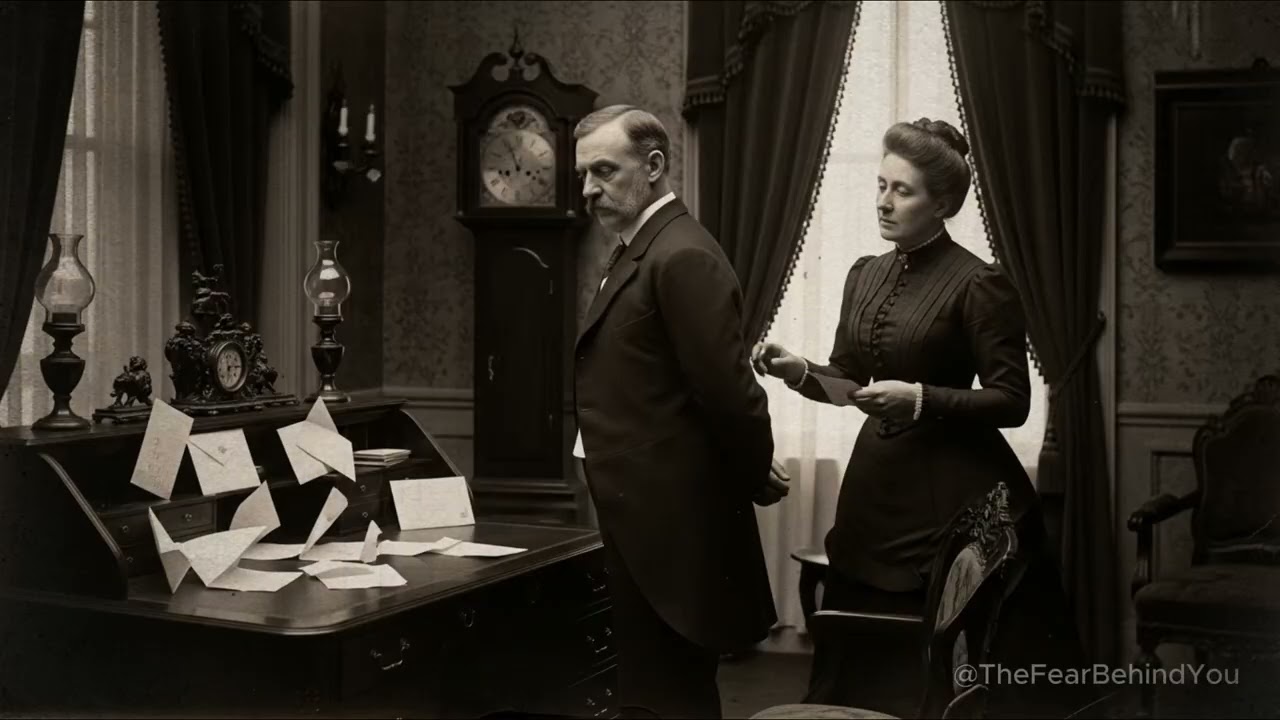
Aldrich Witmore had inherited the estate from his uncle, Cornelius, who had built the house and amassed nearly 3,000 acres of timber and iron-rich land before his death in 1878. Aldrich had no interest in the Virginia mountains. He moved to Baltimore, established himself in the shipping trade, and rarely returned. The house was left in the care of a local family, the Henleys, who maintained it just enough to keep it from collapsing.
The seventeen rooms sat empty, gathering dust while the heir built his life three hundred miles away. The first letter arrived on September 11th, 1897. It bore the return address of the Witmore estate and contained a strange, cryptic message written in cramped, unfamiliar handwriting: “The third room on the left. We need you to see what is there.
Please come home. ” Aldrich dismissed it as a prank. He asked the caretaker, Harland Henley, if anyone had entered the house. Harland swore the house was locked and that he had the only key.
The letters kept coming. Over the next nineteen years, Aldrich received roughly forty-seven of them, perhaps more. They referenced specific rooms, the basement, the attic, a spot near the eastern garden wall. They claimed “the earth knows what it holds” and demanded he return.
Some letters contained details about Aldrich’s private life that no one in rural Virginia should have known: his wife’s maiden name, the date of his anniversary, the name of a ship his company had acquired in a private transaction. Aldrich kept every letter. He hired a private investigator named Josiah Cardy in 1903, who spent two weeks examining the estate and interviewing locals. Cardy found the house locked and empty, but in the third room on the left he discovered disturbed dust and a tin box beneath a loose floorboard containing blank paper and a dry inkwell.
Someone had been writing in that room. Cardy found no secret entrances and no explanation. His final report suggested three possibilities: a copy of the key existed, the Henleys were lying, or something beyond ordinary understanding was at work. The letters grew more impatient over time.
By 1911, they carried an undertone of urgency. “We have waited 30 years,” one read. “We can wait 30 more. But can you?
Your uncle fled this truth. Your family built this tomb. Will you be the one to finally open it? ” Aldrich never returned to Virginia.
His health declined, he slept poorly, and he confided to his wife that he dreamed nightly of walking the house’s hallways, searching for a door that always remained out of reach. He suffered a stroke in 1914 and died on March 3rd, 1916. The letters stopped for exactly one month. Then they resumed, addressed now to his heir: Morgan Witmore, his niece, a practical woman of thirty-one who had taken over the family business.
The first letter told her, “Your uncle refused. You must not make the same mistake. ” Morgan did not burn the letters as her cousin Jessimine urged. Instead, she began researching the estate’s history.
What she found was disturbing. Cornelius Witmore had been involved in repeated legal disputes over fraud, intimidation, and what one filing vaguely called “unwholesome practices regarding laborers. ” Records showed that between 1855 and 1870, seventeen estate workers had vanished without explanation, their names simply disappearing from payroll ledgers with no departure notation and no final payment. Morgan decided to go to Virginia.
On August 21st, 1916, she arrived at the estate and found it badly deteriorated. The roof had partially collapsed, windows were broken, and vines had overgrown the walls. She insisted on entering. With the caretaker Ephraim Henley, she climbed to the second floor and approached the third door on the left, the only one that was locked.
Among her uncle’s papers she had found an old pouch of keys. The third one fit. What she found in that room she would never describe in writing, but she immediately contacted the Bath County Sheriff’s Office. Sheriff Quintrell Dabney arrived with two deputies.
They found a room whose walls were covered in hundreds of tally marks. The floorboards, when pried up, revealed a cavity about four feet deep containing clothing from the mid-1800s, watches, rings, a locket with a photograph, and biological material consistent with long-term interment. The county coroner concluded the remains belonged to at least seven individuals, possibly more, placed there between 1858 and 1869. Cross-referencing the vanished workers’ names produced likely matches: a groundskeeper named Prosper Howlet, a domestic worker named Orinda Slayton, a farmhand named Fleming Bryce, and others whose names could only be guessed.
Sheriff Dabney searched the estate for answers. In the basement, behind a wall of wine barrels, his deputies discovered a hidden passage leading to a small chamber carved from bedrock. It showed signs of habitation: a makeshift bed, an oil lamp, rotted provisions, and hundreds of pages of notes and letters. There was also a journal.
Its author identified herself as Varity Slayton, sister of Orinda, the domestic worker who had vanished in 1862. She claimed to have been living beneath the house on and off since 1875. According to her journal, Varity had never believed her sister left voluntarily. She had spent years working at various estates, gathering information, and eventually heard stories about the Witmore place: workers who went in and never came out, sounds from beneath the house at night, a patriarch with a violent temper.
In 1875, an elderly construction worker who had helped build the house told her about a secret passage Cornelius had commissioned as an escape route. Varity found it. She found the hidden chamber, and she found evidence that confirmed her worst fears about her sister’s fate. She had tried going to the authorities.
In 1876, she told Sheriff Buford Crisp everything. He laughed at her, said the Witmores were a respected family and that her sister had probably run off with a traveling salesman. Varity never trusted the law again. She concluded the only way to expose the truth was to force the family to do it themselves.
For four decades, she and a shifting group of others who had lost loved ones to the estate took turns living in the hidden chamber, writing letters by lamplight, and demanding that the Witmore heirs come and see what their patriarch had done. There were as many as four people at times, a collective of grief dedicated to a single goal: making the family confront its sins. When the investigators found the chamber, it was recently vacated. The journal had been left deliberately on the table, as if its author knew she would not return.
A search for Varity Slayton was launched across western Virginia, but she was never found. Yet Morgan Whitmore’s sealed letter, discovered after her death in 1951, revealed what had really happened. On the night of the discovery, after the sheriff and deputies had left, Morgan returned to the house alone. She went down to the hidden chamber and found Varity Slayton waiting there, an elderly woman sitting in the darkness.
They spoke for hours. Varity told her everything, the full scope of the horror. Then she asked for a promise: to be allowed to stay in the chamber for the rest of her days. Morgan agreed.
Varity lived beneath the house until her death in 1931, with Morgan visiting regularly, bringing food and company. When Varity passed, Morgan buried her in the family cemetery with a marker reading only “VS faithful to the end. ”
Morgan restored the estate, converted the third room on the left into a chapel with a plaque bearing the names of the vanished, and made financial settlements with their living descendants as what she called “a moral debt owed by heritage. ” The letters stopped permanently.
The Witmore case was formally closed in 1917. No charges were ever filed because all potential defendants were long dead. Cornelius Witmore had built his fortune on the labor of people who disappeared, and the truth of what he did went with him to his grave. In 1963, the estate was demolished following a fire that gutted the interior, officially attributed to electrical failure despite the building having no active electrical service.
The county converted the land into a small park, and the family cemetery was relocated. All graves were moved except one: Varity Slayton’s marker could not be found. County workers reported that her grave appeared to have been recently disturbed, the earth freshly turned, though no records existed of any such activity. The historian Pernell Whitaker, who spent three years reconstructing this story, abandoned his research abruptly in 1961.
His final note contained a single sentence: “The letters have started again. ” No letters from the 1960s survive, and no one has ever verified whether it was true. The Witmore case remains partially unexplained, buried in county archives that few have thought to examine.
What is certain is this: a house harbored secrets for decades, a woman sacrificed her entire life to expose them, and those who had vanished were finally named, acknowledged, and remembered.
