On the morning of Tuesday, March 20th, 1923, a grocer from Memphis sat in New York watching the numbers climb and saying very little. By noon the stock of his own company, Piggly Wiggly, had nearly doubled, and the most powerful financiers in America were scrambling to buy back shares they had sold and did not own. He could name his price now. On paper, Clarence Saunders was about to collect tens of millions of dollars from the men who had tried to ruin him.
The bears who had bet against his company were trapped, and everyone on the floor of the New York Stock Exchange knew it. The country boy who had barely seen the inside of a schoolhouse had walked into the temple of American finance and beaten its high priests at their own game. He had not won. He had done something far more dangerous than win.
He had embarrassed the New York Stock Exchange in front of the entire nation, and the men who ran that exchange were not about to let a grocer make fools of them. While Saunders sat counting his paper fortune, they were already gathering in a closed room. They were about to change the rules of the game while it was still being played. To understand how a self-taught farm boy from Virginia came within hours of breaking Wall Street, you have to go back to a small store on Jefferson Street in Memphis that everyone who knew the grocery business agreed would fail.
It opened on September 6th, 1916, at 79 Jefferson Street. From the sidewalk it looked wrong. There was a turnstile at the door, the kind you would expect at a fairground, not a food shop. Inside there were no clerks waiting to help you, no long counter to stand at, just shelves packed close together and a narrow path that wound through all of them.
To see why this looked like madness, you have to know how people bought food in 1916. You walked into a store and you waited. You handed a clerk your list and he walked the shelves for you, fetching each item while you stood there. If four people were ahead of you, you waited for all four.
Most stores ran on credit and delivery, and someone always paid for that convenience: the customer. Saunders looked at all of it and saw waste. The waiting was waste. The clerks were waste.
So he turned the store inside out, pulling the goods off the back shelves and setting them where a customer could reach them. Each shopper got a basket and a nudge toward the turnstile. Past that gate, you were on your own. Every item wore a price tag, its own small revolution, because in most stores the price lived in the clerk’s head and shifted depending on who was asking.
The path mattered more than it looked. Saunders did not let you wander. He built a single winding aisle that ran past every shelf in the store, so that to reach the exit you had to pass all of it. You came in for flour and walked out with flour and soap and a tin of something you had not planned to buy.
The impulse buy was born right there, though he never used the term. A person who sees a thing is far likelier to want it. The first store held a little over 1,100 square feet, small and odd, and it worked almost at once. Prices ran lower because Saunders had stripped out the cost of all those clerks and all that credit.
Shoppers noticed. They came back. Within a year he had filed for a patent on the whole idea, the self-service store, granted in 1917, and from then on he guarded it like treasure. And then there was the name.
He called it Piggly Wiggly. Not a family name, not a place, not anything that meant a thing. For the rest of his life people asked him why, and he enjoyed the question far too much to answer it straight. One story says he watched some piglets struggle under a fence from a train window and the rhyme stuck.
Another says he made it up cold, precisely because it was the kind of name a person could not forget. When a reporter pressed him once, he said he picked it so that people would ask him that very question. A cautious man would have called it Saunders Grocery. Clarence Saunders called it Piggly Wiggly, painted it across a building, and dared you to laugh, and then dared you to forget it.
Nothing about his beginnings explained why he believed he could do any of this. Saunders was born in 1881 on a farm in Amherst County, Virginia, into a family the Civil War had emptied out. His father had marched with the Confederate Army and come home to ruin. Clarence was five years old when his mother died.
In 1891 the family gave up on Virginia and moved to Tennessee, where his father worked another man’s land as a sharecropper near a town called Palmyra. By eleven, the boy was spending his summers in a sawmill and a limestone kiln, and his holidays behind the counter of a general store. Two years of schooling was the whole of his education. At fourteen he quit for good and went to work full-time.
Plenty of poor boys worked hard in 1895. What set this one apart was what he did with the little time that was his own. He read constantly, anything he could reach, teaching himself the things the schoolhouse never got around to. He moved through a string of jobs across the region, shop assistant, night watchman, sawmill hand.
None of it stuck because none of it was the point. At nineteen he landed in Clarksville, Tennessee, in the wholesale grocery trade, working for two men named Hurst and Boylan, and there he climbed fast enough that people started to watch him. That is where Carolyn found him. In the autumn of 1903, a grocery clerk with no money and no standing married the daughter of a wealthy Illinois lawyer.
They came from opposite ends of the American ladder, and they married anyway. A year after the wedding the couple moved to Memphis. Memphis in those years was loud with money. It sat on the river and on the railroads, a funnel that the cotton and goods of half the South had to pass through.
The population had jumped from 33,000 in 1880 to more than 100,000 by the time the Saunders family arrived. The men who got rich there were often not the planters or the bankers but the wholesalers, the ones who bought cheap in bulk and sold the region what it could not do without. Saunders walked straight into that trade and gave it the devotion other men saved for scripture. In 1913 he pulled a group of retail grocers together into a venture he called United Stores, his first try at bending the trade to his own design.
Five years after that first odd little store opened, there were 615 Piggly Wiggly stores scattered across 200 cities in 40 states, all running the same way, all printing money. A year later the number passed a thousand. Saunders had built one of the fastest growing retail chains the country had yet seen, and he had done it on a piece of arithmetic most grocers could not follow even after he showed them. The arithmetic was franchising.
He did not have to build every store himself. Instead, he sold the right to use his system. A grocer in Dallas or Denver paid Saunders a fee and ran a store built to his exact design. A share of the profits came home to Memphis, where more than 250 people worked at headquarters just to keep the machine fed.
His idea multiplied while his own risk stayed put. Imitators came fast, which is the surest sign a thing is working. Up sprang Handy Andy, then Helpy Selfy, then Mick or Mack, and a Mississippi chain with the unimprovable name of Jitney Jungle. Each one borrowed the basic notion of letting people shop for themselves, and each one wrapped it in its own patented machinery to keep Saunders’ lawyers at a distance.
In February of 1922, Piggly Wiggly Stores was listed on the New York Stock Exchange. Tens of thousands of new shares went out at more than $40 each, and the dividend ran fat enough, near 11%, to make the stock look like a favor to anyone who bought it. He was, by any honest measure, among the largest grocers in the United States, rich in a way his father could never have pictured, and barely past 40. Success on that scale does something to a certain kind of man.
It does not make him careful. It persuades him that the rules other people obey are just obstacles he has not gotten around to beating. Saunders had spent his whole life proving doubters wrong. He had lost the ability to imagine that the doubters might, even once, be right.
He had also grasped something the bankers and experts of his day were slow to see: an ordinary person reading the morning paper over coffee could be reached directly, and whoever reached them first usually won the argument. In 1922 he threw his support behind Austin Peay, an old acquaintance from his hometown of Clarksville, in the race for governor of Tennessee. He bought up newspaper space and filled it with the bold, plain-talking persuasion he had spent years perfecting on flour and soap. When the votes were counted, Peay had won, and by some accounts Saunders was among the first men in Tennessee to run a candidate the way you would run a product.
He trusted the crowd more than he trusted the rule makers. If you can reach enough ordinary people loudly and before anyone else, you can win almost any fight, he believed. It was mostly true. Almost any fight is not every fight.
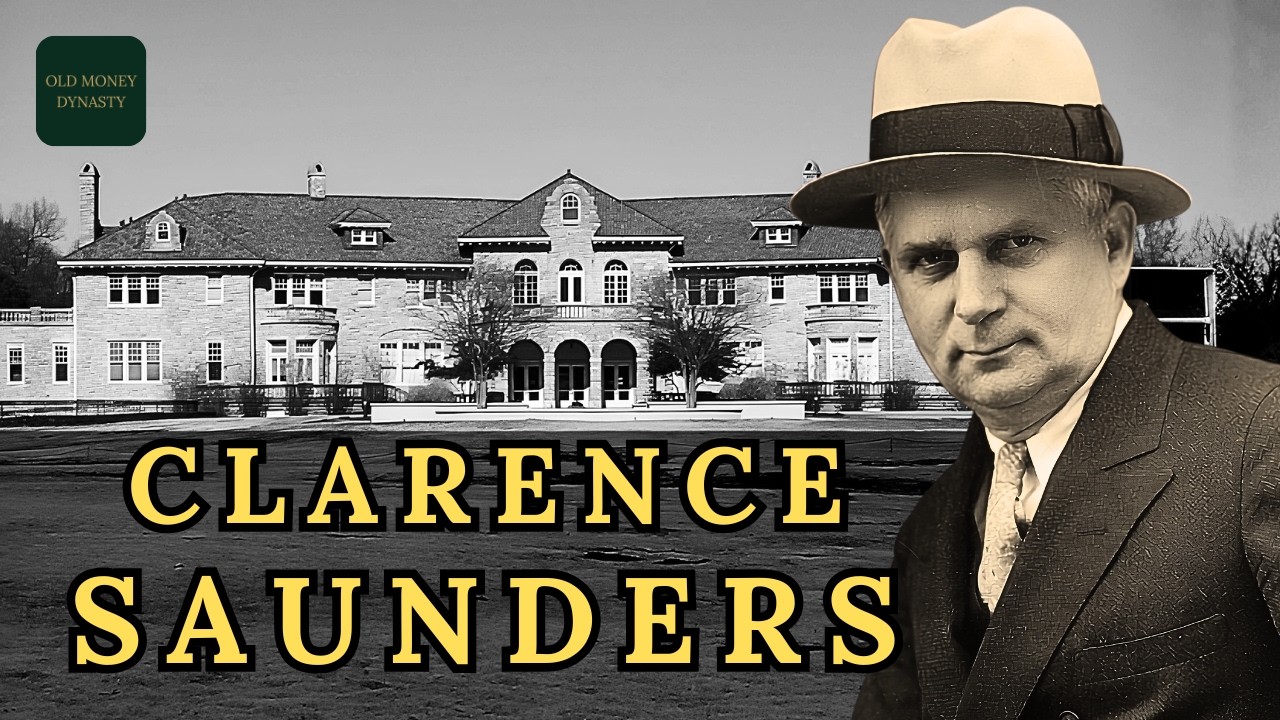
While he sharpened those instincts, he also built in marble. In 1922 he ordered tons of pink Georgia marble and hired an architect named Hubert McGee to wrap a house around it. The finished plans called for more than 36,000 square feet, two stories of rambling stone under a green tile roof with arches and bay windows everywhere. McGee struggled to name the style and settled on Romanesque American Rambling, which meant, roughly, that it was whatever Clarence Saunders wanted it to be.
The plan set aside ground for a private lake and a golf course. Inside there would be a bowling alley, an indoor swimming pool, and a shooting range, the way another man might want a porch swing. He named it Claw LeClair, stitched together from the names of his three children. The people of Memphis took one look at the rising pink stone and chose something simpler.
They called it the Pink Palace, and that name has lasted a hundred years. By his own telling, the architect had only written up the specifications while Saunders had laid out the shape of the whole place himself in two days. By the time the marble was going up, the house had already swallowed more than a million dollars, and it still was not finished. Out in New York, in an office he had never set foot in, a small group of men were studying his company and reaching the opposite conclusion.
They thought the grocer had climbed too high and too fast. They thought his stock was a bubble waiting to burst. In early 1923, a cluster of Piggly Wiggly outlets in New York went under. In the life of a company with more than a thousand stores, this was a scratch, not a wound.
But a few men on Wall Street looked at that scratch and saw a chance to draw blood. The firm of Merrill Lynch and a handful of other speculators decided Piggly Wiggly was ripe for a bear raid. The phrase needs explaining because it sits at the center of everything that follows. To bet that a stock will fall, a trader can sell shares he does not actually own.
He borrows them from someone who does and sells them at today’s price on the promise that he will hand the same shares back later. If the price drops the way he hopes, he buys them back cheaply and keeps the difference. These traders are called bears, and when a pack of them goes after one stock together, talking it down and selling hard, that is a bear raid. They began shorting the stock and whispering that the grocery chain was overbuilt and overvalued, a southern fad on the edge of collapse.
The price started to slide. Down in Memphis, Clarence Saunders read about it in the papers and lost his temper completely. He took it as an insult. These were not merely men betting against a stock.
They were sneering at his company and his city. He said Wall Street had come swooping down on Piggly Wiggly like an eagle on a chicken. And he decided, with the total confidence of a man who had never lost, that he would break Wall Street in return. The safe move was to ignore the bears and let the business speak for itself.
Saunders did the opposite. He went to a group of Southern bankers and borrowed $10 million, a staggering sum worth well over a hundred million in today’s money. Then he marched into the open market and began buying his own company’s stock by the fistful. If the bears were forcing the price down, he would force it back up by buying everything in sight.
Within a week he had scooped up more than a hundred thousand of the two hundred thousand shares in existence. The stock that had sagged toward $39 began to climb: 40, then 50, then 60, and still rising, while the bears who had sold high started to sweat. He never did anything quietly. The newspapers reported that he had arrived in New York on a private railroad car trailed by four armed guards carrying suitcases stuffed with a million dollars in cash.
One New York paper told its readers that Wall Street had better put locks on its safes because Clarence had come to town to teach the city how the financial game was really played. To half the country it was the best show in years. Out in the towns and the farms, people who had never owned a share of anything in their lives were rooting for the grocer who had walked straight into the lion’s den. What almost none of them understood was that he had not actually won anything.
He had only set a trap. Here is what the bears had failed to notice. While they were busy shorting Piggly Wiggly and betting it down, Saunders had been quietly buying it up. By that Tuesday, he claimed to hold all but about 1,100 of the 200,000 shares in existence.
Nearly every piece of paper that proved you owned a sliver of Piggly Wiggly was sitting in his vault. This is called a corner, and it is the deadliest position in the old market. When one man controls the entire supply of a thing, anyone who needs that thing must come to him and pay whatever he asks. And here is the cruelest detail.
To place their short bets, the bears had borrowed shares and sold them off. Some of those borrowed shares had come, without their knowing the source, from Saunders himself. He had lent his own stock to the very men trying to ruin him, which sounds like madness until you see the point of it. A lender can call his shares back whenever he pleases.
So on that Tuesday morning, Saunders called. And the bears, who had already sold those shares to strangers, now had to go and buy them back to return them. Buy them back from whom? Saunders owned nearly all of it.
The bears fanned out across the exchange hunting for Piggly Wiggly stock and there was almost none to be had. The handful of shares that did change hands climbed in price by the minute. The stock opened that morning around $75. Within the hour the frantic bears had bid it up to 90, then 100, then 105.
By midday Piggly Wiggly touched $124 a share with almost nothing actually trading. Men who had sold the stock short at $40 now had to buy it back at 124 to settle their debts. Every dollar the price rose came out of their pockets and went toward his. Under the rules of the exchange, the bears had until the following afternoon to deliver the shares they owed.
They could not find them. Word raced out of New York and across the country. The grocer had done it. In Memphis they were ready to throw him a parade.
In the farm towns they treated him like a folk hero. For a few hours on the afternoon of March 20th, Clarence Saunders was the most envied businessman in America and he believed with everything in him that the fight was over and he had won. Powerful institutions do not lose gracefully. On the very afternoon he believed he had won, the governing committee of the exchange, a body made up of the same kind of men he had just humiliated, retired to a closed room to decide his fate.
They made two decisions, and the second one killed him. First, they suspended trading in Piggly Wiggly stock, which froze the price and stopped the squeeze in its tracks. Then came the blow. Under the normal rule, the cornered bears had one day to deliver the shares they owed.
The committee gave them five. To see why those four extra days mattered so much, you have to remember where the missing shares were. They were not all in New York. They were scattered in the hands of ordinary people across the country, folks who had bought a few shares of Piggly Wiggly years ago and forgotten about them.
In a single day the bears could never have found them. In five days, they could. Telegrams went out to every corner of the map, and the shares came in. Out in towns like Sioux City, people who had never heard the words Piggly Crisis got a strange and welcome offer in the mail.
Someone wanted to buy their old forgotten stock for around $100 a share, double what it had been worth. They sold, delighted, with no idea they were rescuing Wall Street and burying a grocer in Memphis. Saunders saw it happening and fought to the last. He offered to settle for $150 a share if the bears delivered fast, and 250 if they dragged their feet, trying to keep the pressure on.
It made no difference. The exchange had given them the only thing they needed, which was time. By the end of the week, most of the bears had paid him back in full. And here is the cruelest part.
The bears paid him back in shares of Piggly Wiggly, not the high prices he had dreamed of collecting, but the stock itself, now frozen and very nearly worthless. Saunders had won his corner in the narrowest technical sense. He had his shares. What he did not have was money.
Weeks earlier, sensing he would need a way out, Saunders had advertised shares for sale to the public at $55 a piece, a way to turn his paper into cash on his own terms. Once the exchange froze the stock and the price collapsed, no one wanted to buy a falling thing at $55. The door he had built for himself was bricked over. People still argue about whether the exchange had the right to do what it did.
Halting the trading was within its power. Extending the deadline for the losing side in the middle of the fight was something else. What is not in doubt is the result. Clarence Saunders had played the game better than the men who invented it, and they had simply reached over and moved the board.
It was one of the last great corners the New York Stock Exchange would ever permit. Before long, new laws would make the whole maneuver illegal. When it was over, Clarence Saunders had his name and very little else. The loan came due in September, two and a half million dollars of it, and the cash simply was not there.
In August of 1923, Saunders resigned as president of the company he had built from a single store, and he signed nearly everything he owned over to his creditors: his stock, his automobiles, and the pink palace, the marble house he had poured a fortune into. He gave it up having never spent a single night under its roof. Some of his Piggly Wiggly shares, once the most fought-over stock in America, were auctioned off for a single dollar. A year later he was formally bankrupt.
The papers that had sung his praises a month before now called him the boob from Tennessee. He raged at the exchange and swore he would spend the rest of his life seeing justice done. The lawsuits he threatened went nowhere at all. Most men do not come back from a fall like that.
Clarence Saunders was not most men. Within a year he was opening grocery stores again, and he called the new chain Clarence Saunders, Sole Owner of My Name. By one telling, the name came from a bankruptcy judge who looked at him across the courtroom and said that he owned nothing now but his own name. Saunders heard that as a dare.
The new owners of Piggly Wiggly had taken his company and his patents, and they half believed they had bought his name along with them. So he printed that name on every store he built in letters a foot high just to prove it still belonged to him. He set his Sole Owner stores up wherever he could, often directly across the street from a Piggly Wiggly, daring his old company to compete with the man who had invented their whole way of doing business. And it worked.
The stores caught on and within a few years he was a millionaire all over again. He even built himself a second estate outside Memphis, a sprawling lodge of log and timber. Then there is the football team, which is real. To promote his stores, Saunders bankrolled a professional squad and called them the Sole Owner Tigers.
In December of 1929, his grocery store team played the Green Bay Packers, the reigning champions of the National Football League, and beat them 20 to 6. The league was impressed enough to invite the Tigers to join. He said no, because he did not care for the idea of traveling to other cities for away games. The second time Clarence Saunders lost everything, there was no villain to rage at.
In October of 1929 the stock market crashed and the Great Depression settled over the country. People stopped spending. The chain Saunders had built so quickly came apart just as fast, sliding into bankruptcy in the early 1930s. There was no governing committee this time, no closed room to blame, just the slow grinding failure of a whole economy, which is a far lonelier thing to lose to than Wall Street.
A reasonable man, twice ruined, might finally have rested. Saunders did the opposite. He went looking for backers and poured what was left of his energy into the strangest idea of his whole strange life: a grocery store that ran almost entirely without people. He called it the Keydoozle, another made-up word.
The first one opened in Memphis in 1937, and it worked like something out of a dream of the future. The groceries sat behind glass, each item with a small keyhole beneath it. You walked the aisles with a special key, and when you saw what you wanted, you put the key in the slot. The machine noted your choice on a paper tape.
At the front, the system read the tape, and your groceries came gliding out to you on a conveyor belt, bagged and ready. It was, in a real sense, the supermarket of the future, dreamed up decades too early. And that was the problem. The machinery was complicated and expensive, and it tended to break down at exactly the wrong moment, when the store was full and every key was turning at once.
Shoppers grew impatient. The marvel became a nuisance. He tried again with an improved version after the war, and that one failed too, closing its doors in 1949. In between, during the war years, the man who had twice been a millionaire kept himself busy making toy wagons and broomsticks.
The inventor of the modern supermarket, the grocer who had once frightened Wall Street, building little wooden toys in his 60s while he waited for the world to be ready for his machines. He never stopped. At the very end of his life, Saunders was working on yet another automated store, this one called the Food Electric, built around a primitive sort of computer he called a shopping brain. The device would let a customer ring up and wrap her own purchases without a single clerk.
He meant to build it two blocks from the spot where the first Piggly Wiggly had opened almost 40 years before. It never got built. Clarence Saunders died of heart failure in the autumn of 1953, still drawing up plans for a store that did not exist. Walk into any grocery store tonight, anywhere in the country, and you are standing inside Clarence Saunders’ head.
The cart in your hands, the open shelves, the price on every can, the slow loop the aisles pull you through past a hundred things you did not come for. He thought all of that up in a single small room in Memphis, and the world simply kept it long after it forgot the man who handed it over. Piggly Wiggly is still out there, more than a hundred years on, hundreds of its stores still trading across the American South, each one independently owned. The silly name holding up just fine.
Saunders would have enjoyed that. And the Pink Palace still stands in Memphis. The marble house he poured a fortune into and never slept in became the city’s first museum back in 1930. Inside the palace that ruined him sits a careful replica of that first tiny Piggly Wiggly, the little store that started everything.
The mansion and the shop, the peak and the beginning, both preserved under the same pink roof. His Wall Street fight had a strange second life as well. In 2021, when a crowd of small investors online squeezed the big hedge funds on a stock called GameStop, the financial pages went looking for a precedent. They found a Memphis grocer who had tried the very same thing in 1923 and nearly pulled it off before the people who owned the game changed it on him.
A hundred years later, his fight was suddenly everywhere again. He grasped at almost everything and got to keep almost none of it. And yet, the next time you push a cart down an aisle, lost in the small ordinary business of feeding your family, remember that a barefoot Virginia farm boy built the road you are walking.
That may be the strangest fortune of all, the one he never knew he kept.






