The whistles came too late. Three sharp blasts screamed from the brakeman’s position at the rear of the train, slicing through the roar of the boiler and the grinding of steel on ice. The engineer heard them, or thought he did, and reached for the throttle as the curve rushed up out of the darkness ahead. Behind him, the sleds were already pushing.
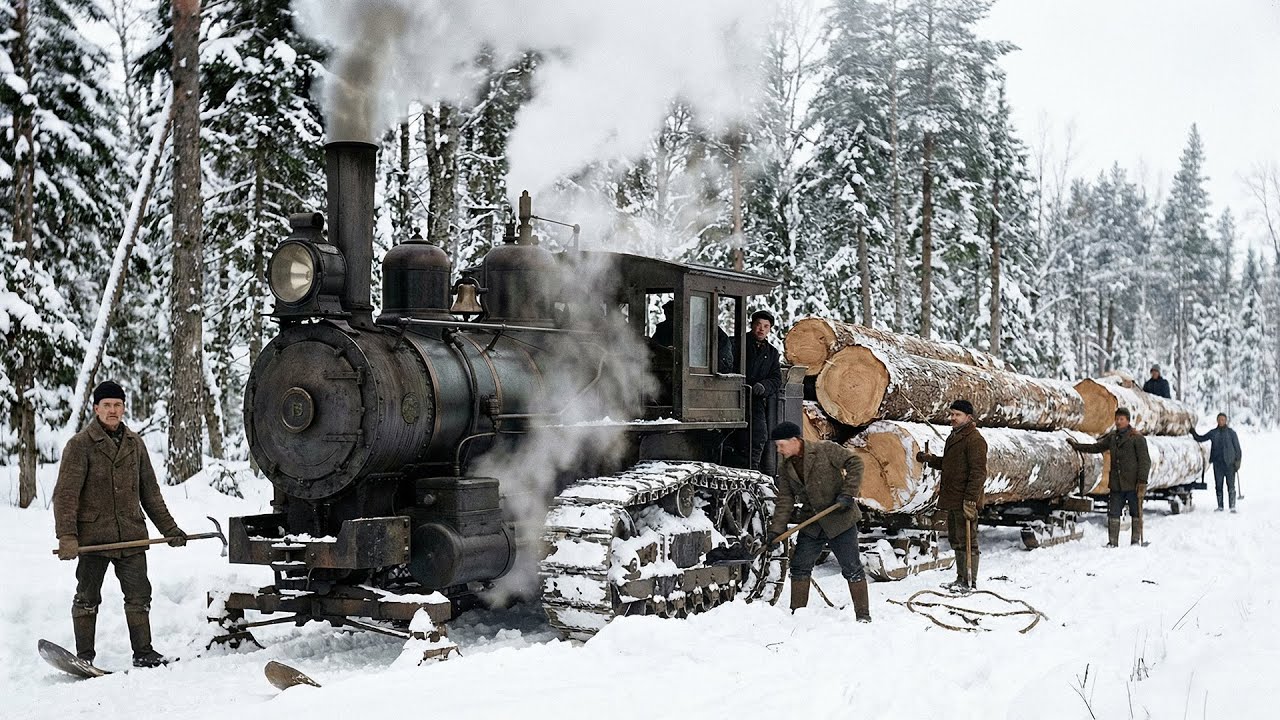
Two hundred tons of freshly cut timber, chained together in a train that stretched more than a hundred yards, had begun to shove the twenty-ton machine faster than any brake could hold. The ice road gleamed ahead, descending into the black of a March night, and the curve was too sharp. The lead sleds left the road first. The chain reaction was instantaneous.
Sleds overturned, logs spilled, and the weight behind pulled the Lombard sideways into the forest. When it was over, near Ashland, Maine, in March 1910, three men were dead. The Bangor Daily News would report the accident with clinical precision: Lombard log hauler lost control on grade. Three men killed when machine overturned.
Cargo lost. The report did not mention that you could hear the men screaming over the sound of tearing metal and splintering wood. Before Alvin Lombard’s invention arrived in the North Woods, winter logging was a brutal arithmetic of horses, ice, and human endurance. You could fell timber year-round, but you could only move it in winter.
Snow and ice transformed muddy forest trails into smooth highways, and teams of horses, sometimes thirty or forty at once, hauled loaded sleds from cutting sites to rivers or rail depots. It was slow. It was limited. And it was the bottleneck that determined how much timber a company could harvest.
The camps operated from November through March, when temperatures dropped low enough to freeze the logging roads solid. You lived in rough hewn bunkhouses heated by a single stove, sleeping in bunks stacked three high. The smell of wet wool, tobacco, and unwashed bodies was so thick you could taste it. Breakfast was beans and salt pork served before dawn.
You worked until dark, six days a week, for wages that barely covered your keep. Maine, New Hampshire, northern Wisconsin, Michigan—anywhere the great northern forest still stood, winter logging camps appeared like temporary towns. The companies paid in scrip, tokens good only at the company store. A pair of boots cost three days’ wages.
A winter coat, a week. By the time spring thaw came, most men owed more than they had earned. The bottleneck was transport. You could cut a hundred trees a day with a good crew, but moving them to market took weeks.
The companies needed speed. They needed capacity. They needed something that could haul more timber faster over ice roads that horses struggled to navigate. Then Alvin Lombard changed everything.
In 1901, Alvin Lombard of Waterville, Maine, patented the first successful steam log hauler. It was a machine that seemed impossible: a steam tractor that ran on steel tracks in the rear and twin skis in front, designed specifically to operate on ice and snow. The vertical boiler stood eight feet tall. The endless track, an innovation that would later influence military tanks, provided traction where wheels would simply spin.
The entire machine weighed over twenty tons empty. It could pull what fifty horses could not: six to ten sleds, each loaded with twenty to thirty tons of logs, chained together in a train that stretched a hundred yards or more. Total cargo approached or exceeded two hundred tons, moving at ten to fifteen miles per hour over ice roads that were watered every night to maintain a glassy surface. The economics were undeniable.
One Lombard could do the work of multiple horse teams, operating longer hours, hauling heavier loads, moving faster. The first camps that acquired them treated them like miracles. Production doubled, then tripled. Timber that would have taken a week to move now made the journey in a day.
The machines cost around five thousand dollars, a fortune in 1901, but they paid for themselves in a single season—if they did not break down or kill someone first. The engineer who operated the Lombard sat exposed on a small platform, one hand on the steering wheel, the other on the throttle. The fireman stood behind him, feeding cordwood into the firebox to maintain steam pressure. The brakeman rode the rear sled, responsible for controlling the friction brake that was supposed to prevent runaways on downhill grades.
And the swampers walked ahead, clearing obstacles and maintaining the ice road surface. Revolutionary, yes, but terrifying. The winter logging season ran from late November through early March, four months of sub-zero temperatures, blizzards, and darkness that came before dinner. You worked in conditions that would kill you if you stopped moving.
Frostbite was common. Hypothermia was a constant threat. And the Lombard itself became a focal point of danger and survival. As fireman, you fed four-foot lengths of cordwood into the firebox at four in the morning, your breath freezing in the air before you could exhale fully.
The boiler needed to reach operating pressure, 150 pounds per square inch or better, before the machine could move. In extreme cold, this took hours. The water in the boiler could freeze overnight despite banking the fire. The metal became brittle.
Every valve, every fitting, every seam was stressed by thermal contraction. The ice roads themselves were engineering marvels and death traps in equal measure. Swampers flooded the logging road every night, pouring water from tanks to create a smooth, glassy surface. The road needed to be perfectly graded: slight uphill on the way out to the cutting sites, slight downhill on the return with loaded sleds.
The sound of a Lombard in operation was unmistakable—the hiss of steam escaping from relief valves, the rhythmic clatter of the track rolling over frozen ground, the deep thrumming of the boiler, and the sharp blast of the whistle used to signal the crew. In the stillness of a winter forest, you could hear a Lombard from miles away. Getting it started was one thing. Keeping it alive, and keeping yourself alive around it, was another.
Building steam pressure in sub-zero temperatures was a ritual that combined precision, patience, and prayer. You started in darkness, hours before the hauling would begin. The firebox had to be fed carefully. Too much wood too fast created dangerous pressure spikes.
Too little, and you would never reach operating temperature. You watched the steam gauge obsessively, looking for that slow climb toward 150 pounds per square inch. The danger of cold starts was real and well documented. Metal that had been sitting at twenty below overnight did not expand evenly when heated.
Boiler seams could crack. Water lines could freeze solid, creating blockages that caused catastrophic pressure buildup. Safety valves could freeze shut. In a February 1907 incident near Greenville, Maine, a Lombard’s boiler exploded during cold start operations, killing the fireman instantly.
The investigation found that a frozen safety valve had prevented pressure relief. The boiler had ruptured at an estimated 200 pounds per square inch. You were feeding wood, watching the gauge, listening to the metal groan and tick as it heated. The first movement of the machine was always a lurch, the track biting into ice, the whole frame shuddering as steam pressure translated into mechanical motion.
If everything worked, the Lombard rolled forward smoothly. If something was frozen or misaligned, it jerked. It stalled. Or worse, it moved when you did not expect it to.
And that was when men died—crushed between the machine and a tree, run over by the track when the Lombard lurched during startup, scalded by steam from a ruptured fitting. The morning routine was the first test of survival, and you had not even hooked up the sleds yet. Hitching the sleds was a study in controlled chaos. Each sled was a massive wooden frame mounted on steel runners, designed to carry fifteen to thirty tons of logs.
They were chained together in sequence, one behind the other, creating a train that could stretch over a hundred yards when fully loaded. You worked on ice in darkness or dim pre-dawn light, with tons of timber and machinery moving around you. You hooked chains in the dark, hands numb despite heavy gloves. If the Lombard lurched forward while you were between the sleds, you had maybe a second to get clear.
The engineer could not see you. The machine was loud enough that he could not hear you scream. The only communication was whistle signals, and in the chaos of coupling operations, signals got missed. A January 1908 accident at a camp near Moosehead Lake killed a young swamper during hitching operations.
The engineer, thinking he had received a signal to move forward, engaged the throttle. The machine lurched. The swamper, crouched between two sleds adjusting a chain, was caught. The massive wooden frame of the rear sled rolled over him.
By the time they stopped the machine, he was dead. He was nineteen years old. The company paid his family forty dollars. The math of the operation was staggering.
Six to ten sleds, each carrying twenty to thirty tons, for a total load approaching or exceeding two hundred tons. The Lombard, powerful as it was, operated at the edge of its capacity. Overloading was common. More timber per trip meant more profit.
The machine could handle it on flat ground. On grades, even slight ones, the physics became murderous. The haul itself was a journey through winter darkness along roads that existed only as long as the ice held. The route from the cutting site to the river landing or rail depot could be ten miles or more, winding through dense forest, over frozen streams, around granite outcrops.
The ice road had to be maintained constantly. Any imperfection could derail a sled or cause the Lombard to lose traction. You steered with a wheel connected by chains to the front skis, but twenty tons does not turn on a dime. You had to anticipate curves hundreds of feet in advance.
The steering was imprecise at best, fighting you at worst. If a ski hit a rut or a patch of rough ice, the whole machine could veer unpredictably. With two hundred tons pushing from behind, even a small deviation from the road could be catastrophic. Speed control was mostly about throttle position.
Open it, and the Lombard accelerated. Close it, and you relied on friction and gravity to slow down. There was a brake, a friction mechanism on the rear sleds operated by the brakeman, but it was woefully inadequate for the loads being hauled. Visibility was often terrible—steam and smoke from the boiler, darkness, snow, fog.
You navigated by feel and memory, trusting that the road ahead was the same as it had been yesterday. The sound and vibration were constant: the grinding of the track over ice, the hiss of steam, the creak of loaded sleds, the deep thrumming of the boiler. You felt it through your boots, through the steering wheel, through your entire body. Hours of this, day after day, in cold that made your bones ache.
And then came the downhill grades. The descent was where physics became the enemy. Ice roads were built with a slight downhill grade on the return journey to make pulling easier. But with two hundred tons of loaded sleds chained behind the Lombard, slight became terrifying.
You felt the sleds pushing, the Lombard picking up speed, and you knew the brake would not hold. The brakeman riding the rear sled operated a friction brake designed to create drag. It was supposed to prevent runaways. In practice, it was a strip of wood or metal pressed against the steel runner, and it worked until it did not.
On a long grade, the friction heated the brake shoe, reducing effectiveness. On glassy ice, even a perfect brake could not generate enough friction to slow two hundred tons of momentum. Communication between engineer and brakeman was by whistle. One blast meant increase speed.
Two meant decrease. Three meant emergency stop. But over the roar of the machine and the screaming of loaded sleds on ice, whistles were often missed or misunderstood. The brakeman might be signaling desperately for a stop while the engineer, hearing nothing, kept the throttle open.
And then things went wrong. A runaway Lombard was a nightmare scenario played out in slow motion, or sometimes terrifyingly fast. The brake fails. The ice is too smooth.
The grade is steeper than expected. You are accelerating. The whistle screams three sharp blasts. And there is a curve ahead that you know the machine will not make.
In March 1910, near Ashland, Maine, the brake failed completely. Later investigation suggested the brake shoe had worn through and was not replaced. The machine and its train of loaded sleds accelerated to an estimated twenty-five miles per hour approaching the curve. The engineer, the fireman, and a swamper walking ahead were killed.
The brakeman survived by jumping clear, suffering a broken leg and severe lacerations. The accident report described the scene in detached language: wreckage scattered over approximately two hundred yards of forest. Logs, twisted metal, and human remains intermixed. Recovery required two days.
The emotional toll was not recorded. Sometimes the disaster was not a sudden runaway. Sometimes it was a slow, grinding loss of control. A chain breaks, sending one or more loaded sleds careening down the mountain independently.
Men scramble to get clear. Not all of them make it. The boiler was the heart of the machine, and like any heart, it could fail catastrophically. Operating a steam boiler in extreme cold created stresses that no amount of engineering could fully mitigate.
The metal expanded and contracted with temperature changes. Seams weakened over repeated heating cycles. Corrosion ate through walls that looked solid from the outside. And the safety systems—pressure relief valves, water level gauges, emergency vents—could freeze solid.
You heard the crack in the boiler seam and had maybe two seconds to jump. If you were lucky, you jumped far enough and fast enough. If not, the explosion caught you. Superheated steam at 300 degrees does not just burn.
It sears lung tissue, strips skin, causes injuries that are agonizing and often fatal. A boiler explosion in January 1911 near Patten, Maine, killed both the engineer and fireman. Witnesses reported hearing a sound like a cannon shot, followed by a massive release of steam. The boiler had ruptured along a seam that later examination showed had been weakened by repeated freeze-thaw cycles.
The explosion sent metal fragments fifty yards into the forest. One piece, weighing an estimated thirty pounds, was found embedded in a tree trunk. Track failures were another constant threat. The endless track system was revolutionary, but it was also mechanical and prone to breaking.
A link could fracture from cold stress or metal fatigue. When a track broke at speed, the Lombard could derail, overturning on narrow ice roads with no margin for error. Steering failures, broken linkages, frozen joints meant losing control entirely. Field repairs in sub-zero temperatures were brutal and often inadequate.
No replacement parts. No machine shop. You fixed what you could with what you had and hoped it held. Speed killed more men than the work itself.
But the system pushed hardest here. The companies demanded results. You had four months, November through March, to extract a year’s worth of timber. Every day the Lombard was not running was a day of lost profit.
Haul quotas were set based on the machine’s theoretical maximum capacity, with no allowance for weather, mechanical issues, or safety concerns. Crews that met quotas earned bonuses. Crews that fell behind were replaced. So you ran worn equipment.
You skipped maintenance. You hauled loads that exceeded design limits. You operated in conditions—blizzards, extreme cold, darkness—that should have shut down operations. Because stopping meant no pay.
And no pay in an isolated winter camp, where everything cost twice what it should, meant debt. The Lombard was often the only machine serving an entire logging operation. There was no backup. If it broke down, production stopped until it was fixed.
This created immense pressure to keep it running regardless of condition. Worn brakes that should have been replaced were good enough. Boilers with visible corrosion were safe enough. Men knew they were taking lethal risks.
They took them anyway, because the alternative was unemployment and debt in a system designed to trap them. The winter logging camps were isolated by geography and season. You could not leave until spring thaw. Even if you wanted to quit, you had nowhere to go.
The nearest town was twenty miles through roadless forest. You had no money. Scrip was worthless outside camp. And the companies maintained blacklists—complain about safety, refuse dangerous work, try to organize for better conditions, and you would never work in timber again.
You worked, you survived, or you did not. And the company had replacements arriving on the next supply run. Spring thaw brought a different kind of danger. The logging season officially ended in March, but companies often pushed operations into April to maximize the winter’s haul.
The ice roads, frozen solid in January, became treacherous as temperatures rose. What had been a glassy highway became a rotting trap. You made one last haul in early April 1909. The ice road had been in use for four months.
Daily traffic from the Lombard and loaded sleds had worn grooves and weak spots. Daytime temperatures climbed above freezing. At night it refroze, but not solid. You could hear the ice creaking under the machine’s weight.
You could see water pooling in low spots. And you kept going, because the company wanted one more load. Ice road collapse was sudden and total. The Lombard, weighing twenty tons, would break through.
If you were lucky, the machine settled onto the frozen ground beneath a shallow layer of ice. If not, it went into a stream or pond. Recovery operations were dangerous, often fatal. Men working to extract a sunken Lombard could be crushed by shifting machinery, drowned if they fell through adjacent ice, or injured by snapping cables and chains.
In April 1912, a Lombard broke through ice near Rangeley, Maine, plunging the engineer and fireman into frigid water. The fireman drowned immediately, trapped beneath the overturned machine. The engineer survived long enough to be pulled from the water, but died from hypothermia before reaching camp. The machine itself took three weeks to recover and was deemed a total loss.
Season’s end meant tallying the cost. How many men injured? How many dead? How many Lombards damaged or destroyed?
Individual stories emerged in accident reports and newspaper accounts when they emerged at all. Most deaths went unrecorded beyond a line in a company ledger. Conservative estimates suggest dozens of deaths directly attributable to Lombard operations during the machine’s peak years. The actual number was almost certainly higher.
Calculating deaths per machine, per season, is impossible because the records do not exist. What we have are fragments: newspaper accounts of spectacular accidents, occasional investigation reports, company ledgers that note operational losses without detail. The Lombard log hauler evolved over two decades of operation. By the 1920s, improved models featured better braking systems, reinforced boilers, and more reliable steering mechanisms.
The lessons were learned in blood, implemented grudgingly, and often only after regulatory pressure made ignoring safety concerns more expensive than addressing them. But the Lombard’s dominance was already fading. Internal combustion tractors, smaller and more maneuverable, began appearing in logging camps. Road improvements meant timber could be hauled year-round, not just during winter.
The specialized niche the Lombard had filled—moving massive loads over ice roads—was shrinking as the industry changed. Regulatory response was minimal and late. Maine and New Hampshire passed industrial safety laws in the 1910s, but enforcement in remote logging camps was nearly nonexistent. Companies paid fines when caught, treated them as operating costs, and changed nothing.
Real safety improvements came from technological advancement and economic pressure, not from concern for workers. The companies that profited—logging firms, timber barons, paper mill owners—built an empire on that wood. The men who died hauling it left widows, orphans, and unmarked graves in forest clearings that are now themselves overgrown and forgotten. A handful of Lombard log haulers survive today, preserved in museums and historical sites across New England.
They sit silent and cold, stripped of the violence they once embodied. The Patten Lumberman’s Museum in Maine has one. The New Hampshire Snowmobile Museum has another. They are massive, impressive, and utterly inert monuments to an era when timber was king and men were expendable.
The infrastructure those machines built still stands. Modern logging technology has changed everything and nothing. The Lombard was just one chapter in a longer story of industrial labor where progress was built on the backs and bones of men who had no choice but to accept the terms offered.
