On the morning of July 14, 1933, a diver stood at the base of a pneumatic caisson sunk into the Mississippi River at Waggaman, Louisiana, enclosed by air compressed to roughly 28 pounds per square inch above atmospheric pressure. The river’s surface lay 75 feet overhead. Above him was the water. All around him was the compressed air that surface compressors drove through an airlock to hold that water back.
Below him was the silt the Mississippi had laid down at that spot across more than 10,000 years: gray clay, fine sand, and decomposed organic matter reaching another 30 feet deeper, until the soil engineers who had completed their investigations the year before verified a solid foundation able to bear the construction. His task was to dig out the material under the caisson’s cutting edge. He did it with a water jet and a shovel. The jet loosened the sediment.
He then shifted the broken-up material toward the middle of the caisson floor, where it dropped into a muck chamber, a sealed compartment built so excavated material could be lifted to the surface without letting the compressed air escape that kept the river out of the working chamber. The caisson around him was a steel cylinder roughly 40 feet across. As digging and removal went on beneath the cutting edge, the weight of the concrete poured above forced the structure down into the riverbed. Every foot of downward progress demanded more excavation beneath the cutting edge and more concrete above it.
The cylinder sank while the pier climbed. He was one of roughly 40 men laboring in compressed air that morning. They worked shifts of restricted length, because the compressed air that kept the water out also altered the nitrogen in their blood in ways physicians did not entirely comprehend, though they had been investigating the problem since the 1870s. The workers saw it in plainer terms: some men who came up too fast after working in compressed air fell gravely ill, and some died.
The ailment was known as caisson disease. The men called it the bends. This is the account of how Louisiana built the southernmost fixed crossing of the Mississippi River at a location where the river stretches nearly a mile wide at flood stage, where the current moves 3 miles per hour at normal flow and faster when the basin is draining. The navigation channel runs more than 100 feet deep at the main crossing, and the sediment under the riverbed continues another 50 feet before reaching material strong enough to support foundations built to carry a loaded freight train at speed.
It is the account of a project that Louisiana was told for 30 years was too costly to finance, too geologically unreliable to construct, and, by some engineers’ judgment, simply too far south on the river to be founded safely on competent material. Yet it was completed in 3 years and 4 months by a man who refused to accept that what others called impossible was truly so, and who built roads and bridges with the same conviction he brought to everything he touched: that the people of Louisiana had been told far too long they could not have what people in other states had, and he was set on proving they could. That man was shot to death 3 months before the bridge opened. The bridge was named for him.
The men who built it survive in the payroll records of the contractors who hired them, in whatever form those records endured. To grasp why the Mississippi south of Memphis had no fixed crossing whatsoever in 1930, and why that stayed true through the industrial age, one must understand what the Lower Mississippi is and what it does to structures that attempt to stand in it. The Mississippi at New Orleans is not the river that flows into Minnesota from Canada. It is the same water, in the sense that water draining the northern basin eventually passes through Louisiana; but by the time it arrives at New Orleans, the river has collected the drainage of 31 states and two Canadian provinces, and it carries that water through a channel it has cut, deserted, and rebuilt across the alluvial plain of the lower valley since the last glacial retreat.
The river keeps no fixed position. Across centuries it has occupied many channels over the breadth of the alluvial Mississippi Valley, leaving a record of its former courses as oxbow lakes, cypress swamps, and ridge lines in the delta topography. The river that bridge engineers faced at New Orleans in the early twentieth century ran through a channel selected relatively recently in geological terms, on a foundation made of its own deposits. Beneath the riverbed, soft material reaches 200 feet down before anything resembling stable bearing capacity appears.
The river’s width at the Waggaman crossing shifts with river stage. At low water, the main channel measures about 2,000 feet across. At flood, the river spreads over its banks to nearly a mile. The main navigation channel at the crossing reaches 100 feet or more in the scour holes the current has carved into the sediment at the bend.
Surface current in the navigation channel reaches 3 miles per hour under normal conditions. During the spring flood season, when snowmelt from the upper basin and rainfall from the Ohio Valley drive the river to its highest stages, surface speed in the main channel reaches 5 miles per hour or more. A steel caisson lowered through 75 feet of river water to reach bearing material beneath the bed must hold its place in that current while men work inside it. Engineers calculated the lateral loads the current would impose.
The river imposed them on its own timetable. Below Memphis, no fixed bridge crossed the river until 1892, when the Memphis Bridge opened: the first crossing between St. Louis and the Gulf of Mexico a locomotive could use without a ferry. Below Memphis, the river crosses Mississippi, Arkansas, Tennessee, and Louisiana through a valley that is flat, extraordinarily wide, and made entirely of the river’s own deposits, so the challenge of anchoring a pier in it with no bedrock at any reachable depth is the same challenge at every site, and greater the deeper and wider the river grows toward the Gulf.
The commercial importance of the lower river made any fixed crossing as much a matter of political negotiation as of engineering. The river was the economic artery of the south-central region. Towboats and barges moved coal, grain, and petroleum products north and south on schedules set by commodity markets, weather, and river stage, not by the wishes of any bridge authority. Any bridge at New Orleans had to permit passage of the tallest ships on the river, had to let them pass without disrupting commercial navigation during construction, and had to accomplish all of it on a foundation of mud while an unceasing current pushed against every structure placed in it.
Initial engineering schemes for a New Orleans crossing of the Mississippi emerged in the 1890s, when the Southern Pacific Railroad funded preliminary investigations for a rail bridge upstream of the city, at a location where the river ran somewhat narrower. Every firm that looked into the matter returned the same verdict. The crossing could be built. The crossing would cost a fortune.
The foundations would have to go deeper than anything the profession had accomplished at any crossing upstream of that point. The mandated navigation clearance would stretch the main spans to lengths at the outer limit of what the era’s technology could build at a reasonable price. The return on investment from rail traffic alone, given the traffic volumes of the 1890s and the first two decades of the twentieth century, did not justify the expense. Southern Pacific kept running ferries.
The railroad had been ferrying its cars across the Mississippi at New Orleans ever since its lines reached the city. The ferry moved cars one by one, on a schedule constrained by vessel capacity, river conditions, and the fog that descended on the Lower Mississippi in fall and winter, when the water stayed warm from the heat its mass had stored through summer while the air above it cooled as the season wore on. Freight cars stacked up at the ferry landing awaiting the lifting of fog meant shipments halted on a schedule the shipper had been assured would never halt. In the 1920s, the automobile reshaped the economics of bridge building on most American rivers, but not on the Mississippi at New Orleans.
The span was wider than any automobile bridge of the 1920s had been asked to cross. The depth was greater. The foundation problem was thornier. The mandated navigation clearance was taller.
Taken together, these factors yielded cost estimates that no projected toll revenue from 1920s traffic was expected to cover. Engineers arrived, examined the problem, and reported what engineers examining the Lower Mississippi invariably concluded. Politicians read the reports, and the reports were not mistaken. What shifted in Louisiana in 1928 was not the river.
It was not the engineering. It was not some new technique for founding piers in deep alluvial sediment. What shifted was the election of Huey Long. Huey Pierce Long took office as governor of Louisiana in 1928 at the age of 35.
He hailed from Winn Parish in the pine hills of central north Louisiana, a background that left him unconnected to the established political class of New Orleans. He won office on a platform of roads, bridges, and schools paid for by taxes on the oil companies and corporate landowners who had controlled Louisiana’s resources for decades without managing them for the benefit of the people living above those resources. He meant what he said. Between 1928 and 1932, Louisiana laid down more miles of paved roads than it had built in the preceding decade.
The highway network linking rural parishes of northern and central Louisiana to the cities of the south was built in those years, or committed to, by a governor who understood that a road you could drive to town was no abstraction. It was a classroom your children could attend, a crop you could get to market, a doctor you could reach before disease killed you. He built the infrastructure of a state that had been permitted to fall behind by an administration more concerned with managing what passed through Louisiana than with building what Louisiana needed. The Mississippi River bridge was a project of an entirely different order from the highway work.
It was the largest single public works project the state had ever undertaken. It demanded the cooperation of the Southern Pacific Railroad, which needed the crossing for its own operational reasons and held the engineering capacity and construction management experience a bridge of this complexity required. It demanded a financing mechanism the bond market would accept, one that toll revenues, railroad operating fees, and highway charges could sustain. It demanded engineers who had worked on the Lower Mississippi and grasped that river’s character.
Long secured all of it. The project was authorized. Financing was assembled through a mix of state bond issues and railroad investment. Southern Pacific would build and run the railroad portion.
Louisiana would build the highway component, two narrow lanes carried on either side of the railroad truss structure, and would operate the highway crossing. The engineering went to Modjeski & Masters, the firm whose principal, Ralph Modjeski, had designed more major American bridges than any other engineer of his generation, including spans over the Ohio, the Missouri, and the Upper Mississippi, where the sediment problem existed but was less severe than at Waggaman. Modjeski’s firm came to the Lower Mississippi and did what engineers must do before designing anything meant to stay in one place. They characterized the site.
They sounded the river’s depth along the proposed crossing alignment. They bored soil samples through the riverbed and sent them to a laboratory to establish the bearing capacity of the material at various depths beneath the bed. They gauged current velocities at the proposed pier locations under differing river stages. They surveyed commercial vessel traffic and established the navigation clearances river traffic would require for the foreseeable future of the commerce the river carried.
Their finding was that the main spans over the navigation channel needed a clearance of 135 feet above the highest navigable water stage to accommodate the vessels river traffic was generating and would generate as barge technology kept advancing. The 135-foot clearance over a 2,000-foot navigation channel at that river stage required main spans of a length the cantilever truss configuration could deliver at a cost the financing structure could bear. This was something the suspension bridge configuration could not deliver at a cost the bond market would accept. The design called for a continuous cantilever truss bridge.
The main span was fixed at 790 feet. Approach spans carried the structure across the full width of the river and its slopes on both banks. Total length of the crossing, approaches included, was roughly 4.4 miles.
The pier foundations required pneumatic caissons. No alternative engineers could identify with confidence existed. The depth of the river at the main pier locations, the depth of soft sediment beneath the riverbed, and the force of the current against any open cofferdam structure made the pneumatic method the only approach with a proven record on comparable foundations. The caissons would be sunk through the riverbed to the bearing material the borings had identified, and concrete would be poured through a water seal to fill the caisson shell and form the foundation on which the pier would rise.
The pneumatic caisson foundation is an effective method, but it kills people. The physics behind it is direct and simple. A hollow cylinder is set on the riverbed with its cutting edge in the sediment. Compressed air is pumped into the working chamber at the bottom, displacing the water that would otherwise fill it.
Workers go down into the working chamber through an airlock, dig out material beneath the cutting edge, and the caisson descends under its own weight plus the weight of concrete placed on top of it. Once the cutting edge reaches the bearing material the engineers had identified, digging ends. Concrete is placed into the chamber underwater until it is full. The caisson then stands as the foundation.
Holding back water at a depth of 70 feet calls for compressed air at roughly 30 pounds per square inch above atmospheric pressure at the surface. Under that pressure, the nitrogen in the compressed air dissolves into the blood and tissues of the men in the chamber, at a rate tied to both the pressure and how long they are exposed. A man who decompressed slowly, stepping down the pressure gradually over a suitable stretch of time, let the nitrogen leave solution little by little through his lungs. He then came out of the caisson unharmed.
A man who decompressed too fast saw the nitrogen leave solution as bubbles. Those bubbles formed in joints, in muscles, in the spinal cord, and in the brain. The pain they produced ran from harsh aches in the joints all the way to paralysis. Cases that reached the spinal cord or the brain could end in death.
The decompression schedules worked out in the 1910s and 1920s on bridge projects that used pneumatic caissons were familiar to the engineers on the Huey P. Long Bridge job. Those schedules were already in place. Men laboring at 28 to 30 pounds per square inch needed about 75 to 90 minutes of staged decompression once a standard shift ended.
This requirement capped the real working time inside the caisson per shift, which meant the production rate per shift was held back not only by how quickly the men could dig out sediment but by how long they could stay safely in the chamber before the decompression began. The caisson workers at Waggaman were paid a premium over the ordinary labor rate. That premium mirrored the character of the work, a thing the men doing it grasped by the standards open to workers in Louisiana in the Depression year of 1933, standards that had to do with what the job paid against what the alternatives paid. And with what the risk was against the risk of having no job at all.
For a Black worker in Jefferson Parish in 1933, the choices were farm labor at low pay in a cotton and sugar economy that had been contracting since 1927, or domestic work at less than the construction rate, or no work at all. The construction wage at Waggaman, premium included, came to more than any of these. The caisson crew filed through the airlock at the start and the end of every shift. The airlock operator handled the pressure differences and the decompression sequence.
Whether each operator on each shift handled it correctly across the 18 months of work at Waggaman is a question the payroll records of the Walsh Construction Company leave unanswered, and those payroll records are the main record that survives. The medical records of the men who came down with caisson disease while working at Waggaman, and the records of how those cases turned out, appear in no widely published account of the bridge. To live in the river construction camp at Waggaman in the summer of 1933 was to live in Gulf Coast summer heat on a riverbank that gave no relief from the heat it produced. The surface temperature of the Mississippi at Waggaman in July runs above 80 degrees Fahrenheit.
The air temperature over that water at that latitude in July runs from the low to mid-90s. The humidity created when air meets a river surface at that temperature in that climate is humidity that dew point readings at the New Orleans weather station recorded consistently above 75 degrees in the morning hours, and that did not fall much as the workday went on. A worker running a water pump in a compressed air chamber 70 feet under a river surface in these conditions labored in a space where the compressed air itself pushed the temperature above surface conditions, where there was no cross-ventilation, no shade, no air movement beyond what the machinery made, in a chamber lit by electricity and full of the noise of compressors running through the walls overhead. He came out of the chamber after his shift and went through the decompression lock to step into July air on the west bank of the Mississippi.
The air on the west bank was only a few degrees cooler than the air in the caisson, not markedly different. The construction camp furnished sleeping quarters and food service. The Mississippi at Waggaman offered no easing of the summer heat it generated. Above the caisson foundations came the ironworkers who raised the steel truss, drawn from the erection crews of the American Bridge Company, a subsidiary of United States Steel, whose fabrication shops and erection divisions had been putting up major bridge steel across the country for decades.
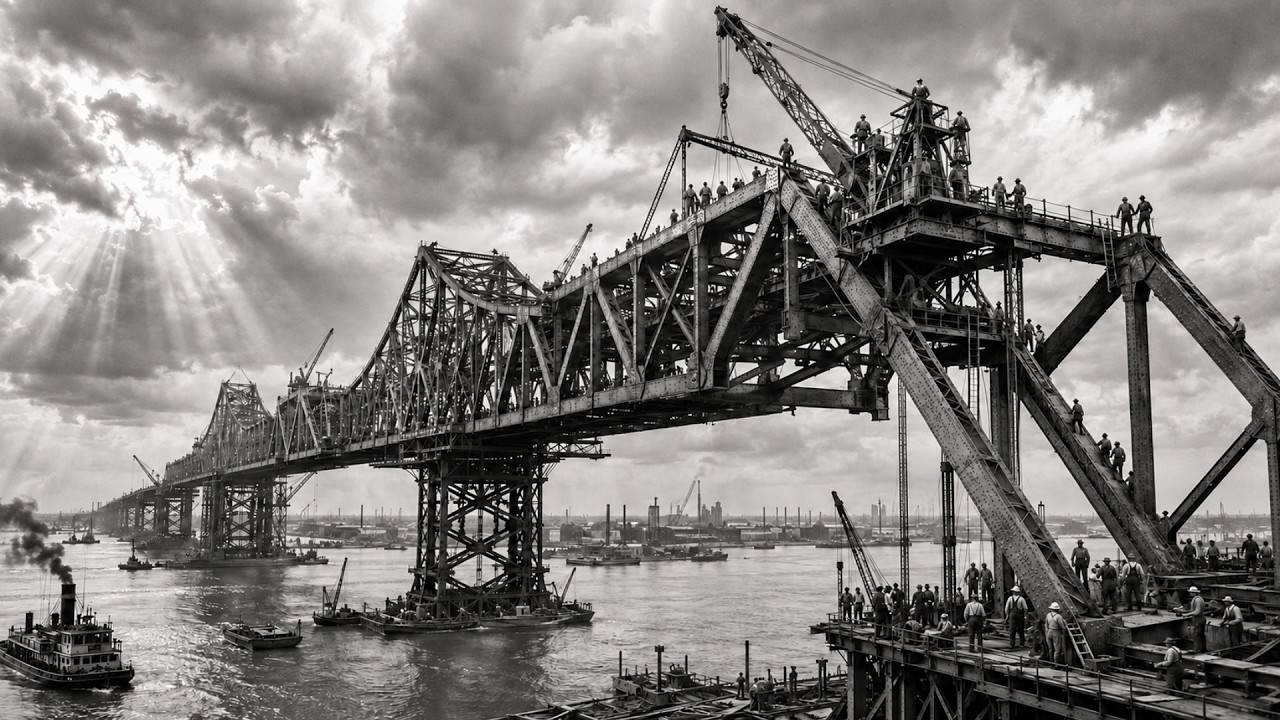
The truss members for the main spans were made in American Bridge shops and shipped by rail to New Orleans, then moved onto barges for delivery to the construction site at Waggaman. The river that made the crossing necessary was the same river that carried the steel to build it. Raising a cantilever truss over the navigation channel of the Mississippi while commercial traffic kept moving underneath demanded a construction sequence coordinated with the Army Corps of Engineers, which controlled navigation on the river, and with the towboat operators whose barge fleets passed through the crossing alignment on schedules set by commerce rather than by construction needs. The erection sequence pushed the cantilever arms of the truss outward from the main piers on both sides of the navigation channel at the same time, reaching toward a mid-span closure point while the river ran below at whatever stage the basin produced.
The ironworkers who built the truss over the navigation channel worked at heights from 70 feet above low water at the bottom chord to more than 130 feet at the peak of the top chord of the main span. The river beneath them was the Mississippi at whatever stage it happened to be. At 130 feet above the water surface in the fall and winter months, when fog climbed from the warm river into the colder air above and cut visibility from one end of the span to the other, the men walking the top chord of the truss they could not fully see depended on touch, on the positions of the members they had set in earlier shifts, and on the feel for the structure that experienced ironworkers gain through years of working steel at heights. Fog forms on the Lower Mississippi in November and December when the temperature of the river surface, warmed by heat the water held all summer, meets an air temperature that falls as the season moves on.
The condensation that follows can blanket the whole surface of the river within an hour of the early-morning temperature inversion. A crew clocking in on a December morning might discover it could not make out the pier it was building toward on the far side of the span under construction. Working through such conditions on a half-finished truss above the main channel of the Mississippi called for an attentiveness to placement and footing that ironworkers gain only by doing the job, and that experience does not make the work safe, only less dangerous. One man fell from the top chord of the main span, 130 feet down into the navigation channel of the Mississippi.
At that location the river runs at 3 miles per hour toward the Gulf of Mexico. A man dropping into water moving at 3 miles per hour from a height of 130 feet met conditions the safety boats posted beneath the work area were there to answer, and how quickly they could answer depended on what the river permitted, how fast the boat could run, and how far away it was. The current carried downstream, no matter where the safety boat happened to be stationed when the man went in. The crews on the job knew what the work demanded of them and what it put at risk.
Ironworkers who raise high steel over moving water know these things before they take the job. They take the work for the wages it pays, and because men who have spent years at this trade have built a relationship with risk that is professional rather than fatalistic. They know which moves are safe and which are not, and what that difference looks like from a particular spot on a particular member of the structure. That knowledge is not infallible.
It was not infallible at Waggaman. The fatalities on the Huey P. Long Bridge project were never gathered into any widely available public record. Death documentation for construction work in Louisiana in the early 1930s came under state labor laws that were less thorough than those passed in later decades.
The river setting around the crossing introduced complications that the records of land-based projects never had to face. A man who fell into the Mississippi from a height and whose body was never recovered downstream is a man whose death may not show up in the construction site’s death records in any way a researcher can readily locate 90 years later. The accounts that circulate tell the story of the bridge as finished. The accounts that do not circulate tell the full price of finishing it.
Huey Long was shot on the evening of September 8, 1935, in a corridor of the Louisiana State Capitol in Baton Rouge. He was 42 years old. He had been a United States senator since 1932, when he left the governorship for the Senate while keeping, through his political organization and his personal command of Louisiana politics, a kind of practical control over the state government that the constitutional separation of those offices would have stopped anyone of a different temperament from holding. He had made the enemies that anyone makes who tells people they have been governed for the benefit of others, and that this arrangement was coming to an end.
His enemies included the oil companies, the New Orleans political elite, and the Franklin Roosevelt administration, with which he quarreled over the pace and aims of the New Deal. Carl Weiss, the doctor who shot him, came from a family that had been at odds with Long’s political organization over a redistricting matter. The circumstances of the shooting and what followed were examined and disputed by historians in the decades afterward. Long died two days after the shooting.
The bridge at Waggaman was almost finished. He never crossed it. The steel structures had been raised, the roadway completed, painting was under way, and the approach structures on both banks stood ready. This was the bridge that Long had forced into being against the advice of the bond markets, the inertia of the political class, and the customary professional skepticism of the engineers who had studied the Lower Mississippi crossing before him and concluded it was prohibitively expensive.
That bridge was finished. He was dead. The Louisiana Legislature named it for him. The Huey P.
Long Bridge opened on December 16, 1935, 97 days after his death. On hand for the opening ceremony that day were officials of the Louisiana Highway Commission, officers of the Southern Pacific Railroad, elected officials of Jefferson and St. Charles Parishes, and the political figures who took over Long’s organization and would govern Louisiana in the years after his passing. Speeches were given at both ends.
There was a ribbon. Photographs taken that morning show officials, engineers, and railroad officers at the highway entrance on the east bank. The workers who had spent 3 years excavating pneumatic caissons 85 feet below the Mississippi riverbed and erecting steel trusses 130 feet above the navigation channel were not at Waggaman on December 16, 1935. A construction workforce does not stay on at a project site once the contract is complete.
The ironworkers from the American Bridge erection crew went on to the next installation job, wherever the company had work. The caisson crews scattered to whatever came next, which for ordinary laborers on large construction projects in Louisiana during the Depression might mean another project if one existed, or a return to the agricultural labor market from which many had come. The construction camp on the west bank was cleared. The barges and equipment were towed away.
The officials in the opening photographs exist in the administrative history of the Louisiana Highway Commission and the records of the Southern Pacific Railroad. The engineers whose names appear on the design drawings exist in the technical literature of the profession, where Modjeski & Masters is cited in connection with every major bridge the firm designed, which is most of the major bridges built in America in the first half of the twentieth century. The governor for whom the bridge was named exists in the political history of the United States, where the argument over what he was and what he meant has gone on unresolved since the day he died. The men who ran the caissons 85 feet below the Mississippi in compressed air, and the men who set the steel 130 feet above the navigation channel, exist in the payroll records of the Walsh Construction Company and the American Bridge Company, in whatever form those records survived the years since 1935.
The bridge carried the traffic it was built for from the day it opened. The Southern Pacific Railroad, which had been ferrying its cars across the Mississippi at New Orleans for decades, now crossed in minutes instead of hours. Freight that had waited at the ferry landings through fog, high water, and equipment failure now moved on a fixed structure the river could slow in flood but could not stop. The highway lanes carried traffic in Jefferson, St.
Charles, and St. John Parishes across the river without the vehicle capacity constraints imposed by the ferry schedule. The highway lanes were narrow. The two cantilevered lanes on either side of the railroad truss were designed within the dimensional constraints imposed by truss engineering, and the result was lanes wide enough for the vehicles of 1935 to cross, while the vehicles of later decades crossed with diminishing comfort as vehicle widths increased.
The bridge authority eventually imposed width restrictions that prevented trucks and vehicles wider than 8 feet 6 inches from using the original spans. This restriction was not a design failure in the sense of the structure performing below its specified capacity. It was a dimension set in 1932 applied to a traffic environment that continued to change over the following 80 years. The parallel highway bridge that eventually supplemented the original crossing was not built by a single decision.
Expanding the crossing’s capacity was proposed, studied, and debated over the decades in which traffic volumes on the original bridge made that restriction relevant to the regional economy it served. The new highway bridge opened in stages in the first decade of the 21st century, and with both structures in service, the full crossing carries the automobile and truck traffic the original bridge could not carry, plus the railroad traffic for which the original structure was built, on the same river, above the same caisson foundations, above the same sediment the caisson crews excavated in 1933. The Huey P. Long Bridge is still in service.
Southern Pacific no longer exists as a commercial entity. It was merged into Union Pacific in 1996, but the trains crossing at Waggaman now carry Union Pacific logos on the same steel structure Southern Pacific built in 1935. The freight they carry moves in the same direction commercial freight has always moved along the Lower Mississippi, toward the Gulf or away from it, depending on season, commodity, and market conditions. At mid-span of the main bridge, 135 feet above the Mississippi at normal stage, the river’s current runs at 3 miles per hour in the navigation channel below.
The channel beneath the main span is 90 feet deep in the scour hole. The current has scoured the alluvial sediment since the bridge piers changed the flow geometry of the water in 1935. That same current has worked on the concrete surfaces of the caisson foundations since the construction crews finished them. Inspection teams that dive through the water column on scheduled inspection cycles examine the concrete, measure any deterioration, record what they find, and file a report to the maintenance crew that decides what needs repair and when.
The foundations are still where the caisson crews left them. They were excavated to the depth the 1932 engineers determined was sufficient to reach the bearing layer identified by the soil samples, where men worked in compressed air 85 feet below the riverbed because the river above them allowed no other method. The identified bearing layer has not moved. The foundations set into it have not moved.
The bridge has been in service since December 16, 1935. The men who came out of those caissons after their shifts and passed through 90 minutes of staged decompression before the pressure equalized and the airlock door opened on the west bank of the Mississippi in the summer of 1933 are recorded in the payroll records of the companies that employed them. The men who walked the top chord of the truss bridge in December, through the fog 130 feet above the navigation channel, and set the steel where the drawings indicated, are recorded in those same records. Their names are not on the bridge.
The bridge bears the name of a governor who was killed three months before it opened, who never drove across it, and whose legacy remains disputed in Louisiana 90 years later. The caisson workers are in the payroll records. The ironworkers are in the payroll records. The men who excavated the bed of the Mississippi in compressed air to give the bridge something to stand on are in those records, in whatever form they have survived.
The current moves through the scour hole below the main pier at 3 miles per hour. The fog rises from the river in November when the water is warm and the air is cold. The bearing material lies 85 feet below the riverbed, where the blow counts indicated and where the men who reached it left it.
The bridge is still there.
