Benjamin Seagull had always hated the nickname the streets of Brooklyn gave him, but by the summer of 1947, he had learned to live with it. Bugsy. It sounded like a loose wire, a man who might explode without warning. That was partly true.
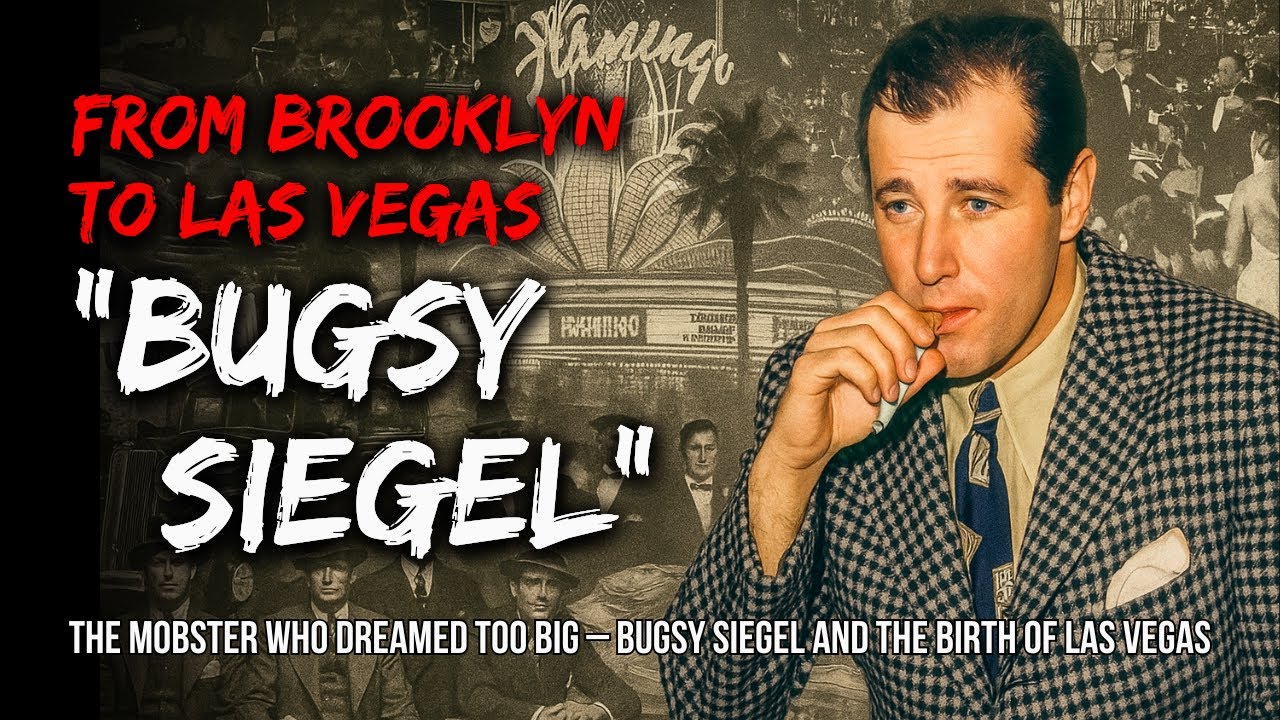
The rest of him, the part that planned, charmed, and dreamed, had just finished building a pink palace in the middle of the Nevada desert, and the men who funded it were done waiting to be repaid. He was born in 1906, the son of Jewish immigrants in Williamsburg, a rough corner of Brooklyn where poverty ruled every cramped apartment and factory whistle marked the hours of men who died slowly at sewing machines. His father worked in a clothing factory. His mother took in laundry.
The boy watched and swore he would never live that way. Money, to him, was not a comfort. It was freedom. The streets educated him early.
Irish gangs held one block, Italians another, and the Jewish kids had nothing organized. That changed when Benjamin met a quiet, calculating boy named Meyer Lansky. They were opposites in almost every way. Benjamin was loud and impulsive; Meyer was cold and mathematical.
Together they formed a partnership that would shape organized crime on the East Coast. Benjamin handled the muscle. Meyer handled the math. Their first operations were small protection rackets and bootleg schemes built around street vendors.
Benjamin’s temper earned him the name Bugsy, a label he resented but could not shake. He hated how it made him sound unhinged. But it stuck because it captured something real, the fast, unpredictable danger that lived beneath the charm. Prohibition turned the underworld into an industry.
By 1920, speakeasies opened in every neighborhood, and bootleggers became the new aristocrats of crime. The cops were either bought or blind, and those who were neither did not last long. Benjamin and Meyer built a crew called the Bugs and Meyer Mob, young men who treated crime like business. Their brand was precision, loyalty, and brutality.
When someone crossed them, the message was delivered personally and violently. The money grew, and so did their connections. Lucky Luciano and Frank Costello were beginning to unify the Italian crews, pushing for a national network that operated like a corporation. Benjamin loved that idea.
He saw himself not as a criminal but as an entrepreneur who happened to work outside the law. He wanted legacy, not just cash. Why settle for crumbs, he would say, when we could own the bakery? The alliance between Luciano, Lansky, and Seagull came to define an era.
Luciano brought vision, Lansky brought calculation, and Seagull brought muscle and charisma. By the early 1930s, they had helped build what became known as the Commission, a governing body for organized crime. Benjamin was not Italian, but he became one of the most trusted enforcers in Luciano’s empire. He managed violence with military precision.
If someone crossed the syndicate, it was not a street fight anymore. It was a vanishing act, clean and final. Murder Incorporated became the enforcement arm of the syndicate, and Benjamin was part of the circle that controlled it. He did not pull every trigger, but he knew who did, when, and why.
He treated killing as maintenance, a tool of management. In his mind, control was what separated professionals from amateurs, even in violence. The work made him rich, but it also left cracks. He slept with a pistol under his pillow and trusted almost no one except Lansky.
The syndicate began looking westward. California was a place where a man could reinvent himself, and Benjamin felt the walls of New York closing in. He moved to Los Angeles in the mid-1930s. Hollywood was a city built on reinvention, and it suited him perfectly.
He rented a home in Beverly Hills, attended parties with movie stars, and built a network of gambling operations for the elite. He partnered with actors like George Raft, who opened doors that money could not. He started running high-stakes betting rings and exclusive dens hidden behind nightclubs. It was in Hollywood that Virginia Hill entered his life.
She was an actress, fiery and volatile, a woman who matched his chaos. Their relationship was explosive, full of love and destruction. She challenged him in ways no one else dared, and she understood the part of him that wanted to be more than a gangster. Together they became the city’s most notorious couple.
The idea that would define him began as a whisper. A small gambling town in Nevada called Las Vegas had legal gambling and open land. Most people saw it as a dusty novelty. Benjamin saw it as the future.
The project started with William Wilkerson, a Hollywood publisher who had purchased land outside Las Vegas and dreamed of building a resort for the elite. Benjamin took over and renamed it the Flamingo. Construction began in 1945, and from the start it was chaos. The desert was unforgiving, sandstorms tore through the site, and water had to be trucked in.
But the real problem was Benjamin himself. He demanded perfection. Imported marble, custom chandeliers, pink motifs down to the napkins. The project ballooned from one million dollars to over six million.
The syndicate back east grew nervous. Invoices did not match, and rumors spread that he and Virginia were skimming the profits. Much of the money went into his obsession with detail, but the bosses did not care about art. They cared about numbers.
The first opening on December 26, 1946, was a disaster. The air conditioning failed, the kitchen ran out of food, and half the rooms were unfinished. The newspapers mocked it as Seagull’s folly. The casino closed for repairs and reopened in early 1947.
This time, it worked. The crowds returned, the games ran smoothly, and the profits began to climb. The Flamingo was finally living up to its promise. But it was too late.
The syndicate had already made its decision. The missing millions could not be accounted for, and the loss of trust was fatal. In their world, trust once lost never returned. Meyer Lansky tried to save his friend, arguing that the casino would pay off, but even he could not hold back the tide.
On the night of June 20, 1947, Benjamin sat in an armchair at Virginia Hill’s house on North Linden Drive in Beverly Hills, reading the Los Angeles Times. Virginia was in Europe. The house was quiet. A police investigation later concluded that seven bullets were fired through the window from outside.
The first struck him in the cheek, the second below his right eye. He was dead before the glass hit the floor. Within hours of the killing, men walked into the Flamingo and announced it was under new management. The casino kept running.
The guests kept gambling. The dream survived its creator. The investigation went nowhere. No witnesses, no suspects, no arrests.
The case was closed quietly. Virginia Hill returned months later, colder and silent. She never talked about that night. Meyer Lansky received the news in silence and rarely spoke of Seagull afterward.
When he did, his tone was quiet. Las Vegas grew inexorably. New casinos rose, corporate money moved in, and the old mob influence faded. The Flamingo was renovated, expanded, and polished.
A small bronze plaque was eventually installed, dedicated to the founder. It reads simply: Visionary, builder, dreamer. No mention of the syndicate or the bullets. The man who built Las Vegas did not live to see it become what he imagined.
But the city itself became his monument. Every neon light that blazes across the desert night carries a trace of his ambition. He wanted immortality, and in the end he got it.
Not in life, but in legend.






