Billy the Kid said the words twice, in Spanish, into the darkness of Pete Maxwell’s bedroom. “Quién es? ” Who is there? No answer came back.
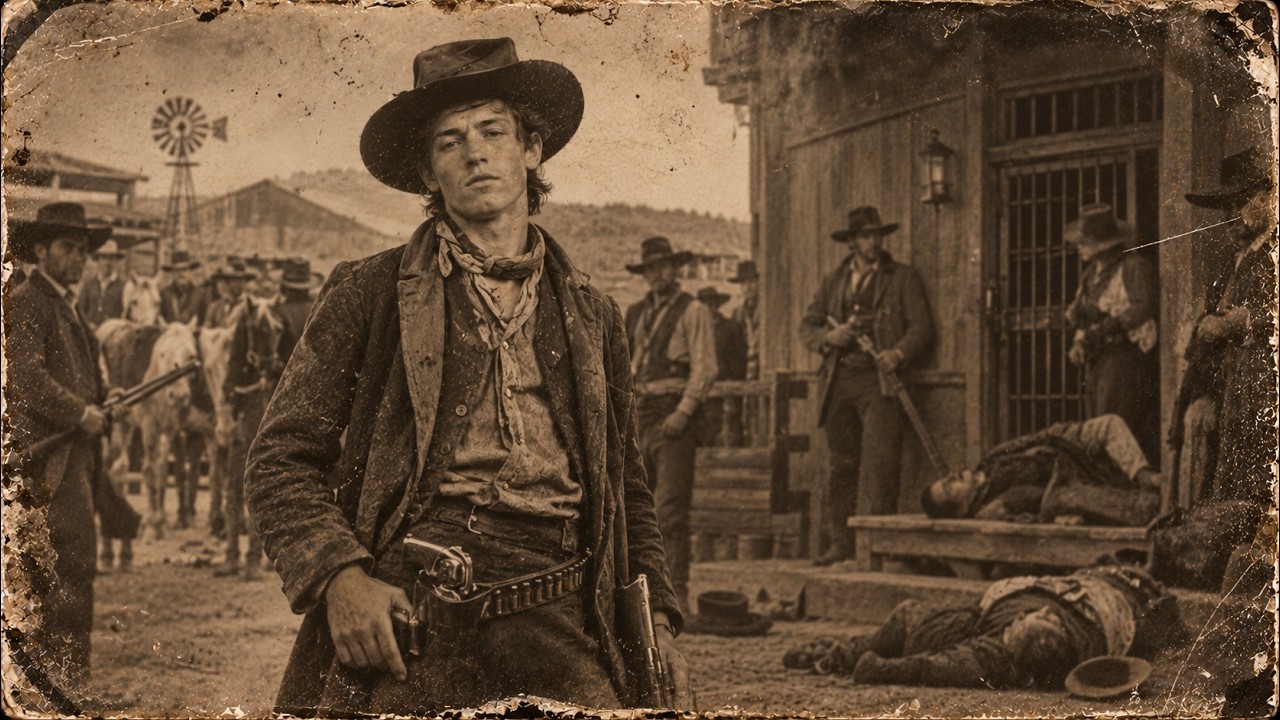
He was barefoot, in his socks, holding a knife, his gun still holstered at his side. He had walked into this room a hundred times believing it was safe. Then two shots rang out. The first struck him in the chest above the heart.
The second went wide. He fell to the dirt floor and died within seconds, without ever seeing the face of the man who killed him. His name has been spoken for more than a century, printed on stamps, postcards, and movie posters, but the strangest fact about the most famous outlaw of the American West is that he may never have known his own real name. The one most historians reach for first is Henry McCarty, the name he was apparently born with sometime around 1859, though even that year is argued over.
Some records point to 1861. His birthplace floats between New York City, Indiana, and Ireland, depending on which source you choose to follow. There is no surviving birth certificate, no baptismal record conclusively tied to him. A man who would become one of the most written-about figures in American history entered the world in near-total silence.
His mother, Katherine McCarty, appears in the records as a determined and resourceful woman. A widow or possibly abandoned, she raised Henry and his brother Joseph largely on her own through the turbulent years after the Civil War. The family moved constantly—Indiana, Kansas, Colorado, New Mexico—following work and land and hope wherever it seemed to be going. In 1873 Katherine married a man named William Antrim in Santa Fe.
Henry, somewhere between twelve and fourteen, took the new surname and became Henry Antrim. But William Antrim would not stay in the picture for long, and neither would the name. By the time the newspapers started writing about Henry in the late 1870s, he was calling himself William H. Bonney.
Where that name came from, no one has ever conclusively explained. Some historians speculate it may have been his mother’s maiden name in some form. Others believe he simply constructed a new identity from scratch, the way a young man on the frontier might when the one he was born with no longer felt like it belonged to him. And then there was the nickname: Billy the Kid.
That branding came later, attached to him by newspapers and lawmen and the mythology machine. But even that name carried a version of the truth. He was young. Almost everyone around him was older.
The “Kid” label was not invented to make him seem dangerous. At first, it was simply accurate. Four names for one life—Henry McCarty, William Antrim, William H. Bonney, Billy the Kid—and none of them fully his.
That kind of rootlessness does not happen by accident. It is built by circumstance, by poverty, by movement, by loss. And the losses were coming for Henry McCarty before he was old enough to understand what loss really meant. In September of 1874, Katherine McCarty Antrim died of tuberculosis in Silver City, New Mexico.
It was a slow, grinding death, with no effective treatment, no hospital worth the name, no safety net for the two boys she left behind. Henry was fourteen, give or take. His brother Joseph was slightly older. Their stepfather, William Antrim, was not a cruel man by most accounts, but he was not built for raising two grieving teenagers alone in a frontier mining town.
Within a short time of Katherine’s death, he effectively withdrew from their lives, moving on to his own work and places to be. Joseph managed to find his footing and eventually built a quiet life that history barely noticed. Henry was not so lucky. Silver City in the 1870s offered little to a young teenager with no family connections and no trade skills.
It was a rough mining settlement where transient workers outnumbered permanent residents and the law was more suggestion than guarantee. Henry drifted, finding work where he could, including washing dishes at the Star Hotel, run by a woman named Sarah Brown. It paid almost nothing. There was no gang waiting to take him in, no mentor to show him the ropes, no romantic outlaw fraternity.
Just a teenager trying to eat and sleep and make it through another week in a town that had no particular interest in his welfare. The American frontier had no juvenile justice system, no social services, no child welfare infrastructure of any kind. Children fell through the cracks regularly, becoming laborers, beggars, criminals, or some tangled combination of all three. Henry McCarty was one more kid the system could not see, because the system barely existed.
The slide into violence happened in stages, and none of them were inevitable. In the fall of 1875, Henry McCarty was arrested for the first time. He was around fifteen. The charge was possession of stolen property—clothing and butter taken by a local man named George Schaefer, who went by the nickname Sombrero Jack.
Henry’s role in the theft was at best minor. He may have been holding the goods for someone else, or he may have been naive enough to take them without understanding where they came from. Sheriff Harvey Whitehill picked him up and put him in a jail cell. Henry sat there for two days.
On the third day, he was gone. He had climbed up the jailhouse chimney, a feat requiring the thin, wiry frame he apparently possessed, and simply escaped. Whitehill later said he was not particularly alarmed at first; he expected the boy to come back or to be found nearby. He was wrong.
Henry never returned to Silver City. This first escape was not about criminal ambition, which at that point was essentially nonexistent. It was about the corner he was backed into. He was a fifteen-year-old with no family, no one to speak for him legally, no real defense to offer.
The charges were minor, but in a frontier town in 1875, minor charges against a homeless teenager with no one to vouch for him could easily snowball into something much worse. Running was not the act of a budding outlaw. It was the instinct of someone who had learned through experience that institutions were not built to help people like him. He ended up in Arizona Territory, drifting through ranch jobs and day labor in the Sulfur Springs Valley.
He was good with horses. He was also learning to be good with a gun, though at that stage it was more a practical frontier skill than a declaration of intent—almost every man in that part of the country was armed. It was the same as wearing boots. The killing happened in August 1877 at a cantina near Camp Grant, Arizona.
The man who died was a civilian army blacksmith named Francis Cahill, known locally as Windy. Cahill was significantly larger than Henry, a physically imposing man with a reputation for bullying smaller men. By multiple accounts, he had been harassing Henry for months, calling him degrading names and physically manhandling him on several occasions. On the night of August 17, the confrontation escalated.
Cahill wrestled Henry to the ground and pinned him. Henry managed to get his gun free and fired once. Cahill died the following day. The coroner’s jury ruled the killing criminal, though a more accurate modern assessment would likely land somewhere around self-defense or manslaughter.
Henry did not wait for the legal process to decide. He ran again, back across the border into New Mexico Territory. He was seventeen years old, with one killing behind him. The Lincoln County War, when it came, was a business war.
Lincoln County in the late 1870s was one of the largest counties in the United States by land area, a vast stretch of high desert and grassland functioning as an almost self-contained economic universe. That universe was controlled by two men: Lawrence Murphy and James Dolan. Through their company store, known locally as “the House,” they operated a monopoly over the county’s commercial life. They controlled the supply of goods, held contracts with the US Army to supply beef to Fort Stanton and food rations to the nearby Mescalero Apache Reservation—contracts worth tens of thousands of dollars annually, an enormous sum in the frontier economy.
They also had deep political connections running up through the Santa Fe Ring, a network of lawyers, politicians, and businessmen who manipulated territorial governance for their own benefit. Farmers and ranchers who needed credit had to get it from the House, and the House charged whatever it decided to charge. Those who could not pay found their land, cattle, or livelihoods disappearing through mechanisms that were technically legal because Murphy and Dolan had enough political friends to make them so. Into this arrangement stepped two men who threatened to break the monopoly.
John Henry Tunstall was a young English rancher with money behind him and idealistic ambitions. Alexander McSween was a lawyer with similar ambitions and similar enemies. Together they established a competing store and bank in Lincoln, offering lower prices and competing for the army contracts. Murphy and Dolan decided to end it.
What followed was a coordinated campaign of legal harassment, property seizure, and eventually open killing, carried out through corrupt sheriffs, hired guns, and political manipulation. In February 1878, Tunstall was murdered on a quiet road, shot from his horse by a posse operating under legal authority but functionally serving Murphy and Dolan’s interests, with cover from County Sheriff William Brady, who was deep in the House’s pocket. Billy the Kid witnessed the aftermath of Tunstall’s murder. By most accounts, Tunstall had treated him with a degree of basic human decency that was rare in Billy’s experience.
He had given him work on his ranch, spoken to him without contempt, and treated him less like a disposable hired hand and more like someone worth respecting. For a teenager who had spent years being invisible, that treatment left a mark. When Tunstall’s allies organized their response, Billy was ready to join. The group that formed around the Tunstall-McSween side called themselves the Regulators.
And at least in the beginning, they were not outlaws. They were legally deputized. Dick Brewer, who managed Tunstall’s ranch, was appointed special constable by Justice of the Peace John Wilson, who was aligned with the McSween faction. That appointment gave Brewer—and by extension the men riding with him—legal authority to arrest individuals connected to Tunstall’s murder.
Billy rode as a Regulator under that legal mandate. At the start of the Lincoln County War, Billy the Kid was not an outlaw operating outside the law. He was a deputized agent of the law, riding with legal authority to bring in men who had committed a murder. Then, in April 1878, the Regulators killed Sheriff William Brady and his deputy George Hindman on the streets of Lincoln.
Brady was corrupt, deeply tied to Murphy and Dolan, and had obstructed justice in the Tunstall case. But he was also the county sheriff, and killing a sitting sheriff, regardless of his corruption, crossed a line that could not be uncrossed. The legal protection the Regulators had operated under began to dissolve. More killings followed.
The violence escalated through the spring and summer of 1878, culminating in the Five-Day Battle in July—a sustained gunfight in the town of Lincoln itself that left McSween dead and the anti–Murphy-Dolan cause effectively broken. The House’s faction won not because it was more righteous, but because it had more political backing, more financial resources, and more powerful friends. After the Five-Day Battle, Billy and the surviving Regulators were left in an impossible position. The side they had fought for had lost.
The legal authority they had operated under was now void or disputed or ignored by the new power structure. The men now controlling Lincoln County had every reason to see Billy charged, convicted, and hanged. The territorial government in Santa Fe, thoroughly infiltrated by the Santa Fe Ring, was not going to intervene. Billy became an outlaw not because he woke up one morning and chose that life, but because the political machinery of New Mexico Territory decided that was what he was—and the people with the power to decide those things had just won a war.
The number that attached itself to Billy’s name was 21. One kill for every year of his life. It was reported in newspapers across the country with the confidence of established fact. It appeared in Pat Garrett’s own account of Billy’s life and death, a book ghostwritten by journalist Ash Upson, published just months after the killing.
It became the cornerstone of the legend, the number that made him sound simultaneously terrifying and poetic. It was almost certainly not true. Modern historians who have gone back through the available records—coroner’s reports, witness accounts, newspaper coverage from the time of each alleged killing—arrive at a very different estimate. The most rigorous assessments put the number of men Billy personally killed somewhere between four and nine.
Some counts go as high as eleven, depending on how you assess contested incidents and group killings during the Lincoln County War. A few older sources push toward nineteen. The famous 21 has no credible historical foundation. The number 21 had a quality that four or nine simply lacked.
It felt meaningful—one kill for every year of life, a narrative symmetry that made the story feel almost mythological. Real history does not arrange itself that neatly, but mythology does. Ash Upson, writing for Pat Garrett, understood that a neater story sold more books than an accurate one. Garrett himself had reasons to want the legend inflated.
Killing an ordinary young man with a handful of deaths behind him was a modest achievement. Killing the most dangerous outlaw in the American Southwest, a young killer with 21 lives on his conscience—that was a career-making act. Newspapers syndicated the number without verifying it. Dime novels picked it up and ran with it.
By the time anyone thought to examine the evidence carefully, the 21 had calcified into accepted fact. There is a detail about Billy the Kid that gets almost no attention in the films: he was, by multiple historical accounts, unusually media-savvy. Billy granted interviews. He talked to reporters because he understood they could be useful.
During his time on the run and during periods of relative freedom, he spoke to journalists who sought him out, offering quotes that were colorful, self-aware, and carefully constructed to shape public perception. Researchers at the University of New Mexico have described his management of his own image as something resembling genuine press agentry, a term more associated with the twentieth century than the nineteenth. The nickname itself was part of this. Billy did not fight the “Kid” label; he leaned into it.
It framed him as young, which he was, but also as something other than a seasoned, hardened criminal. A kid could be sympathetic. A killer was just a killer. His quotes, as reported in newspapers of the time, carried a dry wit and a self-deprecating quality that read as charming rather than threatening.
He knew how to make a journalist leave with a good story, which meant the journalist was inclined to come back. And each sympathetic story reinforced the image of Billy as a young man wronged by powerful forces rather than a murderer on the loose. Hollywood eventually inherited the same image Billy himself had been carefully shaping during his lifetime. Every film that made him a tragic rebel with a quick smile was in some sense following a script that Billy himself helped write.
Billy was also fluent in Spanish. He had grown up around Hispanic communities in New Mexico, worked alongside Hispanic cowboys and ranch hands, and spent enough of his young life in those social spaces that Spanish became as natural to him as English. He knew the customs, the food, and he was known in those communities by a nickname rarely mentioned in American popular history: El Chivato, “the kid goat”—a term of rough affection, the kind of name you give someone young and quick and a little unpredictable. Among many Mexican families in the region, Billy was not seen as a monster.
He was seen as something closer to an ally. The Murphy-Dolan monopoly had not been good for Hispanic ranchers and farmers either. The House had squeezed everyone it could reach, and those with the least political power had been squeezed hardest. The Tunstall-McSween faction had offered an alternative.
And Billy, who had ridden for that faction and could speak to you in your own language without condescension, was a figure many families were genuinely glad to shelter. When he was on the run, it was often Hispanic families who took him in, hid him from posses, fed him, and kept his location to themselves. It was not naive loyalty or romantic outlaw worship. It was a calculated response to a power structure that had already shown those communities what it thought of them.
In 1878, the governor of New Mexico Territory was a man named Lew Wallace, better known to history as the author of Ben-Hur. Wallace arrived as a political appointee tasked with bringing order to a territory that had descended into open warfare. Billy, by 1879, was caught in a dangerous position. He had killings behind him, enemies with political power who wanted him charged and hanged.
But he also had information—specific, detailed, credible information about murders and corruption in Lincoln County that the governor desperately needed. The two men made contact. What followed was one of the most remarkable and ultimately tragic episodes in the entire story. Wallace offered immunity.
The deal, communicated through back-channel letters, was straightforward. Billy would testify about the Lincoln County killings, providing the names, details, and evidence that could prosecute the men most responsible for the violence. In exchange, the charges against him would be dropped. He would walk away free.
Billy agreed. He gave himself up to a staged arrest to protect his safety while the arrangement was worked out. He met with Wallace in person at night in a private house in Lincoln, and the two men talked through the terms. Wallace, by the account of that meeting, was impressed.
He found Billy intelligent, clear-headed, and credible. Billy testified, giving detailed statements about the killings he had witnessed and participated in. He held up his end of the arrangement. Then Lew Wallace stopped holding up his.
The reasons were almost entirely political. Wallace was navigating a territorial government still heavily influenced by the Santa Fe Ring, the same network that had backed Murphy and Dolan. Pushing for the prosecutions Billy’s testimony could support would have meant picking a very expensive fight with very powerful men. Wallace, with his literary ambitions and political future to consider, decided the fight was not worth it.
He left New Mexico in 1881 to take up the position of United States Minister to the Ottoman Empire. Before he left, Billy sent him letters—multiple letters, careful, articulate letters reminding the governor of the promises made in that private room in Lincoln, asking with increasing urgency when the immunity deal would be honored. They went unanswered. The prosecutions Billy’s testimony was supposed to enable never materialized in any meaningful way, and the deal that was supposed to free him was treated, by the time Wallace departed, as if it had never been made at all.
Billy the Kid once trusted the government. He sat down with a governor. He testified under conditions that put him at personal risk. He wrote letters asking for the justice he had been promised.
Those letters are still in the historical record, and so are Wallace’s non-responses. In 1880, at Fort Sumner, New Mexico, the war was over. The Regulators were scattered or dead. Wallace had moved on.
Billy was twenty years old, roughly speaking, and he was tired. What he wanted during those months was remarkably ordinary. He worked cowboy jobs on the ranches surrounding the old military post, jobs requiring skill with horses and cattle and long hours in the saddle, which Billy had in abundance. He danced.
Fort Sumner had a social life built around fandangos, informal dances that brought together Anglo settlers and Hispanic families, and Billy was a regular, enthusiastic presence. By multiple accounts he was a good dancer. He laughed easily. He played cards.
He sat around fires with people he liked, told stories, listened to theirs. The Hispanic families of Fort Sumner knew who he was and sheltered him anyway. In person, away from the mythology, Billy was good company—funny, easy to be around, the kind of person who remembered your kids’ names and what you talked about three months ago. There was a woman named Paulita Maxwell who was, by various accounts, genuinely close to him.
Her brother Pete would later play a role in the final chapter. During those Fort Sumner months, the Maxwell household was one of the places where Billy felt something approaching safety. The tragedy of this period is not what happened during it. It is what it proved was possible: Billy the Kid, given something resembling stability and community, given people who treated him as a human being rather than a weapon or a target, was capable of living quietly.
The violence that defined his legend was not intrinsic to him. It was a response to conditions. Change the conditions, and you change the man. But the conditions were about to change again.
Before Pat Garrett was the man who killed Billy the Kid, he was someone Billy drank with. They had been in the same saloons, played cards at the same tables, shared meals in the same rough frontier establishments. Garrett was a tall Texan who had drifted into New Mexico in the mid-1870s, working as a buffalo hunter and then a cowboy. His path crossed Billy’s during those Fort Sumner years in ways that went beyond casual acquaintance.
They were, by the standards of the time, something close to friends. In November 1880, Garrett was elected sheriff of Lincoln County. He ran on an explicit platform of capturing or killing Billy the Kid. The people with money and influence in Lincoln County wanted Billy gone, and they backed Garrett because they believed he could deliver.
Garrett knew the territory. He knew Billy’s habits, his hiding places, the families who sheltered him, the people he trusted. He had gathered all of that knowledge during the years when he and Billy had been on the same side of the social ledger. Now he was going to use it.
Billy heard that Garrett had been elected and understood what it meant. He sent word through back channels that he was willing to talk, willing to negotiate, possibly willing to turn himself in under the right conditions. Those overtures went nowhere. Garrett was not interested in negotiation.
The pursuit moved quickly. Garrett tracked Billy through the late months of 1880 and into 1881, capturing him once at Stinking Springs in December 1880. Billy was taken to Santa Fe, tried, convicted, and sentenced to hang in the spring of 1881. Then he escaped again, killing two guards in the process—men named Bob Olinger and James Bell.
He rode back toward Fort Sumner, back toward the people he knew, back toward the last place that had felt anything like home. Garrett followed. July 14, 1881. Fort Sumner, New Mexico.
Pat Garrett had ridden into town quietly, without announcement, with two deputies named John Poe and Tip McKinney. He had received information that Billy was still in the area, still moving between the families who sheltered him. Garrett went to the house of Pete Maxwell, Paulita’s brother, late in the evening, and sat on the edge of the bed in Maxwell’s dark room. Billy was outside.
He had been sleeping elsewhere on the property and walked over to Maxwell’s room for reasons historians have debated for more than a century. Some say he was hungry and wanted to cut some meat from a side hanging near the room. Others offer different explanations. What is certain is that he was moving through the night in a place he believed was safe, wearing only his socks, holding a knife, his gun holstered at his side.
He noticed figures outside in the darkness—Garrett’s deputies, Poe and McKinney, standing near the porch. Billy apparently did not recognize them. He backed away from them and moved toward Maxwell’s doorway, stepping into the room. It was dark.
Garrett sat on the bed beside Maxwell, his body in shadow, invisible to anyone stepping in from outside. Billy sensed someone in the room. He asked in Spanish, “Quién es? ” Twice.
Garrett drew his pistol and fired two shots. The first struck Billy in the chest above the heart. The second went wide. Billy fell to the floor and died within seconds.
He never saw who shot him. He never had the chance to draw. There was no duel, no last stand, no dramatic confrontation between two men who had once shared a table and a bottle and whatever passed for friendship on the New Mexico frontier. There was darkness, a question asked twice in Spanish, and then two shots from a man Billy could not see.
He died confused in the dark, in a place he thought was safe, killed by someone who had once been close enough to be called a friend. Billy the Kid had been dead for less than two months when the first book about him appeared. Pat Garrett’s account, ghostwritten almost entirely by Ash Upson, was titled The Authentic Life of Billy the Kid—one of the more audacious uses of the word “authentic” in the history of publishing. It was not particularly authentic.
It was a narrative constructed to serve Garrett’s reputation, to establish his killing of Billy as the righteous elimination of a genuine monster. The 21 kills appeared in its pages as established fact. The Lincoln County War was simplified into a story of good law and bad outlaws. The political corruption, the broken immunity deal, the years of poverty and abandonment—all of it was either absent or distorted beyond recognition.
The book sold, of course. The American reading public in 1882 was hungry for exactly this kind of story. The frontier was closing. The Indian Wars were winding down.
The railroads were threading through territories that had seemed impossibly wild a generation earlier. The Wild West was becoming a memory even as it still technically existed, and Americans wanted their memories packaged in a form that felt heroic and exciting and morally uncomplicated. The telegraph had already done its work during Billy’s lifetime, spreading exaggerated accounts before the truth could follow. The dime novel industry picked up where the newspapers left off, each retelling adding details that never happened and removing complications too real to be romantic.
The homeless dishwasher from Silver City became a dashing gunfighter. The teenager caught in a corrupt business war became a rebel hero striking back against tyranny. The frightened young man asking into the dark became a legend, dying on his feet. By the turn of the twentieth century, Billy the Kid had been dead for nearly twenty years and was more alive in American culture than he had ever been while breathing.
Then came cinema. Every generation rebuilt Billy into whatever version of the Wild West it needed. The silent era just needed him to be exciting. By the time the western genre hit its peak, he had picked up tragic romance.
Then the 1960s happened, and suddenly he was a countercultural symbol, a young man destroyed by a corrupt establishment. Young Guns in 1988 gave him to the MTV generation—all style and speed and cool detachment. Each version reflected the era that produced it far more accurately than it reflected the historical record. Billy the Kid became a franchise.
His name generated revenue. His image was licensed and reproduced and sold on everything from postcards to whiskey bottles. Lincoln, New Mexico, built a tourism industry around the sites of the war. The state periodically debates whether to grant him a posthumous pardon, a debate that generates significant media coverage every time it resurfaces.
More than a century after that night in Fort Sumner, people have claimed Billy survived. Towns have fought over his remains. States have debated posthumous pardons. The myth outlasted the man by so long that the two are now almost impossible to separate.
But the real story is darker than any body count, because it does not resolve cleanly. It does not give you a villain you can point to or a hero you can root for without reservation. What it gives you is a child abandoned into poverty, drifting toward violence not by choice but by circumstance. A teenager with no name he could fully claim, no family to return to, no institution that saw him as worth protecting.
A young man handed a gun and a legal mandate by one side of a corrupt business war, then discarded when that side lost. A person who, given a brief window of peace in Fort Sumner, demonstrated that the violence was not who he was but what he had been shaped into. A frightened teenager shaped by poverty and political betrayal, who trusted a governor and was abandoned, who found something like peace and then heard two shots in a dark room and never knew who fired them. That is the real Billy the Kid.
The myth made him dangerous. The real story just makes you uncomfortable—which is a different thing entirely, and harder to sell.
