Just before noon on March 15th, in the year 44 before the common era, a man in a white toga is walking through the streets of Rome. He is 55 years old. He is the most powerful human being alive. There is no army in the known world that has not either fought him or trembled at the mention of his name.
And in his right hand, at this very moment, he is carrying a small folded document. A letter written by a man named Artemidorus. It contains, written in careful Greek, the names of every single senator planning to murder him in the next 30 minutes. He does not read it.
He tucks it away with the other petitions. He keeps walking. In the time it takes to boil water for a cup of coffee, 23 blades will enter his body. He will be stabbed by men he pardoned, men he promoted, men he wrote into his will.
Of those 23 wounds, only one of them actually killed him. A Roman physician examined the body hours later and made a chilling discovery. The other 22 were shallow, panicked; some barely broke the skin. That is not the wound pattern of an execution.
It is the mark of sheer terror. Rome, early March, 44 before the common era. Julius Caesar is 55 years old and he has broken every rule the Republic ever wrote. He is a patrician from an old but not wealthy family.
A lawyer, a gambler, a general who conquered Gaul with a speed that terrified his own Senate. He has been declared dictator perpetuo, dictator for life, a title Rome has not used in over 400 years and which sounds a great deal like the word Romans hate most in the world: king. Caesar knows this. He knows exactly what people are whispering.
And in the weeks before his death he does something that his officers will later describe as either the noblest gesture of his career or the most catastrophically stupid decision he ever made. He dismisses his personal bodyguard—the veterans, the hardened Spanish legionaries who had followed him from Gaul, from the Rubicon, from Pharsalus. He sends them all away. Caesar has decided that a man who leads Rome should not need soldiers to walk through Rome.
He is not a king. He does not fear his own citizens. He wants them to see him alone, unarmed, trusting. It is the last mistake he will ever make.
While Caesar is walking unguarded through the Forum, 60 men are meeting in private houses. Some are old aristocrats who lost everything when Caesar defeated Pompey in the civil war. Some are men he defeated and then pardoned—a mercy they now interpret as humiliation. And some are men he elevated, promoted, made rich, made powerful.
They are meeting in twos and threes at odd hours in the darker corners of the city. They are drawing up lists, assigning roles, debating in low, tense voices whether they should kill only Caesar or Caesar and all his allies. There are three men you need to understand. The first is Gaius Cassius Longinus.
Around 42, a hard, angular, ambitious man who fought against Caesar in the civil war, was pardoned, and has been quietly furious about it ever since. Cassius is the engine of the conspiracy. The man who does the recruiting, the calculating, the persuading. The second is Decimus Junius Brutus Albinus.
Late 30s, one of Caesar’s most trusted generals in Gaul. A man Caesar loved so deeply that when he wrote his will, he named Decimus as a secondary heir. Caesar wrote Decimus Brutus into his will, and Decimus Brutus wrote Caesar into a grave. And then there is Marcus Junius Brutus.
He is 39, a stoic philosopher, a writer, a man who talks about virtue and duty and the ancient Roman Republic. Brutus’ mother, Servilia, had been Caesar’s lover for decades. There are ancient rumors, never proven, never disproven, that Caesar may have been Brutus’ biological father. What is beyond dispute is that Caesar had spared Brutus’ life after Pharsalus, given him office, elevated him, treated him in every letter and public gesture like a favored son.
That is the man who will be the last to draw a blade. In a house somewhere in Rome in the last days before the Ides, the conspirators have one final terrible argument. Cassius wants to kill Mark Antony, too. Antony is 39, Caesar’s co-consul, a hardened cavalry commander from Gaul.
If Caesar dies and Antony lives, Antony will not go quietly. He will avenge his friend. He will command the loyalty of Caesar’s veterans. Killing him, Cassius argues, is not vengeance.
It is survival. But Brutus refuses. He tells them that if they kill more than Caesar, they will not be liberators. They will be butchers.
The people of Rome must see this as a surgical act. A single tyrant removed for the sake of the Republic, not a purge, not a coup. Brutus won the argument. Antony would live.
And that single decision will destroy every man who voted for it. They choose the location carefully. The traditional Senate house is being renovated, so the Senate is meeting instead in an annex: a rectangular hall attached to the enormous theater complex built by Pompey the Great, the Curia Pompeia. Pompey, the man Caesar defeated in the civil war, the man whose head was cut off in Egypt and delivered to Caesar in a basket.
Pompey’s massive marble statue stands in a place of honor inside the very room where Caesar is about to die. The conspirators plan to sit close, to crowd around under the pretext of presenting a petition, to draw their daggers—small enough to hide in the folds of a toga or a stack of documents—and to strike all at once in that packed space before anyone can react. By the night of March 14th, everything is ready. Daggers hidden, roles assigned.
Trebonius has been given a single job: keep Antony outside the Curia at all costs. Tillius Cimber will approach Caesar first with the petition. Casca will strike first. The signal will be the pulling of Caesar’s toga.
There is only one problem. It is a problem sitting in a bedroom on Palatine Hill. A woman who has just fallen asleep and who is about to have a dream that almost stops everything. Her name is Calpurnia.
She is Caesar’s third wife, probably in her late 20s or early 30s, the daughter of a former consul. On the night of March 14th, she wakes up screaming. The ancient sources vary on exactly what she saw. Plutarch says she dreamed the roof of their house collapsed.
Another version says she dreamed she was holding Caesar in her arms and he was bleeding from a hundred wounds. A third says she dreamed of the statue of Caesar in front of their house—a statue the Senate had erected as an honor—and in the dream, it was spouting blood from its base. Whatever she saw, it broke her. Roman women did not intervene in politics.
They did not tell their husbands what to do. For Calpurnia to wake up sobbing and beg the dictator of Rome to cancel a Senate meeting was not superstition. She grabs him. She tells him about the dream.
She reminds him of the omens over the previous days: the sacrificial animals with malformed organs, the strange lights in the sky, the birds behaving oddly. She begs him, just today, just this one Senate session, stay home. Caesar agrees. He sends word to the Senate that he will not attend, that the session is postponed.
He tells Calpurnia he will stay home. And then, sometime that morning, there is a knock at the door. Decimus Brutus is standing there—Caesar’s protégé, his trusted lieutenant, the man in his will. Decimus has come, ostensibly, to walk Caesar to the Senate as a friend.
In reality, he has come because the conspirators know that if Caesar does not show up today, the entire plot is exposed. Sixty men have hidden daggers in their togas. Sixty men are waiting in that hall. If Caesar stays home, someone will talk.
And the moment the plot is discovered, all 60 of them are dead men. Decimus Brutus walks into his friend’s house—a house where his friend’s terrified wife is begging him to stay alive—and proceeds to talk him out of it, gently, reasonably, with a smile. Decimus mocks the dreams. He appeals to Caesar’s pride.
Would a dictator of Rome, the conqueror of Gaul, really cancel the business of the state because his wife had a nightmare? What will the senators say? What will the plebs say? He stresses that the Senate is preparing to confirm important decrees today, decrees Caesar needs.
Caesar changes his mind. He gets up, he puts on his toga, and he walks out the door with the man who is about to kill him. The walk from the Palatine Hill to the Curia Pompeia is about a mile, 15 minutes on foot. Caesar walks it slowly, surrounded by friends, accompanied by his lictors carrying the fasces, the bundles of rods and axes that symbolize his authority.
He is unguarded, unarmed, undefended. On the way, he passes a soothsayer named Spurina, a haruspex, a man trained to read the future in animal entrails. Weeks earlier, Spurina had warned Caesar to beware of the Ides of March. Now, walking past him in the crowded street, Caesar smiles.
“The Ides of March have come,” Caesar says, half in jest. But Spurina does not smile back. He looks up at Caesar with an expression that ancient sources describe as cold, and he speaks the sentence that will haunt every retelling of this day for the next 2,000 years. “Yes, Caesar,” he says, “they have come, but they have not gone.
”
Caesar keeps walking. Somewhere along the route, another man pushes through the crowd. His name is Artemidorus. He is a Greek teacher of rhetoric who has become friendly with several of the conspirators—friendly enough that they have made a catastrophic mistake.
They have talked, and Artemidorus has learned everything: names, locations, the plan. In a city of a million people, at a moment when 60 senators have kept a secret with perfect discipline for weeks, one Greek professor of rhetoric has managed to piece together the entire conspiracy. He is running through the crowd right now with the names in his hand. Artemidorus reaches Caesar.
He presses a folded document into his hand. Plutarch says he told Caesar to read it immediately, that it concerned him alone. Caesar takes the document. He looks at it.
And then a petitioner pushes forward with another request. Then another. Then another. Caesar tucks Artemidorus’ letter into the stack with the rest.
He will never read it. Caesar arrives at the theater complex. He steps out of the sunlight and into the dim, echoing interior of the Curia Pompeia. The senators rise to greet him.
Pompey’s statue looms above the room, staring down. Caesar walks to his curule chair and sits. He does not know that the man on his left is going to try to kill him. He does not know that the young man across the room—the one whose mother he loved, the one he pardoned, the one he treated like a son—will be the last one to drive a blade into his body.
He has 30 seconds left before it starts. Tillius Cimber steps forward with a petition. He is begging for the recall of his exiled brother from banishment. He speaks in low tones.
He steps close. The other conspirators drift toward him. They cluster. They lean in as if to add their voices to the petition.
Caesar looks up at Cimber and refuses the request. He waves it off. And then Cimber does something no one should do to the dictator of Rome. He reaches down.
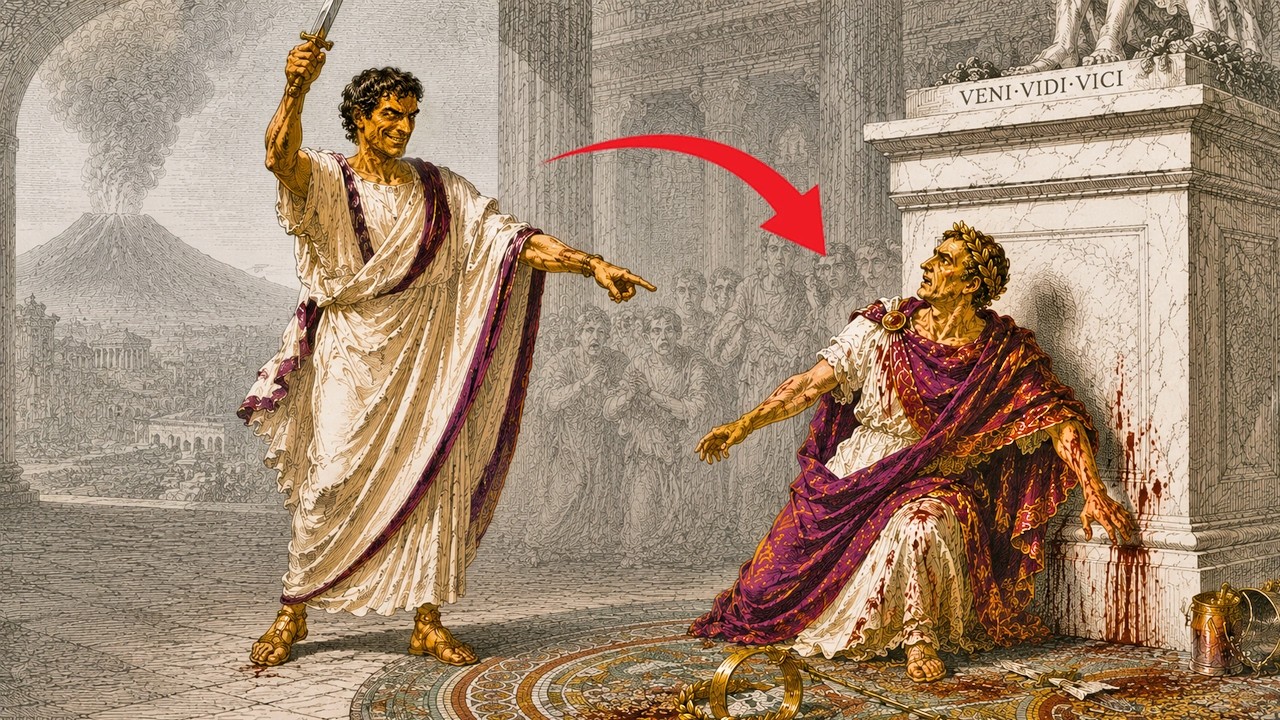
He grabs the neck of Caesar’s toga and yanks it off his shoulders. That is the signal. Publius Servilius Casca, standing behind Caesar’s chair, draws his dagger and strikes down toward the base of the dictator’s neck. But Casca’s hand shakes.
The blade goes shallow. It cuts. It does not kill. Caesar spins in his chair, feels the pain, sees the dagger, and does something no conspirator expected.
He fights back. He grabs Casca’s arm. He wrenches it. And in Latin or possibly Greek—the sources disagree—he shouts, “Villain Casca, what are you doing?
”
Casca has just committed high treason. He has stabbed the dictator of Rome. And the dictator of Rome is still alive, still holding his wrist, still shouting his name in front of the entire Senate. If the other conspirators hesitate for even 3 seconds, Casca is a dead man.
He screams for his brother. And then the other blades come out. They come from every direction at once. Cassius drives his dagger into Caesar’s face.
Some ancient sources specify a wound to the cheek or mouth. Another blade enters his back, another his side. The men are pressed shoulder to shoulder in the tight space around the chair, all trying to reach the same body. In the chaos they begin cutting each other.
Suetonius specifically records this detail: some conspirators were wounded by the blades of their own comrades. This was not a dignified execution. This was a mob—20-something men, most of them not trained fighters—hacking in a frenzy at a single body in a space no larger than a living room. Blood on the floor, blood on the marble, blood on their own togas, blood on each other.
And in the middle of it, one 55-year-old man, unarmed, still trying to stand. For the first several blows, Caesar fights. Nicholas of Damascus, one of our closest sources to the events, writes that Caesar tried to defend himself with his stylus, a small metal writing instrument, essentially a pen, jabbing at the men closest to him. He turns.
He twists. He tries to break out of the pack. He is 55 years old and he has been in a hundred battles and his body remembers what to do. He is fighting for survival with the raw instinct of a veteran who refuses to die easily.
Twenty-three stab wounds. Only one of them fatal. As Caesar is fighting for his life, 22 of the blows that land on his body are shallow, panicked, poorly aimed strikes by men who have never killed anyone before. This is a room full of politicians who thought they knew what killing looked like and who are discovering in real time that they do not.
The senators who are not part of the plot are frozen. Some try to run. Some climb over benches to reach the exits. They do not intervene.
They do not draw weapons to defend Caesar. They watch. They flee. In a hall of hundreds of Roman senators, the most powerful man in the world is being butchered and no one lifts a hand to help him.
The blows keep coming. Caesar’s toga is soaked. His arms are cut. His face is cut.
His chest is opened. Slowly, his body begins to slow down. Not from pain—Caesar has been in enough battles to know how to endure pain. From blood loss.
From the simple fact that a body with 20 stab wounds is running out of the fluid it needs to keep standing. And then he sees the face. Marcus Junius Brutus is standing in the pack. He has been there the entire time.
The sources vary on whether he has already struck or is about to strike. What they agree on is this. Caesar’s eyes lock onto Brutus’ face. The man he pardoned.
The man he elevated. The son of the woman he loved. Suetonius records that at this moment Caesar may have spoken his final words. Not in Latin, in Greek.
He looks at Brutus and says, “Kai su teknon? You too, child? ” Not “Et tu, Brute. ” That famous line is Shakespeare, written 1,600 years later.
What Caesar actually said, if he said anything at all, was probably the words of a 55-year-old man looking at a young man he had raised and asking why. You too, child? Some sources say he said nothing. Some say he simply stopped fighting.
Every source agrees on what happened next. Caesar takes his toga—the great white ceremonial toga of a Roman dictator, now heavy with his own blood—and pulls it up over his head. He covers his face. In Roman culture, a man covering his face at the moment of death was a gesture of dignity, of refusing to let his enemies see the fear or pain in his final moments.
Julius Caesar, in the last conscious act of his life, decided not to look at Brutus. He decided not to look at any of them. He sinks to the floor. He falls at the foot of Pompey’s statue.
Pompey, the man he defeated, the man whose head had been delivered to him in a basket 6 years earlier. And now Pompey’s cold marble face looks down as blood pools on the base of his statue. As Plutarch wrote, it was as if Pompey had come back to have his revenge. The stabbing continues even after Caesar collapses.
They keep going, blade after blade into a body that is no longer resisting. Because none of them are certain, in the frenzy, whether he is actually dead. Because none of them want to be the one who held back. And because the conspirators had agreed in advance that every one of them would strike a blow so that they would all share equally in the guilt, and none of them could later betray the others.
Every one of them had to make sure their blade got blood on it. And then, at some point, it stops. The last blade lifts, the pack of men steps back, and they see what they have done. There is a body on the floor.
It is wrapped in a bloody toga. It is not moving. The marble around it is slick and red. Pompey’s statue is splattered.
The men themselves are covered—their arms, their hands, their togas, their faces. Some of them are bleeding from wounds they gave each other by accident. The hall is nearly empty. The non-conspirator senators have fled, spreading the news through the city like fire on dry grass.
One of the conspirators raises his blade high and shouts a word. Depending on which source you believe, the word is either “liberty” or “Cicero. ” Cicero is not there. No one is there, just the conspirators and the body and the truth, which is only now beginning to settle on them.
They have absolutely no idea what to do next. They had planned the murder perfectly. They had not planned a single moment after it. They leave the Curia.
They walk out into the sunlight of the Roman noon, still holding their bloody daggers, still wearing their bloody togas, and they attempt what they believe will be the greatest political theater in Roman history. They will march to the Forum. They will announce to the people that the tyrant is dead. They will be hailed as liberators.
The Forum is empty. The moment the non-conspirator senators fled the Curia screaming, the entire city of Rome barricaded itself. Shops slammed shut. Families locked themselves in their homes.
The streets emptied. When the conspirators emerge from the Curia expecting cheering crowds, they find a ghost city. The people of Rome, faced with the news that their dictator has been butchered by a mob of senators, have responded not with joy, but with terror. The conspirators improvise.
They walk to the Capitoline Hill. They occupy it. They send messengers to their allies. They wait for Rome to embrace them.
Meanwhile, in the Curia Pompeia, Caesar’s body lies on the floor, alone. His slaves eventually come. They lift him. His arm falls loose.
When they carried him through the streets on a litter, one arm hung down beneath the covering, dragging in the dust. The arm of the most powerful man in the world trailing in the dirt of the city he had ruled. They take him home to Calpurnia, who has been waiting all morning, who had begged him not to go. That afternoon, or perhaps the next day, a physician named Antistius examined Caesar’s body.
He counts the wounds. He examines each one carefully. Of the 23 wounds, Antistius reports, only one was fatal. A single stab delivered to the chest that penetrated deep enough to strike the heart or a major vessel.
Every other wound—the cuts to the face, the arms, the thighs, the neck, the back—was superficial. Some were barely more than scratches. One man, one blade, one deep, precise thrust to the heart. History has never named him.
On the Capitoline Hill, the liberators are waiting. They have declared victory. They have sent word to the citizens of Rome that the Republic has been restored. They are expecting embraces, speeches, parades.
Nothing comes. The city does not celebrate. The people do not gather. The Senate, when it finally convenes two days later, does something almost incomprehensible in its cowardice.
It passes an amnesty for the assassins while at the same time confirming all of Caesar’s laws and decrees. It refuses to declare him a tyrant. It refuses to celebrate his killers. It tries, in a single legislative act, to please everyone and pleases no one.
And then there is the problem of Mark Antony. Remember the argument in that room. Remember Brutus standing up and insisting that Antony be spared. That single decision is about to devour every one of them.
Because Antony has not fled. Antony has been thinking. He has seized Caesar’s papers. He has seized Caesar’s treasury.
He has met privately with Calpurnia and taken possession of Caesar’s will. And he has asked for one thing, one small courtesy from the amnesty conspirators. He has asked to deliver Caesar’s funeral oration. They say yes.
Three days later, the Forum, a crowd of tens of thousands. Caesar’s body has been carried down from the Palatine on a golden bier. It is displayed for all to see. Antony steps forward.
He is 39 years old, a cavalry commander, a drinker, a womanizer, a man not previously known for great oratory. But on this day, in this hour, he delivers the speech of his life. He begins by praising Caesar. He recites his conquests, his laws, his generosity.
He reads from Caesar’s will—the will that leaves 75 drachmas to every Roman citizen, that leaves Caesar’s private gardens to the people of the city. The crowd gasps. Then he does something no one expected. He lifts up the bloody toga.
He holds it high. He shows them, one by one, the tears in the fabric where each blade entered. And he names them. “Here,” he says, “is where Cassius struck.
Here is where Casca struck. Here, here is where Brutus struck. ” He points to each wound. He names each murderer.
And he says the sentence that lights the fuse. “Look, in this place ran the dagger of the man he loved. ”
The crowd erupts. They tear apart the wooden benches of the Forum to build a funeral pyre on the spot.
They light it. They burn Caesar’s body in the open air. And then, still holding torches from the pyre, they turn as one and march on the houses of the conspirators. Doors are smashed, homes are burned.
Brutus and Cassius flee for their lives. Every one of them dies. Brutus flees east, raises an army, is defeated at the Battle of Philippi 2 years later, and ends his own life on the battlefield. Cassius, in the same battle, mistakenly believing Brutus already lost, chooses his own final moment before the true outcome is known.
Decimus Brutus—the man in Caesar’s will, the man who talked him out of staying home that morning—is captured in the wilderness while trying to flee to safety and is executed on the orders of a local warlord. Trebonius, the man assigned to distract Antony, is captured in Asia and tortured to death. Every last one of them. The republic they claimed to save does not survive them.
Within 13 years of Caesar’s death, his adopted heir Octavian will defeat every rival, take the name Augustus, and become the first emperor of Rome—a title far grander and far more absolute than dictator perpetuo ever was. The 23 wounds, only one fatal, tell us that the killing was a frenzy of amateurs, not the surgical strike of statesmen. The letter Caesar never read—Artemidorus’ warning—was crushed under the weight of an ordinary morning. Too many petitioners, too many voices, too many small distractions on the way to death.
Caesar did not ignore his fate. He was simply overwhelmed by the pace of his own life on the last morning of it. The story we tell of the Ides of March is not the story of what happened. It is a story polished over 2,000 years, dramatized by Plutarch, refined by Suetonius, and finally set in stone by a playwright named William Shakespeare, who was born 1,600 years after Caesar died.
Shakespeare gave us “Et tu, Brute? “—a line no Roman source records. Shakespeare gave us the noble Brutus, the honorable man, the tragic philosopher hero. Shakespeare gave us the tidy morality play of tyranny and liberty.
And in doing so, he obscured what actually happened in that hall. What actually happened was messier, bloodier, more human. A group of terrified men in a small space hacking in panic, cutting each other by accident, unable in their fear to deliver a clean killing blow. A 55-year-old man fighting with a writing instrument, then covering his face because he refused to let them see his fear.
A young man he loved holding a bloody blade. For centuries, tourists have visited the Roman Forum, standing before the ruins of the Temple of Divus Julius, and been told, “This is where Caesar was killed. ” It is not. The actual site of Caesar’s murder, the Curia Pompeia, is not in the Forum at all.
It is in a place called the Largo di Torre Argentina, a busy modern square in central Rome, about half a kilometer from where most tourists look for it. And what stands there today, on the exact spot where the most famous political killing in human history took place—the spot where 23 blades entered a 55-year-old man in a white toga—is a cat sanctuary. Feral cats have lived among the ruins for over a century. They sleep in the sun.
They doze on the marble, right on top of the stones where Caesar bled out. The most powerful man who ever lived, killed by his friends, forgotten in his own city, guarded now by cats. Back at the beginning, that man in the white toga walking through Rome with a letter in his hand that he never read. Now you know what was written in it.
You know the names. You know what waited for him in that hall. You know that a wife had begged him to stay. You know that a soothsayer had warned him and he had smiled.
You know that the Ides had come, but they had not yet gone. And you know something else. You know that when he sat down in his curule chair beneath the statue of Pompey, he had 30 seconds left. And in that 30 seconds, he tried to fight.
He tried to defend himself with a pen. He grabbed the arm of the man who struck him first. And only when he saw the face of the boy he had raised did he stop fighting. He covered his face.
He fell. And in falling, he took the Republic with him. 23 wounds, only one that mattered.
60 conspirators, not a single one lived to see the world they thought they were building.
