In April 1945, American soldiers took a German position. They raised the flag over the building, a standard procedure. Then they found him, in the cellar, a German commander who had not surrendered, who had been hiding. They brought him out into the yard, hands raised, and he looked up at the flag on the pole above the building.
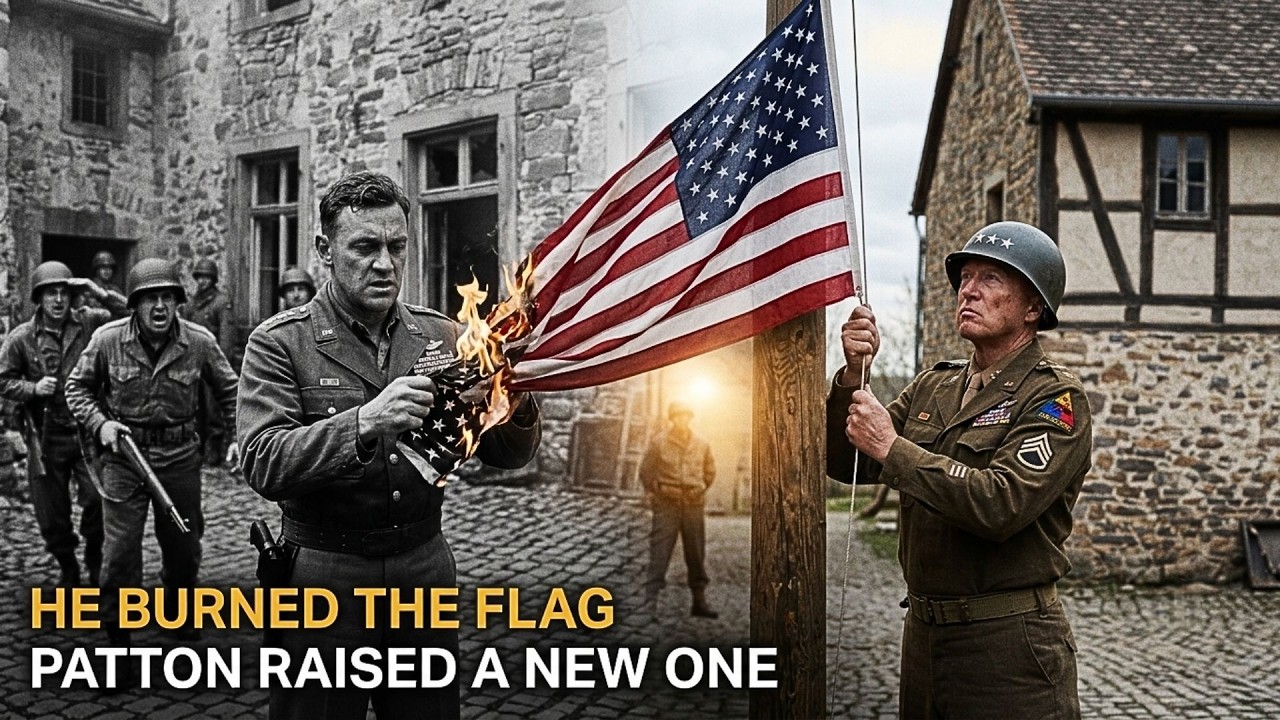
His expression changed. Then he did something that stopped every soldier in that yard cold. He lunged for the flagpole, reached it before anyone could stop him, and hauled the flag down. He had a lighter in his pocket.
Three seconds. The flag was burning in his hands. He dropped it on the ground and looked at the soldiers around him. No one moved.
Then one of them stepped forward and took hold of him. The report reached Patton twenty minutes later. Patton read it, set it down slowly, picked up his helmet, got into his car, and drove to that position himself. What he did when he got there, and what he said to that German commander face to face, remained the talk of the Third Army for weeks.
The date was April 14, 1945. The Third Army was moving through Bavaria and seizing positions faster than the German defenses could reorganize. Farms, crossroads, small villages, hilltop positions—each was taken, secured, and a flag raised over it. The American flag flown over a captured position was a visible marker from a distance, understood by everyone, meaning the position had fallen, that it was now theirs, that the advancing forces had passed through and the place belonged to a different army.
The farm outside the town of Neustadt had been taken that morning by an infantry squad led by Sergeant Pete Harris, twenty-six years old, from Texas, who had been in Germany since March. The sweep of the building was straightforward and quick. The structure appeared abandoned. Most rooms were empty.
The soldiers moved through it room by room in less than twenty minutes. Harris ordered the flag raised above the main entrance, standard procedure for securing a building. Then one of his men found the cellar door. Major Karl Steiner was forty-four years old, from Munich, an officer in the Wehrmacht for six years.
Not SS, not a fanatic, a professional soldier who had done what was asked of him through France, the Eastern Front, and the retreat back into Germany. He had watched the war take its course, until on April 14, 1945, he found himself in the cellar of a Bavarian farmhouse, nowhere to go, and no decision he truly wanted to make. He had been sitting in that cellar for two and a half hours when the sounds from above began to change. He heard boots on the wooden floorboards over his head, voices in a language he did not understand, the sound of doors opening and closing.
He sat very still and waited. Then the cellar door did not open. The soldiers passed him by. After that, he heard the sound of the flag being raised.
He recognized it immediately: the rasp of rope against the metal pole. He had raised too many flags in too many places over too many years not to know exactly what was happening in the yard above him. His men were brought out, hands raised. Then the cellar door opened, light spilled in, and he was found.
He climbed the stairs with his hands up and walked into the yard, two soldiers behind him with their weapons trained on him. Then he looked up. The American flag was flying over the entrance of the farmhouse where his unit had been stationed for three weeks, where he had eaten and slept and held meetings and written his last reports, where his men had lived out the final weeks of a war that was, to all appearances, already over. The farmhouse that was, in every real sense, the last position he would ever occupy in his life.
Something happened to him in that moment. He moved before anyone registered what was going on. Fast, faster than a forty-four-year-old man in the final week of a losing war has any right to move. He reached the flagpole, grabbed the rope with both hands, and brought the flag down in one swift motion.
Harris shouted. Steiner already had the lighter out of his coat pocket. Three seconds. The lighter worked on the first try.
The flag caught fire. He held it while it burned, then dropped it onto the stones of the yard when the heat reached his hands. He stood there, the burning flag at his feet, looking at the Americans. Soldiers in the yard, around the yard, at the windows.
No one moved for a full three seconds. Then, after a long moment, one of them picked up the radio. Harris’s report was precise and complete. What had happened, the sequence of events, what had been burned, who had done it, the current status of the prisoner.
The report reached Patton’s headquarters within twenty minutes. Colonel Thomas Reid brought it in and placed it on the desk without comment. Patton read the message through once, then set it aside. He stood, picked up his helmet, and put it on.
“Get me a vehicle,” Patton said. Reid looked at him. “And get me a flag,” Patton said. “Full size, from the supplies.
” “Now. ”
He drove to Neustadt, covering twenty-three miles on Bavarian roads in April. He did not speak during the drive. Neither did Reid.
When he reached the farm, Harris was in the yard. Steiner was held under guard near the wall of the building. The burned remains of the flag were still on the stones of the yard. Patton got out of the vehicle and walked into the yard.
He looked at what lay on the stones: the charred fabric, the scorched edges, what remained of it. He stood there for a moment. Then he looked at Steiner. Steiner stood by the wall with two soldiers beside him.
He was not tied. The soldiers were there, but his hands were free. He had been staring at the ground, staring at the ground ever since Harris pulled him away from the flagpole. He heard footsteps and raised his head.
He saw the four stars on the helmet. He saw Patton’s face. He saw the folded flag under Reid’s arm. Patton walked until he was three feet away and stopped.
The two men looked at each other. Patton did not speak at once. He looked at Steiner the way he looked at things he was trying to fully understand. Steiner met his gaze.
Then Patton turned his back on him. He walked to the flagpole, took the new flag from Reid—a full-size American flag, still folded—and handed it to Harris. “Raise it,” Patton said. Harris tied the new flag to the rope and ran it up.
The flag caught the April breeze and opened over the yard, whole, clean, unburned. The same flag that had been there before, that was there now again. Patton stood at the base of the pole and watched it rise to the top. Then he turned back to Steiner.
He walked back to him. He stood in front of him. “You burned a flag,” Patton said. His voice was calm, not loud, not anything.
“I understand the impulse. You are a soldier, and this place you commanded—now another man’s flag hangs on the pole. I understand that. ” He paused.
“But that flag,” he said, gesturing upward without taking his eyes off Steiner, “will be there when you are gone, and when I am gone. It was there before either of us reached this yard this morning, and it will be there after we leave it. What you did changed none of that. All you changed was what is now known about you.
” He stopped speaking. “That is what I drove twenty-three miles to tell you. ”
He turned to Harris. “Treat him as a prisoner of war,” he said.
Standard procedure. He walked back to his car without looking back. He returned to headquarters without a word spoken. Steiner was processed as a prisoner of war within the hour, standard intake procedures, exactly as Patton ordered.
He was held until the end of the war, went through the usual prisoner processing, and was released in 1947. He returned to Munich in 1947. The city had been heavily bombed and was in the early stages of reconstruction, rubble still visible in places. The skeleton of what the city had been showed through what it was becoming.
He worked in a print shop for twenty years. He never spoke publicly about his service or about what had happened at any time during it. He spoke to his son once, in the early 1960s, when his son was a teenager and found a photograph of Steiner in uniform and asked about it. Steiner told him a version of the story: the farm, the flag, what he had done.
His son asked him why he did it. Steiner was silent for a long time before he answered. “Something happened to me when I came up those cellar stairs,” he said. “I watched that flag rise over that building, and I was not in control of what I did next.
I did not think about it. I simply moved. I am not proud of it. It was the act of a man who was already finished and did not fully realize it.
” A long pause. “The general came himself,” he said. “He drove twenty-three miles and raised a new flag on that pole. He told me the flag would be there when I was gone.
Then he ordered that I be treated properly, according to the rules. ” He looked at the photograph. “A man who drives twenty-three miles to raise a flag instead of raising his voice understood something that morning that I had not understood, and it took me years to understand it myself. ”
Harris told the story publicly for the first time at a veterans’ gathering thirty-eight years later.
“Patton did not say a single word in the car the whole way,” Harris said. “Twenty-three miles, not one word. He drove there, walked in, looked at what was on the stones, then raised a new flag in place of the burned one. ” He paused.
“Then he stood in front of that German officer and told him the flag would outlast both of them. And afterward he ordered that he be treated according to protocol and law. ” He shook his head. “I have thought about it for thirty years.
Raising the new flag was the right response. Not what I would have done in that moment if it had been up to me, but it was the right response. ”
