The morning after Caroline Astor discovered her daughter had not been invited, her carriage appeared on Fifth Avenue. She had no choice. Carrie had been practicing a quadrille for weeks. Her friends had all received their invitations.
To be excluded would be a humiliation the Astor name could not afford. So the Queen of New York society did something she had never done before. She sent her footmen to the door of the Vanderbilt mansion with her calling card. It was a surrender disguised as a social courtesy.
The invitation arrived the following day. On March 26, 1883, the trap that Alva Vanderbilt had laid for Caroline Astor snapped shut. It had taken years to set, and it would change the social order of New York forever. But to understand what that single calling card meant, one had to understand the war that had been fought for decades before it.
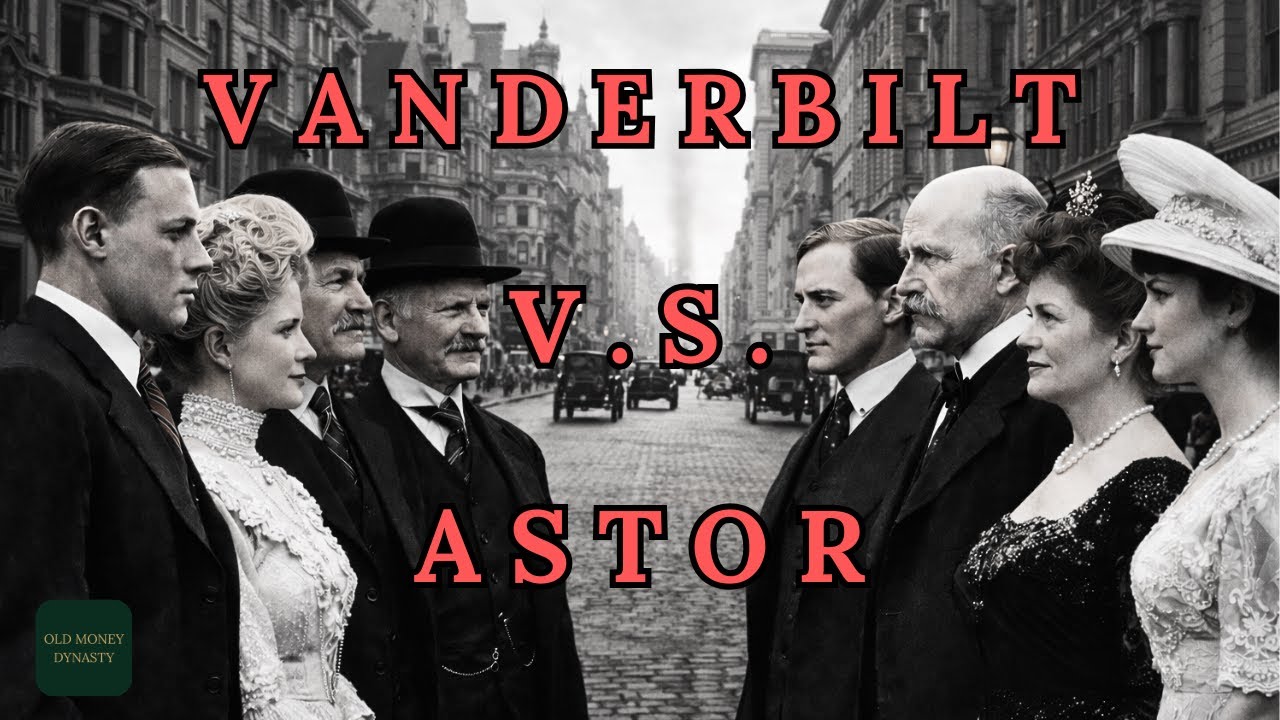
On one side stood the Astors, descendants of a German butcher’s son who had arrived in America with seven flutes in his pocket and a fortune in his future. On the other stood the Vanderbilts, heirs of a Staten Island ferry boy who had built the largest fortune America had ever seen. They did not fight with weapons. They fought with marble, gold leaf, and chandeliers the size of carriages.
The mansions that rose from this conflict became the most spectacular the country had ever witnessed. The Astors’ story began in 1763, in the village of Waldorf near Heidelberg, where Johan Jakob Astor was born to a butcher with little money and few prospects. By seventeen, Johan had left home, walked to the Rhine, and worked his way downriver on a timber barge to London, where his brother George had started a business making musical instruments. He spent four years there, learning English and saving every penny.
In 1783 he boarded a ship for the newly independent United States, carrying a few pounds, seven flutes to sell, and an ambition that would reshape New York. The voyage took nearly three months. Somewhere in the Atlantic he met a German passenger who had made money trading furs in America, buying pelts from trappers and Native Americans for almost nothing and selling them in London for enormous profit. By the time the ship reached Baltimore, Astor had abandoned the music trade.
He arrived in New York in 1784 and anglicized his name. Within two years he had opened a small shop buying raw hides and preparing them for export, working brutal hours, learning to grade furs by touch. The Jay Treaty of 1794 opened new markets in Canada and the Great Lakes. Astor moved quickly, establishing trading posts, making deals with the Northwest Company in Montreal, and building a network that stretched from the Atlantic coast to the frontier.
By 1800 he had accumulated a quarter of a million dollars, a figure that approaches half a billion in today’s terms. He was not yet forty, but he understood something that would define his family for generations. Fur trading was profitable but unpredictable; fashion changed, animal populations declined. The real money lay in the ground itself.
Manhattan. As the city pushed north, Astor bought farms, swamps, and empty lots that others considered worthless. He did not build on them; he waited. In 1808 he founded the American Fur Company with the blessing of President Thomas Jefferson, and the enterprise grew into a monopoly dominating the trade from the Great Lakes to the Pacific.
When the fur business declined just as he had predicted, he had already sold most of his trading interests and concentrated on real estate, building tenements, collecting rents, and lending money at interest rates that made him richer while others struggled. When John Jacob Astor died in March 1848, he was the wealthiest person in the United States, his estate valued between twenty and thirty million dollars, nearly one percent of the entire American economy. He left $400,000 to establish a public library, later merged into the New York Public Library, and $50,000 for a poor house in Waldorf, the village he had fled sixty-five years earlier. The rest went to his son, William Backhouse Astor.
Money alone did not carry the Astors’ true inheritance; the name now meant old wealth, established wealth, respectable wealth, the kind that could look down on anyone who came after. The man who came after was Cornelius Vanderbilt. At sixteen, he stood at the edge of New York Harbor watching boats cross between Staten Island and Manhattan. He had quit school five years earlier, could barely read, but understood water, wind, and profit better than most men twice his age.
According to family legend, he borrowed $100 from his mother to buy a small flat-bottomed sailing vessel called a periauger. Within twelve months he had repaid her and earned $1,000 in profit. Within a decade he dominated the waters around New York. Born May 27, 1794 in Port Richmond on Staten Island, he descended from Dutch settlers who had arrived in the 1600s, but generations of hard labor had not lifted his family from poverty.
Young Cornelius saw no future in farming. The War of 1812 provided his first major opportunity. The federal government needed supplies delivered to forts around New York Harbor, and Vanderbilt won contracts, expanded his fleet, and learned to navigate not just currents but commerce. By the time peace returned, he had accumulated $10,000 and a small fleet.
Then came steam. In 1817, Thomas Gibbons offered him a job captaining a steamboat between New Jersey and New York, paying only $1,000 a year. Vanderbilt accepted, recognizing what steam meant for the future, and spent eleven years learning the technology and fighting monopolies. New York had granted exclusive steamboat rights to Robert Fulton and Robert Livingston; Vanderbilt ran his boat anyway, evading capture, challenging the courts, undercutting prices until the monopoly collapsed.
By 1829 he worked for himself, launching competing steamboat lines on the Hudson and Long Island Sound. His strategy never varied. Enter a market, slash prices below what competitors could sustain, drive them into bankruptcy or force them to pay him to leave, then raise prices and collect the profits. It was ruthless, legal, and made him extraordinarily rich.
By the 1840s, only one man still carried the honorary title of Commodore: Cornelius Vanderbilt. The California Gold Rush of 1849 opened new possibilities; thousands needed passage to San Francisco, and the fastest route ran through Panama, controlled by established companies. Vanderbilt built an alternative transit route across Nicaragua, cutting travel time and offering lower fares. The venture earned over a million dollars annually.
In 1863, at an age when most men retired, Vanderbilt pivoted to railroads, taking control of the New York and Harlem Railroad, then the Hudson River Railroad, then the New York Central, merging them in 1870 into one of the first giant corporations in American history. By 1873 he controlled a single railroad system connecting New York to Chicago. Grand Central Depot, completed in 1871, stood as the physical monument to his achievement. When Cornelius Vanderbilt died on January 4, 1877, at eighty-two, his fortune exceeded $100 million.
Adjusted for the size of the American economy, no individual has matched that concentration of wealth since. He left the bulk to his son, William Henry, believing the others lacked discipline. He had built more wealth than John Jacob Astor, transformed American transportation, proven that a boy with no education and no connections could dominate an entire nation’s economy. But none of it mattered to the people who controlled New York society.
To them, Cornelius Vanderbilt remained what he had always been: a ferryman with too much money. In Gilded Age New York, money alone meant nothing. You could own railroads stretching from the Atlantic to Chicago, build mansions that dwarfed European palaces. None of it mattered if the wrong woman refused to know you.
Her name was Caroline Schermerhorn Astor. Born in 1830, she came from a family tracing its roots to the Dutch settlers who founded New Amsterdam two centuries earlier. Her father made his fortune in shipping; her mother descended from the Van Cortlandts. The Schermerhorns had lineage, generations of status that no amount of cash could purchase.
In 1853, Caroline married William Backhouse Astor Jr. , grandson of the fur trader who had died the richest man in America. But the Astor name still carried the faint odor of commerce. Only two generations separated the family from a German immigrant who arrived with seven flutes.
Caroline intended to change that. After her mother-in-law died in 1872, she began her ascent. Within a decade she controlled who mattered in New York. Her partner was Ward McAllister, a short, balding southerner born in Savannah to a prominent legal family.
He had spent years in Europe studying the rituals of titled nobility and returned determined to impose similar standards on the chaotic wealth flooding into New York after the Civil War. He called Caroline the Mystic Rose, a reference to Dante. Together they built a system elegant in its cruelty. Society operated through calling cards.
Before you could attend a ball, the hostess had to acknowledge your existence. Mrs. Astor kept a list. If your name did not appear on it, no door would open.
In 1872, McAllister founded the Society of Patriarchs, a committee of twenty-five gentlemen overseeing the great balls of each season. By the 1880s he had crystallized his legacy by declaring that only 400 people counted in fashionable New York, a number matching the capacity of Mrs. Astor’s ballroom. The Vanderbilts were not among them.
By the 1870s, the Vanderbilts possessed more wealth than the Astors had ever accumulated. But in the eyes of old New York, they remained descendants of a Staten Island ferryman, outsiders. William Kissam Vanderbilt, grandson of the Commodore, had married a woman determined to change that verdict. Alva Smith was born in 1853 in Mobile, Alabama, the daughter of a cotton merchant whose fortune the Civil War destroyed.
Educated in France, she learned European manners and ambition in equal measure. When she returned to New York she possessed beauty, charm, and no intention of accepting exclusion. In 1875, at twenty-two, she married William Kissam at Calvary Church. She had found her weapon.
The Vanderbilt fortune gave her resources old New York could not match, but direct assault would fail. Mrs. Astor simply refused to acknowledge the family existed. No calling card had ever been exchanged.
Alva studied her enemy. To defeat the gatekeeper, she would need to build something so magnificent that even the queen of society could not ignore it. In 1878, construction began on the corner of Fifth Avenue and 52nd Street. Over the next four years a building unlike anything New York had seen rose from the ground.
The architect, Richard Morris Hunt, had been the first American admitted to the prestigious École des Beaux-Arts in Paris, had studied the great châteaux of the Loire Valley, and understood exactly what Alva wanted: not a home, a statement. Hunt designed a French Renaissance palace in gleaming white limestone, a style known as châteauesque, inspired by the castles of fifteenth-century France. It stood in stark contrast to the somber brownstones lining the rest of Fifth Avenue. Where neighboring homes whispered respectability, this one shouted ambition.
The mansion contained sixty rooms across three stories. Visitors entered through a grand hall sixty feet long, its walls faced entirely in stone. The library featured French Renaissance paneling imported from Europe. The salon contained furniture that had once belonged to Marie Antoinette.
A Gothic banquet room measured fifty by thirty-five feet, dominated by a massive double fireplace with an oak overmantel carved by the Austrian sculptor Karl Bitter. The total cost reached $3 million, approaching $100 million today. New Yorkers called it the Petite Château. The name was ironic; there was nothing small about it.
The mansion occupied the northwest corner of Fifth Avenue, directly across from the triple palace William Kissam’s father had built. An entire stretch of Fifth Avenue now belonged to the Vanderbilts. Old money noticed; they could not help but notice. But a building alone would not be enough.
Mrs. Astor could simply refuse to acknowledge its existence. The Petite Château was finished, beautiful, and socially irrelevant. Alva needed an event, something so spectacular that refusing to attend would be more damaging than attending.
She planned a costume ball on a scale New York had never witnessed. She would invite over a thousand guests and spend whatever it took to make the evening unforgettable. The invitations went out in the spring of 1883. The date was set for March 26th.
New York society began preparing costumes months in advance; newspapers reported with breathless anticipation. But one invitation was conspicuously absent. According to the story that circulated through New York drawing rooms, Alva had not sent a card to young Carrie Astor, the popular daughter of Mrs. Astor herself.
The omission was deliberate. Carrie had been rehearsing a quadrille with her friends, a dance they planned to perform at the ball. Without an invitation, she could not attend. And Alva knew exactly why no invitation had been sent.
Mrs. Astor had never called on her. According to the rules of society, you could not invite someone to your home if they had never formally acknowledged your existence. Mrs.
Astor had spent years pretending the Vanderbilts did not exist. Now that silence had consequences. On the evening of Monday, March 26, 1883, police officers assembled at the corner of Fifth Avenue and 52nd Street. By eight o’clock, crowds had gathered on the sidewalks.
Workers were still putting up the awning over the entrance. The city had never seen anything quite like this. Carriages began arriving at ten o’clock. Nearly 1,200 guests stepped onto the red carpet, each wearing costumes that had taken months to prepare.
Dressmakers and cobblers had studied old books to ensure historical accuracy. Some costumes had been ordered from the House of Worth in Paris; others were decorated with real sapphires, rubies, and emeralds. The host, William Kissam Vanderbilt, appeared as the Duke de Guise in yellow silk tights and a black velvet cloak embroidered in gold. Alva wore the costume of a Venetian princess inspired by a Cabanel painting, her gown shading from deep orange to pale canary with a train of blue satin embroidered in gold.
On her head sat a jeweled cap featuring a peacock made entirely of colored gems. But the costume everyone remembered belonged to Alice Vanderbilt, wife of Cornelius Vanderbilt II. She came dressed as electric light. Her gown of yellow satin was decorated with glass beads in a lightning bolt pattern.
In her hand she carried a torch powered by hidden batteries; when she raised it above her head, it glowed like the Statue of Liberty. Thomas Edison had opened the nation’s first electric station only the year before. Alice Vanderbilt had turned herself into the future. At exactly eleven, the dancing began.
The guests had assembled in the third-floor gymnasium, transformed into a tropical forest filled with palm trees, orchids, and bougainvillea. One by one, five quadrilles descended the grand staircase. The Dresden quadrille wore all white like living porcelain dolls. The Opera Bouffe quadrille featured costumes trimmed with demon fringe.
The Star quadrille was organized by Mrs. Astor herself. And there she was, Caroline Schermerhorn Astor, the woman who had refused to acknowledge the Vanderbilts for years, dancing in their home. Her daughter Carrie performed the quadrille she had practiced.
Ward McAllister, the arbiter of taste who had helped create the Four Hundred, was there too. The chefs of Delmonico’s served dinner at two in the morning: terrapin, fried oysters, salmon. The champagne alone had cost $65,000. Contemporary sources put the total expense at $250,000, nearly $6 million today.
Eleven thousand had gone to flowers. The dancing continued until sunrise. As dawn broke over Fifth Avenue, Alva led her guests in one final Virginia reel. Then it was over.
Men in powdered wigs stumbled home through the morning light. The newspapers praised Alva’s taste, marveled at the costumes, declared it the social event of the generation. There was criticism too; the New York Sun published an article condemning such excess when so many in the same city were suffering. But the criticism did not matter.
What mattered was that as of March 27, 1883, the Vanderbilts stood at the top of New York society. Mrs. Astor had come to their house. She had danced in their ballroom.
She could never pretend they did not exist again. The Academy of Music had stood at 14th Street and Irving Place since 1854. For nearly three decades it had been the only opera house in New York that mattered. The city’s oldest families owned the eighteen boxes lining its interior, and those boxes determined who belonged in society and who did not.
The Vanderbilts did not own a box. William Kissam Vanderbilt reportedly offered $30,000 to purchase one. The Academy’s directors refused. It did not matter how much money the new families had; there was no room for them.
That was the point. The Academy’s limited capacity was not a flaw; it was a feature. As Edith Wharton later wrote, the old families cherished the opera house precisely because it was small and inconvenient and thus kept out the new people. But the new people had something the old families did not fully appreciate.
They had patience, ambition, and enough money to build their own opera house. On April 28, 1880, twenty-two men gathered at Delmonico’s restaurant. They elected officers and established subscriptions for a new company. The founding stockholders included names that would define American industry for generations: Vanderbilt, Morgan, Roosevelt.
Each box was assessed at 100 shares of stock, each share worth $100. When August Belmont, president of the Academy, learned of the project, he panicked and offered to add twenty-six new boxes to the existing eighteen. But the placement of those boxes would have been far less prestigious than the originals. The new families declined.
They were no longer interested in being accommodated. They intended to dominate. The site they chose was on Broadway between 39th and 40th Streets. The architect, J.
Cleaveland Cady, designed three tiers of private boxes where the new industrial families could display their wealth to the world. Construction took three years. On the evening of October 22, 1883, the Metropolitan Opera opened its doors. The production was Gounod’s Faust.
The Swedish soprano Christine Nilsson sang Marguerite, lured away from the Academy at $2,000 per performance. Henry Abbey, the impresario who leased the building, had spared no expense. The performance lasted five hours. In the boxes sat the Vanderbilts, the Morgans, the Drexels, the Whitneys, the Goelets.
William Henry Vanderbilt, whose fortune exceeded that of any other American, occupied two boxes and hosted the Lord Chief Justice of England. The newspapers described the house as bright as a new dollar. Someone noted that the box holders themselves were the real spectacle; the opera was almost incidental. Mrs.
Paran Stevens, a social climber famous for hedging her bets, attended both houses that night. For the next three years, New York had two opera companies competing for audiences. The Academy countered by hiring Adelina Patti, the most famous soprano in the world, at $5,000 per performance. Both impresarios lost fortunes; Abbey ended his first season nearly half a million dollars in debt.
But money was not the issue. Prestige had shifted. The Metropolitan Opera had more boxes, better sightlines, and the backing of families whose combined fortunes dwarfed those of the old Knickerbocker aristocracy. Most importantly, it had become the place where society wanted to be seen.
By 1886, the Academy of Music canceled its opera season. It never presented opera again. The building survived another four decades, hosting vaudeville before being demolished in 1926. Caroline Astor understood what had happened.
Within a few years she purchased a box at the Metropolitan Opera. On Monday evenings during the opera season she sat in the Diamond Horseshoe, draped in jewels, receiving visitors during intermission. Her rival sat nearby in Box 4. That rival was Alice Vanderbilt, wife of Cornelius II.
The opera war was over. The Vanderbilts had won that battle too. Before the Vanderbilts arrived, Newport was a seaside town where wealthy families escaped the summer heat in wooden cottages. The houses were large and comfortable but deliberately restrained; the established families believed too much display was vulgar.
Old money whispered; it did not shout. Alva Vanderbilt intended to change that. By 1888 she had conquered New York, but summer remained the province of the old families, and Newport was their stronghold. That year the Goelets threw down a challenge.
Ogden Goelet, whose family ranked second only to the Astors among New York landlords, hired Richard Morris Hunt to design a mansion that would surpass the Petite Château. His wife, Mary Wilson Goelet, made no secret of her ambitions. The new house would be called Ochre Court, and it would be the grandest residence Newport had ever seen. Alva’s response was swift.
Within months she hired Hunt herself and commissioned a summer cottage of her own. It would not merely match Ochre Court. It would obliterate it. The site she chose was a parcel on Bellevue Avenue, the fashionable thoroughfare where Newport society paraded each afternoon.
Construction began in 1888. Alva insisted on absolute secrecy. Fences surrounded the property. According to one widely repeated story, she brought in workers who spoke no English, so they could not gossip about the project in local taverns.
For four years Hunt and his craftsmen labored. The mansion that emerged in 1892 was unlike anything America had seen. They called it Marble House, and the name was no exaggeration. Five hundred thousand cubic feet of marble covered the exterior and interior, the stone coming from three continents: white marble from America, yellow Siena marble from Italy, pink Numidian marble from Algeria.
The total cost reached $11 million, of which $7 million went to marble alone, a figure approaching $400 million today. The design drew inspiration from the Petit Trianon at Versailles, the intimate palace where Marie Antoinette had retreated from court formalities. But there was nothing intimate about Marble House. Fifty rooms spread across four floors; a staff of thirty-six servants maintained it.
Visitors entered through bronze doors weighing 3,000 pounds apiece. Inside, a grand staircase of yellow Siena marble swept upward beneath a ceiling painted with gods and goddesses. The wrought-iron and gilt-bronze railing alone cost more than most houses. The grand salon announced the Vanderbilts’ arrival among American royalty, every surface covered in 22-karat gold leaf, crystal chandeliers scattering light across mirrored walls.
The dining room offered a different kind of extravagance. Walls of pink Numidian marble surrounded a massive table set with chairs modeled after those in the court of Louis XIV, each cast in bronze and gilded with gold. They weighed seventy-five pounds apiece; the armchairs at either end weighed 100. Guests could not seat themselves; a footman was required to slide each chair into place.
The message was unmistakable. The Vanderbilts did not merely live like kings; they lived like kings of an older, grander age. William Kissam Vanderbilt presented the deed to the completed mansion as a birthday gift to his wife on her thirty-ninth birthday. The gesture was generous but also shrewd; when the marriage ended three years later, Alva already owned Marble House outright.
The Goelets finished Ochre Court the same year, 1892. Their château was impressive, with fifty rooms and a three-story great hall that rivaled the finest houses in France, and at $4. 5 million it was among the most expensive homes ever built in Newport. But Marble House cost more than twice as much, and everyone knew it.
The summer of 1892 marked the beginning of a new era. The wooden cottages that had defined Newport for decades suddenly looked modest, almost quaint. Families who had spent summers in comfortable shingled houses now faced a choice: build something grander or accept diminished status. One by one, they chose to build.
Cornelius Vanderbilt II, William’s older brother, had purchased a wooden mansion called the Breakers several years earlier. After seeing what his younger brother and sister-in-law had accomplished, he began planning something far more ambitious. When the original Breakers burned in 1892, he seized the opportunity to start fresh. The race was on.
Newport’s transformation from Summer Colony to Monument of American Wealth had begun. At the center of it all stood Alva Vanderbilt in her marble palace on Bellevue Avenue, having once again bent society to her will. On the night of November 25, 1892, fire swept through a wooden mansion on Ochre Point in Newport. By morning, nothing remained but ashes and two fire-damaged safes containing Alice Vanderbilt’s jewelry.
The house had been called the Breakers, named for the waves that crashed against the cliffs below. Cornelius Vanderbilt II had purchased it seven years earlier from tobacco heir Pierre Lorillard for nearly half a million dollars, and had spent another $500,000 improving it. Now it was gone. For most families, such a loss would have been devastating.
For Cornelius Vanderbilt, it was an opportunity. That same year his younger brother William Kissum had completed Marble House, the $11 million palace that had transformed Newport and established William and Alva as the undisputed leaders of summer society. Cornelius was the senior member of the Vanderbilt family, chairman of the New York Central Railroad, the man who had inherited the bulk of his father’s fortune. Yet his brother’s summer cottage had surpassed anything he owned.
The fire changed that calculation. Within six weeks Cornelius had hired Richard Morris Hunt to design a replacement. The architect had just finished Marble House. Now the elder brother wanted something grander.
Hunt initially proposed a modest two-story villa in fireproof limestone. Cornelius rejected it. He wanted a palace. The design that emerged drew inspiration from the sixteenth-century palazzos of Genoa and Turin.
Hunt studied the architectural treatises of the Italian Renaissance, particularly the work of Rubens documenting the great houses of Northern Italy. The result would be his masterpiece. Construction began in the spring of 1893. Cornelius demanded speed.
Two thousand workers labored in shifts around the clock to complete the structure in just two years. Marble House had taken four years; the Breakers would take half that time. The mansion that rose on Ochre Point dwarfed everything else in Newport. Seventy rooms spread across five floors; the footprint covered nearly an acre.
The Great Hall measured fifty feet in every direction, a perfect cube of limestone and marble rising to a ceiling painted with classical figures. Over each of its six doors, sculptural groups celebrated human achievement. One depicted Richard Morris Hunt himself, immortalized alongside Galileo, Dante, and Apollo. The fireproofing Cornelius demanded shaped every decision.
The structure used steel trusses throughout; no wooden framing appeared anywhere in the building. The exterior was faced in Indiana limestone over brick. Most remarkably, the boilers were located in a separate underground facility beneath the front lawn, connected to the house by a tunnel. Cornelius would never lose another home to fire.
The interior brought together craftsmen from across the world. Jules Allard and Sons of Paris designed the formal rooms. Karl Bitter, the Austrian sculptor who had worked on Marble House, created relief panels. The library featured sixteenth-century paneling from a French château and walls of Circassian walnut stamped with gold leaf.
The dining room ceiling took inspiration from a Roman villa, with painted dolphins symbolizing hospitality and the sea. The cost reached $7 million, less than Marble House only because William had spent $7 million on marble alone. In every other respect, the Breakers exceeded its rival. It was larger, grander, built faster, and it belonged to the senior brother.
Richard Morris Hunt did not live to see his creation fully appreciated. He died in Newport during the summer of 1895, supervising the finishing touches on what would be his final commission. He was sixty-seven. The mansion he left behind would define American architecture for generations.
Cornelius enjoyed only one summer at the Breakers in good health. In July 1896 he suffered a stroke that left him partially paralyzed. The workaholic who had never seemed happy, who took his position so seriously that friends rarely saw him smile, was forced to retire from active business. He died of a cerebral hemorrhage on September 12, 1899.
He was fifty-five. His widow Alice remained. She had overseen the household operations at the Breakers and influenced much of its design. Now she presided over it alone, hosting Monday evening receptions during the Newport season, receiving visitors in the music room where her daughter Gertrude had been married.
Alice outlived her husband by thirty-five years, and outlived four of her seven children. Her eldest daughter died in childhood. Her eldest son, William, died of typhoid while attending Yale. Her son Alfred went down with the Lusitania.
Her son Reginald drank himself to death. Only Gertrude, who founded the Whitney Museum of American Art, and Gladys, who inherited the Breakers, survived her. When Alice died in 1934, the era she represented had already vanished. Income taxes and stock market crashes had made such houses impossible to maintain.
The Breakers passed to Gladys, who in 1948 leased it to the Preservation Society of Newport County for $1 per year. Today it stands as the largest and most visited of the Newport mansions. Four hundred thousand people walk through its rooms each year. What they cannot see is the rivalry that created it: two brothers, two commissions, two visions of what it meant to be a Vanderbilt.
William built Marble House to prove the family belonged in society. Cornelius built the Breakers to prove he still led it. In the early 1890s, two women in New York both claimed the same title. One was Caroline Schermerhorn Astor.
The other was Mary Dahlgren Paul Astor, wife of William Waldorf Astor, Caroline’s nephew by marriage. The dispute centered on something that might seem trivial: a name on a card. But in Gilded Age New York, names meant everything. William Waldorf believed his wife deserved to be known simply as Mrs.
Astor. His father, John Jacob Astor III, had been the elder brother of Caroline’s husband, making William the head of the senior branch of the family. In his view, his aunt should add her husband’s name to distinguish herself. Caroline ignored him.
She had spent twenty years building her position; she would not share her title with anyone. William Waldorf decided to make her pay. The Astor family owned adjacent mansions on Fifth Avenue in the lower thirties. Caroline lived at 350, on the southwest corner of 34th Street.
William Waldorf had inherited his father’s house next door at the corner of 33rd. The two brownstones shared a wall; the families had once been close enough to connect their homes with interior passages. Now William Waldorf announced his intentions. He would demolish his father’s mansion.
In its place, he would build a hotel. Not just any hotel: a thirteen-story tower that would loom over his aunt’s home, block her light, fill her quiet neighborhood with strangers, and make her life unbearable. He named it after the German village where the Astor fortune had begun. The Waldorf Hotel opened on March 13, 1893.
Designed by Henry Janeway Hardenbergh in the German Renaissance style, it rose 225 feet above Fifth Avenue, with fifteen public rooms and 450 guest rooms. William Waldorf did not stay to watch his aunt suffer; he had already left for England, where he would eventually renounce his American citizenship and accept a British peerage. But he could imagine her reaction from across the Atlantic. Caroline reportedly called it a glorified tavern.
But she understood what her nephew had done. He had turned her own neighborhood against her. For three years she endured it. Then she capitulated.
In 1896, Caroline Astor moved uptown. Her new residence, designed by Richard Morris Hunt, occupied the northeast corner of Fifth Avenue and 65th Street. It was a double mansion in the French Renaissance style, one half for Caroline, one half for her son John Jacob Astor IV. The ballroom could accommodate 1,200 guests, three times the capacity of her old home.
The new mansion faced Central Park, in a neighborhood quieter and more fashionable, further from the commercial development creeping up from below. Caroline had retreated, but she had retreated in style. Her son saw an opportunity. John Jacob Astor IV was now the head of the American branch of the family.
His cousin had fled to England; his mother had abandoned her old home. The site at 34th Street sat empty, waiting for someone to decide its fate. He chose to build another hotel. The Astoria opened in 1897, directly adjacent to the Waldorf.
Hardenbergh designed this one too, making it taller and grander than its neighbor: sixteen stories rising 270 feet, with 550 guest rooms and twenty-five public rooms. The style matched the Waldorf but exceeded it in every dimension. The two hotels stood side by side, built by feuding relatives, competing for the same guests. It was an absurd arrangement, but the Astors had always understood real estate better than family harmony.
Someone proposed a merger. The hotels would be connected by a 300-foot marble corridor, lined with restaurants and shops. The fashionable set called it Peacock Alley, because the wealthy strutted through it displaying their finery. The combined establishment became the Waldorf-Astoria.
The hyphen represented the corridor that joined them. With 1,300 guest rooms and forty public spaces, it was the largest hotel in the world. The total cost of both buildings, excluding furnishings, reached $15 million. Oscar Tschirky, the maître d’hôtel who had come from Delmonico’s, presided over the dining rooms and invented dishes that would outlast the building itself: Waldorf salad, eggs Benedict, thousand island dressing.
The hotel became the living room of New York society, a place where old families and new could mingle in public splendor. Caroline Astor never returned to 34th Street. She remained in her mansion on 65th Street, hosting her annual balls, receiving visitors, maintaining the rituals she had established decades earlier. Her health declined in her final years.
By the time she died in October 1908, her mind had retreated into the past. According to those who attended her in those final months, she would dress in her finest gowns, descend her marble staircase, and receive guests who existed only in her memory. Her son survived her by less than four years. In April 1912, John Jacob Astor IV boarded the Titanic with his young second wife.
He did not survive the sinking. The Waldorf-Astoria outlasted them both, but not by much. By the 1920s the neighborhood had changed; the residential elegance Caroline had fled was long gone, replaced by hotels and department stores. The Waldorf-Astoria, once the most modern establishment in the city, now seemed dated.
In 1929 the buildings were sold and demolished. In their place rose the Empire State Building, for decades the tallest structure in the world. The name survived; a new Waldorf-Astoria opened on Park Avenue in 1931. But the original site where Caroline Astor had once presided over society from her brownstone parlor now belonged to something even grander than she could have imagined.
William Waldorf Astor had wanted to loom over his aunt. In the end, everything was eclipsed. The world that made the Vanderbilts and Astors possible was ending. In February 1913 the Sixteenth Amendment was ratified, allowing the federal government to tax income for the first time in American history.
The initial rates were modest; less than one percent of Americans owed anything at all. But the principle had been established. The great fortunes that had accumulated untaxed for generations would now be subject to redistribution. Within five years, wartime rates pushed the top bracket to 77 percent.
The era of limitless accumulation was over. The Great War accelerated everything. It consumed ten million lives and redrew the map of Europe. It also claimed members of both families whose rivalry had defined New York society for a generation.
Alfred Gwynne Vanderbilt boarded the Lusitania on May 1, 1915. He was thirty-seven, son of Cornelius Vanderbilt II, and one of the wealthiest men in America. His father had disinherited his older brother Cornelius III for marrying against family wishes, leaving Alfred as principal heir, with over $70 million received at age twenty-two. Alfred was traveling to England for a meeting of the International Horse Breeders Association.
He had received warnings before departure; the German government had placed notices in American newspapers declaring the waters around Britain a war zone, and an anonymous telegram urged him not to sail. He dismissed it as a prank. On May 7, a German submarine fired a torpedo into the ship’s hull off the coast of Ireland. The Lusitania sank in eighteen minutes.
Alfred could not swim. Witnesses reported that he spent his final moments helping women and children into lifeboats and distributing life jackets. When a young mother holding an infant had no way to secure herself, he gave her his own life vest and fastened it around her. Then the ship went down.
His body was never recovered. The New York Times reported that people would remember him not as a millionaire sportsman but as the children’s hero. His family, however, asked that the Lusitania not be mentioned in funeral announcements or his obituary. The ship that killed him was to remain nameless.
The sinking helped turn American public opinion against Germany. Two years later, the United States entered the war. Alva Vanderbilt Belmont, who had once forced her way into Caroline Astor’s ballroom, now devoted her fortune to a different cause. After her divorce from William K.
Vanderbilt in 1895 she had remarried Oliver Hazard Perry Belmont. When he died in 1908, she found a new purpose: the suffrage movement. Inspired by the militant tactics of Emmeline Pankhurst’s activists in England, she funded organizations, hosted conferences at Marble House, and put her money behind the campaign for women’s right to vote. In 1916 she helped found the National Woman’s Party alongside Alice Paul.
The following January they organized the first protest ever held in front of the White House. Alva became the organization’s president and its most important financial supporter. In August 1920 the Nineteenth Amendment was ratified; women could vote. By then her former husband was dead.
William K. Vanderbilt had passed away in Paris on July 22, 1920, at seventy. His estate was valued at over $50 million; federal estate taxes claimed more than $11 million. The woman who had built Marble House and broken into Mrs.
Astor’s world spent her final years in France near her daughter Consuelo, the daughter she had forced into marriage with a duke, the daughter who had eventually forgiven her. They had reconciled over their shared commitment to women’s rights, and Consuelo had spoken at suffrage gatherings Alva organized. Alva suffered a stroke in 1932 that left her partially paralyzed. She died in Paris on January 26, 1933.
Her funeral at St. Thomas Episcopal Church in New York featured all-female pallbearers; her casket was flanked by members of the National Woman’s Party. She left $100,000 to the organization in her will. She had begun her public life as a society woman determined to storm the gates of old money.
She ended it as an activist determined to tear down the barriers that excluded half the population from political life. The ballrooms she had stormed were empty now. The mansions she had built were being sold or demolished. In 1926 the wrecking balls arrived on Fifth Avenue.
One by one, the great houses that had defined New York society for a generation were reduced to rubble. The Petite Château went first. Sold to real estate developer Benjamin Winter, who paid for the land, not the building, the mansion that had cost $3 million to construct in 1882 was demolished in the spring of 1926. In its place rose a twenty-story commercial building; today a clothing store occupies the ground floor.
Alva, by then Mrs. Belmont, noted the demolition in passing in a draft of her memoirs. She did not linger on the subject. The same year, the largest private residence ever built in New York City met the same fate.
The Cornelius Vanderbilt II mansion, stretching an entire block along Fifth Avenue from 57th to 58th Street, was sold to the Braced Realty Corporation for $7 million. The price reflected the value of the land, not the 130 rooms that stood on it. Alice Vanderbilt had lived alone in the house for nearly three decades. It required more than thirty servants to maintain, and the income from her trust fund barely covered the costs.
Commercial development had surrounded her on all sides. She resisted as long as she could; then she capitulated. A week before the wreckers arrived, Alice opened the house to the public. For fifty cents, anyone could walk through the rooms where the Vanderbilts had entertained presidents and princes.
Thousands came. Then the walls came down. In 1928, Bergdorf Goodman opened on the site. But Alice saved what she could.
The wrought-iron gates that had guarded the entrance were donated to Central Park, where they still stand at the Conservatory Garden. The carved fireplace from the Great Hall went to the Metropolitan Museum of Art. Sculptural reliefs from the facade ended up in the lobby of the Sherry-Netherland Hotel. The mansion was gone, but fragments of it survived, scattered across the city like relics of a vanished civilization.
The Astors lost their palace too. The double mansion at 65th Street, where Caroline had spent her final years receiving phantom guests, was sold and demolished in 1926. The contents were auctioned off: paintings, furniture, decorative ceilings, architectural elements. In its place rose Temple Emanu-El, one of the largest synagogues in the world.
The old order was being erased. The reasons were practical. Maintaining a mansion required an army of servants, and servants had become expensive. Heating the cavernous rooms consumed mountains of coal.
Property taxes climbed every year, and the land beneath these houses had become worth more than the houses themselves. The federal estate tax made the calculations even clearer; when a patriarch died, his heirs faced bills that could consume a quarter of the fortune. The only way to pay was to sell assets, and the mansions, which produced no income and cost fortunes to maintain, were the obvious choice. By the end of the 1920s, Millionaires’ Row had become a memory.
A few survivors remained further north, where the march of commerce had not yet reached, but everyone knew it was only a matter of time. Some of the Newport cottages fared better. The Breakers still stands on Bellevue Avenue, its seventy rooms preserved exactly as Alice Vanderbilt left them. Four hundred thousand visitors walk through the Great Hall each summer.
Marble House survives too, the birthday gift William K. Vanderbilt gave to Alva in 1892; the ballroom where she plotted the suffrage movement’s campaigns is open to tourists; the dining room chairs still weigh seventy-five pounds each. And in the mountains of North Carolina, the largest private home in America remains in the Vanderbilt family. Biltmore, built by George Washington Vanderbilt II in the 1890s, encompasses 250 rooms on 8,000 acres.
Too remote and too large to demolish, his descendants opened it to the public in 1930, charging admission to help pay the bills. It remains a private residence and a tourist attraction. These are the survivors. They exist because someone decided to transform private homes into public museums.
The alternative was demolition; there was no middle ground. The Fifth Avenue mansions did not survive because no one fought for them. The houses came down, and the city moved on. What replaced them was taller, denser, more profitable.
The skyline that defines modern Manhattan rose from the rubble of the Gilded Age. The Empire State Building stands where the Astors once feuded. Department stores occupy the land where the Vanderbilts once competed for supremacy. The war is over.
The combatants are gone. Caroline Astor died believing she still ruled a society that had already moved on without her. Alva Vanderbilt Belmont died fighting for causes that would have horrified the world she had once conquered. The fortunes they married into were taxed and divided and dispersed across generations until the name Vanderbilt no longer automatically meant wealth.
The social hierarchy Caroline had policed so carefully collapsed under the weight of immigration and war and economic transformation; the Four Hundred became a quaint historical footnote. But something remains. The summer cottages at Newport stand largely as their owners left them, preserved not as ruins but as functioning museums. Tour guides lead visitors through rooms designed to intimidate, explaining the cost of the marble, the weight of the chandeliers, the number of servants required to maintain the illusion of effortless elegance.
The houses that once announced to the world that their owners had arrived now announce that an entire way of life has departed. In New York, the great mansions are gone, but fragments survive, scattered across the city, embedded in institutions that serve the public. The private became public. The exclusive became accessible.
The monuments to individual wealth became monuments to collective memory. The Gilded Age was not a golden age. The name itself was meant as criticism, coined by Mark Twain to describe an era that glittered on the surface but concealed corruption and exploitation beneath. The mansions were built by workers who would never set foot inside them except as servants.
The fortunes were accumulated through practices that would later be outlawed. And yet the houses were beautiful. The craftsmanship was extraordinary. The ambition, however misdirected, produced structures that still inspire awe.
What remains is the story: two families, one old and one new, fighting for position in a world they helped create. The houses they built as weapons in that war. The balls and operas and snubs they delivered and endured. The way they lived, the way they died, the way they are remembered.
It is a story about wealth, but not only about wealth. It is a story about belonging, about the human need to be recognized, to be accepted, to matter. Caroline Astor and Alva Vanderbilt were both, in their different ways, trying to answer the same question. Who counts?
Who belongs? Who gets to decide? They answered that question for their era. Their answers no longer apply.
The gates are open now. Anyone can walk through.
