Brittany Murphy’s laugh was the thing people remembered first. It was not a delicate, polite sound. It was a big, throaty, full-bodied expression of joy that could erupt without warning and fill an entire room. For a time in the late 1990s and early 2000s, she seemed to be everywhere, a quirky, raw, incandescent presence who appeared destined for a long and brilliant career.
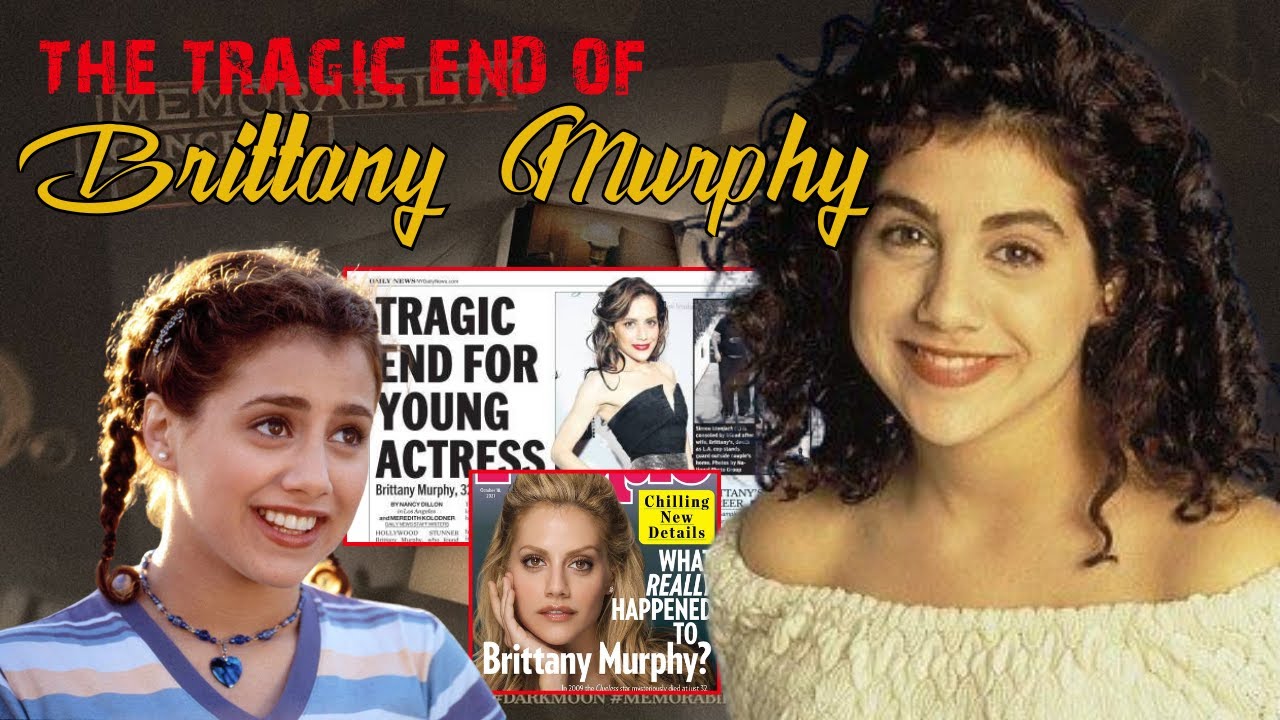
And then, just as suddenly as she had arrived, she was gone. Her death at the age of 32, followed five months later by the death of her husband in the same house and the same bedroom, remains one of the most unsettling tragedies in modern Hollywood history, a story filled with unanswered questions, whispers of conspiracy, and a profound sense of a life cut tragically short. Murphy came of age as an actress in the 1990s, a transformative time in Hollywood. The old studio system with its rigid control over stars had crumbled, replaced by a more independent spirit.
This was the era of Quentin Tarantino and Sundance, of quirky, character-driven films that broke the mold of the summer blockbuster. For a young actress who did not fit the conventional blonde, blue-eyed cheerleader mold, it was a time of incredible opportunity. She was born in Atlanta in 1977 but grew up in Edison, New Jersey, raised by her single mother, Sharon. From the very beginning, their bond was extraordinarily close, a partnership forged against the odds.
Sharon saw the spark in her daughter early and nurtured it with everything she had. Murphy was a performer from the moment she could walk and talk, an old soul with a deep well of emotion she could tap into with astonishing ease. By the time she was a young teenager, she had convinced her mother to move across the country to Los Angeles, a bold and risky move fueled by a shared and unshakable belief in her talent. The Hollywood they arrived in was a town of dreamers and schemers, a place where fortunes could be made and hearts broken in the blink of an eye.
For every success story, there were thousands of hopefuls who never got their big break. The pressure on young actors, especially young women, was immense. With her unconventional looks and her boundless, almost chaotic energy, Murphy was not an easy fit. She was not the girl next door.
She had to fight for every role to prove she was more than just a quirky sidekick. Her mother was her rock, her manager, her best friend, and her fiercest protector. Together they navigated the treacherous waters of the industry, a mother and daughter against the world. Her early years were a flurry of small television roles, guest spots on shows like Murphy Brown and Blossom.
She was a working actress, honing her craft and paying her dues. But everyone who worked with her, even in those early days, knew they were seeing something special. There was a raw, unfiltered quality to her performances, a willingness to be vulnerable and emotionally messy that set her apart. Her big break came in 1995 with a role that would define a generation.
As Tai Frasier in Amy Heckerling’s high school satire Clueless, Murphy burst onto the scene. Tai was the ugly duckling, the new girl from the wrong side of the tracks who undergoes a makeover at the hands of Cher Horowitz. It would have been easy to play her as a one-dimensional caricature, but Murphy gave her heart, humor, and a touching vulnerability. Her famous line, “You’re a virgin who can’t drive,” delivered with a perfect mix of shock and sass, became an instant classic.
Clueless was a cultural phenomenon, and Murphy was its breakout star. But the success also threatened to typecast her as the quirky, funny sidekick. She was determined to show the full range of her talent. In 1999, she delivered a stunning and heartbreaking performance as Daisy Randone, a troubled patient in a psychiatric hospital, in Girl, Interrupted.
Acting alongside established stars like Winona Ryder and a pre-Oscar Angelina Jolie, Murphy held her own, creating a character who was both fragile and deeply disturbing. It was a powerful declaration that she was a serious dramatic actress. Then in 2002, she went head-to-head with Eminem in the gritty semi-autobiographical film 8 Mile. As Alex, the tough, ambitious love interest, she was utterly convincing, bringing a raw, street-smart energy that perfectly matched the film’s tone.
One of the most surprising detours in her career was her foray into music. In 2006, she collaborated with DJ Paul Oakenfold on the song “Faster Kill Pussycat. ” As a deliberate promotional strategy, the track was initially sent to clubs as a white label single, with her vocals intentionally uncredited. The song became a club hit on its own merit, sparking widespread speculation about the identity of the mystery singer.
It was only after this initial success that she was revealed as the singer. Murphy had always dreamed of being a singer, and this was a moment of pure joy, a success entirely on her own terms. But as her career progressed, something began to shift. Her physical appearance changed dramatically.
She lost a significant amount of weight, and her once natural look was replaced by something more traditionally Hollywood. Whispers began to circulate about her health, about possible eating disorders or drug use. Her behavior in interviews sometimes seemed erratic or unfocused. The bright, bubbly girl from Clueless seemed to be fading, replaced by a more fragile and uncertain figure.
Her career, once on a meteoric rise, began to stall. She was relegated to smaller, direct-to-video films, a far cry from the A-list projects she had once commanded. The turning point came in 2007, the year her life took a significant and, many would say, fatal turn. She married Simon Monjack, a little-known British screenwriter.
Their relationship was a complete whirlwind and raised eyebrows from the very beginning. It was not just that he was unknown. It was that he seemed to come out of nowhere at a time when she was at her most vulnerable. Her career was stalling, and she seemed to be looking for an anchor.
Instead, she found Monjack, a deeply controversial figure with a history of legal troubles, outstanding warrants, and a reputation for being incredibly controlling and manipulative. Her friends and colleagues, the people who had known her for years, were terrified for her. They saw a classic tragic pattern emerging. They felt he almost immediately began to isolate her, cutting her off from her old support system, her agents, her managers, and the friends who had been her rock.
Soon after their marriage, her mother, Sharon, moved in with the couple, creating an unusual and intensely insular domestic situation. The three of them became a self-contained unit holed up in a big Hollywood Hills mansion. They were rarely seen socializing and became increasingly detached from the outside world. People who managed to get inside described the house as chaotic, the blinds always drawn, a feeling of darkness and paranoia hanging in the air.
Monjack officially took over the management of Murphy’s career, and her professional life declined even more rapidly. He had no real Hollywood experience or connections. He would allegedly get on calls and make outrageous demands, burning the few bridges she had left. She was dropped from projects, and rumors circulated that she was difficult to work with.
There is a particularly unsettling story from one of her last films, a small-budget horror movie. A director on the film noted that during a scene, Murphy seemed off, disconnected. She was looking off-camera for approval after every single take. He soon realized she was looking at Monjack, who was standing just behind the camera, silently directing her performance with his eyes and small gestures.
An actor’s job is to be present, to connect with their scene partner, to trust their director. But she was bypassing all of that, looking for permission from her husband. It was a small but telling detail that seemed to confirm the fears of many that the vibrant, independent spirit who had fought so hard for her career was now under the complete control of her husband. Murphy died on December 20, 2009, sending a shockwave through Hollywood.
The official report from the Los Angeles County Coroner was stark and, for many, deeply unsatisfying. The cause of death was listed as pneumonia with secondary factors of iron deficiency anemia and multiple drug intoxication. The coroner was clear that the death was accidental. The drugs found in her system were all legal, a mix of over-the-counter and prescription medications likely taken to treat a cold or respiratory infection.
The coroner stated that her death could have been prevented if she had simply been taken to a doctor. But this official explanation did little to quell the storm of speculation. How could a vibrant 32-year-old woman die of pneumonia in her own home? Why was she not taken to a hospital?
The behavior of her husband and her mother in the aftermath only fueled public suspicion. Instead of retreating from the spotlight, they engaged in a series of bizarre and contradictory interviews, offering conflicting accounts of Murphy’s final days. Then came the truly shocking twist. Just five months after Murphy’s death, Simon Monjack was found dead in the same house, in the very same bedroom.
The cause of death was eerily similar: acute pneumonia and severe anemia. The second death transformed the case from a tragedy into a full-blown mystery. One of the most persistent theories was that of toxic mold. Monjack himself had floated this idea, claiming there was mold in the house that was making them sick.
While an initial investigation by the coroner’s office found no evidence of mold being a factor, the idea took hold in the public imagination. Murphy’s own father, Angelo Bertolotti, from whom she had been estranged for many years, publicly challenged the coroner’s findings. He commissioned independent lab tests on samples of her hair, which he claimed showed high levels of heavy metals, suggesting the possibility of poisoning. These claims were widely disputed by forensic experts and never substantiated by law enforcement.
The historical debate remains unsettled. On one side is the official scientific explanation: a tragic and preventable death caused by a confluence of illness and self-medication. In this view, Murphy was a young woman who had fallen ill and, due to a combination of poor judgment and perhaps a distrust of mainstream medicine, failed to get the help she needed in time. Monjack’s subsequent death, while a shocking coincidence, could be explained by a similar lifestyle and a shared unhealthy environment.
On the other side are the unanswered questions: Why were both of them so severely anemic? Why was a young, wealthy actress not receiving top-notch medical care? And what role did Monjack and Sharon Murphy play in her increasing isolation? Murphy is remembered first and foremost as a unique and singular talent, an actress who defied categorization, bringing raw charisma to every role.
Her work continues to captivate new audiences. But her story also serves as a dark cautionary tale about the unforgiving nature of Hollywood, a stark reminder of the immense pressures of fame, the impossible beauty standards imposed on women, and how quickly the industry can cast an artist aside. Ultimately, beyond the speculation, hers is a deeply human tragedy about a sensitive soul extinguished far too soon, a story about the painful gap between a sparkling public image and a private reality.
The greatest tribute is not to obsess over the mystery of her death, but to celebrate the vibrancy of her life, the laughter, the films, and the open heart she shared with the world.
