Barbara Stanwyck spent her life building walls. Born Ruby Catherine Stevens in Brooklyn on July 16, 1907, she was the youngest of five children in a family that would shatter before she turned five. In 1911, a drunken stranger shoved her pregnant mother off a moving streetcar. Katherine Stevens died from the fall.
Two weeks after the funeral, her father Byron left for work on the Panama Canal and never returned. Ruby and her brother were shuffled through foster homes, sometimes four in a single year, while their teenage sister Mildred toured as a chorus girl to scrape together a living. The child learned early that no one could be trusted to take care of her. She started smoking at nine, fought in the streets by her early teens, and dropped out of school in the eighth grade.
The only light in that hard childhood came from the movies. At nickelodeons, she idolized the fearless silent-film heroines and dreamed of escaping into their world of adventure. At fifteen, she lied about her age and landed a chorus line spot at a Times Square nightclub. Within months, she was dancing on the New Amsterdam Theater stage as a Ziegfeld Follies girl, shaking for sugar daddies and learning precisely how to inflame a man’s interest and then give him the brush-off.
That skill would later become her signature on screen. In 1926, producer Willard Mack spotted the scrappy nineteen-year-old dancer and gave her a part in his Broadway drama The Noose. She took herself a new name for her new life: Barbara Stanwyck. The play flopped at first, but when it reopened months later, her minor part had been expanded.
Night after night, she broke the audience’s hearts as a tragic chorus girl. Critics took notice, and Broadway offered up a hit melodrama called Burlesque in 1927 that put her name in lights. Hollywood began circling. Her first marriage seemed like refuge from a lifetime of loss.
Frank Fay, a vaudeville comedian ten years her senior, was Broadway’s golden boy, and after the sudden death of her secret lover and co-star Rex Cherryman in 1928, Stanwyck clung to Fay’s stability. They married in August 1928 and headed west for his Warner Brothers contract. Her own first two films made hardly a ripple, but true stardom arrived when Fay introduced her to an up-and-coming director named Frank Capra. The 1930 film Ladies of Leisure changed her life.
Capra had doubted her until he saw her screen test footage; something in her natural talent electrified him. Critics raved that a new star had arrived. Throughout the early 1930s, Stanwyck blazed through roles that pushed the era’s boundaries. Her women were nobody’s fools: streetwise, tough, and vulnerable all at once.
In Babyface, she famously portrayed an ambitious young woman who sleeps her way up the corporate ladder, a performance so scandalously frank about female sexual power it became a prime suspect when Hollywood faced the new production code. By 1934, she was cranking out up to four films a year, developing the range that became her brand: steel and sensitivity intertwined. At home, though, her life was veering into melodrama. As Barbara’s star ascended, Frank Fay’s career collapsed.
The proud man who had championed her grew resentful of being eclipsed by his own wife. He slid deeper into alcoholism and inflicted violence on her. In 1932, hoping a family might heal the rift, they adopted a baby boy named Dion Anthony, called Tony. But fatherhood only inflamed Fay’s temper.
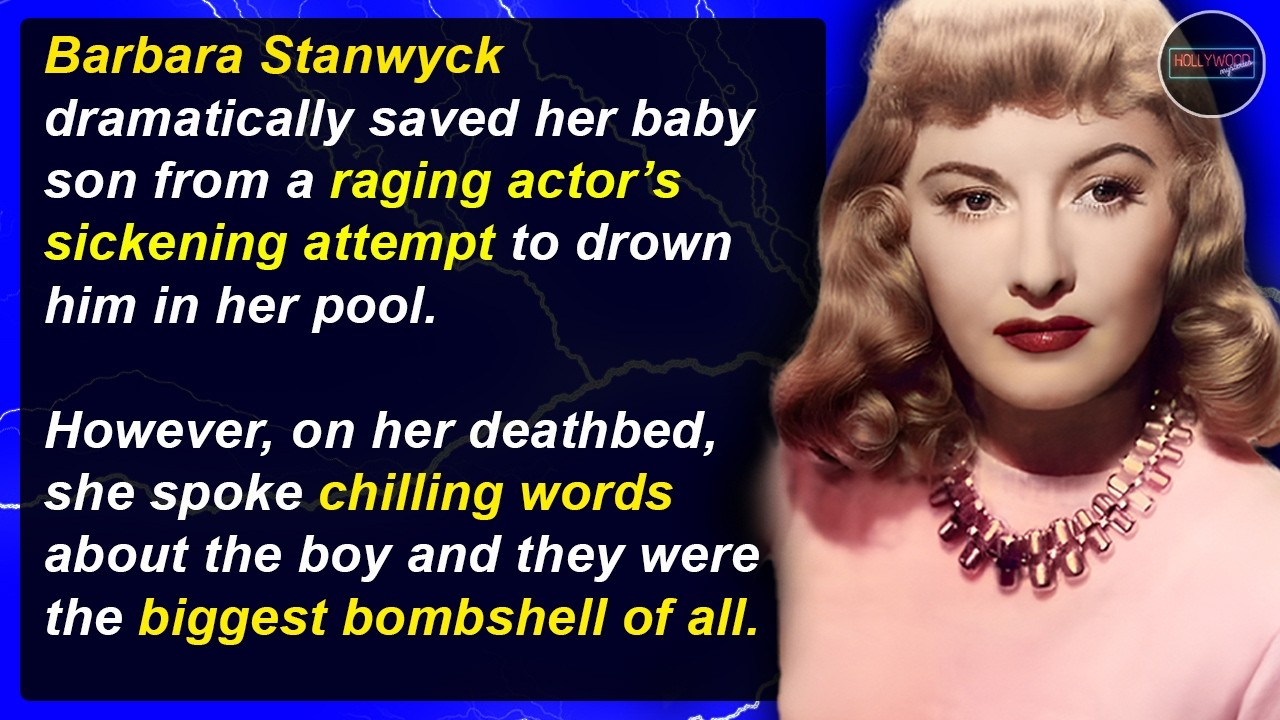
On one horrifying occasion, he came home drunk, picked up little Tony, and threw the toddler into the swimming pool. Barbara jumped in fully clothed to rescue her child. In 1935, after seven years of misery, she left Fay for good and won sole custody. Beneath the surface, Stanwyck carried a deeper secret.
At fifteen, she had become pregnant, most likely from being raped by a foster carer, and a back-alley abortion left her with lasting injuries that meant she could likely never bear children. The adoption had been an attempt to fill that void. On the set of a musical called His Brother’s Wife in 1936, she met Robert Taylor, a twenty-five-year-old MGM contract player whose clean-cut Nebraska manners were the opposite of everything she had left behind. The romance was slow, built on friendship.
She coached him on scripts; he taught her to loosen up. But in 1930s Hollywood, an unmarried couple living openly was scandalous, and studio mogul Louis B. Mayer, protecting MGM’s wholesome image, pushed them toward marriage. Both resisted at first, but stars were at the mercy of their contracts.
On May 14, 1939, they married in a brief ceremony at her Beverly Hills home. There was no honeymoon. Taylor later admitted he wasn’t sure he was in love, feeling boxed in by the studio’s ultimatum. Publicly, they played the devoted Hollywood power couple, and for a time life was kind.
Stanwyck reached her career zenith. She dazzled in The Lady Eve, earned an Oscar nomination for Stella Dallas, and then created her most indelible character in 1944: Phyllis Dietrichson in Double Indemnity, the housewife turned black widow who seduces an insurance agent into murder. With her platinum wig and glinting anklet, she became the very definition of the film noir femme fatale. By 1944, she was the highest paid woman in America, earning $400,000 that year, and she was nearing forty, an age when most actresses were being sent to the scrap heap.
She was nominated for a third Oscar. The marriage, however, was cracking. During the war, Taylor served in the Navy, and when he returned, he chafed at taking orders at home. He became obsessed with Lana Turner, his co-star in Johnny Eager, and actually asked Barbara for a divorce to pursue her.
She refused and swallowed her hurt. Worse betrayal followed in 1948, when she befriended Ava Gardner on the set of East Side, West Side, unaware Gardner was secretly bedding Taylor behind her back. In the film, Stanwyck played a betrayed wife while Gardner played the other woman; off camera, the same triangle occurred with real emotions. The final straw came in 1950, when Taylor went to Rome to film Quo Vadis and began an indiscreet affair with a young Italian starlet.
This time, the tabloids got wind of it. Stanwyck delivered an ultimatum, and when Taylor didn’t beg for forgiveness, they quietly filed for divorce in 1951. In an unusual settlement story, she demanded he pay her alimony, fifteen percent of his future income, until one of them died. He agreed without protest.
In 1953, not long after the divorce, Stanwyck signed on to a shipboard drama called Titanic. On set, she met a tall, dark newcomer named Robert Wagner, twenty-two years old, half her age. He played her college-age lover, and life imitated art with uncanny speed. An intense affair blossomed.
She nicknamed him R. J. and let her guard down in his playful company. But 20th Century Fox, grooming Wagner as a matinee idol, decided a public entanglement with a woman twenty-three years older would damage his image.
The studio planted a story that he was engaged to a young starlet named Terry Moore, a complete fabrication. The phony announcement rattled Stanwyck, and Wagner recognized a hard truth: if he stayed with her, he would forever be Mr. Stanwyck. They quietly went their separate ways.
He later called it a wonderful, wonderful experience; she never discussed the affair publicly. Her relationship with her son Tony had never healed. She had sent him to military school at sixteen, and they grew apart entirely. As an adult, he led a troubled life, and she kept her distance emotionally.
On her deathbed, she gave explicit orders that her son not be allowed to see her under any circumstances. He outlived her by sixteen years, never having reconciled. By the late 1950s, the golden age that made her a star was fading, and Stanwyck pragmatically moved to television. In 1960, she headlined an anthology series that lasted only one season but earned her an Emmy, one of the first major film stars to win television’s top prize.
A few years later, she struck gold with The Big Valley, a western that cast her as Victoria Barkley, the strong-willed matriarch of a ranching dynasty. Over four seasons, she won three more Emmys. She became close with her young co-star Linda Evans, who had lost her mother during the series run. Barbara stepped into the breach.
The orphan who had felt so incapable of mothering her own child became a beloved mother figure to a co-star. In 1983, at nearly seventy-six, she starred in the blockbuster miniseries The Thorn Birds as Mary Carson, and won a Golden Globe and yet another Emmy. A lifelong heavy smoker, she suffered from chronic obstructive pulmonary disease and heart issues. One October night in 1981, a burglar broke into her Beverly Hills home, struck the seventy-four-year-old actress on the head with a flashlight, and locked her in a closet while he ransacked her belongings, making off with $40,000 in jewels, including a cherished ring Robert Taylor had once given her.
The trauma lingered, and she became more reclusive. In 1982, the Academy gave her an honorary Oscar, but she was too frail to attend. She died of congestive heart failure on January 20, 1990, at eighty-two. True to form, she had requested no funeral, no memorial service.
She left behind a body of over eighty films, characters ranging from gun-toting cowgirls to noir temptresses to self-sacrificing mothers. As she once said, “I’m a tough old broad from Brooklyn. Don’t try to make me into something I’m not.
” The orphan girl who learned to trust no one became one of the most respected and enduring stars Hollywood ever produced, harder for every wound and brighter for every loss.
