The Eclipse came off the shipways at New Albany, Indiana, in 1852, and anyone who saw her knew she was not an ordinary boat. She measured roughly 350 feet in length and weighed 1,117 tons, which made her about three times the size of most vessels on the Western rivers. Inside her hull sat a grand saloon that doubled as a dining room and social hall, with 140 staterooms arranged alongside it. One traveler called her one of the three wonders of America.
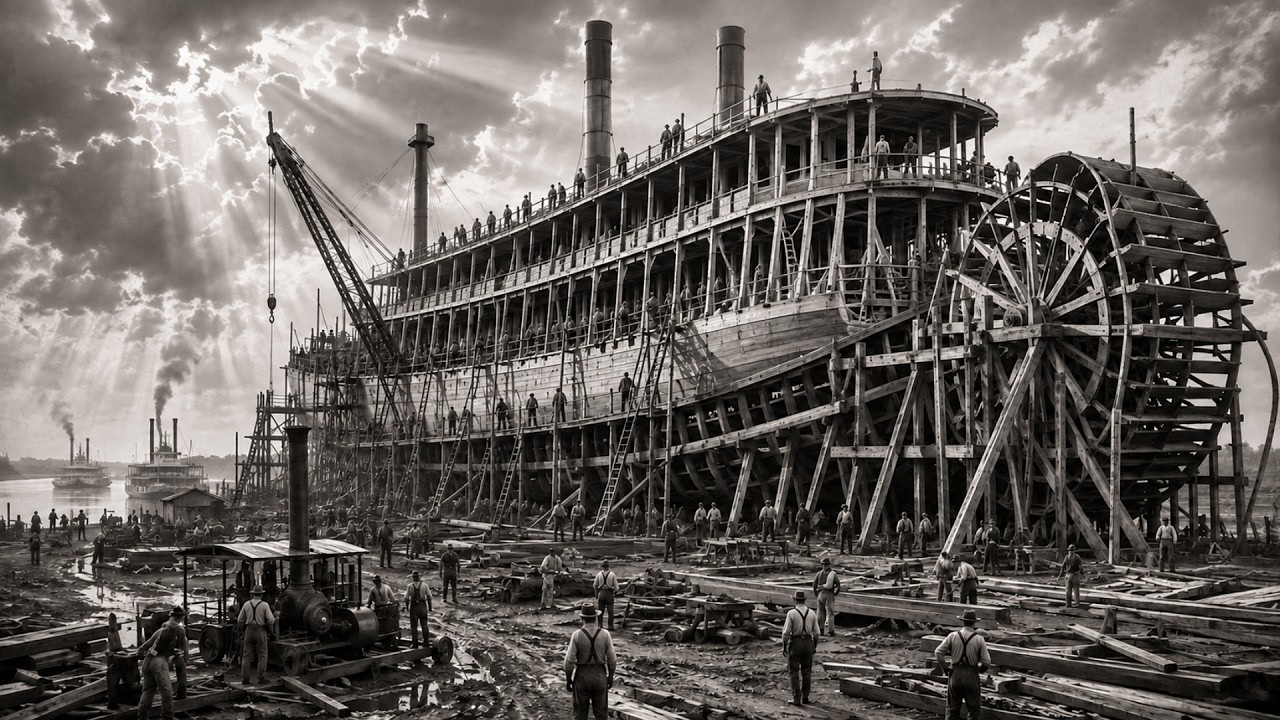
A newspaper report from December 1851, when she was nearly finished, put her cost to her owner at no less than $90,000, an enormous sum for a riverboat in those years. The same report noted that she had been built under the close supervision of Captain Edward J. Sturgeon, and that she was meant to run as a regular packet between Louisville and New Orleans. The next year, she proved what she could do.
On May 18, 1853, the Eclipse arrived in Louisville from New Orleans in 4 days, 9 hours, and 31 minutes. It was a record. And yet, for all her fame, historians who study her admit they know surprisingly little about her. No plans, drawings, or schematics of the Eclipse survive.
Not one. The boat that once amazed travelers left behind almost no trace of how she was designed, who built her, or how she worked. To understand what that silence means, you have to understand the world that produced her, and the people that world forgot to write down. Before steam, the Western rivers were a one-way street.
Goods from the Ohio Valley floated south to New Orleans, and getting back north was the hard part. One verified example stands out. In 1814, a young keelboat captain named Henry Miller Shreve hauled and pulled a barge about 2,200 miles from New Orleans back up to Brownsville, Pennsylvania. By the best reconstruction of the records, the trip took about four months.
Shreve is a name worth remembering, because he would matter a great deal to what came next. The question for anyone with money in 1811 was simple: could steam power beat the current? The first attempt came from the east. That year, a steamboat called the New Orleans was built at Pittsburgh for a company organized by Robert Fulton and Robert Livingston.
Fulton designed her. She was 138 feet long with a 26 and a half foot beam, could carry 300 to 400 tons, and cost about $38,000. She left Pittsburgh on October 20, 1811, and reached Louisville eight days later. She was a milestone, the first steamboat on the Western rivers.
But she was a large, heavy side-wheeler with a deep draft, and her low-pressure Bolton and Watt engine drove a heavy, inefficient power train. Louis Hunter’s classic history of Western steamboats put it plainly: the first steamboats were too heavy and needed too much power and too much water to work on most of the Mississippi-Ohio system. The answer to that problem did not come from Fulton. It came from a small boatyard town in Pennsylvania.
Brownsville sits on the Monongahela, and in the 1810s an engineer there named Daniel French was working on a different kind of steam engine, a lightweight, high-pressure design. A boat called the Comet, launched in 1813, was the first on the Mississippi system to use a French high-pressure engine turning a stern paddle wheel. She was not a success. The next boat, the Enterprise, launched in 1814 at Brownsville, was.
The Enterprise used a high-pressure engine, a single stern paddle wheel, and a shallow draft. The architect Benjamin Latrobe, inspecting a shoal she passed daily in August 1814, reported that no boat drawing more than two and a half feet could pass it at low water. The Enterprise did. So here is something the usual story skips: the engine design that made Western steamboats work came from Daniel French, not from Shreve.
Shreve’s role was something else. He was the man who knew how to drive these boats on a river he understood in his bones. In December 1814, the Enterprise was sent to New Orleans carrying munitions for Andrew Jackson’s army. Shreve took command because of his first-hand knowledge of the rivers.
She left Pittsburgh on December 21, passed the falls at Louisville on December 28, and arrived at New Orleans on January 9, 1815. The Battle of New Orleans had been fought the day before. What happened next shows how tangled this story is. After the battle, the heirs of Robert Fulton and Robert Livingston sued Shreve and the Enterprise’s owners, arguing that the Fulton-Livingston monopoly on steamboats in Louisiana waters had been violated.
Shreve got out of that fight. In May 1815, he took the Enterprise from New Orleans to Louisville in 25 days. It was the first time a steamboat had made that trip against the current. A Brownsville newspaper that July said she was the first steamboat to make the voyage to the mouth of the Mississippi and back.
Then Shreve built something bigger. He and four partners hired a builder named George White to construct a new boat at Wheeling called the Washington. Daniel French again supplied the engine and drivetrain. She launched in 1816 and was the first steamboat with two decks: a main deck for the boiler and cargo, and an upper deck for passengers.
She drew about four feet of water. According to Hunter, she was the largest steamboat on the Western rivers at the time, and she outperformed every earlier boat. In the spring of 1817, Shreve took the Washington from New Orleans to Louisville in 25 days, equaling the record the Enterprise had set two years earlier. That success came with a second lawsuit from the monopoly’s heirs.
On April 21, 1817, a federal judge, Dominic Hall, dismissed all the suits, ruling that the court did not have jurisdiction. That ended any practical enforcement of the Fulton-Livingston monopoly in Louisiana courts. Notice what had just happened. The technology, a lawyer’s ruling, and one river captain’s experience all came together within about three years.
After that, boats multiplied. But there was still the problem that sank them: the rivers were still full of snags, deadwood lodged in the channel. Shreve would spend much of his life fighting them. In 1826, he was appointed superintendent of western river improvements.
He had been working on a design for a snag boat since 1821. The result was a twin-hulled steamboat called the Heliopolis, completed in August 1829. She had a steam-powered windlass to pull big masses of deadwood out of the water. In 1832, he was ordered to clear the Great Raft, 150 miles of deadwood jammed on the Red River in Louisiana.
He finished the job by 1839. The city of Shreveport is named after him. Now consider the boats themselves. These were long wooden hulls, wide and shallow, with heavy machinery at certain points.
That creates a structural problem. In general engineering terms, a long shallow hull with concentrated weight can sag at the ends and arch in the middle, a failure called hogging. The answer was the hog chain, a system of iron rods held up by tall posts and tightened to hold the hull straight. For the Eclipse specifically, the historian Robert Gudmestad records that her hog chains ran from the forward hull up and over the upper decks and back down to the stern.
It was those chains, he says, that made it possible for her to have such enormous guards. The guards were the wide platforms that extended out beyond the hull on each side, and they are a big part of why the Eclipse looked the way she did. Gudmestad notes that when the guards started sagging under the weight of freight or passengers, deck hands tightened turnbuckles on the hog chains to keep the boat from hogging. Guards added carrying capacity.
Average riverboat tonnage rose from about 110 tons before 1820 to about 360 tons in the 1850s. At 1,917 tons, the Eclipse was roughly three times that 1850s average. Walk through her, and you move through a floating world. At the bottom was the main deck.
It held the engine, the freight room, and most of the cargo. It was also where the deck passengers lived. Above it was the boiler deck, built on the roof of the boiler room. That level belonged to the cabin passengers, and their conditions were noticeably different from the main deck below.
Higher still was the hurricane deck, named for its ever-present breeze. It was the roof of the cabins, and it held the ship’s signal bell and a place for small cargo. Above that sat a shorter, narrower level, at most a third the length of the vessel, which was home to the crew. The Eclipse’s own plans do not survive, so this layout comes from what Gudmestad describes for boats of her type.
But the engineering is verifiable: the hog chains, the guards, the enormous size, all of it is documented. Now, who ran it? The Eclipse’s crew list does not survive, so what can be known is the verified pattern for boats on these rivers. Depending on size, a steamboat needed anywhere from five crew members to several dozen.
The officers were typically white American men. The rest of the crew was made up of immigrants, enslaved people, and free people of color. They kept the boilers running, loaded and unloaded cargo, cleaned the boat, and served the passengers. Gudmestad writes that many bond servants worked on steamboats, either owned by crew members or hired from their owners on a yearly or monthly basis.
Enslaved porters served meals to cabin passengers. Enslaved firemen tended the furnaces, work he describes as difficult and dangerous. Free African-Americans also worked aboard as cooks, stewards, barbers, waiters, and deckhands. For some free black men and women, steamboat work was one of the few jobs that let them travel.
Cabin crews were expected to wear clean white shirts and present the polish the boat was selling. Down on the main deck, deckhands and roustabouts risked being crushed by cargo, knocked overboard, or frostbitten. Irish immigrants also worked as deckhands, and the best study Gudmestad knows of estimates that up to 20,000 African-Americans worked on steamboats in the 1850s. Then there were the passengers.
Wealthy travelers were cabin passengers. They had individual rooms, ate elaborate meals, and passed their days talking, reading, listening to music, or playing cards. Most travelers, though, were deck passengers who slept and ate alongside the cargo. A Smithsonian exhibit says deck passengers usually outnumbered cabin passengers three or four to one, and that their fares were cheap but their comforts few.
And the cargo was everything. Surviving manifests show farm implements and pianos. Steamboats also carried live cargo: cows, mules, chickens, and enslaved people. Historians document that many of the enslaved people who were sold down the river made that journey on the decks of steamboats.
The boats were not just a convenience. They were part of how that system moved. The economics were staggering. In 1810, river travel from New Orleans to Louisville took at least four months.
By 1830, it took about eight days, and shipping costs collapsed. In 1815, it cost $5 to ship 100 pounds of freight from New Orleans to Louisville. By 1860, it cost 25 cents. Cotton drove much of it.
Mississippi’s cotton production went from 20 million pounds in 1820 to 535 million in 1860, and over half of all US cotton passed through New Orleans in the antebellum period. By comparison, a 450-ton boat could carry about 280 tons of goods, hundreds of bales of cotton, and around 100 passengers. The Eclipse was more than twice that size. But who actually built a boat this big?
To answer that, you have to go to the town where the Eclipse was built. From the mid-1820s to the Civil War, shipbuilding drove the economy of New Albany. The town’s yards produced about $12 million worth of riverboats by 1860. Production began in 1819 and peaked in 1856, when builders there launched 22 boats.
In tonnage launched, New Albany ranked second only to Pittsburgh. Six firms dominated the trade: Dowerman and Humphreys, William Jones, Charles Wibble, John Evans, Peter Tellon and Jacob Alford, and George Armstrong. In the 1850s, the five largest yards employed about 450 laborers and mechanics. Around them stood the suppliers: foundries, cabinet makers, blacksmiths, tin and coppersmiths, all dependent on the yards.
The Phoenix Foundry, founded by William Lent, Benjamin South, and W. C. Shipman, became a leading producer of steamboat engines and boilers, and by 1860 employed over 100 workers. The historian Lawrence Lippen estimates that suppliers to the shipyards employed between 2,000 and 2,500 mechanics, artisans, and laborers.
This was not a handful of men; this was thousands of people in one small Indiana river town. The Louisville area as a whole, with yards at New Albany and Jeffersonville, built 704 steamboats between 1817 and 1860, about 18 percent of all the riverboats used west of the Appalachians. So who built the Eclipse? The facts that can be verified are these: she was built in New Albany in 1852.
The Indiana State Library and the New Albany Floyd County Public Library both hold records saying so. But no source names the specific yard, master builder, or crew that built her. It is possible to say which firms dominated New Albany shipbuilding at the time, but not which one built the Eclipse. There is a reason for that, and it applies to almost every Western steamboat.
Gudmestad explains that steamboats were usually owned by a handful of individuals who tended to throw out or destroy business records: bills of lading, passenger lists, financial ledgers, and payroll sheets. For most boats, only the barest minimum survives: the year of construction, tonnage, year of loss, and home port. The records were not hidden. They were discarded.
Only one photograph is known, taken around 1850, showing steamboats under construction on the New Albany waterfront. One photograph for an industry that employed thousands of people. What is known about the kind of work done in these yards comes from the broader history. The yards were full of specialized trades: ship carpenters, joiners who finished the passenger cabins, calkers, iron workers, and boiler makers.
Alongside the yards were foundries building engines and boilers. What can be said with confidence is this: the Eclipse had a grand saloon and 140 staterooms, and somebody fitted out all of that. The hog chains were iron, and somebody made them and fitted them. The engines and boilers came from foundries like the Phoenix or others like it.
Those people did the work that made her famous, and they did not get their names in the newspapers. In her day, the Eclipse was famous for more than size. She took part in what New Albany historians call the most famous steamboat race before the Civil War, a contest against another New Albany-built boat, the A. L.
Shotwell. The race did not produce a winner. The captains of both boats claimed victory, but it drew enormous attention. Racing mattered.
A fast boat meant passengers and freight, and a famous one meant business. Captains became public figures, which is why Captain Sturgeon’s name is known, and why the names of the men who built the hull he stood on are not. But racing had a darker side, and one of the worst examples happened on the river in front of New Albany. On October 23, 1844, a steamboat called the Lucy Walker left the Louisville Wharf at noon, bound for New Orleans.
She was an average boat for her time, 144 feet long with three boilers. She crossed to the Indiana side and picked up more passengers at New Albany. About 5:00 that afternoon, her engines stopped, and she drifted in mid-river some four to five miles below New Albany while crews made repairs. Then her three boilers exploded.
The blast set the boat on fire, and she sank in about 12 feet of water. The crew of a nearby snagboat, the Gofer, helped rescue survivors. The exact number of dead was never known. Thirty-six passengers and 20 crew members were identified as killed, and 48 passengers and seven crew members survived from 111 people identified aboard.
But the pilot estimated at least 130 travelers, including deck passengers, plus a 30-man crew. The passenger manifests and crew lists were lost. Estimates of the dead range from under 20 to more than 100, and the newspapers did not name the enslaved crewmen who worked the boat. In the days that followed, newspapers blamed a faulty pump and low water in the boiler, reckless officers, or shoddy construction.
Later, people speculated that racing contributed. Historians say much of the problem was ignorance. Designers did not know the strength of the metals they used. Engineers did not understand how mud and scale affected feed water pumps.
Boilers could run with few pressure gauges, and safety valves could be overloaded. Sometimes owners were simply too frugal to pay for good equipment or competent employees. The public worried that racing made it worse, but captains and passengers loved the excitement and the gambling. Then came the law: an inadequate law passed in 1838.
After more disasters, Congress passed the Act of 1852, which required hydrostatic testing of boilers, set maximum pressures, and called for boiler plates to be inspected where they were made. Engineers also had to be tested and licensed. Notice the year. The Eclipse was built in 1852, the same year Congress finally put real rules on the boilers that pushed boats like her.
There is a mix-up that appears in many retellings of this story. The Howard name is everywhere in accounts of steamboat building on the Ohio, and it is easy to mix Howard up with New Albany. So get it straight: the Howard Shipyard was not in New Albany. It was in Jeffersonville, Indiana, another river town just across from Louisville.
A 19-year-old named James Howard bought a yard there in 1834. According to local history, boat builders had occupied that site since about 1820. The Howard family ran the yard for three generations, for 107 years, until it was sold to the US government in 1941. The Howard Steamboat Museum is in Jeffersonville, in the family mansion that James Howard’s son Edmund built in the 1890s.
Workers from the shipyard helped build the house. The sources do not agree on how many vessels the Howard Yard built; one museum source says over 1,100, another says over 3,000. But no source links the Howard Yard to the Eclipse. She came out of New Albany.
Then the Civil War changed the river trade. The Union and Confederate armies both needed boats. New Albany’s yards contributed. One example: the sternwheel steamer Huntress, built in New Albany in 1862, was acquired by the Union Navy in 1864, armed with Parrot rifles and howitzers, and used as a gunboat on the Mississippi between Mound City and Memphis.
Her depth of hold was just 4 feet 2 inches. Then the war ended, and so did New Albany’s boat-building era. Railroads quickly took over the business of moving goods and people. Shipbuilding in New Albany ended after the Civil War.
One firm, Murray and Company, stayed in business by switching to flatboats and barges. The foundries and cabinet makers found other markets, and the craftsmen went to work for new employers. It ended not with a disaster, but with a change in the economy and thousands of skilled workers moving on. What survives of all this?
A painting of the Eclipse. A few photographs of her at the dock. A record time: 4 days, 9 hours, and 31 minutes. A scholarly article by Robert Gudmestad that exists largely because so little else does.
A museum in Jeffersonville with tools, models, and photographs from the Howard Yard. And one photograph taken around 1850 of steamboats under construction on the New Albany waterfront. What does not survive is the Eclipse’s blueprint, her payroll, or the names of the people who built her. That tells something about how history works.
The things that get kept are the things somebody had a reason to keep. The owner kept the boat’s name. The newspapers kept the captains.
The people who swung the hammers were not anyone’s reason for keeping a record.
