In the autumn of 1859, a 41-year-old Methodist circuit rider named Absalom Teague was overtaken on a road north of Waynesville, North Carolina, by a Cherokee boy of perhaps fourteen years who would not give his name, but who asked the reverend a specific question before anything else. The boy asked whether he was the man who buries. Teague said that he was a minister and that he did bury, when the family wanted a Christian burial. The boy nodded, and then he told the preacher what he had walked down the mountain to say: there was a woman at the head of a hollow called Sorrow Gap who had died three days earlier, whose family would not go up to her, whose body was still inside the cabin, and would the reverend come and do the burying so that the woman could be put in the ground before the fourth night.
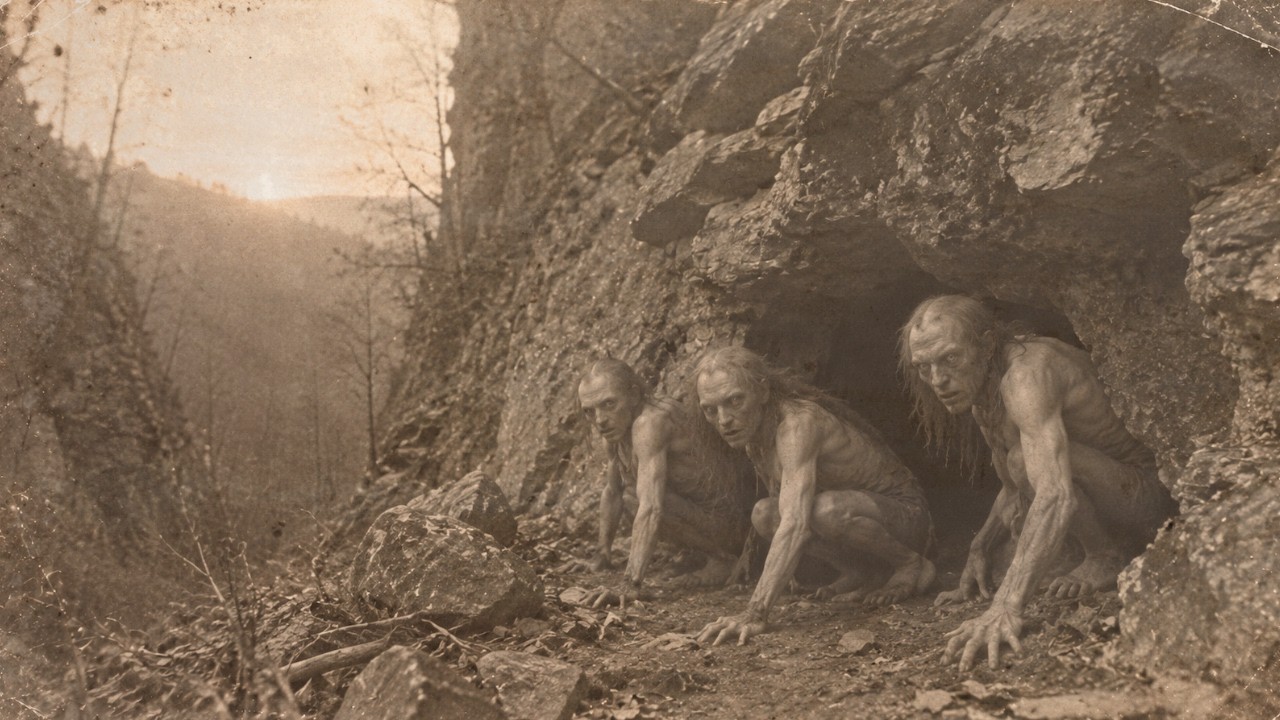
Teague asked why the family would not go up. The boy did not answer. He asked why the fourth night. The boy looked at the reverend’s hands, then at his own hands, and said, “Because on the fourth night they come up for her.
”
That sentence, the first time the arrangement at Sorrow Gap was ever described in plain words to a man from the outside, was written down in Teague’s journal that night at a wayside tavern on the Pigeon River, and underlined twice. Beneath it, in his careful hand, he wrote, “I am a minister of the gospel of Christ. I am not afraid of superstition. ” And then, in a different ink, as though added later: “I was afraid of the boy.
The boy had the eyes of someone who had seen the fourth night and had come back changed. ”
Teague was a widower. His wife Hannah had died of childbed fever in the spring of 1850, and the child, a daughter they had already agreed to name Faith if the child lived, had died with her. He had buried them both in the same pine box in the church lot at Clyde, and had spent the next decade on horseback, preaching in cabins and barns and schoolhouses, burying the dead of a hundred small mountain families whose names run page after page in his journal in a hand his bishop later described as the clearest and most honest he had ever read.
He was not a credulous man and not a nervous man. That was the man who rode into Sorrow Gap. On the morning of the fourth of October, 1859, he rode north with the Cherokee boy walking ahead of him, leaving the Pigeon River Road at a cut that was not marked, climbing through hemlock and chestnut and rhododendron so dense the trail disappeared and reappeared and disappeared again. He wrote that the drainage was the quietest piece of woods he had ridden through in nine years in the mountains.
He did not hear a bird. He did not see a squirrel. He stopped halfway up and listened for a full minute and heard only his own breathing, his horse’s breathing, and the leather of the saddle creaking. He had the sense, he wrote, that the woods were not merely silent, but were being silent deliberately, the way a room full of people is silent when someone they are afraid of walks in.
Around three in the afternoon the forest opened onto a small cove, perhaps forty acres in extent, surrounded on three sides by limestone bluffs streaked white with mineral weep, and on the fourth side by a steep saddle the boy named in Cherokee as the place where the ones below come up. The cove held one cabin and one burying ground. The burying ground, thirty paces behind the cabin on slightly higher ground, held nineteen marked graves and perhaps forty or fifty unmarked depressions, all in two neat east-facing rows. Teague counted the depressions twice.
He noted that the unmarked ones were fresh, by which he meant the earth over them had not settled as earth normally settles over a grave within six months to a year. The ground over the unmarked rows had the character of ground that is being disturbed and refilled on a cycle that does not permit settling. Inside the cabin lay the body of a woman of perhaps fifty, called only Nance, on a pine table under a wool blanket. Three persons were present: an elderly man named Enos, said to be the husband, and two women of middle age, Nance’s sisters, who gave no names.
There were no children. Teague asked where the children were. The husband said there had never been children. During this exchange, one of the sisters crossed herself—the reverend noted that gesture because the family was not Catholic, and because in nine years in that country he had never seen a Methodist or Baptist or Presbyterian cross themselves at the mention of their own kin, and because she crossed herself not when the preacher asked about her sister, or looked at the body, but when he asked where the children were.
The husband had answered a different question than the preacher had asked. The preacher had asked where the children were. The husband had answered that children had never existed at all. Teague asked whether anyone had sat with the body.
Enos said no one would sit with the body because of the fourth night, and that was why the reverend had been sent for. Teague, a kind man who did not yet understand what he had ridden into, said he would sit with the body himself, and would do the burying that evening, as the body had been in the house three days and should be in the ground. The husband said thank you. The sisters said nothing.
The preacher took off his coat, hung it on a peg by the door, and sat on a stool beside the pine table. He read the eleventh chapter of the Gospel of John, then read it again, then read from the fifteenth chapter of First Corinthians. He noticed that the two sisters had come closer and were standing just behind him, listening not to the words of scripture but to the body, as though waiting for something in the body to answer the reading. When nothing answered, they relaxed and stepped back.
He prayed over the body. He noted that the body, which by the family’s own account had been dead three days, did not have the color, the stiffness, or the smell of a body dead three days. It was cool to the touch, but not cold. The limbs were pliable.
The skin at the throat and the inside of the wrists held a flush of color he described as the color of a person sleeping warmly. He asked Enos if he was certain of the day of death. Enos said he was certain: Nance had stopped breathing on the first of October, in the hour before dawn, and they had closed her eyes themselves. Teague asked why they had not buried her the first day, or the second, or the third.
Enos said, “We were waiting for a man who would do the burying. We did not know when the man would come. We only knew the man would come. ”
The preacher wrote that night that he had not known he was sent for.
He had been intercepted on a public road. He had not been summoned, and yet the family expected him, and the boy knew where to find him, and the burying was waiting. Whatever lived under that cove knew when a Methodist circuit rider left Waynesville on the morning of the second of October, knew the road he was riding, knew the hour he would reach the Pigeon River cut, and knew enough to send a child down the mountain to intercept him. They carried the body to the burying ground after dark.
The lanterns dimmed, all three at the same instant, down to a low blue glow, and after perhaps three seconds returned to full. It happened twice. Neither sister reacted. The grave had been dug before his arrival, to a depth of about four feet, which Teague thought shallow.
Enos said the ground becomes rock at four feet and cannot be dug further. The reverend accepted this, though he noticed the two unmarked plots on either side of the open grave had been recently dug and refilled. He spoke the final prayer. The grave was filled in by the two sisters with wooden shovels.
When the mound was raised, the husband placed on it a flat sandstone slab of perhaps eighteen inches square, carved with no name, no date, no cross, but with a single symbol Teague tried to reproduce in his journal and failed. He wrote, “It is three lines meeting at an angle that is not a right angle and is not an acute angle. The lines are not of equal length. The symbol is older than any writing I have ever seen, and I’m ashamed to say that I knew when I saw it carved into the stone that I had seen it before and I could not remember where.
”
That night he lay down to sleep on the pine table where the body had lain. He slept badly. Around midnight he rose and went outside. The moon was in its last quarter, and from the burying ground he heard a sound he described only as the sound of a jar being opened under water.
He heard it three times at intervals of about a minute, each time slightly closer to the cabin. He went back inside and barred the cabin door with a bar propped against the wall that had plainly been used many times before. He wrote, “I was not afraid for my body. I was afraid that if I went up and I looked, I would see something that would unseat the arrangement of my mind, and I would not be able to put it back where it was.
”
In the morning of the fifth of October, the mound over Nance was still raised and the slab still in place, but the earth of the mound had the character of earth that had been disturbed and refilled during the night. Around the edges of the mound were perhaps a half dozen small depressions in the fresh earth, each about the size of a man’s palm, each perfectly circular, pressed in a ring, as though something had set down the same object six times around the perimeter of the grave and then picked that object up and taken it back with it when it left. He said nothing to the family. As he was readying his horse, he asked Enos what the symbol on the slab meant.
Enos said, “It means she will not come back up. It means we have asked for her to be left where she is. It means we have given something in exchange so that she will be left where she is. ” The reverend asked, “Given what?
” Enos said, “That is not your concern, preacher. You have done your office. You should ride down the mountain now, and you should not come back, and you should pray for us as you ride. ”
Absalom rode.
He got as far as the saddle at the head of the cove, and he looked down into the cove behind him, and he saw a figure standing in the burying ground. The figure was pale. It was not Enos, and not one of the sisters. It was looking up at him across roughly three hundred yards, and the figure’s eyes did not close while he watched it, and he watched it for the length of time it took a cloud to cross the sun.
The eyes did not close. He turned his horse and rode, and did not look back a second time. He rode for the remainder of that day, through the following night, until he reached Waynesville on the morning of the sixth of October and presented himself at the home of a fellow Methodist minister named Josiah Barkley. He asked for a bed and a glass of brandy, which he had not drunk in nine years.
Barkley later testified in a sworn deposition filed with the Haywood County Clerk in 1862 that the coat Teague arrived in was not the dark Methodist black he had set out in, but homespun brown, cut in the fashion of perhaps forty years earlier, smelling of a cellar that had been closed for a long time. When Barkley asked whose coat it was, Teague said, “I think it belonged to a man who used to live below, and I do not want to speak of him, and I do not want to wear the coat another hour, and would you please take it and burn it in your stove. ”
Barkley burned it. He said the coat did not burn the way wool burns.
It caught at the center in a single spot about the size of a silver dollar in the middle of the back, and the fire spread outward in a perfect circle over about three minutes. The smoke was black and heavy and smelled of the inside of a grave that has been opened in cold weather. Barkley’s wife came to the kitchen, stepped one foot inside, put her apron over her face, and backed out, and did not come back for the rest of the day. When the coat had finished burning, the ashes were white, bone white, and they did not blow when he opened the stove door.
He had to scrape them out with a shovel. He buried the ashes in the garden and said nothing to Absalom. For the rest of his life, nothing grew in that spot—not grass, not weeds—in a circle about three feet across, in the exact place where he had buried the ashes, until the day they sold the house in 1871. Absalom slept for thirty hours.
When he woke, he wrote in his journal for seven straight hours. He wrote the entire account of what he had seen in Sorrow Gap: the names of the family, the description of the burying ground, the slab, the symbol he could not draw, and the figure he had seen from the saddle. He wrote that he believed the family in that cove was engaged in a transaction with persons who lived below the ground, that the ones below came up on the fourth night and took what had been left for them, and that in exchange they did not come up on the first, second, or third nights, and they did not come up for the living. The arrangement had been kept by both sides for a very long time.
And the woman Nance, in dying on the first of October and being buried on the fourth, was being offered in payment of a debt he did not understand and did not wish to understand. He sealed the journal in oilcloth, closed it with pitch, and gave the packet to Barkley with instructions that it was not to be opened in his lifetime, and then to be deposited with the Haywood County clerk and placed under seal for a period of sixty-four years from the date of deposit—a number he did not explain, calculated by a reckoning he did not explain, as the number of years required for the generation that knew the arrangement to die out of the mountains entirely. In a letter Teague sent to his bishop three weeks after coming down off the mountain, a letter the bishop’s grandson read and burned in 1904 but first copied two paragraphs of into his own private diary, Absalom wrote that the fear in that cove was not of this world, that whatever lived below it was aware of him specifically by name, and had been aware of him from the hour the boy spoke to him on the Pigeon River Road, and had made a decision about him during that second night, and had decided to let him leave. He wrote, “I do not know whether what I felt in that cabin was the devil.
I know only that it was older than the devil. It had grown in the dark where no light had ever reached, and it had grown patient, and it had grown hungry, and it was feeding by an arrangement that was not of my making and not of any Christian’s making. ”
He never preached another sermon in the mountains. He asked the bishop for a transfer, and in November of 1859 was placed at a small chapel on the coast of South Carolina, in a parish settlement called Little Cedar Landing, twelve miles south of Georgetown on a tidal creek.
He requested the posting himself, specifically, and the reason is in the second paragraph of the letter he sent the bishop, which is in the archive. He wrote: “I require a station in which the dead are kept in daily sight in their proper places under my own key because I have seen what happens in a country where the dead are not kept, and I need to spend the remaining years of my life as the sexton of a house where the dead are at peace, in order to persuade myself before I die that the dead can be at peace. ”
The chapel had been built in 1804 by a rice planting family named Daubeny who had died out, and it was attached to an ossuary of 217 named interments in nine stacked tiers of brick-faced niches, with the unnamed infants in a separate chamber beneath the floor. The two rooms shared one roof.
There was no congregation. Absalom moved into the two-room sexton’s cottage on the 18th of November, 1859, and lived there continuously until his death on the morning of the 9th of August, 1881—twenty-one years and eight months. In that time he preached four sermons, married two couples, buried eleven persons, all in the small public graveyard behind the chapel, and none in the ossuary. He kept the chapel locked except on the first Sunday of each month, and the ossuary locked at all times with a single key on a leather cord around his neck, inside his shirt.
He kept a second journal in which he recorded two things every evening for twenty-one years and eight months: the state of the tide at sunset, and whether the iron door of the ossuary had been found in the position in which he had left it that morning. There are 7,926 nightly entries in that second journal. In 7,924 of them, the door was where he had left it. In two, it was not.
The first was the night of the 16th of April, 1864. The second was the night of the 12th of October, 1879. On both nights, he entered the ossuary with a lantern, counted the niches, verified each interment, descended through the trapdoor into the infant chamber, verified it undisturbed. On both nights he found nothing missing and nothing out of place.
On both nights, he recorded one additional detail that he recorded on no other night: that the air inside the ossuary was warm. Not warm the way a closed room is warm in April. Warm the way a room is warm when a body has recently been in it. And on the second night, the 12th of October, 1879, he recorded that on walking in with his lantern, he had called into the dark at the far end of the ossuary the name of his wife—Hannah—just the one word, and that something in the dark where the lantern light did not reach answered him, not in words, but with the sound of a jar being opened under water.
He turned, walked out, locked the door, barred his cottage, and wrote one sentence at the bottom of that evening’s entry: “It has found me. It has not come in. The grate at Sorrow Gap is still holding, but it knows where I am, and it is patient, and it will try the door again. ”
He died less than two years later, kneeling at the altar rail, the forehead on the altar cloth, the hands folded, the key still on its cord around his neck.
The cause of death recorded by a visiting physician from Georgetown named Dr. Pelham Woodruff was congestive heart failure. Woodruff noted two unusual findings. The first was that the body, at the time of discovery, had been dead perhaps six hours, yet had not fallen; the forehead remained on the cloth and the hands remained folded for the full six hours of postmortem rigor, as though held in place.
The second was that the ossuary door, locked when he first arrived and requiring the key, opened under no resistance when he finally lifted the key from the dead man’s neck and tried it. The lock had been thrown, but the latch—the physical iron bolt—had been retracted from the inside, and the only key was outside, on the chest of the man who had died at the altar rail. The chapel was shuttered within the month. The ossuary was welded shut with iron plate in October of 1881 by order of the Bishop.
The welders were paid in cash, by a draft drawn on an account at the Bank of Charleston in the name of an estate trust that had been established eleven years earlier, in April of 1870, under the name of a man none of the welders knew and nobody in the parish could identify. The bank declined to describe the account except to confirm it was active, fully funded, and had standing instructions to pay any invoice related to the physical sealing of certain named sites, of which the Daubeny Chapel ossuary at Little Cedar Landing was number three on a list of five. In the 81 years between Absalom Teague’s death and the opening of the first journal in October of 1923, exactly four people attempted to inquire into the ossuary chapel and what had happened to the preacher who had lived there. None of them was permitted to look at the second journal.
All four died within periods ranging from six months to four years after their inquiry. A bishop who requested access to the papers died of a stroke in his study. A Charleston attorney who wrote one letter to the trust’s attorneys received a reply he described as the shortest and most frightening piece of legal correspondence he had ever received, advised his client to drop the matter, and died three months later of sudden unexplained respiratory failure. A folklorist from the University of North Carolina who interviewed two old women about the chapel died of what was recorded as influenza during the first wave of the great pandemic; her monograph, which recorded that the welded ossuary door had been found three times warm to the touch in cold weather, and that a fisherman who put his ear to the plate had heard from inside the sound of a jar being opened under water, was never published.
The fourth was a Charleston journalist named Royal Kinsey, who in 1921 began investigating the estate trust itself. He identified that it had been established under the name of a man who did not appear to have existed, that its original endowment had been gold coinage inconsistent with any known mining or minting operation in the United States, and that it had standing instructions to pay for the sealing of five named sites. His newspaper declined to run the story. In the summer of 1922 he received a one-sentence letter from the trust’s attorneys: “Mr.
Kinsey, you have a wife and three daughters in a house at number 411 South Battery Street in Charleston, and we would be sorry to see any of them come to harm. ” He wrote back the same day that he understood the communication perfectly and would not pursue the matter further. He died of a sudden heart attack on the morning of the 4th of October, 1923, at the age of fifty-one. That was the same morning Clarence Everhart, the Haywood County clerk, opened the vault at eight o’clock, broke the pitch seal with a kitchen knife, read the Teague journal through by lunchtime, and walked across the town square into the office of Sheriff Monroe Dills.
He placed the open journal on the sheriff’s desk and said, “I believe we have a problem up Deep Creek that has been a problem for a very long time. And I believe we need to send someone up there. And I believe that the man we send needs to be told what he is going up there to find. And I do not believe I am the man to tell him.
”
Sheriff Dills read the journal for ninety minutes. When he finished he said, “Clarence, if this is a fiction, then the man who wrote it is one of the finest fiction writers who ever lived in this country. And if it is not a fiction, then there is nothing in my office or in the state capital or in Washington that is equipped to deal with it. Which do you think it is?
” Everhart said, “I think it is not a fiction. ”
Dills took the journal home and did not sleep. He wrote a telegram in his own hand, and before he left for the telegraph office he kissed his wife on the forehead and said, “Lucy, I may have to go up Deep Creek and I may not come back the way I went up. ” He sent the telegram not to his own deputies or the state police, but to the Tennessee Valley Authority Survey Office in Knoxville, requesting that their Deep Creek crew hold at current position pending his arrival, and, under any circumstance, not advance into the western drainage.
The Knoxville office replied that very morning with the message that the crew, under a surveyor named Lemuel Scoggin, had already sent its own telegram requesting immediate recall. Scoggin’s telegram, filed two hours before the sheriff’s arrived, read: “Have located chambers below first bench of deep creek drainage. Stop. Chambers appear artificial.
Stop. Have found what Washington will not want to hear. Stop. Crew refuses to continue.
Stop. Foreman has resigned. Stop. Request recall of entire party and sealing of entry.
Stop. Will not describe findings by wire. Stop. Will report in person Knoxville Monday.
Stop. Stop. Stop. ”
Scoggin reported in person at Knoxville on Monday the 8th of October, 1923, in a closed-door meeting with the regional director that lasted four hours and ten minutes.
At the end of it, the director issued three orders: the immediate and permanent abandonment of the Deep Creek Western Drainage Survey; the redrawing of the watershed map to exclude the western drainage entirely, rerouting the boundary around the saddle the Cherokee called the place where the ones below come up; and a third order, noted in the secretary’s log but not preserved in the formal records—that Scoggin be placed on paid leave for six months, given a cash disbursement of $1,000, and instructed, formally and in writing, to speak of what he had seen to no one, under penalty of forfeiting the disbursement and his position. Scoggin accepted. He did not return to the authority. He moved to Fort Smith, Arkansas, opened a hardware store, and lived until 1954 without ever once describing what he had seen.
He did, however, keep until his death a single glass plate negative, donated after his death to the Smokies archive at the University of Tennessee, catalogued as item TVA DCWD 1923/1. The image shows the entrance to a chamber cut into the limestone of a wooded hillside, roughly four feet high and three feet wide, and directly above the chamber mouth, carved into the limestone, a symbol: three lines meeting at an angle that is not a right angle and is not an acute angle. The same symbol Teague had failed to draw sixty-four years earlier. The archivist’s notes on the catalog card recommended that the image not be reproduced in publications, and that researchers wishing to view it apply in writing.
It has never been published. A retired archivist who worked at Knoxville from 1968 to 2004 later told a researcher that the plate is not stored with the other glass plates, but in a separate climate-controlled box in a separate room inside a lead-lined case inside a cedar inner box, and that the inner box is kept, when the plate is not being viewed, with its longer axis oriented north-south, because a note in the file left by someone before his time said it should be stored that way, and no archivist in the fifty-four years since has had the nerve to orient it any other way. He said he once asked the curator who had hired him why the plate was stored that way. The curator said, “I was told the figure in the image prefers it.
” He asked what she meant. She said, “You do not look at that plate for longer than you have to. You do not photograph it. You do not reproduce it.
When you take it out, you look at the back of the plate first and the front second, and you look at the front for no more than ten seconds, and then you put it back and you turn the box back to north-south and you leave the room and you do not go back into that room for the rest of the day. ” He observed the instruction for thirty-six years. He said that in those years, the figure visible in the chamber mouth was always in the same posture, with its eyes open and not blinking, and that in his final viewing, in 1999, the figure’s head was tilted slightly more toward the camera than it had been in the first viewing in 1968. He said he was not certain of this, and that he never mentioned it to anybody.
The first man to attempt entering the cove after Teague was a Union Army veteran named Harlan Bricker, who went in on the night of the 22nd of July, 1874. He was a former trapper and part-time surveyor who had been told by an old Cherokee woman at Oconaluftee that there was a chamber in the limestone below the burying ground that might hold articles of value. She gave him three rules. Do not go in on the fourth night.
Do not go in alone. Do not take anything that has moved. Bricker, who did not respect mountain superstition, went in alone, by night, through an entrance he had located that afternoon in a limestone outcrop forty paces behind the overgrown burying ground, partially sealed with recently piled stones. He kept a short field notebook, recovered from his pack after his disappearance.
The first entries are routine: chamber dry, ceiling perhaps seven feet, floor smooth as a mill floor. He found a side passage running east and heard water, and elected not to go east. He found a west passage running down, steep, with twenty-nine steps cut into the stone, warm to the touch. He descended the 29 warm steps into a second chamber, large, with the ceiling not visible by lantern, the floor lined with what he took to be the long bones of persons, more than two hundred by his count, arranged by size—long with long, small with small—and infant bones in a separate pit at the center of the chamber.
The pit was open. The pit did not have a lid. The next entries of the notebook become less composed. He wrote, “I believe there are others here.
” He wrote, “I can hear breathing that is not my own, and that is not air. ” He wrote, “The breathing is coming from the pit. ” He wrote, “Something has climbed out of the pit. ” He wrote, “It is standing in the dark at the edge of my light, and it is not moving, and I believe it is waiting for me to put out the lantern.
” The eleventh and final entry, in a distinctly different hand, reads: “I am going to put the lantern out. I am going to leave the notebook here. I am going to climb back up the 29 steps. I am not going to look behind me.
If I reach the surface, I will come back for the notebook in daylight. There is a thing in the pit under the Deep Creek drainage that I believe has been in that pit since before this land was called by any name. It is not to be looked at by lantern light or by any light. I am sorry, cousin.
I am sorry. ”
He did not reach the surface. His pack, containing the notebook, a half-eaten ration of hardtack, a spent percussion cap, and a folded letter from the cousin in Scranton, was found two weeks later in the first chamber, six feet from the mouth, by three men from Oconaluftee sent in to look for him. The lantern was cold, with an inch of oil remaining.
The three men did not go deeper. They retrieved the pack, repiled the stones, walked out, and told the sheriff they would not, under any circumstance, return to assist in a further search. The notebook was placed in the same vault, under the same seal, as the Teague journal. In the three days between the pack’s recovery and its delivery to the sheriff, one of the three men, a trapper named Elias Hawkins, began to speak in his sleep.
His wife said she had never heard him make a sound in his sleep before, and that now he spoke every single night, and that what spoke was not his own voice—deeper, slower, in a language she did not recognize and that was not Cherokee. The voice spoke for perhaps forty minutes each night in that low cadence, and then stopped. She said he had no memory of it, and she did not have the heart to tell him. In the sixth week, the voice stopped speaking in the unknown language and said in plain English, in that voice, “I am coming for the notebook.
” And her husband sat up in bed with his eyes closed, and he reached across to her side of the bed, and put his hand on her face, and said in that voice, “Do not tell anyone this. ” He died six years later of pneumonia. The notebook was never taken. The second man who went in was a photographer from Asheville named Ambrose Caulfield, who went in on the morning of the 9th of May, 1906.
He had been told by an elderly Cherokee woman, Nancy Walkingstick, that if he took a photograph of the entrance to the chamber and developed the plate in a room with no window and no mirror, the plate would show him what the chamber held, and he would then know whether to go in. She advised him to take the photograph. She advised him not to go in. He took the photograph and developed it.
The plate shows the limestone outcrop, the piled stones at the entrance, and, standing in the chamber mouth visible through chinks in the stones, a pale figure, roughly four feet in height, its eyes open, its eyes in the developed image having the character of eyes that cannot blink. In a letter to Mrs. Walkingstick dated the 11th of May, 1906, preserved in her family’s papers, he wrote that when the image emerged in the developing bath, he sat down on the darkroom floor and wept for perhaps twenty minutes, and that he would not be entering the chamber at Deep Creek. He enclosed a bank draft of $50.
The draft was never cashed. She kept it in her family Bible until her death in 1924. It has not been cashed in 120 years. Caulfield never attempted to enter the chamber.
He lived to be seventy-nine, and never spoke publicly of the plate. But his son, donating the plate to the Asheville archive in 1954, described one thing his father did every night for the rest of his life: he kept a small mirror on the inside of the front door of his house, and every evening before bed, he would open the door a crack, close it, and look at himself in the mirror for perhaps three seconds, then turn and go to bed. He did this every night for forty-six years. The son wrote that he did not understand it until he read his father’s letter to Mrs.
Walkingstick after his death. His father was checking. He was looking in the mirror every night to make sure the man in the mirror was still him. On the night of the 14th of November, 1952, he went to the front door and opened it a crack and looked at himself in the mirror and did not turn around.
His mother found him in the morning, dead on the threshold, the door still open a crack, the mirror still swinging on its nail from the draft. The expression on his face was not the expression of a man who had died of surprise. The third man who went in was Raiford Lamprey, a deputy sheriff of Swain County, who went in on the 28th of March, 1972, investigating the disappearance of a 23-year-old graduate student from Duke named Peter Yost Hallenbeck. The hiker’s pack had been found in the cove at the head of Deep Creek.
Lamprey hiked in to inspect it, and found, in addition to the pack, a long-collapsed cabin, a burying ground gone almost completely to brush, and a limestone outcrop with an entrance partially sealed by piled stones. In his radio report at 3:44 in the afternoon, he said, “There is no sound in this cove. ” He said he had heard the creek from a hundred yards off and a crow from a mile away five minutes ago, but as of the moment he stepped into the clearing, he could not hear anything, and he had been standing there two minutes to make sure. The dispatcher, a woman named Faye Lackey, later told the sheriff in a conversation recorded in a private memo that in those two minutes she heard the quality of his voice change from his normal professional tone to what she described as a bedroom voice—the quiet voice a man uses in a room with a sleeping child—and she understood he was not just reporting the silence but adjusting his own voice to it, becoming quieter because something in that cove was listening.
Lamprey reported he was going to enter the cave to see whether the hiker had taken shelter in it, and that he would be back on the radio in one hour. He was back on the radio in two hours and twelve minutes. His voice was flat. He said only this: “The hiker is not alive.
The hiker is below the second chamber. The hiker is not alone in being below the second chamber. I have photographed the second chamber. I am climbing out.
I am not looking behind me. I will be at the trailhead by nightfall. I will submit the film to the sheriff personally. End of transmission.
”
He submitted the film. Twelve negatives were developed, twelve prints made, and the prints were examined by the sheriff and the sitting county judge, Garland Trantham, in a closed session that began at 11:00 in the morning and ended at 12:17 in the afternoon. At 12:17, Judge Trantham signed an order directing that all twelve prints and all twelve negatives be burned in the courthouse furnace that afternoon in the presence of the sheriff, of the deputy who had developed them, and of himself. He further directed that no reproduction of the images be preserved, and that the inquiry into the disappearance of Peter Yost Hallenbeck be closed pending the production of further evidence that would never be produced.
He resigned the bench in a letter dictated at 12:41 and signed at 12:44. He gave no reason beyond declining health. He left the courthouse at 1:00. He never practiced law again.
He lived in Franklin, North Carolina until his death in 1986, and never described what he had seen in the twelve prints. But from the day of his resignation until the month of his death, he paid out of his personal funds a monthly retainer to a Charleston law firm that was the public counsel of record for the estate trust that held the Deep Creek drainage, for the specific service of the maintenance of the physical integrity of the iron grate at the entrance to the chamber system. The deputy who developed the prints, Earl Vann, lived until 1998. In a letter to a nephew in 1994, he wrote that of the twelve images he developed in the darkroom under the courthouse, the first eleven were of the chamber, and the twelfth was not.
The twelfth was of him—a photograph taken from the inside of the camera looking out through the lens at his own face in the red light of the darkroom. In the twelfth image, his face was not quite his own, and behind him, in the red light, stood a figure about four feet in height, its eyes open, reaching with one long hand toward the back of his head. He turned around in the darkroom. He was alone.
The door was locked from the inside. He printed all twelve, and watched them burn. He wrote that the twelfth burned last, taking forty seconds longer than any of the others, burning from the center outward in a perfect circle, with smoke that was black and heavy and smelled of the inside of a grave that has been opened in cold weather. He retired from the sheriff’s department in 1981, and did not develop another photograph for thirty years.
He kept a small mirror on the inside of his front door. He wrote, “I check it every night. The man in the mirror has, so far, been me. ”
In the summer of 1984, the estate trust placed an order with a fabrication yard in North Charleston for a second iron grate to replace the first, which had been fitted in April of 1870, the year the trust was established.
The first grate’s bars, each an inch and a quarter thick, had been bowed outward from the inside by a uniform pressure applied over 114 years—a bulge of about four inches at the center. The new grate was to be fitted by four welders flown in from a shipyard in Hamburg, Germany, who did not speak English, and who would be supervised on site by a representative of the trust and a Cherokee interpreter whose only written duty was to ensure the welders did not speak to any local person. The grate was fitted on the 18th of July, 1984. The welders were paid in cash and flown back to Hamburg on the 22nd.
Their affidavits, taken on departure by a notary employed by the trust, are sealed within the trust’s own records. One of the welders, Hartmut Reinecke, described what he had seen in a conversation with his nephew in Hamburg in the autumn of 2002, which the nephew recorded in a diary later donated to the Hamburg municipal archive. Reinecke described the first grate, the bars bent uniformly outward, as having the character of a man testing the strength of a cage by leaning on it slowly over years to see where it would give. The welders cut the first grate out of the frame and laid the bent bars on the ground under a canvas tarp.
While they fitted the second grate, they heard from inside the chamber behind them a sound: something slowly dragging a soft object along a stone floor, approaching the chamber mouth from inside, and then stopping at a distance Reinecke estimated as perhaps fifteen feet behind them, and waiting. The sound stayed at fifteen feet while they worked. They did not turn around. When the grate was fitted, the trust representative shone a hand torch through it into the chamber for perhaps three seconds and said, “We are finished.
” Reinecke, against instruction, turned his head perhaps thirty degrees, and saw standing in the beam of the torch at the distance the sound had stopped a pale figure, roughly four feet in height, not moving, its eyes open and not blinking. The limbs were too long. The head sat on the shoulders at a slight tilt. The mouth was open, and in the open mouth there was something he could not identify.
He thought about it for eighteen years. He told his nephew that the shape in the mouth of the figure was the shape of a human infant, folded, the small head toward the back of the figure’s throat, the small feet toward the lips, the small arms crossed, held the way a cat holds a kitten, with the teeth not closed on it. He said it had not been alive for a very long time, and he believed the figure had been carrying it in its mouth for a very long time. He said that in the three seconds the torch was on, the figure understood that he had seen it, and did not care, because it understood he would be flown back to Hamburg within the week and would not speak of it for the rest of his life.
He died six months later, quietly, in his sleep. His doctor said he had been in good health. The scholar who eventually consulted the Reinecke diary was an American named Dr. Linwood Beresford, a historian of what he calls the hidden continental substrate—the body of evidence suggesting the North American continent was inhabited before the ancestors of the modern Native American peoples by a civilization of unknown origin.
He argues that the chamber system below the Deep Creek drainage is one of eighteen such sites across the eastern United States, each administered by a private estate trust, each established in a window of about six years following the end of the Civil War, each funded in perpetuity by an original endowment of unknown source. He argues the chambers were cut into the stone by tools not consistent with any technology attested in the archaeological record, in several cases predating any human presence on the continent at all. He calls this prior civilization, provisionally, Tartaria, and states in a footnote that it is not the civilization’s own name for itself, and that the civilization had no name for itself in any language we would recognize, because it did not use language as we use language. He writes that the chambers were not dwellings but waiting rooms, places where the long-lived members of the civilization went down in a condition he hesitates to call either sleep or death, and waited—for a change in the surface of the earth they expected and we would not recognize.
He writes that they wake periodically on cycles tied to lunar and solar reckonings embedded in the symbol carved above every one of the eighteen chamber mouths, and that during their waking they require a certain intake of a specific kind of organic matter to return to their condition of waiting—the recently buried human dead, provided by long and reluctant agreement. He concludes that if the arrangement is broken from the surface side, the ones below will come up for every surface population above them. He writes, “We have been, for the entire history of our occupancy of this land, the tenants of a lower civilization that has been patient with us. We should not become unwilling.
We should not break the arrangement. And we should not look, under any circumstance, into the chamber mouths that remain open. Because what is below is not for our eyes. And our eyes, once they have seen it, will not again close.
”
The second grate is still in place, checked four times a year by a Charleston attorney who stands at the grate in silence for a measured interval of five minutes and listens, and reports back what he has heard in documents referred to internally as sound reports. The first grate took 114 years to bow four inches. The second grate required its first replacement bars in 1996, twelve years after fitting; its second in 2005, nine years later; its third and a full structural reinforcement with an eight-inch crossmember in 2019, fourteen years later. The acceleration is not slowing.
It is itself accelerating. In October of 2022, the inspection confirmed measurable outward deflection of three-eighths of an inch at the center in the three years since the reinforcement—nearly four times the historical average rate of the first grate. On the 14th of April, 2022, the inspecting attorney recorded in his sound report that during the five-minute silent interval, he heard from inside the chamber a sound: something dragging a soft object along a stone floor, slowly approaching the chamber mouth, and stopping at a distance he estimated as perhaps twenty feet behind the grate, and waiting. The sound in 1984 had stopped at fifteen feet.
The sound in 2022 stopped at twenty feet. It did not advance during his presence. It did not retreat. It remained at twenty feet in the dark for the full five minutes.
When he stepped back from the grate, it did not follow him. He wrote, “I believe the sound is aware of my presence. I believe the sound is measuring the grate. I recommend the next structural inspection be moved up by 6 months.
”
A Cherokee interpreter who worked for the trust from 1987 to 2004, a man who asked to be called Dallas Hamby because he has grandchildren, described the job as it had been handed down in his family across four generations, from 1870. He said the written job, preventing the welders from speaking to local people, was not the real job. The real job was to stand at the chamber mouth while the welders worked and listen in Cherokee—a language the trust representative did not speak—to whatever came from the dark side of the grate, and to translate if there was anything to translate, and to carry what was said down the mountain to a particular stone on a bend of the Oconaluftee River, and speak it aloud over the running water, so the water would carry the words down the Tennessee and into the Mississippi and into the Gulf, to whoever was listening at the far end of that long chain of water. He said his great-grandfather had been told in 1870 that there was somebody listening, and that the knowing of who it was would not be his to carry.
He said he asked twice in his lifetime, and twice was told that the asking was itself a form of answering. So they did not know. Four generations of Hamby men, 153 years, listening at a grate and carrying words to the water, not knowing who was receiving them. He said that on most of his sixty-four visits to the grate, there was no sound at all.
But on six occasions, he heard something. The first was in April of 1989, when he heard from behind the bars a single word spoken clearly in Cherokee, in a voice that was not a voice any human throat could make. The word was the Cherokee word for mother. He did not translate that one.
He said he could not. He carried that one word in that voice for thirty-four years, and never spoke it to anyone until the afternoon he told the researcher. The other occasions were shorter: in 1993, a sound like a bell struck once far down inside the chamber; in 1997, three words in Cherokee which translated to child and asleep and warm; in 2001, a long low sound he described only as the sound of a thing exhaling after it had been holding its breath for a very long time; in 2003, the Cherokee word for door, said twice; and in his last visit in February of 2004, a single phrase in Cherokee that he translated as, “It is almost time. ” He took that one down to the river because he thought it was his duty, and spoke it into the water, and resigned the following week, and never returned to the cove.
He said his decision to resign, and his decision to tell the story, were the only two acts in his life he was certain had been his own. A separate piece of evidence bears on this. In July of 1978, a hydrogeologist named Dr. Winifred Kessler, conducting a routine groundwater study in the Deep Creek watershed for the North Carolina State Geological Survey, introduced a non-toxic fluorescent dye into a swallow hole on the eastern slope of the ridge above the western drainage.
This is standard groundwater tracing: put the dye in, wait, check the downstream springs. Based on her modeling, the dye should have appeared in a spring about three miles from the swallow hole within about seventy-two hours. It did not appear at the expected spring. It did not appear in seven days.
It appeared in trace quantities, confirmed by laboratory analysis, on the 29th of August, 1978—46 days after introduction—at a sampling point 423 miles away, on the Gulf Coast of Mississippi, in a brackish tidal creek near Bay St. Louis. She published the finding carefully in 1979, suggesting an unmapped and probably very old subsurface drainage system connecting the Southern Appalachians directly to the Gulf of Mexico. Two months after publication, she received a letter from a Charleston law firm offering her a substantial grant to redirect her research to a different watershed in Virginia.
She accepted. The grant was $57,000, more than her annual salary. She did not publish on the Deep Creek watershed again. The dye trace is documented.
The 423 miles in 46 days are documented. In October of 2024, a researcher drove to Waynesville and spent three days in the basement of the Haywood County Courthouse reviewing the original Teague journal, the Bricker notebook, and the Everhart file. The journal smelled faintly at the center of its pages of something no archival conservator had been able to identify. On the back cover of Bricker’s notebook, in pencil so faint he almost missed it, was a mark: three lines meeting at an angle that is not a right angle and is not an acute angle.
It was the symbol. It was not drawn by Bricker. The pencil was too soft and the hand was wrong. It had been drawn at some point between the recovery of the notebook from the first chamber and its deposit in the vault, by one of the three men from Oconaluftee, or by the sheriff, or by a clerk—somebody in that chain who understood the symbol well enough to draw it from memory and leave it there as a silent signature on the account of what the chamber held.
On his third evening in Waynesville, the researcher had dinner at a diner on Main Street. A man was sitting in the booth across the aisle. He had been there when the researcher came in. He had not ordered anything.
He was looking at the researcher the way a man looks at another man he has been expecting. He was perhaps sixty, thin, clean-shaven, wearing a dark wool coat that was wrong for the weather. His face was hard to hold on to—not blurred, but such that when the researcher looked away and looked back, he could not quite reassemble what he had just seen. His eyes were a color that could not be placed.
The researcher did not finish his pie. He paid the bill and did not look at him on the way out. He walked back to his hotel, locked the door, and did not sleep well. In the morning he checked out four hours early and drove home.
He decided to tell this, he said, because the telling is itself a kind of insurance. A postmistress of the small town nearest the trailhead, a woman named Marjorie Finch, worked from 1958 to 1993 and kept a notebook of every parcel she handled that she believed came from or was going to the chamber inspection. Her notebook, found after her death and donated to the local historical society, contains 312 entries. Over those thirty-five years, the Charleston firm mailed a parcel to the hunting cabin on the trust land four times a year, on a schedule that varied by no more than three days over three decades.
The parcels weighed between 18 and 22 pounds each. By the sound they made and the shape of the box, they contained metal objects about the size of a man’s forearm wrapped in oiled paper. Finch believed the parcels contained replacement bars. In the margin of the entry for the parcel she handled on the 7th of October, 1984, eleven weeks after the second grate was fitted, she wrote that she had asked the postman who drove parcels up to the cabin whether he had ever seen the men who received them.
He said he had never seen a man receive one. He said he left the parcels on the porch of the cabin as instructed, and in the morning they were always gone. He said that in twenty-two years of leaving parcels on that porch, he had never once, upon returning the following week with the next parcel, found the previous one still there. And then, in a different ink, added years later: “I believe the parcels are not being taken in by the Charleston firm.
I believe the parcels are being taken in by whatever is on the other side of the grate. I believe the firm has not fitted a replacement bar in 30 years. I believe the firm has only mailed them, and I believe the thing on the other side of the grate has been fitting its own replacement bars out of the metal we have been mailing it in order to prolong its own cage. Because the thing on the other side of the grate is not trying to escape the cage.
The thing on the other side of the grate is maintaining the cage from inside. Because the day the cage fails is the day the arrangement ends, and the thing on the other side of the grate does not want the arrangement to end. Not yet. Not until something else, which only the thing on the other side of the grate knows, is ready.
”
The grate is still holding. The trust is still paying. The parcels are still being mailed. The symbol is still carved above the chamber mouth.
The journal is still in the vault at Waynesville. The photograph at Knoxville is still oriented north-south in a lead-lined box in a separate room. The plate at Asheville is still in the file with Thomas Caulfield’s letter about the small mirror. The affidavit is still sealed in Charleston.
The nephew’s diary is still in Hamburg. The postmistress’s notebook is still in the historical society in Hallam. The second grate is still in Swain County, and the ones below Sorrow Gap are still waiting, and still pressing, and still watching with eyes that do not blink from the dark side of the iron—for the day the grate gives way, or for whatever other day the only one of them who understands the arrangement is waiting for. And the one instruction that has been passed down through all of it, from the bishop who answered the young widow in Clyde, North Carolina, in the spring of 1860, is this: speak the name of the dead out loud every day for the first year, once a week for the second, once a month for every year thereafter, into the open air, in the presence of nobody, so the name stays in use, so the arrangement cannot find the dead by their silence, so the dead remain a person who is still being called.
That is the whole of the instruction. That is all they have ever had. Keep the arrangement.
Speak the name.
