The Gestapo was hunting Jews in Athens, and Princess Alice of Greece and Denmark had hidden them inside her own home. Rachel Cohen, the widow of a former Greek member of parliament, and two of her teenage sons had been living for months behind shuttered windows on the middle floor of a three-story house in the heart of the occupied city, while Nazi patrols scoured the streets below. Under German occupation, aiding Jews was punishable by death, and the princess had no protection other than her royal name, her family’s German connections, and a deafness she knew how to use. She had been born with congenital deafness, and it had served her all her life.
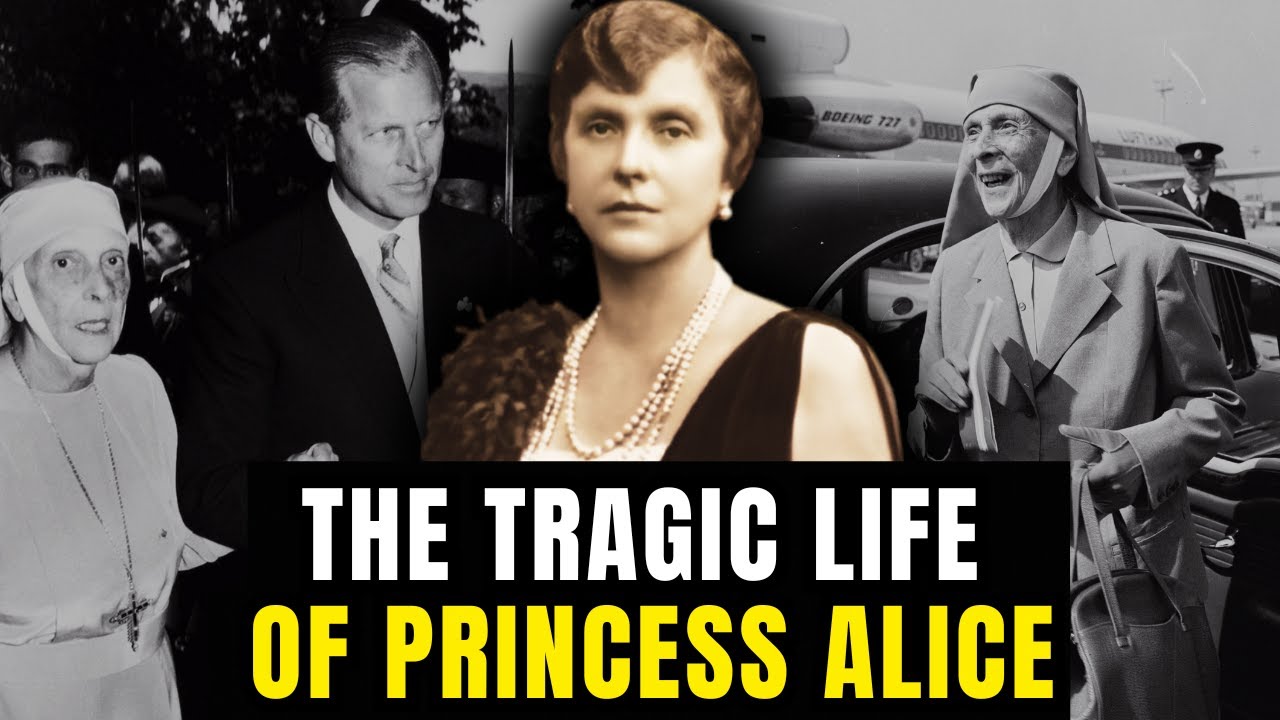
When German officers came to inspect the house, she pointed to her ears and indicated she could not hear. Her fluency in German had always been perfect, but she had learned to feign incomprehension when it suited her, and it spared her from arrest more than once during the occupation. On this occasion it worked again. The Cohens were never discovered.
Decades earlier, in 1913, the boys’ father, Haki Cohen, had helped King George I of Greece. The king had promised the favor would one day be repaid. During the occupation, Haki’s son remembered that royal promise and appealed to Alice, one of the last members of the royal family still in Athens. She honored the debt of gratitude and hid the family.
She never spoke of it as heroism. Years later she would be recognized for it, but at the time she acted purely out of conscience and religious faith. Alice Victoria Elizabeth Julia Mary of Battenberg was born on 25 February 1885 in the Tapestry Room at Windsor Castle, with her great-grandmother, Queen Victoria, nearby. She was the firstborn child of Prince Louis of Battenberg and Princess Victoria of Hesse and by Rhine.
On her mother’s side she was the granddaughter of Princess Alice of the United Kingdom, Queen Victoria’s second daughter; on her father’s side she belonged to the Battenberg family, a German branch of the House of Hesse that had settled in Britain. Her younger siblings were Louise, the future Queen Consort of Sweden; George, the second Marquess of Milford Haven; and Louis Mountbatten, the future Earl Mountbatten of Burma. All of them would become prominent figures in twentieth-century royalty and diplomacy. From her earliest years she faced a significant obstacle.
Her family noticed she was slow to speak and that her pronunciation was unclear, and her maternal grandmother, Grand Duchess Alice of Hesse, suspected a hearing problem. Taken to a specialist, she was confirmed to have hearing loss. With the determined support of her mother, she learned to lip-read and to communicate effectively in several languages. She became fluent in English and German, received a private education that included French, and years later, when her destiny became intertwined with the Greek royal family, she learned Greek in order to integrate fully into her new country.
Her childhood unfolded across various European royal residences. She spent time in Darmstadt in Germany, in London, and on the island of Malta, where her father served as an officer in the British Royal Navy. At just eight years old she served as a bridesmaid at the wedding of the future King George V and Princess Mary of Teck in 1893. At sixteen she attended the funeral of her great-grandmother Queen Victoria at Windsor in early 1901, and later that same year she was confirmed into the Anglican faith.
In the summer of 1902, during the coronation celebrations for King Edward VII in London, she met Prince Andrew of Greece and Denmark. Andrew, called Andrea by his family and friends, was a handsome officer in the Greek army and the fourth son of King George I of Greece and Queen Olga, who was of Russian origin. He was a grandson of King Christian IX of Denmark, known as the father-in-law of Europe. The attraction that arose during the coronation soon blossomed into a formal engagement.
They were married in Darmstadt, Germany in October 1903, in one of the last great gatherings of European royalty before the First World War. The celebration comprised three ceremonies: a civil service on 6 October, followed the next day by a Lutheran service in the Chapel of Darmstadt Palace in respect of Alice’s Protestant background, and then a Greek Orthodox service in the city’s Russian chapel. Attendees included members of the royal houses of Britain, Germany, Russia, Denmark, Greece, and Hesse, demonstrating the intricate family ties that united the nobility of the time. From the moment of her marriage, Alice adopted the style of Princess Andrew of Greece and Denmark, in accordance with the English-speaking custom of referring to wives by their husband’s title.
The couple settled in Greece, where Andrew continued his military career as an officer in the Hellenic army, and Alice began to engage in charitable work and the social life of her new country. They raised a large family. Their first child, Princess Margaret, was born on 18 April 1905 at the Royal Palace in Athens; Princess Theodora followed on 30 May 1906 at Tatoi Palace near Athens; Princess Cecilie on 22 June 1911, also at Tatoi; Princess Sophie on 26 June 1914 at the Mon Repos villa on the island of Corfu; and finally their only son, Prince Philip of Greece and Denmark, on 10 June 1921, also at Mon Repos. During the years leading up to the First World War, Alice accompanied her husband to various ceremonies and official engagements.
In 1908 she travelled to Russia to attend the wedding of one of the Tsar’s nieces. There she reunited with her aunt, Grand Duchess Elizabeth Feodorovna, sister of Tsarina Alexandra and an Orthodox nun, who shared with her plans to establish a religious order of nurses to assist the poor and vulnerable. Grand Duchess Elizabeth had embraced religious life after the death of her husband, sold all her possessions, and founded a charitable Orthodox convent. She became a spiritual role model for Alice.
Although in 1908 Alice was still fully immersed in her role as a royal consort, the seed of a vocation to serve had been planted, one that would blossom decades later. Upon returning to Greece, Alice found the country politically unstable. In 1909 a revolt by nationalist officers known as the Military League led to Prince Andrew’s resignation from his military posts and paved the way for the rise of the statesman Eleftherios Venizelos. When the Balkan Wars broke out, Greece became involved in conflict with the Ottoman Empire, and Prince Andrew was recalled to military service.
Princess Alice played an active role as a volunteer nurse, collaborating with organizations such as the Hellenic Red Cross. Dressed in a medical uniform, she helped care for the wounded, visited hospitals, and supported medical efforts wherever needed. In 1913, King George V of the United Kingdom, her cousin, awarded her the Royal Red Cross. During the First World War, Greece initially adopted a stance of neutrality under King Constantine I, Alice’s brother-in-law and Prince Andrew’s brother.
But that neutrality caused deep internal divisions. While Prime Minister Venizelos openly supported the Allies, Constantine, married to a sister of Kaiser Wilhelm II, was accused of pro-German sympathies. The situation escalated into a major constitutional crisis culminating in December 1916, when French troops intervened militarily in Athens in an episode known as the Noemvriana. During the clashes, which involved gunfire and bombardments across the city, the Greek royal family remained sheltered inside the royal palace.
Alice and her children witnessed the violence up close. In June 1917, Allied pressure forced Constantine to abdicate. Most of the Greek royal family, including Alice, Andrew, and their daughters, was forced into exile. A provisional government sympathetic to the Allies was installed, and Greece belatedly joined the war on the victorious side.
During the remaining years of the war, the Greek royals resided primarily in Switzerland, in relatively safe exile on neutral territory, though Alice remained troubled by news from the trenches and anxious about family members fighting on opposing sides. The war brought about the collapse of many European monarchies, and Alice’s own family was not immune. Her father, Prince Louis of Battenberg, a high-ranking admiral in the British Royal Navy, was forced to resign at the start of the war due to growing anti-German sentiment. By order of King George V on 14 July 1917, Louis renounced his title of Prince of Battenberg and anglicized his surname to Mountbatten, relinquishing his German lineage in favor of fully embracing British nationality.
The following day the king granted him the title of Marquess of Milford Haven. Alice witnessed even the name of her family being changed under the pressure of war. The war also brought personal tragedies. In 1918 two of her maternal aunts, Empress Alexandra of Russia and Grand Duchess Elizabeth Feodorovna, were murdered by the Bolsheviks following the Russian Revolution.
Alice, who had known and visited them in her youth, was deeply affected. By the end of the war, the Russian, Austro-Hungarian, and German empires had all collapsed. Several members of her extended family lost their thrones, including her uncle, Grand Duke Ernest Louis of Hesse and by Rhine, who was deposed and saw his duchy disappear with the rise of the German Republic. After the war, the Greek royal family briefly enjoyed a respite.
In 1920, following the sudden death of King Alexander I, his father, King Constantine I, was restored to the throne by plebiscite. Alice, Andrew, and their daughters returned to Greece and resettled at the Mon Repos villa on Corfu, where their youngest child, Prince Philip, was born on 10 June 1921. But the peace proved short-lived. Since 1919 Greece had been embroiled in a war with Turkey over territories in Asia Minor, and the campaign ended in disaster.
In September 1922, following the Greek defeat in Anatolia and the loss of Smyrna, a military revolt overthrew the government and forced Constantine to abdicate once again. In the chaos, Prince Andrew, who had served as commander of the Greek Second Army Corps during the Greco-Turkish War, was taken into custody. The new regime sought scapegoats for what became known as the catastrophe of Smyrna. Several former ministers and generals were summarily executed in the infamous Trial of the Six, and all signs pointed to Andrew facing the same fate.
Terrified that her husband might be executed, Alice did everything in her power to save him. British diplomats intervened urgently. The British naval attaché in Athens, Commander Gerald Talbot, personally took action. In a heavily biased military tribunal, Andrew was found guilty of failing to carry out his duty.
But instead of being sentenced to death, he was condemned to permanent exile from Greece, a lifetime banishment for the entire family. In December 1922, Alice, Andrew, and their five children fled Greece aboard the British warship HMS Calypso. According to family accounts, the infant Philip was transported in an improvised cot made from an empty orange box. That image, a royal baby sleeping in a fruit crate, symbolized the dramatic reversal of fortune that had struck the family.
Once again in exile, they found refuge in France. Princess Marie Bonaparte, a wealthy great-niece of Napoleon and wife of Prince George of Greece, Andrew’s brother, offered them her villa on the outskirts of Paris. In that modest home loaned by her sister-in-law, Alice settled with her family in 1923. They had gone from palaces to depending on the charity of relatives.
The princess maintained her dignity and resumed her humanitarian work, supporting other Greek refugees who, like her, had fled the instability of their homeland. She worked in a small charitable shop, providing aid to Greek immigrants and war veterans trying to rebuild their lives abroad. During her stay in France, Alice underwent a profound inner transformation. She had always been a woman of faith, but now her religiosity became more intense.
In 1928 she formally converted to the Greek Orthodox Church, the faith of her husband and the country to which she still felt she belonged. That same year, as a gesture of marital loyalty, she translated into English her husband’s written defense of his actions during the Greco-Turkish War, hoping to restore his reputation. She spent long hours in prayer and began to display a marked mysticism. She claimed to experience divine revelations and believed she possessed healing powers, asserting that she received messages from God and had visions of Jesus Christ.
Her behavior began to worry those around her. In 1930, after suffering a severe nervous and religious breakdown, she was examined by several mental health specialists and diagnosed with paranoid schizophrenia. The Battenberg family decided the best course was treatment at a specialized sanatorium. At just forty-five years of age, Alice was admitted against her will to Dr.
Ernst Simmel’s sanatorium in Tegel, Berlin. Simmel consulted the renowned neurologist and father of psychoanalysis, Sigmund Freud. Believing Alice’s visions might stem from sexual frustration, Freud suggested a radical treatment aimed at eliminating her libido: the application of X-ray radiation to her ovaries, inducing premature menopause in hopes of calming her psychological disturbances. This experimental and aggressive method was consistent with certain psychiatric practices of the era, though later deemed a medical barbarity.
Additionally, it is believed she underwent shock therapy. She resisted as much as she could, even attempting to escape the clinic, but her family, convinced they were acting in her best interest, kept her hospitalized. After an initial period in Germany, Alice was transferred to another sanatorium in Switzerland, where she remained for around two years, from 1930 to 1932, far from her husband and children. During that time Prince Andrew definitively distanced himself, settling in the French Riviera and leading a carefree lifestyle.
The marriage effectively collapsed. Her daughters, now of marrying age, wed without their mother’s presence. Between 1930 and 1931, Margaret, Theodora, Cecilie, and Sophie all married German princes from various noble houses. Alice, confined to the clinic, was unable to attend any of the weddings.
Meanwhile, her young son Philip, just nine years old, was sent to England to live with his maternal uncles, Louis Mountbatten, the Marquess of Milford Haven, and George, and his grandmother, Victoria, the Dowager Marchioness of Milford Haven. The child grew up apart from both parents. The family was completely fragmented, except for a few letters exchanged with her mother. By 1932 the princess had shown sufficient improvement to be medically discharged.
At forty-seven, without a fixed residence or official role, she began a wandering existence, living incognito in various cities across central Europe, traveling through Germany, Italy, and France, possibly under assumed names. Her mental health, though fragile, remained stable. A new blow struck in 1937. On 16 November, her third daughter, Cecilie, died in a plane crash in Ostend, Belgium, alongside her husband, Hereditary Grand Duke Georg Donatus of Hesse, and two of their young sons.
The family had been en route to London to attend a royal wedding when their aircraft crashed during a storm. For the first time in six years, Alice reunited with her family in person, traveling to Cecilie’s funeral in Darmstadt, where she was reunited with Prince Andrew, her son Philip, and other relatives, including Lord Louis Mountbatten. High-ranking members of the Nazi regime attended, including Hermann Göring, sent as an official representative, as the Hesse family had ties to the German elite. Alice buried her daughter surrounded by swastika-emblazoned uniforms, yet her composure was remarkable.
After this painful reunion, Alice resolved to reestablish contact with her loved ones. At the beginning of 1938 she made a courageous decision: she returned alone to Greece. The Greek monarchy had been restored in 1935 in the person of King George II, but her husband chose not to return, settling instead in Monte Carlo. Alice settled in Athens, leading a simple and discreet life.
From a modest flat she worked actively with charitable organizations, visiting impoverished neighborhoods and providing aid to the sick and underprivileged children. She also sought to restore her relationship with her youngest child. Philip, by then a handsome teenager, occasionally traveled to Athens to visit her. She welcomed him with affection and hope, seeking to rebuild the bond lost during the years of separation.
By the late 1930s, Alice was living in Athens almost as an ordinary citizen, wholly devoted to charity and the Orthodox faith. She could hardly have imagined the world was on the brink of another devastating war, nor that her convictions and inner strength would be tested once again, this time amidst enemy occupation. The outbreak of the Second World War in 1939 painfully divided her family. Three of her daughters were living in Germany, married to German noblemen connected to varying degrees to the military apparatus of the Third Reich.
Prince Christoph of Hesse, Sophie’s husband, was a member of the Nazi party and an officer in the SS. Margrave Berthold of Baden, Theodora’s husband, served as an officer in the German army until he was wounded in 1940. Prince Gottfried of Hohenlohe-Langenburg, Margaret’s husband, fought in the Wehrmacht. Meanwhile, her only son, Philip, had joined the British Royal Navy as an officer and was fighting for the Allied cause.
Alice had sons-in-law fighting for Germany and a son fighting for Britain. Her sympathies were firmly with Philip, but several of her own cousins were also involved in the war, among them Viktor of Erbach-Schönberg, who served as the German ambassador to Greece in the early years of the conflict. Greece initially managed to remain neutral, but in 1940 it was invaded by Italy and in 1941 by Nazi Germany. The Greek royal family, including King George II, fled into exile in Egypt and South Africa.
Alice made the courageous decision to remain in Athens. Her sister-in-law, Princess Helena, widow of Prince Nicholas of Greece, also stayed. The two of them would become the only members of the royal family to endure the enemy occupation on Greek soil. Alice left her small apartment and moved into the three-story house in central Athens owned by her brother-in-law, Prince George.
Athens experienced severe famine during the Italo-German occupation, especially in the winter of 1941–42, and thousands died of starvation. Alice worked closely with the Red Cross and other humanitarian organizations, helping to establish soup kitchens that served basic meals to the poor and starving children. Risking her own safety, she traveled to Sweden under the pretext of visiting her sister Louise, married to the future King Gustaf VI Adolf, but in reality used the trip to secure the delivery of medicine and supplies for the Greeks in need. She also organized shelters for orphaned children and coordinated networks of nurses to assist families in Athens’s poorest districts.
At first, the occupying authorities regarded Alice as harmless, perhaps even sympathetic to their cause, given her family’s German connections. Two of her sons-in-law wore the uniforms of the Wehrmacht and the SS. But Alice did not share Nazi ideology in the slightest, and she made this clear through her actions. One day a German general, thinking the princess might be in distress, visited her and politely asked if there was anything he could do.
Alice replied without hesitation: “Yes, there is something you can do. Get your troops out of my country. ” The general was stunned. In occupied Athens, such a statement could have led to immediate arrest.
But Alice had a kind of shield: her royal status, and her well-known deafness, which allowed her to feign incomprehension when confronted by German officers. According to later witnesses, pretending not to hear when it suited her was a tactic that spared her from arrest more than once. In September 1943, after Italy’s surrender, German forces took full control of Athens. Many Greek Jews had sought refuge in the capital to escape the mass deportations already underway.
Of the 75,000 Jews who had lived in Greece before the war, around 60,000 would be sent to Nazi concentration camps. Most never returned. Knowing the deadly risk they faced, Alice chose to act. She hid the Cohen family in her own home: Rachel Cohen, the widow of a former Greek MP, and two of her teenage sons.
The Gestapo was actively hunting hidden Jews, and aiding them was punishable by death. Alice kept the family safe. They were never discovered. In October 1944, German forces finally withdrew from Athens as Allied troops advanced.
The city was liberated, and Alice emerged from those dark years having saved lives, though her own health had been seriously affected. After the war, Greece entered a difficult period marked by economic crisis, political unrest, and a civil war that began in 1946 between monarchists and communists. In this turbulent context, Alice was required to leave the country for an important reason: to attend the wedding of her son. In April 1947 she returned to England.
The ceremony took place on 20 November at Westminster Abbey, where Prince Philip married Princess Elizabeth, daughter of King George VI. Despite years of financial hardship, Alice still retained a few pieces of family jewelry. She offered a pair of diamonds from an old tiara to be used in her daughter-in-law’s engagement ring; with the remaining stones, a bracelet was fashioned as a wedding gift. Her presence, quiet yet dignified, was well received by both the court and the press.
Due to strong anti-German sentiment still present in Britain after the war, Philip’s four sisters, married to German nobles who had served in the Nazi regime or German military, were not invited. Inspired by her deep religious convictions, Alice took a further step in her faith journey. In January 1949 in Athens, she founded a small religious fraternity, the Christian Sisterhood of Martha and Mary, an Orthodox community of deaconesses dedicated to caring for the poor, the sick, and orphans. It was modeled on the order established in 1909 by her aunt, Grand Duchess Elizabeth Feodorovna.
At the age of sixty-four she devoted herself fully to this vocation, undergoing theological and medical training on the island of Tinos, a renowned center of Orthodox spirituality. The main base of her sisterhood was established in Neo Irakleio, a modest neighborhood in the northern outskirts of Athens, where she opened a convalescent home for the sick and a small orphanage. To fund the project she sold the last of her remaining jewels and lived virtually without possessions. Resources were limited, and she traveled to the United States twice in 1950 and again in 1952 to raise funds.
Her decision to live as an Orthodox nun surprised some members of her family, though she did not abandon certain personal habits such as smoking cigarettes. Her mother would later remark with some irony, “What can you say about a nun who smokes and plays canasta? ”
In 1953, when her daughter-in-law was crowned Queen Elizabeth II, Alice traveled to London to attend the ceremony at Westminster Abbey. True to herself, she wore a simple gray habit resembling the attire of her religious order amidst a sea of tiaras and glittering jewels worn by the other royal ladies.
Many mistook her for an actual nun. Indeed, she saw herself as one in spirit. Unfortunately, her project did not flourish as she had hoped. Greece was undergoing a period of social transformation, religious vocations were dwindling, and her nursing order struggled to recruit new sisters and eventually disbanded some years later.
Nevertheless, Alice never ceased to help those around her, always with discretion and compassion. In 1960 she accepted an invitation to visit India, demonstrating that her religious curiosity transcended denominations. She was drawn to understanding other faiths and sought spiritual communion between East and West. During her stay she suffered a sudden health collapse, possibly due to exhaustion or heat.
Her sister-in-law, Lady Edwina Mountbatten, wife of Lord Louis Mountbatten, who happened to be in Delhi, came to her aid with local authorities. Edwina died shortly thereafter in that same year, 1960, another aristocratic woman who had devoted her life to charity until the very end. Alice mourned her death deeply. By the mid-1960s, Alice was increasingly deaf.
Her already limited hearing had virtually disappeared, and her physical health was in decline after decades of uninterrupted smoking. In 1967, her son Philip and the British royal family began to worry about her safety due to the political situation in Greece. On 21 April of that year, a military coup led by the group known as the Colonels overthrew the democratic government and established a right-wing dictatorship. The Greek monarchy, then headed by the young King Constantine II, Alice’s great-nephew, was placed in a precarious position under the strict control of the junta.
Foreseeing unstable times, Philip insisted on bringing his mother back to England. Queen Elizabeth II extended a formal invitation for the princess to reside permanently with them in London. Alice accepted, though not without deep reflection on the people she was leaving behind. In a final act of generosity, she donated her property in Athens to the Hellenic Red Cross to be converted into a home for the elderly.
The mansion continued to function for decades as a care home. Alice left Greece for the last time in the autumn of 1967. Settled at Buckingham Palace, she spent her final two years surrounded by her son’s family. Staff at the royal household described her as a delightful elderly lady, always dressed in her simple gray robes, moving with some fragility but wearing a gentle smile, discreet and cheerful.
She was occasionally visited by her grandchildren. Among them, Prince Charles of Wales, the future Charles III, found her fascinating, almost like a character from another era. Alice had given away quite literally all her material possessions. According to her relatives, at the time of her death she owned just three house robes.
Princess Alice of Battenberg died on 5 December 1969 at Buckingham Palace, aged eighty-four. Despite unfounded rumors of supposed senility, she remained mentally lucid until the very end, though her body was worn down by age and illness. As she had wished, she died with no possessions. She left a final message to her son Philip that reflected both her love and her spirituality: “Dearest Philip, be brave and remember that I will never leave you and that you will always find me when you need me.
All my devoted love, your old mama. ” These words, written in a note Philip found after her passing, captured the very essence of Alice: a loving mother of unshakable faith. Her funeral was modest. Initially her remains were placed in the royal crypt at St.
George’s Chapel, Windsor Castle. But Alice had expressed a profound wish years earlier: she wanted to be buried in Jerusalem, at the convent of St. Mary Magdalene on the Mount of Olives, where her aunt, Grand Duchess Elizabeth Feodorovna, canonized as a martyr by the Russian Orthodox Church, was also buried. When her eldest daughter, Princess Sophie, protested that Jerusalem was too far to visit the grave, Alice replied with her characteristic humor, “Nonsense.
There’s a perfectly good bus service. ” After complex diplomatic arrangements, her remains were transferred nearly two decades after her death. On 3 August 1988 they were taken to Jerusalem and interred in the crypt beneath the church of St. Mary Magdalene in Gethsemane, on the Mount of Olives, beside her aunt.
The heroic act she carried out during the Second World War took years to receive public recognition, but it eventually earned her the highest honors. In 1993 the state of Israel posthumously awarded Princess Alice the title of Righteous Among the Nations, the highest civilian honor granted to non-Jews who saved Jewish lives during the Holocaust. The following year, on 31 October 1994, her two surviving children, Prince Philip, Duke of Edinburgh, and Princess Sophie of Hanover, traveled to Jerusalem to attend the official ceremony honoring their mother’s memory. At the event, Prince Philip spoke before an international audience.
“I suspect that it never occurred to her that her actions were in any way special,” he said. “She was a person with a deep religious faith, and she would have considered it a perfectly natural human response to fellow beings in distress. ”
Her biographer Hugo Vickers remarked that throughout her life, virtually every pillar of stability was swept away, and that despite ending up without money and even going hungry during the Second World War, Alice exemplified the best of what a princess could be by rising above adversity with virtue and compassion. Vickers went so far as to say that Alice ought to be a saint for all she did in the service of others.
Within Greek Orthodox circles she has been regarded as a model of faith. No formal canonization process was ever initiated, but her life has inspired many believers. “Deaf, nun, and savior of Jews,” read one newspaper headline recounting her story. She faced disability without self-pity, endured exile and mental illness, suffered abandonment with dignity, and gave up royal privilege to serve the sick and the hungry.
Today she is remembered not merely for her noble titles or as the mother of the Duke of Edinburgh and grandmother of the British king, but for the totality of her good deeds and her unwavering faith. A princess, nurse, mother, and nun, she left a legacy of profound humanity.
