In the spring of 1943, a lieutenant named Salman Buland stepped out of his tent in the jungles of eastern New Guinea, grabbed a wrench, and did something that might have finished his naval career. He went to an American aircraft boneyard, took a cannon off the nose of a dead fighter plane, and fastened it to the deck of a wooden boat. He had no authorization, and he never requested any. Over the six months that followed, the boats he commanded killed more Japanese soldiers than the whole torpedo boat force in the Pacific had killed in the war’s first two years.
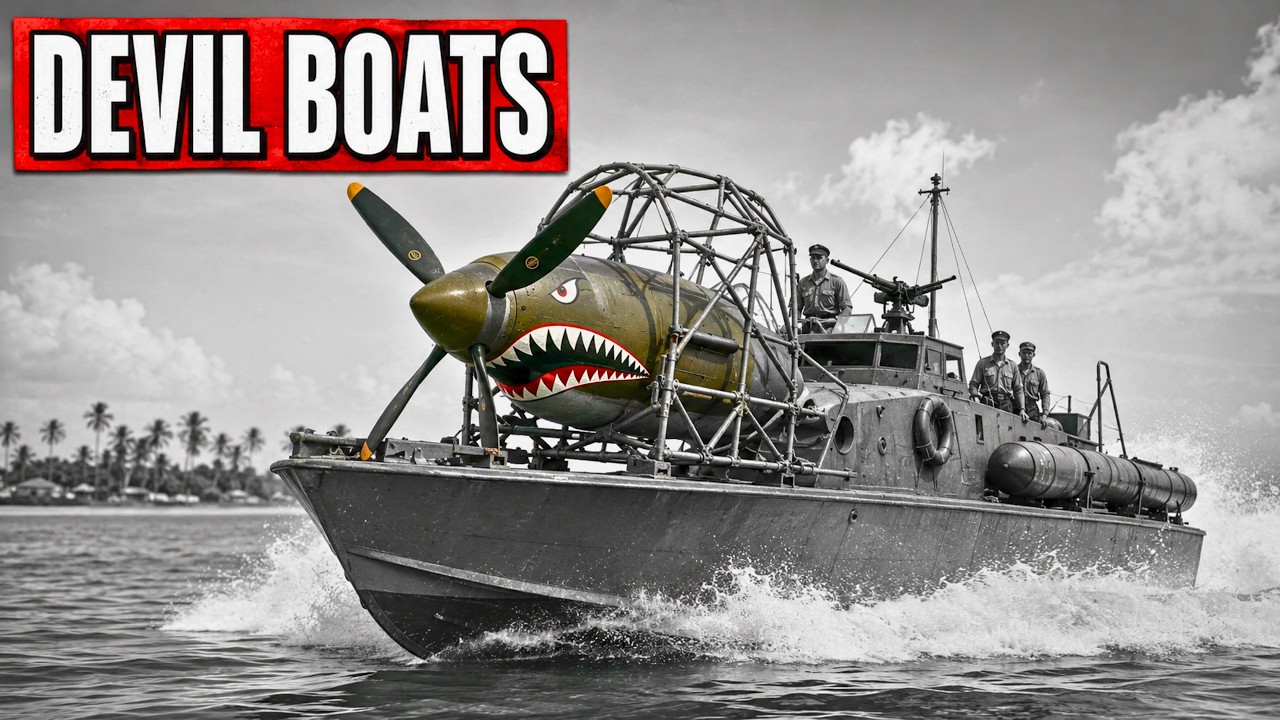
The men who fought against those boats gave them a name. It was not “Devil Boats,” as that name came later from a book cover. The Americans who fought alongside them called them the “Green Dragons.” This is the story of the man who built them, a man almost no one remembers today.
The waters south of the Florida Islands were called “Ironbottom Sound.” By the autumn of 1942, they had earned that name. American cruisers rested on the seafloor, along with Australian cruisers, Japanese destroyers, and transports packed with Marines who never reached the shore. Steel from both fleets lay tangled in the darkness at a depth of 400 fathoms.
Above them, wooden boats went out every night from a base on the northeastern tip of Tulagi. It was a strip of pierced steel matting stretched across coral and jungle, with a crude wooden sign over the main path reading: “Through these gates pass the best torpedo boats in the world.” The words had been carved by men who wanted to believe them. The fleet was Motor Torpedo Boat Squadron 3, commanded by Lieutenant Alan P.
Calvert of the United States Navy, an Annapolis graduate of 1929. He was in his late thirties, cautious, and tired. The base bore his name, “Calvertville,” but he had never wanted the honor. By mid-October 1942, his squadron had lost six boats and seventeen men.
Some had burned, some had vanished into the water and were never found. The pattern was always the same. The patrol left at dusk, the boat threaded its way through the coral, lookouts scanning the horizon. Somewhere across the black water, a Japanese formation appeared on radar.
The skipper turned, the crew readied torpedoes, but they missed. Not because the aim was wrong; the aim was accurate. The problem was mathematical. The Mark 8 torpedo carried 466 pounds of TNT and weighed over 2,000 pounds.
It was designed to run deep and hit a battleship’s belt armor below the waterline. In the Solomons, it ran deeper than designed, often ten feet or more, which put it beneath the belly of a barge. The Japanese knew this. By late 1942, the big destroyer runs of the “Tokyo Express” had become too costly.
American aircraft from Henderson Field, though battered and worn, made daylight impossible and dusk dangerous. So the Japanese turned to a smaller, slower method, one the Americans could not touch. They used barges. The barge was 46 feet long, with a single diesel engine and sides covered in steel plate heavy enough to stop a rifle bullet.
It could carry 60 fully equipped soldiers or eight tons of rice, ammunition, and quinine. It drew five feet of water. The Mark 8 torpedo ran at ten feet. Every torpedo the American PT boats fired at a barge passed harmlessly beneath its hull.
The wake rose, and the barge kept moving, the men aboard continuing toward the Guadalcanal channel, toward starving Japanese soldiers dying of malaria and hunger in the jungle, carrying food and bullets that would prolong the fighting another week. The PT crews tried everything. They set the torpedoes to their shallowest depth, but it was still too deep. They fired their twin .
50 caliber Brownings at 850 rounds per minute, and the bullets struck the steel plate and disappeared. They tried ramming. That worked exactly once. By October, Calvert was writing letters he did not want to write.
Some went to widows in Ohio and Pennsylvania. Others went up the chain to Nouméa, to Nimitz, to Washington. The letters going up said the same thing in different words, over and over: our torpedoes cannot hit these targets. Our guns cannot hurt them.
We request advice. No advice came. By early 1943, whispers reached the men at Tulagi. Whispers from Pearl Harbor, from the offices where careers were built and destroyed.
The whispers said the entire PT boat program had been a mistake. That wooden boats had no place in modern naval warfare. That the losses could not be justified. The men at Tulagi suspected this the way a patient suspects a fever.
Something was wrong, something no one wanted to name. In August 1943, that suspicion nearly killed the son of a Massachusetts politician. His name was John F. Kennedy.
He was 26 years old, a lieutenant junior grade in the Naval Reserve. He was thin, tall, and had suffered from back pain since his college days. He commanded PT-109. Before his patrol on the night of August 1, 1943, Kennedy did what many boat commanders in the Solomons had begun to do.
He had his crew lash an Army M3 antitank gun to the forward deck. The M3 was a towed 37mm weapon designed to fire at light armor from a trench. The crew removed the wheels, lashed the carriage to wooden planks with rope and wire, hoping the gun could fire one shot. Then it had to be reloaded by hand, one round at a time, while everything else in the world tried to kill you.
That night, Kennedy took PT-109 into Blackett Strait. It was one of fifteen boats sent to intercept four Japanese destroyers running the Tokyo Express. The M3 antitank gun was never fired. At 2:27 on the morning of August 2, the destroyer Amagiri came out of the darkness at nearly 40 knots and cut PT-109 in half.
Two of Kennedy’s crew were killed instantly. The rest, some badly burned, clung to the floating bow section. Kennedy, his back aching, towed an injured engineer named Patrick McMahon three miles to an island with a belt strap held between his teeth. They survived six days on a coral reef, with a message carved on a coconut delivered by a Solomon Islander named Biuku Gasa.
Kennedy returned. He returned changed. He asked for another command. He was given PT-59.
Then he did something unworthy of a politician’s son. He rebuilt it. He removed all four torpedo tubes from the deck. The Mark 8 tubes that had failed him and everyone else in the Solomons were taken ashore.
In their place, he mounted two 40mm Bofors guns, .45 caliber machine guns, and every firearm his crew could steal, scrounge, or improvise. PT-59 was no longer a torpedo boat. It was a gunboat.
Late in 1943, it was among the first vessels of its type to reach the Solomons, though it was not the first anywhere in the war. That honor went to boats a thousand miles northwest of Pearl Harbor, a fact nobody in Pearl Harbor had yet learned. Kennedy would take PT-59 out on the night of November 2, 1943, to pull more than 40 U. S.
Marines off the coast of Choiseul Island, where they were pinned down. His back was giving out, and the pain was nearly unbearable. He had sixteen days remaining in command. Yet by that point, something had already shifted.
Because another man, a thousand miles northwest of the Solomons, was wrestling with the very same problem. His name was Salman Buland, and he was a lieutenant in the U. S. Navy, somewhere in his mid-thirties.
Early in 1943, he took command of Motor Torpedo Boat Squadron 21 in the jungles of eastern New Guinea. His base sat at a place called Tufi, a town ringed by fjords on Cape Nelson Peninsula, where the sea pushed inland between cliffs the color of iron. The trouble in New Guinea matched the trouble at Guadalcanal. The Japanese Eighteenth Army was falling back along the north coast, starving, from Lae to Salamaua to Finschhafen.
Night after night, barges crept along the shoreline of Huon Peninsula, hauling rice and rifles to men who would otherwise have perished in their trenches. Each morning Buland watched his boats return. The same arithmetic, the same failure. One afternoon that spring, he drove to the airstrips at Dobodura and examined what the U.
S. Army Air Forces had abandoned there, left to rot in the kunai grass. Dozens of P-39 Airacobras sat stripped and broken. Some had cracked up on landing, others had been downed over the Owen Stanley Mountains and hauled back in pieces.
Engines, wings, and radios were long gone, but the guns remained. The P-39 was an odd bird. Its engine sat behind the pilot, with the propeller shaft running under his feet. In the nose, where an ordinary fighter mounted machine guns, the P-39 carried a single M4 automatic cannon, 37mm, firing through the propeller hub at 150 rounds per minute, with a muzzle velocity of 2,000 feet per second, fed by horseshoe-shaped magazines holding 30 rounds of explosive shells.
The guns were still bolted to the airframes. Buland studied them for a long while. Here is the first thing you should know about Salman Buland: he was no product of the service academies. He had risen through the reserves, raised among machines.
He came at problems the way a mechanic does, from underneath. The second thing is that the reason he stood in a New Guinea jungle eyeing wrecked planes with a wrench in his hand was that his boats no longer counted. By the spring of 1943, the American high command had already started writing off the PT boats. The torpedo they were built around had failed, and the doctrine they were built around had failed.
Serious voices in Pearl Harbor were urging the program be quietly wound down once the hulls burned or sank. In the end, that was precisely what saved them. A weapon nobody is watching is a weapon that can be altered. No one in Pearl Harbor was checking what Buland did to his hulls.
No one in the Bureau of Ordnance checked whether a gun had turned up on the bow of one of his boats. No admiral dispatched inspectors to Tufi. The PT program was left to die. And in that silence, a lieutenant with grease under his fingernails picked up a wrench, walked to an airplane nobody wanted anymore, and began to take it apart.
The Dobodura complex was fifteen airstrips carved into the swamp and kunai grass east of Buna in wet Papua. By April 1943, it ranked among the largest Allied airfields in the South Pacific. It was also a graveyard for aircraft. The P-39 Airacobra, when it failed, failed catastrophically.
With the engine behind the pilot, a fire meant the pilot burned before he could jump. If it stalled on takeoff, which happened often in tropical heat, it pitched forward onto its nose and drove the cannon muzzle into the coral like a spear. Buland and his men walked among the wrecks in the midday sun. There were no ceremonies.
No records of whose planes these had been. The names of the dead pilots had already reached their families by telegram. What was left was aluminum and torn wire, and in the nose of each broken plane, an M4 cannon. Buland brought two men with him that first day.
One was the chief motor machinist’s mate, a veteran sailor in his early forties with a Missouri accent, his hands broken in three places and healed crooked. He had spent the war aboard submarines and knew every kind of oil that leaked from machinery. The other was a boatswain’s mate second class, 22 years old, from a mill town in Massachusetts. He had finished high school and joined the fleet in 1940.
He had lived through the sinking of a patrol boat off Vella Gulf and did not sleep well. The three of them stood before an Airacobra whose left wing had been sheared off in a taxi accident three months earlier. The nose was intact, the propeller bent, the gun inside untouched. Buland reached out, laid his hand on the muzzle, and said, “Let’s take this one first.
” That was all he said. They came back the next morning with a truck and cutting torches borrowed from an Army Air Forces ordnance unit. The price was two bottles of Australian whiskey and a promise to ask no questions. The Army did not.
Pulling an M4 out of a P-39 was work meant for a heated hangar with proper cranes. At Dobodura in April, the metal grew so hot by nine in the morning that a man’s palms would blister on the cowling. The chief machinist laid a wet cloth on the fuselage before touching it. The boatswain’s mate worked the wrench.
The mounting bolts were frozen. The hydraulic recoil tubes had stiffened. The electrical wiring had corroded green. That first gun took nine hours to remove.
They loaded it onto the truck and drove 70 miles through mud back to Tufi. When they arrived after dark, the crew of the boat slated to receive it, PT-149 of Squadron 21, was waiting on the dock with lanterns. No one said a word. The gun lay on the deck like a length of black iron pipe.
It did not look like a weapon. It looked like wreckage. Buland rested his hand on the chartroom of the boat and stared out at the black water of Tufi harbor. He knew that what he was about to do appeared in no official papers.
He was aware that in Nouméa, at the PT headquarters, his direct commander, a regular officer by the name of Morton C. Mumma, would view this as insubordination verging on sabotage. He was aware that a Navy PT boat had no authorization to mount an Air Force aircraft gun on its deck. He was aware that if the weapon failed under recoil and killed one of his men, he would face an inquiry that would put an end to his career.
He was aware of all of it, and in his office at Tufi he kept letters he had written to the families of six sailors who had died over the past four months because their boats could not destroy barges. He gave the order. The mount was designed the following morning by a man whose name almost nobody knows. He was a shipfitter first class in his late thirties, born in Norway, brought to Minnesota as a boy, and enlisted in the Navy in 1936.
He had an injured leg. He was not meant to be in a combat zone. He had lied on his physical to remain. He sketched the mount in twenty minutes on the back of a torpedo training table, using a carpenter’s pencil.
It was a ring of half-inch steel plate, a length of pipe salvaged from a sunken Japanese freighter, a rotating collar packed with bronze bushings taken from a Liberty ship’s steering column, and an arm bent by hand from angle iron. The engineering was rough, but it functioned. They welded it that night in the yard behind the mess hall, running a portable arc welder off a jeep engine. Sparks dropped into puddles left by the afternoon rains with a hissing sound.
The Norwegian shipfitter did the welding himself, because he trusted no one else with his design. Once it was done, they bolted it to the forward deck of PT-149 through a double frame of oak. They hoisted the M4 onto it with a block and tackle. They wired the electric solenoid to a manual switch.
They loaded the magazine. The whole installation, from Dobodura to the completed boat, took eleven days. The modified PT-149 sailed on the night of April 30, 1943. Her captain was a young lieutenant named Rumple, from Iowa, 25 years old.
He had orders to sweep the north coast of Huon Peninsula between the villages of Morobe and Salamaua, where reports of Japanese boat traffic had come in nearly every night that week. The gunner assigned to the M4 was the boatswain’s mate from Massachusetts, the one who did not sleep. He had never fired an aircraft gun before. Neither had anyone else aboard.
There was no manual. At 12:33 a.m., PT-149 spotted two barges near shore, heading east, hugging the reef.
Rumple closed to 600 yards. The barges fired first, as they always did, with their heavy Type 92 machine guns. Green tracers skipped across the water on the port side. Rumple held his course.
At 400 yards, the boatswain’s mate fired the M4. The muzzle flash blinded the deck. The recoil slammed the gun back hard against its bronze collar, and the mount did not move. Thirty rounds left the horseshoe magazine in twelve seconds.
Twenty-two struck the lead barge. The first shells tore through the steel plate as if it were tin. The following rounds found the diesel tank, and the entire barge lifted briefly out of the water in a white flash that lit the coast for a mile. The second barge turned to flee.
The gunner reloaded. Feeding the 40-pound magazine by hand while the boat pitched took eight seconds. He was screaming, but he could not hear himself. PT-149 closed to 300 yards and fired again.
The second barge caught fire astern. A man aboard jumped into the sea, burning. The barge kept burning as it drifted toward the reef. Rumple broke off the engagement at 12:31 a.
m. and turned for home. Two barges destroyed, no American casualties, 60 rounds fired. One gun, built to shoot down Japanese Zeros from an American fighter, welded by a wounded Norwegian shipfitter to the bow of a wooden boat, had killed more men in twelve seconds than PT-149 had in its entire service.
Buland met the boat at the dock at four in the morning. He did not smile. He asked one question: did the mount hold? The chief machinist, who had ridden the patrol as a passenger to watch the gun under fire, said yes.
Buland nodded once. Then he walked up the hill to his tent, sat at his desk, and began writing orders for every other boat in Squadron 21. Within 30 days, every operating PT boat at Tufi had a 37mm cannon on its bow. The Army Air Forces detachment at Dobodura began noticing its wrecked planes losing guns overnight.
When an Air Force liaison officer flew in to complain, Buland took him out on a boat and let him watch a barge burn. The liaison officer filed no complaint. By the end of May, word of what Squadron 21 was doing reached Squadron 7 at Kana Kopa and Squadron 6 at Morobe, then slowly spread across the Coral Sea back to Tulagi, where Calvert was still burying his men. By July, boats in the Solomons were mounting guns too.
That was the month Kennedy lost PT-109. That same month, a young Navy intelligence officer at Guadalcanal, reviewing captured Japanese radio traffic from the Bismarck Sea, found the phrase Japanese barge crews were using to describe the American boats killing them. It was not “Devil Boats.” The journalist William Boyle of Pennsylvania coined that term forty years later in a 1987 book.
It was just a book cover, not history. The word that appeared in some intercepts and later interviews was calmer. The boats were said to be hunted by “ryūko,” the green dragons. The name supposedly came from the green work clothes the American sailors wore at night, cloth from the shipyards where their boats were built.
The Japanese sources themselves are less certain. In their records, the boats are often described as mere mosquitoes. But the American gunners preferred the other name, and it stuck. Whatever the name, the Green Dragons were taking a toll.
By the end of August 1943, Squadron 21 alone had sunk more Japanese barges than the entire PT force in the Solomons had sunk in its first eight months of operations. The losses were not massive in number. The barges were small. But the men aboard them were reinforcements the Eighteenth Army at Salamaua could not replace, and the rice they carried was rice the starving soldiers ashore could not eat.
By the summer of 1943, Salman Buland was running the most successful small-craft killing operation in the Pacific war. He was also, by any literal reading of Navy regulations, a criminal. The letter arrived in early September. It was addressed to Buland personally from PT Squadron Headquarters in the Southwest Pacific at Milne Bay.
It was signed by Commander Morton C. Mumma. The letter requested Lieutenant Buland appear personally to explain the unauthorized installation of U. S.
Army Air Forces ordnance mounted on the craft he commanded. Buland went through the letter a second time. After that he placed it inside a wooden box he kept in his tent. He let six weeks pass without answering, since by that point the boats he led had started doing something nobody had planned for.
They had started going after destroyers. In the tight waters of Vitiaz Strait, the channel between New Guinea and New Britain, the Japanese had begun pairing escort destroyers with their barge convoys. The barges stopped coming out on their own. They arrived screened by Japanese destroyers armed with 5-inch main batteries.
In 1942 a PT boat stood no chance against a destroyer. By the summer of 1943, fitted with a 37mm autocannon on the bow and manned by a crew drilled to fire low along the waterline, it did. Sinking the destroyer was usually beyond it, but driving it out of formation was not. It could compel the destroyer to swing away from the barges and engage.
And once the destroyer swung, the barges broke apart, and the remaining PT boats emerged from the darkness and picked them off one at a time while their escort went after the wrong target. That, in the end, was the quiet surprise no headline would ever capture. The M4 did not turn PT boats into superior torpedo boats. It turned them into something altogether different.
By September 1943, along the north coast of New Guinea, PT boats had given up carrying torpedoes entirely. Buland’s mechanics started pulling them from the tubes for good, and on some boats they cut the tubes clean off. The weight they freed up went into extra ammunition, extra armor, extra guns. These craft had been built to sink big warships with one warhead.
They had turned into something the Navy had neither requested nor approved. They had turned into gunboats, and the men directing the Navy in Washington and Pearl Harbor still had no idea. In the end the letter Buland never answered stopped mattering. Commander Mumma made the trip to Tufi in October 1943 to run the investigation on his own.
He came expecting to strip Buland of his command. He remained three days. On the second night he rode out aboard PT-149. He watched the boatswain’s mate from Massachusetts open up with the M4 at 400 yards.
He watched a barge that, by later Japanese accounts, carried 41 soldiers of the 51st Division vanish abruptly in the middle of a black sea. Mumma flew back to Milne Bay the following morning. He brought no charges. What he did instead was write a report to the Bureau of Ordnance in Washington laying out the modification, what it had achieved, and his recommendation that it be made standard.
The report sank into the Navy’s sluggish bureaucracy and sat there for months. All the while, the war went on. By the close of 1943, MacArthur’s forces were pushing toward the Huon Peninsula. Lae fell, then Finschhafen.
Each mile of coast the Japanese gave up was a mile their supply barges could no longer reach. In the northern Solomons, Halsey’s forces seized Bougainville. The PT boats trailed the advancing forces from base to base, hauling their tents, their fuel drums, and the salvaged aircraft guns. By January 1944, the Bureau of Ordnance had quietly approved a new naval weapon, the Mark 9 37mm gun, built by Colt Patent Firearms in Hartford, Connecticut.
It fired at a muzzle velocity of 3,000 feet per second and weighed 405 pounds. In every respect it was the M4 redesigned for naval service. The Elco Naval Division in Bayonne, New Jersey, started fitting these guns to new PT boats before they ever left the yard. Starting with hull number PT-565, the gun was no longer a modification.
It was standard equipment. It took nine months. From the day Salman Buland stepped onto the Dobodura airstrip and laid his hand on the wreck of a P-39, nine months passed before what he had done in the jungle became what the Navy did in a factory. Buland was not around to witness it.
In early 1944 he was promoted to full commander and handed command of an entire PT group backing the invasion of the Admiralty Islands. He pushed north alongside MacArthur, fighting at Hollandia, Morotai, Leyte Gulf, and the liberation of the Philippines. He never brought up the gun in an official document again. The men who had built the first mount were soon scattered.
The Norwegian shipfitter, the one with the bad leg who welded the mount in the rain, was reassigned to a repair ship at Manus Island in the spring of 1944. He left no memoir and gave no interview. The Navy discharged him in December 1945, and he went back to Duluth, Minnesota, where he spent his working years in a boiler shop until he retired. His name never turned up in the official histories of the PT boat war, and his grandchildren, if he had any, know nothing about it.
The chief machinist from Missouri headed home in 1945 and set up a small engine repair shop outside Kansas City. He died in 1968. His obituary mentioned that he had served in the Pacific. The boatswain’s mate from Massachusetts, who fired the first shot from PT-149 and who could not sleep, made it through the war.
He went back to the mill town he had left in 1940. The mill had shut down. He spent a while at a gas station, then took a job with the town’s public works department. He was an alcoholic.
He married and had no children. He never spoke about the boats. He died in 1971 of a heart attack at the age of fifty. Kennedy was the first to come home.
His back gave out at last, and he was taken off PT-59 on November 18, 1943. The boat carried on without him. He was sent to a Navy hospital, then to a spinal specialist in Massachusetts, then to the House, then to the Senate, then to the White House. He was the only PT commander of 1943 the country ever came to know.
His 1960 election brought the story of PT-109 along with it. The book, the film, the tie clasps shaped like torpedo boats. Americans knew the name of the boat he lost. They never found out the name of PT-59, the one he had rebuilt with his own hands from a torpedo boat into a gunboat, the one he used in early November 1943 to reach the beach at Choiseul and pull out some 40 U.
S. Marines from the sand under Japanese fire. That night never made it into the book, and there is a reason. The story of PT-109 is the story of a young man who came through a disaster.
It is a story of endurance against adversity. It is a story a political campaign could put to use. The story of PT-59 is the story of a young man who found that the weapon the Navy had handed him did not work, so he quietly took it apart in the jungle and built another. It is not a heroic story.
It is a tale of a bureaucracy that failed and a generation of young men who got ahead of it anyway. That tale is a difficult one to sell. By the fall of 1944, the boats were performing the task they had been built for on a scale nobody had foreseen. In Leyte Gulf across October and November, 39 PT boats sailed the waters of the central Philippines.
They came from Squadrons 7, 12, 21, 24, 33, and 36. Each one mounted a 37mm gun, most also had a 40mm gun up forward, and some carried rocket launchers. Hardly any still carried torpedoes. These boats sliced through Japanese shipping in the Leyte campaign the way a surgeon cuts out a tumor.
The Japanese Thirty-Fifth Army holding Leyte required reinforcements across the Camotes Sea from Cebu. It required rice, medicine, and ammunition for the guns still firing in the hills above Ormoc. Almost none of it got through. In postwar interviews and in U.
S. Strategic Bombing Survey reports, the Japanese officers who directed the defense of the Philippines said they lost the campaign not at the great fleet battle off Samar, but in the narrow waters between the islands, in the bays and straits, to the small boats that came out at night and wiped out the barges. The Japanese Thirty-Fifth Army at Leyte, under Lieutenant General Sosaku Suzuki, by his own staff’s reckoning, got less than 30 percent of the supplies sent to it. The remainder burned at sea.
The Green Dragons had finished their work. The war ended on August 15, 1945. By that time, Colt had turned out more than 1,537 Mark 9 guns for the U. S.
Navy. Most of them went to PT boats. Some went to landing craft. A handful went to patrol craft guarding the American coast.
The final Mark 9 left the Hartford factory on August 10, five days before the Japanese surrender. It was boxed, shipped to the Pacific, received at a base on Samar in the central Philippines, and mounted on a boat that would never fight a real battle. By November, that boat had been hauled ashore at a place called Samar alongside more than 100 others. This is the hardest part of the story.
Of the 531 PT boats that served the U. S. Navy in World War II, 99 were lost. The other 432 survived.
Most were still afloat. Most were still operational. Most were in the western Pacific when the war ended. The Navy had a decision to make.
The wooden hulls had rotted through three years of tropical service. The packed engines were worn out. The electronics were obsolete. Shipping them home to the United States would eat up commercial cargo capacity needed to bring the troops back.
Repairing them for postwar duty would cost more than they were worth. The order came down in November 1945: burn them. At a place called Samar in the Philippines, the U. S.
Navy hauled more than 100 PT boats ashore. The crews had already been reassigned. The guns had been taken off. The engines had been drained.
Gasoline was poured over them. They were set ablaze. The photographs that survive from that day are hard to look at if you understand what you are seeing. These boats had been the fastest in the American fleet.
They had been built by hand, plank upon plank, in Bayonne and New Orleans by shipwrights who signed their initials into the hulls. They had carried men through nights no one else dared to sail. They came back each morning holed, and their crews patched the holes with plywood and went back out. Most burned for the better part of a day.
If the Norwegian shipfitter ever laid eyes on those photographs, he left no sign of it. There is a boat today in a museum in Fall River, Massachusetts. Its hull number is PT-617. It was built at the Elco yard in Bayonne in 1945 and never saw combat because it was finished too late.
It is one of the few surviving PT boats from World War II. On its bow, mounted on a standard steel base, sits a Mark 9 37mm gun that still works. Children clamber over it, and now and then old men stand beside it in silence for a long while. The design of the base beneath it can be traced through drawings in the Bureau of Ordnance files at the National Archives back to a set of specifications adopted in January 1944.
Those specifications can be traced through Commander Mumma’s report of November 1943 back to a boat called PT-149, which fought a battle off the coast of New Guinea. And the source of the PT-149 design, if you know where to look, can be traced back to a carpenter’s pencil, a torpedo training table, and twenty minutes of work by a wounded Norwegian shipfitter whose name appears in none of the books. That is where the Mark 9 came from. Not from a design office, not from a laboratory, not from an admiral’s vision, but from the sun-blistered hands of men who refused to accept that their weapons did not work, went to an American aircraft graveyard, and took what they needed to keep their crews alive.
Salman Buland retired from the Navy as a captain in 1961 and moved to Texas, where he lived quietly. He wrote no book. He gave, as far as any historian knows, only one recorded interview about the PT boat war, and in it he spoke almost entirely about the men who served under him, rarely about himself. He died in San Antonio in 1990 at the age of 81.
A local newspaper called him a retired naval officer in his obituary. It said nothing about the guns, or the barges, or Tufi, or the letter he never answered, or the nine months between a wrecked airplane in the jungle and a factory in Connecticut. It did not mention the Green Dragons. That is how most of these stories end.
Not with a monument, and not with a funeral procession for an old man in a small city in a country that has mostly forgotten what he did, buried beside the wife he came home to. The boats are gone, most of the men are gone, and the letters they wrote to the families of the dead sit in file cabinets in Maryland that almost no one opens. But if you go to Fall River on a summer Saturday, you can climb aboard PT-617, put your hand on the muzzle of a 37mm gun drawn by a Norwegian immigrant on the back of a torpedo training table in the spring of 1943. You can stand there, look out at the water, and remember for a moment that the weapons that decide wars are not always the ones designed by military leaders.
Sometimes they are the ones built by sailors in the dark, out of the wreckage of something already broken, because the men beside them were dying and no one else was coming.
