The widow Mave O’Connell did not understand the silence that fell over the courthouse lawn that morning. She only understood that it was hot, that her shawl was too heavy, and that the boy on the steps looked lost. The auctioneer had just called out a price so absurd that the crowd seemed to stop breathing. Seventeen cents.
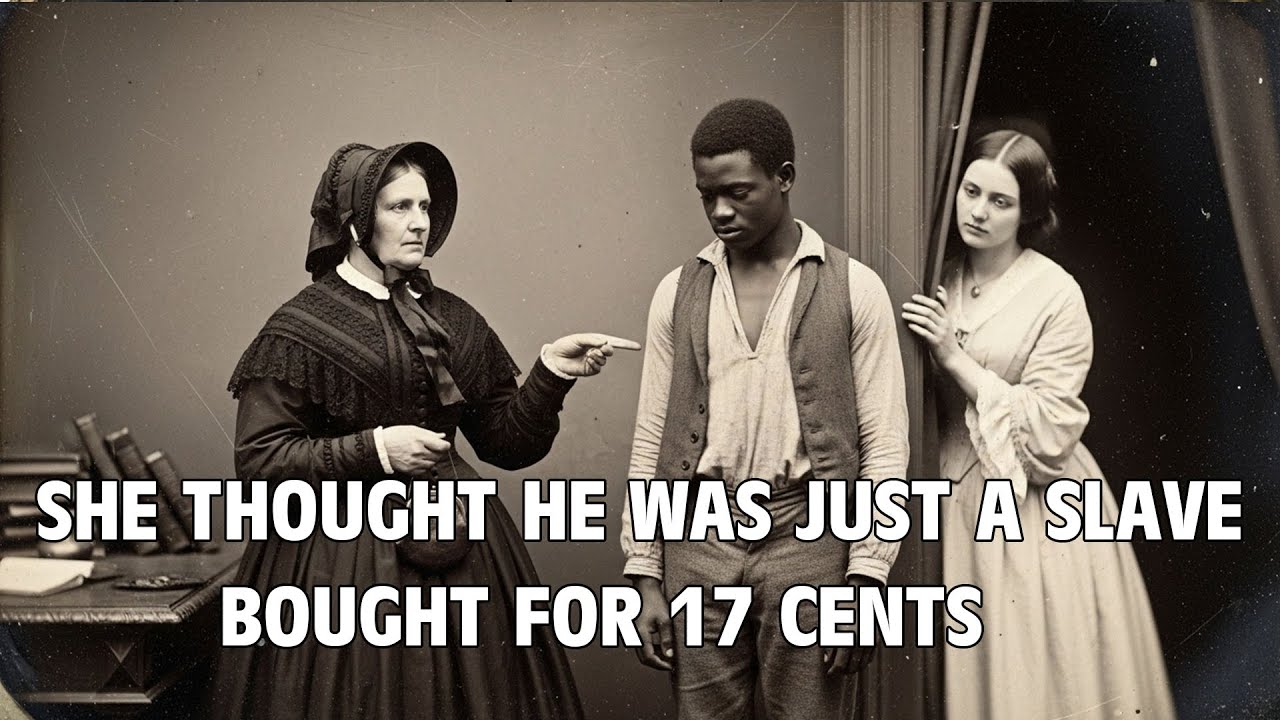
For a young man in his prime. It made no sense, and the smarter men in the crowd knew it. They understood that this was not a sale but a ritual, a public humiliation orchestrated by a hand none of them dared to cross. No one bid.
No one moved. So Mave, a widow with three acres of unplowed land and a debt at the general store, pushed through the crowd and made her offer. She paid the seventeen copper pennies, signed the deed with a shaky X, and led him away. She never knew his name wasn’t Kalin.
Not really. She never knew the crime he was accused of was a lie. And she never knew that three months before, in secret, he had married the most powerful man in Augustine Parish’s daughter. The transaction happened on the morning of April 11th, in the humid mosquito-thick air of the parish in Louisiana.
It was designed to be forgotten. The receipt itself became a ghost, a brittle brown slip of paper tucked inside the binding of a tax ledger from 1849, hidden for over 170 years, kept by dust and institutional silence. But the silence that followed that auction wasn’t accidental. It was engineered by a man who had the power to make reality bend to his will.
His name was Judge Alistair Finch. In Augustine Parish, Finch’s word wasn’t just law. It was scripture. He was a man carved from granite and swamp shadow, his family having controlled the parish’s legal and financial arteries for three generations.
His power was absolute, not because of the land he owned—though he owned thousands of acres—but because he controlled the very definition of truth. He presided over the court. He appointed the sheriff. He held the mortgages on half the businesses in town.
To cross Judge Finch was not to risk your livelihood. It was to risk your existence. He could have a man’s name stricken from the voting rolls, his credit evaporated, his property seized on a forgotten technicality. He was a king in all but name, and his kingdom was a place of suffocating order where every person knew their place.
Kalin had been one of his acquisitions. Not born on the plantation, but purchased years earlier from a traitor passing through from Virginia. He was quiet, unusually intelligent, and possessed a stillness that unnerved the other slaves and fascinated the judge. Finch saw him not as a person, but as a beautiful, intricate chess piece.
He had Kalin educated in secret, taught him to read, to understand ledgers, even to speak a little French. It was a whim, a pet project. The judge enjoyed owning something no one else had—a mind he had personally cultivated, a soul he believed he had authored. But a mind once opened cannot be easily controlled.
Kalin saw the world with a clarity the judge never anticipated. And that clarity would lead him to the one person in Augustine Parish he was never supposed to see as an equal. Whispered rumors from that time, passed down through the Gullah communities of the coast, speak of shadow marriages—unions between the enslaved and the powerful, consecrated not by law but by older, more binding vows. They were secrets that, if revealed, could unravel the very fabric of that society.
This story is one of them. Kalin’s duties eventually brought him inside the judge’s immaculate white pillared mansion. He was assigned to the library, a vast silent room filled with books from London and Paris. And it was there he met Genevieve Finch, the judge’s only daughter.
She was seventeen, a ghost in her own home, educated but isolated, surrounded by wealth but suffocating under the rigid expectations of her father. She was promised to a senator’s son from Baton Rouge, a political alliance that would cement the Finch dynasty. But Genevieve had a mind as sharp as her father’s and a heart he had long since forgotten how to nurture. She saw in Kalin not a servant, not a piece of property, but the only other person in her world who seemed truly alive.
Their conversations began in whispers, hidden between the leather-bound spines of Voltaire and Shakespeare. He spoke of the stars. She spoke of the sea. He taught her the names of the constellations as he understood them from African folklore.
She read him poetry from books her father had forbidden her to open. They were two prisoners in the same gilded cage. In that shared confinement, something forbidden began to grow. They both knew it was impossible.
They both knew it was a death sentence. But knowing and stopping were two different things. In the dead of winter, under the skeletal branches of a live oak that had stood for three hundred years, they made a vow. No priest would marry them.
No law would recognize their union. So they found an old woman on the edge of the swamp, a root doctor named Elizabeth, who practiced traditions that predated the parish, predated America itself. In a ceremony lit by a single candle, with vows spoken in a mixture of English and a language the judge would have called pagan nonsense, they bound themselves to each other. For a few stolen weeks they were husband and wife in a kingdom of two.
But secrets in a place like Augustine Parish have a way of bleeding through. A misplaced book. A lingering look held a second too long. A note discovered by a house servant loyal to the judge.
The details of how Finch found out are lost. But the explosion of his rage was legendary. It was not the hot screaming rage of a common man. It was a cold fury, a terrifying silent pressure that seemed to suck the air out of a room.
He didn’t confront them. He didn’t rage or accuse. He simply began to move his pieces. The first move was to isolate Genevieve.
She was confined to her rooms, her books taken away, the windows of her world shrinking until all she could see was her father’s cold, unforgiving face. He never raised his voice. He simply explained, in calm measured tones, that she had dishonored her name, her family, and her God. He told her she was sick, that her mind had been poisoned, and that he would cure her.
It was a campaign of psychological warfare designed to break her spirit completely. His second move was against Kalin. The judge understood that simply killing the boy would be too merciful. It would also create a martyr.
No. Death was an ending. The judge wanted an eraser. He needed to utterly annihilate the man his daughter had chosen, to reduce him to a state so low that the very memory of him would become a source of shame for Genevieve.
He devised a plan of exquisite cruelty. He took a silver locket, a gift he had given his daughter years before, and planted it in Kalin’s small sleeping quarters. Then he had the sheriff—a man whose career and life belonged to Finch—discover the stolen item. Theft was a common enough crime, but theft from the judge’s own family was an unforgivable sin.
Kalin was dragged from his bed in the middle of the night. He never saw Genevieve again. He was taken to the parish jail, a damp stone box where he was held for two weeks without a word. He wasn’t whipped.
He wasn’t beaten. The judge’s cruelty was more refined. Kalin was simply left alone in the dark with the silence and the rats to contemplate the totality of his powerlessness. The charge was formally read: theft of property valued at twenty dollars.
The punishment by parish law was to be sold at public auction. It was all perfectly legal. It was all a monstrous lie. The judge himself signed the order, his penmanship as elegant and merciless as the man himself.
He was not just destroying a man. He was editing a story, rewriting a truth he found offensive, and ensuring that the final draft contained no mention of his daughter’s love. The auction was set for April 11th. The morning was thick with hazy, oppressive heat that promised a storm later in the day.
A small crowd gathered on the courthouse lawn, mostly farmers and small-time merchants, men with weathered faces and calculating eyes. They were there for livestock, for a seized cotton gin, for the mundane business of a struggling parish. Kalin was the last lot of the day. He was brought out onto the steps, his hands bound in front of him.
He was clean, a detail the judge had insisted upon. He was not to look like a common field hand. He was to look like what he was: a house slave, something refined, something that had fallen from a great height. The auctioneer, a man named Bartholomew who owed Judge Finch a significant debt, began the proceedings.
He didn’t describe Kalin’s skills, his literacy, his intelligence. He simply stated the charge and the judgment. Then he announced the opening bid. “The court sets the price,” he bellowed, his voice straining, “at seventeen cents.
”
A confused murmur rippled through the crowd. Seventeen cents. It was an insult. An enslaved man in his prime, even accused of theft, was worth hundreds, perhaps a thousand dollars.
A price this low meant one of two things: either the man was secretly diseased and dying, or this was something else entirely. The smarter men understood immediately. To bid would be to interfere, to involve oneself in the affairs of the powerful. In Augustine Parish, no one was foolish enough to do that.
The silence stretched, thick and uncomfortable. It was in that moment that Mave O’Connell made her move. She didn’t understand the politics. She didn’t recognize the invisible lines of power shimmering in the air.
All she saw was a boy who looked lost and a price she could actually afford. Her husband had left her with three acres of unplowed land and a debt at the general store. For seventeen cents, she could have a helper. Simple, desperate arithmetic.
She pushed through the crowd, her shawl pulled tight despite the heat. “I’ll take him,” she said, her voice thin but clear. “Seventeen cents. ”
The auctioneer looked stunned.
He glanced nervously toward the courthouse, where he knew Judge Finch was watching from his office window. This was not part of the plan. The plan was for Kalin to stand unsold until the auction ended, a piece of human refuse no one would touch. He would then be remanded to the parish work farm, a place from which no one ever returned healthy.
But a bid had been made, a legal public bid. To refuse it would be to break the very laws the judge claimed to uphold. Bartholomew hesitated, sweat beading on his forehead. “Seventeen cents from the widow,” he called out, his voice cracking.
He looked around, praying someone would counter. But the crowd remained silent, their faces a mixture of pity and fear. They knew what this woman did not. She wasn’t just buying a slave.
She was picking up a cursed object, a piece of a story she was never meant to be part of. “Going once,” Bartholomew stammered, his eyes darting back to the courthouse window. “Going twice. ” He paused, giving the universe one last chance to correct this error.
Nothing. The cicadas screamed in the trees, a sound like frayed nerves. “Sold,” he finally choked out, slamming his gavel down with a sound that felt both final and deeply wrong. “To the widow O’Connell for seventeen cents.
”
Mave counted out the coins, her hand trembling slightly as she dropped them into Bartholomew’s sweaty palm. The deed of sale was drafted by a clerk whose hands moved with unnatural speed, as if he wanted the document out of his possession as quickly as possible. Mave signed with her X. The transaction was complete.
She had just purchased a human being for the price of a spool of thread. As she led Kalin away from the courthouse steps, he didn’t look at her. His eyes were fixed on the second-story window where he knew the judge was watching. Their gazes locked for a brief, searing moment across the square.
In that look, a thousand unspoken things were communicated. It was a look of triumph from the judge, a look that said, “See what I have made you. ” And from Kalin, it was a look of something else. Not defeat.
Not hatred. It was a look of terrifying, unshakable promise. Mave saw none of it. She was just a poor widow who had made a desperate bargain.
She had no idea she was now the keeper of a king’s ruined treasure, the accidental guardian of a secret that could still burn Augustine Parish to the ground. She was taking him home to her small dusty cabin, never knowing she had just bought a man who was married to the most powerful man’s daughter. The cruelest lies are often told in silence. This quote, attributed to the philosopher Robert Louis Stevenson, perfectly captures the atmosphere of the O’Connell cabin in the days that followed.
Mave didn’t know what to do with Kalin. He was not defiant, but he was absent. He worked from sunup to sundown, clearing the stubborn clay-packed soil, his movements efficient and tireless. He did everything she asked, his obedience so absolute it was unsettling.
But he never spoke unless spoken to, and his eyes had a haunted, distant quality. Mave tried to talk to him. She asked about his life before. “I was in service, ma’am,” he answered.
She asked if he had a family. He just shook his head. The silence in the cabin was heavier than the humid air outside. It was a silence filled with his unspoken history and her unasked questions.
She was a simple woman, devout and kind-hearted. The institution of slavery had always been an abstraction to her, a thing that happened on grand plantations far from her small life. Now it sat at her rough pine table, a living enigma. She watched him trying to piece together the puzzle.
His hands, though calloused from farm work, were not the hands of a field laborer. They were long and slender. The way he carried himself, even in worn-out clothes, had a grace that seemed out of place. One evening she saw him staring up at the night sky, his lips moving silently.
He wasn’t praying. He was naming the stars. The judge, meanwhile, was consumed by a quiet, festering rage. The widow’s interference had spoiled the perfect symmetry of his revenge.
Kalin was supposed to disappear into the anonymity of the parish work farm, a place of slow, grinding oblivion. Instead, he was living just two miles away, a constant living reminder of his daughter’s betrayal. Every day Kalin existed was an affront to the judge’s power. He became obsessed.
He had the sheriff ride past the O’Connell place twice a day, a silent act of intimidation. He pressured the general store owner to deny Mave credit, hoping to starve her out, to force her to sell the boy. But Mave was resilient, and the small community of poor farmers, who held no love for the judge, began to help her in small ways. A sack of flour left on her porch.
A few jars of preserves. They saw it as a quiet act of defiance against a man who held them all in his grip. The judge’s frustration grew. He needed Kalin gone, but it had to be done in a way that didn’t lead back to him.
Another public spectacle was out of the question. It had to be quiet. Final. He began to look for an instrument, a man who could operate in the shadows.
He found such a man in a conjure tracker named Rauch, a shadowy figure who lived deep in the swamps and was rumored to have skills that were not entirely natural. Rauch was a man who found people who didn’t want to be found, and who, for the right price, could make people disappear forever. The dynamic on the farm began to shift in subtle ways. Kalin, realizing the judge’s gaze was still upon him, started to let slivers of his true self show.
It was a calculated risk. He needed an ally, and this simple widow was the only one he had. One evening, he noticed her struggling with her late husband’s account book. She could read numbers, but not words.
Quietly, he stepped forward. “If I may, ma’am,” he said, his voice soft. He took the ledger and in a few minutes organized the chaotic entries, his handwriting a fluid, elegant script. Mave stared at the page, then at him, her eyes wide with astonishment.
“Where did you learn to do that? ” she whispered. “The judge valued certain skills,” he answered, the first hint of irony she had ever heard from him. He began to help her in other ways, showing her how to better irrigate the fields, how to mend tools she thought were broken.
He was not just a laborer. He was an architect of survival. A bond, fragile and unspoken, started to form. It wasn’t friendship, not yet.
It was the weary respect of two people clinging to the same piece of driftwood in a vast, hostile ocean. Mave began to see him not as seventeen cents’ worth of muscle, but as a man of profound depth. With that realization came a terrifying thought. Whatever he had done to incur the wrath of Judge Finch must have been extraordinary.
She was harboring not just a runaway, but a secret. And secrets in Augustine Parish had a very high price. A chilling description from an old parish diary describes the man who now began to circle Mave’s small farm. “Saw the judge’s man, Rauch, in town today.
He does not walk like other men. He glides, silent as a water moccasin. And his eyes—they are the color of swamp mud, and they see everything you try to hide. ” Kalin felt his presence before he ever saw him.
It was a change in the air, a stillness in the woods that felt unnatural. The birds would go quiet. The insects would cease their chirping. It was the predatory silence of a hunter closing in on prey.
Kalin knew what it meant. The judge had grown impatient. Time was running out. He had to act.
He had one hidden card left to play, a secret he had guarded even from Genevieve. Before he was taken, he had managed to hide the only proof of his marriage. Not a document, which could be burned, but something far more permanent. He had taken a small book of poetry Genevieve had given him, and on the inside back cover, using ink made from berries and rust, he had written a short account of their vows, their secret ceremony.
He had signed it. Beside his name, he had pricked Genevieve’s finger with a needle and pressed her bloody thumbprint to the page. It was a symbol, a piece of irrefutable truth. If that book were ever found, it would be a permanent stain on the Finch legacy, a story that could not be erased.
The book was hidden in the one place the judge would never think to look: inside the old parish church, tucked behind a loose stone in the back of the fireplace. Kalin knew he couldn’t retrieve it himself. He was being watched. Every move he made was scrutinized.
He needed to get a message to someone, but he trusted no one. The entire parish was a web of the judge’s spies. So he devised a desperate plan, one that hinged on the courage of a woman who still knew nothing. He began to draw in the dirt, scratching out patterns with a stick while he worked the fields.
At first Mave thought it was idle doodling, but then she noticed the patterns were intricate, almost like maps. One evening, as she brought him a cup of water, he didn’t look at her. He kept drawing, his finger tracing a line from a crude drawing of her cabin to a drawing of the church steeple. Then he drew a small square inside the church, and beside it, a shape that looked like a flame.
He looked up at her, his eyes conveying a desperate silent plea. It was a message without words, a map drawn in dust. He was trusting her to understand. Mave felt a cold knot of fear in her stomach.
She knew what he was asking. He wanted her to go to the church, to the fireplace. He wanted her to retrieve something for him. To do so would be to move from passive observer to active conspirator.
It was a choice. She could erase the map with her foot, pretend she hadn’t understood, and live out her days in quiet servitude. Or she could trust this strange, silent man she had bought for seventeen cents, and step into the heart of the storm. For two days, Mave was paralyzed by indecision.
The fear of Judge Finch was a physical thing, a sickness in her gut. But the look in Kalin’s eyes haunted her. It wasn’t the look of a criminal. It was the look of a man trying to save his own soul.
On the third night, she made her choice. After Kalin was asleep in the small barn that served as his quarters, she slipped out of her cabin, a small lantern clutched in her hand. The walk to the church was the longest two miles of her life. Every rustle in the trees sounded like the swamp tracker Rauch.
Every shadow seemed to hold the judge’s cruel gaze. The church was dark and silent. The back door was never locked. She crept inside, the air cool and smelling of old wood and candle wax.
She found the fireplace, her heart hammering against her ribs. Her fingers, rough and calloused from farm work, searched the stones in the dim lantern light. She found it: a single stone that was slightly loose. With a broken piece of kindling, she pried it open.
Inside the dark cavity, wrapped in a piece of oilcloth, was a small leather-bound book. She pulled it out, her hands shaking so badly she almost dropped it. She didn’t open it. She didn’t want to know.
She just knew it was the source of all this danger, the secret worth more than a man’s life. She tucked it into her apron, replaced the stone, and fled back into the night, the book feeling like a block of ice against her skin. She had crossed the line. There was no going back now.
When she returned to the farm just before dawn, she found Kalin waiting for her outside the cabin. He wasn’t in the barn. He was standing there watching the road, as if he had been standing guard. He saw the book in her hands, and for the first time since she had met him, something other than despair crossed his face.
It was relief so profound it was almost painful to watch. He took the book from her, his fingers brushing hers. “Thank you,” he whispered, his voice thick with emotion. “You don’t have to thank me,” she said, her own voice trembling.
“You just have to tell me what we do now. ”
Before he could answer, a sound cut through the pre-dawn stillness. A dog barking frantically from a neighboring farm. Then another.
Kalin’s head snapped up, his body instantly rigid. “He’s here,” he said, his voice flat and cold. “Rauch. ” He pushed the book back into her hands.
“There is a man,” he said, speaking quickly, his words precise. “His name is Silas. He works the ferry at the Black Creek Crossing. He is an old friend, one of the few the judge does not own.
Give him this book. Tell him—tell him the mockingbird is free. ”
Mave stared at him, confused. “What about you?
” “The judge doesn’t just want the book,” Kalin said, his eyes already looking past her toward the dark tree line. “He wants me. I will lead Rauch away from here. I will give you time.
Go now. ”
He turned and ran, not toward the road, but directly into the thick tangled woods behind the cabin. A deliberate sacrificial act. Mave stood frozen for a second, clutching the book, his strange message echoing in her ears.
Then she heard the sound of someone moving through the undergrowth, moving with unnerving speed and silence. She turned and ran. Mave ran like she had never run in her life, her breath tearing at her lungs, the dark woods pressing in on all sides. She didn’t know the paths.
She stumbled over roots, her face whipped by low-hanging branches. She just knew the direction of Black Creek, and she ran toward it, fueled by a terror she had never known. Behind her, she could hear the chase. Not the sounds of a clumsy pursuit, but the chillingly efficient sounds of a predator.
A snapped twig here, a soft footfall there. And further ahead, Kalin, making just enough noise to keep the hunter focused on him, drawing the danger away from her. It was a race against sunrise. She finally burst out of the woods onto the muddy banks of Black Creek.
The ferry was a simple wooden raft operated by a pulley system. A stooped, gray-haired Black man stood beside it, preparing for the day’s first crossing. “Silas! ” she gasped, stumbling toward him.
The man looked up, his eyes sharp and intelligent. He took in her torn dress, her panicked expression, the book clutched in her hand. “Are you Silas? ” she repeated, her voice frantic.
“I am,” he said, his voice a low, calming rumble. “Kalin sent me,” she panted, holding out the book. “He said to give you this. He said—the mockingbird is free.
”
Silas’s weathered face showed no surprise. He took the book with a steady hand, his expression grim. He understood the code. It meant Kalin was activating the final, most desperate part of their plan.
It meant he likely wasn’t going to survive the night. He had chosen to sacrifice himself to ensure the truth survived. From across the creek, a sound echoed through the morning mist. A single sharp cry, a sound of pain abruptly cut short.
Mave flinched, her blood running cold. She knew it was Kalin. Silas’s jaw tightened. “Get on the ferry, ma’am,” he said, his voice urgent.
He didn’t wait for her. He untied the rope and began pulling them across the churning brown water, his old muscles straining with the effort. As they reached the middle of the creek, they saw him. Rauch emerged from the tree line on the opposite bank.
He was holding a long, wicked-looking knife, its blade stained dark. He stood there watching the ferry, his face a mask of cold frustration. He was too late. Mave stared at the man who had just hunted—and likely killed—the boy she had bought for seventeen cents.
She felt a wave of nausea and grief so intense it buckled her knees. “What happens now? ” she whispered, her voice a raw, broken thing. Silas didn’t look at her.
He kept his eyes fixed on the far bank, as if daring the tracker to try and cross. “Now,” he said, his voice resonating with a deep, weary sorrow, “the judge loses. ” He pulled the book from his coat, holding it up for Rauch to see across the water. A gesture of defiance, a promise that this story would not end in the silence of the swamp.
Rauch simply turned and melted back into the woods. His mission was both a success and a catastrophic failure. They reached the other side of the creek, a land that felt like a different country, a place where the judge’s immediate power could not reach. Silas secured the ferry and led Mave to a small hidden cabin a short walk from the bank.
Inside, an oil lamp cast a warm glow on a simple room. Silas placed the book on the table with a reverence that surprised her. “You are safe here for now,” he said. “Who are you?
” Mave finally asked. “Really? ” “I knew Kalin’s mother,” Silas began, his voice dropping low, taking on the quality of a confession. “Years ago, before the judge bought her.
We were from the same place in Virginia. I promised her I would look out for her boy. ” He paused, his gaze distant. “I failed.
I stood by and did nothing for years, too afraid of what the judge could do. Kalin knew I ran this ferry. He knew I had connections to people who help others disappear. The Underground Railroad.
He contacted me weeks ago, before any of this happened. He had a feeling the judge knew his secret. We made a plan, a desperate one. Getting him out was one thing, but he refused to leave without the proof.
Without this book. ” He tapped the cover. “He said, ‘A man’s life is temporary, but the truth can be permanent if someone is brave enough to protect it. ‘”
He finally looked at her, his eyes filled with profound sadness.
“He didn’t think he would survive. He made me promise that if he sent the signal, I would get the book north, no matter the cost. He sacrificed himself so that one day everyone will know what Judge Finch did to his own daughter. ”
Mave finally broke.
The tears she had held back for days, for weeks, finally came. A storm of grief for a boy she barely knew, but whose courage had shattered her world. She wept for his lost love, for his stolen life, for the sheer monstrous injustice of it all. Silas let her cry, his silence a respectful witness to her sorrow.
When she was finished, her body aching with the force of her sobs, she looked at the book on the table. “His wife,” she said, her voice barely audible. “The judge’s daughter. What happened to her?
”
Silas’s face hardened. “After the judge locked her away, he brought in a doctor from New Orleans, a man who specializes in female hysteria. They declared her mentally unfit, a danger to herself. She was sent to an asylum in Mobile, a place people go to be forgotten.
She’s a prisoner, same as Kalin was. The judge didn’t just take her husband. He took her mind, her freedom, her very name. As far as the world knows, Genevieve Finch had a nervous breakdown and was sent away for her health.
The story is neat, clean, and utterly false. ” The cruelty of it was breathtaking. It was a murder of the soul, a perfectly legal and socially acceptable form of annihilation. The judge hadn’t just erased Kalin.
He had erased his own daughter, turning her into a ghost long before she was dead. Now Mave understood the seventeen cents, the auction, the tracker. It was all part of a meticulous evil masterpiece of control. And she, the ignorant widow, had stumbled onto the stage and ruined the final act.
“What’s in the book? ” Mave asked, her voice barely a whisper. Silas opened it carefully. He turned to the inside back cover.
There, in Kalin’s elegant script, was the story of their secret marriage. Below the text were two signatures. One was Kalin’s. The other was not a signature, but a small red-brown smudge.
A bloody thumbprint. “Genevieve’s mark,” Silas said softly. “He told me about it. Proof that she entered the vow of her own free will.
In the right hands, this book destroys the judge’s entire narrative. It proves he manufactured the theft charge. It proves he institutionalized his own daughter to cover up a truth he couldn’t stomach. ” He closed the book.
“My contacts will get this to abolitionist publishers in Philadelphia. It will be printed. The story will be told. It won’t bring Kalin back.
It might not even free Genevieve. But it will be a crack in the judge’s throne. It will be a fire he can never completely extinguish. ”
He looked at Mave, his expression serious.
“But you can’t go back to Augustine Parish, ever. The judge will never stop looking for you. You’re the loose end, the witness who knows the whole story. ” Mave thought of her small farm, the only home she had.
She thought of her husband’s grave. It was all gone, wiped away by a history she never asked to be part of. She was adrift, a refugee from a secret war. “Where will I go?
” she asked, the question hanging in the air like smoke. “North,” Silas said. “We’ll get you to a safe place. A new life.
It’s the least we can do. It’s what he would have wanted. ”
And so Mave O’Connell disappeared, aided by Silas and the quiet, determined network of the Underground Railroad. She traveled by night, hiding in barns and secret cellars, moving steadily north until the Spanish moss of Louisiana was just a bad memory.
She changed her name, cut her hair, and became someone else, a woman with no past. The book traveled with her, a sacred, dangerous relic passed from one steady hand to another until it finally reached Philadelphia. In the spring of 1850, an anonymous pamphlet began to circulate. It was titled “A Parish of Lies,” and it told the story of a powerful southern judge, his daughter, and the educated slave he destroyed to protect his family’s name.
It didn’t name Judge Finch or Augustine Parish directly—to do so would have been too dangerous for the printers—but the details were specific enough that those in power in Louisiana knew exactly who it was about. The story was dismissed by the mainstream press as abolitionist propaganda, but the damage was done. The whisper had started. The crack in the throne had appeared.
The judge’s power, once absolute, now had a boundary. He became more reclusive, more paranoid, seeing betrayal in every shadow. He spent a fortune trying to find the source of the pamphlet, hunting for the widow who had vanished, but he found nothing. He was fighting a ghost.
The truth, once released, could not be recaptured. Judge Alistair Finch died in 1863, not from a bullet in the war that tore his world apart, but from a stroke, alone in his grand library, surrounded by the books that had been the backdrop for his daughter’s forbidden love. They say in his final years he raged at unseen figures, his mind consumed by enemies, real and imagined, who had tarnished his perfect legacy. Genevieve Finch remained in the asylum in Mobile for the rest of her life.
She died in 1888. The official cause of death was pneumonia, but the asylum records note that she spent her last forty years in a state of quiet, detached silence, never speaking a word to anyone. Whether her silence was the result of the asylum’s brutal treatments or her own willed act of eternal mourning, no one knows. She became the ghost her father had always wanted her to be.
Rauch the tracker disappeared back into the swamps. His name appears one last time in the historical record in a sheriff’s report from 1854. He was found dead, floating in a bayou, his body bloated and unrecognizable. The report lists the cause as an alligator attack, but rumors persist that someone caught up with him, that a debt from that night on Black Creek was finally paid.
Silas continued to operate his ferry, a quiet, unassuming man helping countless others find their way to freedom, his own act of atonement lasting a lifetime. And Kalin. His body was never found. Rauch likely buried him in an unmarked grave deep in the swamp, another soul absorbed by the dark Louisiana soil.
He was erased just as the judge intended. But his story, the one he died to protect, survived. It became a quiet legend, a cautionary tale whispered by those who knew the truth. It was a testament to the fact that you can silence a person, but you cannot kill an idea.
You can bury a body, but you can’t bury the truth. Not forever. The widow Mave lived to be an old woman in a small town in Ohio. She never spoke of what happened.
But they say she kept a small, worn-out pamphlet in a locked box until the day she died. The story of the boy she bought for seventeen cents. The boy who was secretly a husband, a rebel, a king in a world that refused to see him. One final disturbing rumor has persisted about Genevieve Finch.
Some of the older nurses at the Mobile asylum used to tell a story about the silent woman in room 213. Every year, on the anniversary of the April 11th auction, she would do one thing. She would find a piece of charcoal—or use her own blood, if she had to—and draw a single image on the wall of her cell. It was always the same image: a mockingbird with its throat cut.
The asylum staff would scrub it off every time, trying to erase the strange, sad graffiti. But the next year it would always reappear. A silent yearly memorial for a love that had been silenced, a message to a world that had forgotten her. It was her only remaining act of rebellion, a ghost of a memory that refused to be exorcised.
It suggests that even though her father broke her life, he never truly broke her spirit. The love she had for Kalin was still there, buried so deep that forty years of institutional brutality couldn’t touch it. It was her own book, written on the walls of her prison. A story told in silence and blood.
If you visit Augustine Parish today, you will find no official record of any of this. The Finch family name is still on the courthouse, on the library. History, as it is written, is the story of the winners. But if you go down to the Black Creek Crossing, some of the old folks might tell you a different story.
They’ll tell you about a ghost who sometimes walks the woods, looking for a book. They’ll tell you about a love that was stronger than the law, and about a truth that cost everything. Kalin and Genevieve’s crime wasn’t theft. It wasn’t just love.
Their crime was believing they were equals. Their rebellion was the act of seeing full humanity in each other. That was the one sin the judge and the entire world he represented could not tolerate. Because if a slave and a master’s daughter could be husband and wife, if they could be bound by a vow that transcended law and property, then the entire foundation of their society was a lie.
The judge had to destroy them, not just to punish them, but to protect his own sanity, to reinforce the walls of reality he had built around himself. His cruelty wasn’t just revenge. It was desperate self-preservation. He was trying to kill a truth that threatened to expose him as a fraud, a king ruling over a kingdom of ghosts.
The sale of Kalin for seventeen cents wasn’t just cruel. It was a perversion of the very idea of value. It was an act of economic and spiritual warfare designed to prove that a man’s worth could be dictated, that a soul could be priced and found wanting. It was the ultimate expression of a power so absolute it could declare a human being worthless and make it legally so.
But they were wrong. His life was not worthless. It was priceless. The proof is that his story survived, over a century and a half later.
The receipt for seventeen cents sits in a university archive now, a historical curiosity. Most who see it just see a strange, sad transaction from a brutal era. They see the price and shake their heads at the cruelty. They don’t know the truth.
They don’t know the story behind the ink. They don’t see the ghost of a secret marriage, the cold fury of a powerful judge, or the impossible courage of a woman who chose to trust a stranger. They don’t know that those seventeen pennies were the price of a king’s ransom in love and rebellion. Judge Finch believed he was the author of this story, that he could write the final chapter and close the book on a love he found offensive.
He used the law, the economy, and the fear of his community as his ink. He thought he had created a masterpiece of erasure, a perfect silent monument to his own power. But he made one critical mistake. He forgot that true stories are not written on paper.
They are written on the human heart. And the heart has a memory that no law can extinguish, no ledger can contain, and no passage of time can truly erase. He thought he was closing a book. All he did was create a ghost.
A ghost that has haunted the edges of history for 170 years, waiting for someone to finally speak its name. He wanted to prove a man could be worth only seventeen cents. Instead, he proved that a single defiant act of love could be worth everything.
