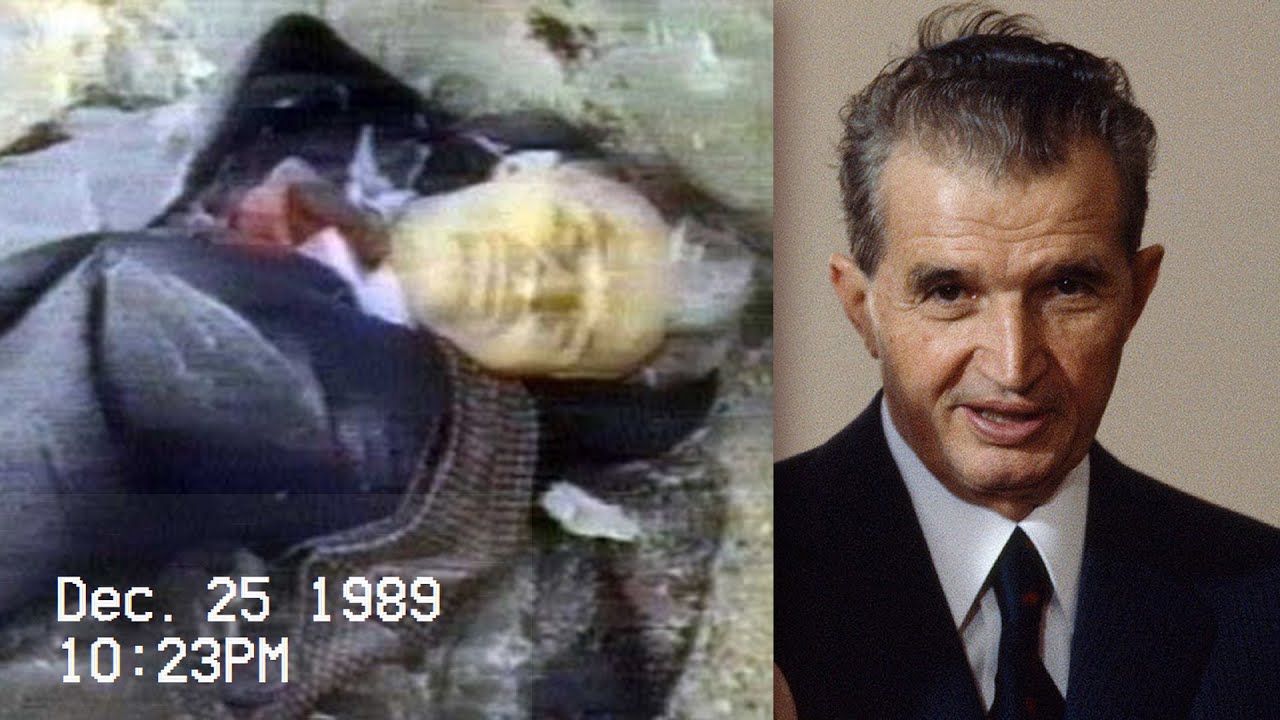
On Christmas Day 1989, Romania and the Romanians received the greatest gift in their history. The dreaded dictator Nicolae Ceaușescu was executed along with his especially hated wife, Elena. Ceaușescu had been known as the Conducător, the Leader. Not an original title for a dictator, for sure, but another Romanian dictator, Ion Antonescu, who had allied himself with Hitler, also used the name.
Antonescu was shot by the Soviets in 1946. No politician in Romania today, on a local, provincial, or national level, calls themselves that, and likely never will. Ceaușescu had other titles he preferred, but his wife loved them. She was the best mother Romania could have and the Mother of the Nation.
She also liked to pose as a world-renowned scientist. And though virtually all of her credentials were fake, she was still known as the Great Scientist of International Renown. The news and the truth were tightly controlled in Ceaușescu’s Romania. Outside of the country, at least outside the communist bloc, she was known as a real power in the country, but not a scientist or intellectual of any kind.
Three days before Christmas, Ceaușescu walked onto a large balcony in the building of the Central Committee of the Communist Party to make a speech. Over the past year, communism in Eastern Europe had begun to crumble. By the time Ceaușescu walked onto the balcony, Poland, Hungary, Czechoslovakia, and Bulgaria had overthrown their communist systems. East Germany had essentially ceased to exist when the Berlin Wall crumbled in November.
Having been in power since 1965 and having ruled the country with possibly the most pervasive secret police force in history, Ceaușescu was determined to keep power at any cost. He walked out onto that balcony and began to speak in the same threatening and paranoid language communists had been using since the Soviet Union became the first communist nation in 1917. Romania’s problems were the result of foreign interference and hooliganism. These fascist provocations by reactionary circles and foreign agents were aimed at destroying the perfect state, which could be part of a bright future, if only they would listen to him.
Well, they had listened to, or been forced to listen to, him for 24 years, and they wouldn’t listen to him any longer. Many of the 100,000 or so people in the plaza below him had been bused in from other parts of the country to hear him and cheer him. Before the anti-communist revolutions of 1989 had brought down all but two communist nations, Yugoslavia and Albania, no one would have dared to do anything but cheer. But not today.
After about nine minutes of the same old thing, having seen or heard through word of mouth and an underground press that the other people of the Soviet bloc had overthrown their own leaders, and for the most part peacefully, the people below the Conducător began to chant, to move menacingly closer to the building, and then began to call for the end of the regime and for Ceaușescu’s blood. Elena’s too. They ran with their personal security and escaped the capital by helicopter, landing in the small town of Snagov, and then on to Târgoviște, a small city about fifty miles from Bucharest, the capital. All through his panicked flight, Ceaușescu attempted to contact and organize a military response to the uprising.
But having seen the writing on the wall in the rest of Eastern Europe and hearing about what had happened in the capital, officers and men throughout Romania were either walking away or joining the opposition. By the time the couple had arrived in Târgoviște, the local garrison, commanded by Ceaușescu’s former defense minister, who had wisely switched sides, were waiting for the Conducător and the Great Scientist of International Renown, and took them to the local military base. Two and a half days after his last speech, Ceaușescu was put on trial. He had ruled the country for 24 years.
His trial, if you can call it that, lasted one hour. His appointed defense team acted more like a second set of prosecutors. When given the opportunity to ask questions of their client, almost every time Ceaușescu tried to speak, he was shouted down. When his wife tried to defend him, the people in the hall nearly went berserk.
Everyone knew, except maybe the Conducător himself, what the verdict would be. And when it came, it took about fifteen minutes to get the former power couple up against the wall of the base infirmary, handcuffed. No blindfolds were offered. Three paratroopers stood before them and quickly opened fire, emptying their magazines into the couple.
Within certain circles in Romania, there had been a hope for a lengthy trial, not to help Ceaușescu, but to allow the Romanian people to see exactly how much of a monster he really was. In Western Europe and the United States, politicians and pundits, while not at all sad about the Conducător’s death, also wanted to see the rule of law re-established in Romania, and hoped that a trial would have helped to do that. In Romania, most people were happy the couple was dead, and most, if they could, would gladly repeat the action. First and foremost, Ceaușescu, born in 1918, who became a communist in the 1930s, idolized Stalin.
As Romania bordered the Soviet Union, this was a good idea if you were a communist, even if they weren’t in power yet. By the 1930s, and especially in the last part of the decade, Stalin had created a state so completely in control of its citizens’ lives, especially in the cities, that for decades diplomats and historians considered it the most complete of the infamous totalitarian states of the twentieth century. Though it is a matter of debate, many historians think Ceaușescu might have done Stalin one better. His secret police, the Securitate, was figuratively and literally everywhere.
In a country of 23 million in 1989, nearly 500,000 were employed directly or indirectly by the secret police. Propaganda and fear made it seem like more. After the Ceaușescu regime, it was revealed in secret police files that every phone in the country was bugged. Not only that, but most apartments and houses in the cities were bugged as well.
The Romanian countryside, then and now, was much poorer than the cities, and people there mostly concentrated on just getting by. But many of their homes and cottages were bugged, too. What the listening devices didn’t hear was often picked up by informers, most of the time family members and co-workers. More often than you would think, members of the same family informed on each other without knowing it.
Before you ask, a polite “no thank you” to the Securitate’s offer often meant arrest, beatings, torture, long prison terms, and many times disappearances. So husbands and wives, children and their parents informed on each other. And the Securitate knew if you were lying too, because they had informers everywhere: at your work, at the bar you went to after work, in your building, and at home. Lie to the Securitate, and you could expect to land in one of the most brutal penal systems on Earth.
In the late 1940s and early 1950s, before Ceaușescu became leader, while he was a rising star in the party, hardcore Stalinists had taken control of the Romanian Communist Party. At that time, Stalin was at the height of his power, and with him and his huge army just across the border, Romanian Stalinists wanted to impress him with their ruthlessness in hunting down foreign agents and enemies of the state within the Communist Party. It was also a good time to simply get rid of enemies as well. The experiment read like something out of a political thriller.
The goal was to see if a person could be broken so completely that they would not only do what you asked, but would believe that what you asked was the right thing to do. On some occasions, prisoners were forced to shoot or bludgeon other prisoners to death. If they showed remorse, guess who was next? Some were seldom touched, but were forced to watch the torture of others, to break them both psychologically and emotionally.
Just like the Nazis did in their camps, certain prisoners were given extra food and perks for tormenting, beating, electrocuting, hanging, and waterboarding other prisoners. When the people in charge of the program decided to make a power play for control, the rest of the party had had enough. By some miracle, this happened just after Stalin died in 1953. Many of the people running the experiment were executed, including the prisoners who were forced to torture and kill others for perks.
But the Securitate remembered, and used these techniques, and new ones, to torture and terrify their countrymen and women. Romania is slightly smaller than the US state of Oregon. It had 44 prisons and 72 labor camps. When Ceaușescu first came to power, many political prisoners were released and a number of prisons and camps closed.
But it didn’t take long for them to reopen. Ceaușescu was rather popular when he first came to power in 1965–66. The closing of prisons and a wide-ranging amnesty for political prisoners were announced. Internationally, Ceaușescu slowly steered a careful course between the USSR and the West, setting himself up as a kind of diplomatic go-between and as an independent thinker, not cowed by the post-Stalin Soviet leadership.
In 1969, US President Nixon became the first American president to visit a communist nation. The two leaders got on so well that Ceaușescu visited Nixon in the White House in 1970. He visited President Ford in 1973. His last visit was in 1978, during the Carter administration.
Did the Americans know what was going on in Romania? Without a doubt. They may not have known every brutal detail, but they knew enough. Why the visits then?
Precisely because Ceaușescu had distanced his country from Russia, though he knew not to distance Romania too far. Throughout Ceaușescu’s rule, Romania was a desperately poor country, though he did spend what today would amount to billions of dollars on making Bucharest a modern communist showcase city. However, Romania was desperately poor in the smaller towns and the countryside. In 1970, a farm village with a tractor was considered very fortunate.
Most people were still following oxen behind plows. Over time, living conditions improved, because Ceaușescu had seized control of the economy and used tax revenue and money from the many illegal operations that he and the Securitate were involved in. They trafficked guns throughout Europe and the Middle East. They imported and distributed drugs in Eastern Europe.
Cigarettes and foreign currency were stolen and sold on the black market, and the proceeds put into Ceaușescu’s and Elena’s personal accounts. Worst of all were the hostage plans. Romania has always had a problem with anti-Semitism. In World War II, the fascist regime of Antonescu perpetrated some of the war’s worst horrors at the massacre of Romanian Jews at Iași, where an estimated 15,000 people were slaughtered and starved to death.
However, when the winds of World War II shifted and it appeared that Hitler would lose, the persecution of Romanian Jews began to ease slowly. Out of an estimated pre-war Jewish population of six to seven hundred thousand, about half survived the war years. By the time Ceaușescu came to power in 1965, the war had been over for twenty years, and the remaining Jews of Romania tried to rebuild their lives. Still, life was tough.
General discrimination and bullying, in addition to the oppressiveness of a communist regime, made a lot of Romanian Jews want to leave the country. But that seemed impossible, until Ceaușescu came to the rescue. Using vaguely threatening language, he proposed to Israel a deal: his remaining Jews for hard US and European currency. Basically, the Jews of Romania were hostages.
With the goal of bringing as many of the world’s Jews to Israel, the Israelis jumped at the chance. So did the Germans, which may sound odd, but interestingly enough, Romania had a sizable ethnic German population, and had for centuries. After World War II, no one in Romania had any use for Germans. So Ceaușescu sold them to West Germany, which paid, in today’s money, between 2.
5 and 3. 5 billion dollars for them. The Israelis paid an approximate 30 million dollars. Though most people left the country in the late 1960s and early ’70s, Romanian Jews and Germans were still being ransomed off as late as 1989.
This money did not go to buy a tractor for poor Romanian farmers. No, these funds and much else went into building Ceaușescu’s home, the world’s largest private residence. Prepare yourself. Ceaușescu’s home, really the world’s ugliest palace, was 3.
9 million square feet, or 365,000 square meters. Real gold covered everything. The finest marble was imported from Italy. No expense was spared.
In 2025, the house would cost nearly five billion dollars. Some communists. Though Ceaușescu was often seen in poorly fitting suits as a proper communist and man of the people, Elena went all out. While her shoe collection wasn’t as extensive as the Philippines’ first lady Imelda Marcos’s 3,000-pair shoe collection, she had nearly 1,000.
She also had hundreds of furs and some of the most expensive jewelry in the world. Still, as Romanians of the time liked to say, very carefully and quietly, no amount of fur or jewelry would make the great scientific mind a beauty queen. Though she was determined to see herself that way and insisted others did too. Elena hated being in a room with actual beautiful women, and reportedly enjoyed seeing them publicly humiliated.
While Ceaușescu was being wined and dined in Washington and worldwide and spending the nation’s money, people all over Romania began to suffer. By the late 1980s, the Soviet economy, as well as the economies of the rest of Eastern Europe, had begun to shrink. Reagan’s defense spending and the corrupt nature of every communist government made it impossible for Romania to thrive. Suffering the most were the children.
Those of you old enough to recall remember the constant news stories about the Romanian orphanages discovered after the fall of the regime: children who looked like concentration camp survivors. Some were so underdeveloped from malnutrition that brain damage had occurred. Thirteen-year-olds were as smart and underdeveloped as seven-year-olds, and much more. You don’t need to imagine very hard all of the other abuses that children and young teens suffered in the orphanages.
They were there for two main reasons. Both parents were classified as enemies of the state, and the kids were taken from home and dumped into rundown orphanages, which were often abandoned buildings or warehouses. Other children had been pushed out of the house because the parents did not have enough money to feed them. Most of the country’s wealth had gone directly into the pockets of Ceaușescu, Elena, their children, and cronies.
Just days before he was captured and executed, Ceaușescu had ordered the arrest of a prominent pastor in the town of Timișoara. Romania was officially atheist. A few churches were allowed to stay open, heavily monitored. When pastor László Tőkés began denouncing the regime, the arrest order went out.
To protect their pastor, townspeople surrounded the building he was in. And though Tőkés survived, over 100 people were shot in the street or executed. Three days later, the Conducător made his last speech.
