The cabin sat at the bottom of a hollow in northwest Arkansas, and the two men sat across the table from me eating a bowl of beans like they had never seen beans before. I want to tell you that story all the way through, the way I lived it, because I am the only one left who can. My name is Goff Tatum. In the autumn of 1877 I was 51 years old, a widower of nine years, and the only doctor for thirty miles in any direction.
I rode a tobacco-colored mule named Pellet. I kept ledgers, I weighed grain, and I doubted what I could not measure. I want that on the record before I tell you the rest, because the rest will ask you to believe things a measuring man has no business believing. The town was called Lock Step Crossing, named for the place where two old wagon roads met, one running east and west between Fayetteville and the Missouri line, the other dropping south out of the hills toward Van Buren.
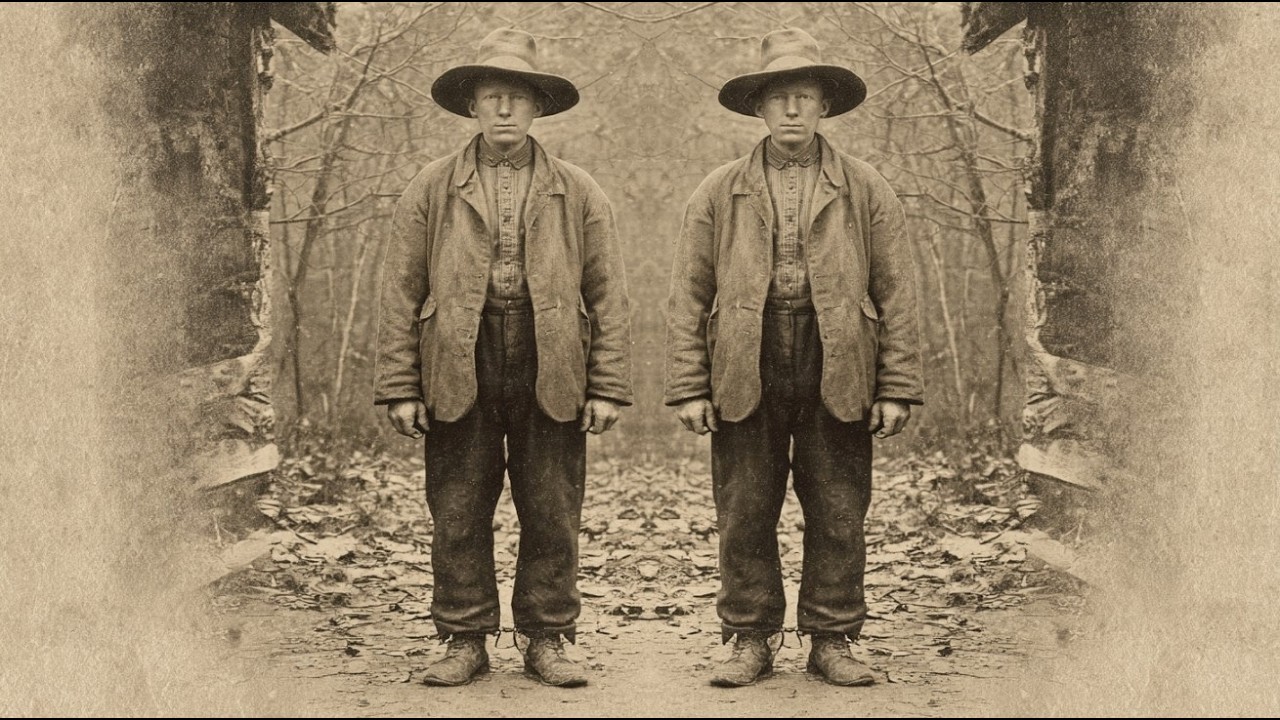
There were 42 houses, a feed store, a smithy, a Methodist meeting hall that doubled as a schoolhouse, and my office above the feed store. South of the meeting hall there was a cemetery. The Pickrel brothers lived four miles up the hollow in a one-room cabin their father had built in 1859 and died in in 1871. Wystan and Talmadge were identical twins, just turned 31.
Both stood about five foot ten, lean through the waist and heavy through the shoulders. Both had black hair that went the color of wet ash in the summer. Both carried a small, neat scar above the left eyebrow from the same fall off the same roof one autumn when they were boys patching shingles. The differences were the kind you only noticed if you sat with them a while.
Wystan was the talker. He chewed plug tobacco out of the left side of his mouth and spat into a tin can he kept on the porch rail. Talmadge was the quiet one. He answered with a nod or a single word, and he had a way of looking at you that made you feel he was hearing you twice, once with his ears and once with something else.
Their work was trapping. They ran a line of about forty traps across two ridges and three creek bottoms, selling the pelts down at the crossing, or twice a year taking them by wagon to Fayetteville. They had a brindle hound mix named Bucket, a horse named Reuben, their father’s Henry rifle on pegs above the door, and their mother’s Bible on the table by the window, though I never once saw either of them open it. Their mother had died of a fever in the cold weeks of 1846, the same winter they were born, a season that took her and two other women of the hollow.
Their father never spoke her first name aloud in his sons’ presence, only ever called her your mother, or she. I knew her name because I had written her death certificate the year before I buried my own wife. Her name was Sela. Hold on to that.
It comes back. The hollow they lived in was called Whitten Hollow, though no one ever explained who Whitten was, or had been, or whether he was a man at all. It ran north and south for about three miles between two ridges that rose four hundred feet on either side. The floor of it was so narrow in places that the sun did not reach the cabin until almost ten in the morning, even in summer.
A creek with no name on any map ran the length of it. The cabin sat at a widening near the middle, where a man could plant a half acre of corn and keep a horse. Behind it, the ground rose into a stand of white oak so old that two grown men could not get their arms around the trunks. The brothers had cut firewood from the deadfalls of those oaks all their lives, and they had never cut a live one, because their father had told them not to.
On the 4th of November, the brothers walked out of that cabin at first light to check the trap line. They wore the same canvas coats they always wore, the same boots. Wystan carried the rifle. Talmadge carried the skinning knife and the wire.
Bucket trotted ahead. Reuben stayed in the lean-to, because they were going up on the ground where a horse could not follow. They told their nearest neighbor, an old widower named Renfro Cabe who lived two ridges over, that they expected to be gone three days, maybe four. They asked him to look in on the horse.
Renfro did, on the 5th, the 6th, and the 7th. On the 7th he noticed the dog, Bucket, was back at the cabin lying under the porch, shivering. The dog had come back without the brothers. That was the first wrong thing.
Bucket did not come back without those boys, not ever. That dog had been raised on the trap line. He had been bitten by a bobcat once and still finished the day’s circuit on three legs. Renfro rode down to the crossing on the morning of the 8th and told the men at the smithy, and the men at the smithy told me.
By that afternoon, nine of us were riding up the hollow, fanning out across the ridges, calling the brothers’ names into a country that had gone strangely still. We searched for three days. We found nothing. No tracks, no sprung traps, no campfire ash, no torn cloth on a briar, no blood on a rock.
The trap line itself, when we walked it, was just gone. Not destroyed. Gone. As if the traps had never been set.
As if the brothers had walked up onto the ridge and the ridge had closed up behind them. There is a small thing about that search I have thought about since. The first day out, the dog Bucket would not leave the porch. The second day, when we came back through at dusk, the dog had crawled as far under the porch as he could go, and his eyes in the lantern light were like two coins held too long under water.
Renfro tried to feed him a strip of jerked beef. He would not take it. On the third day, I was paired with Hardacre, the old hunter. We worked the south slope of the second ridge, calling the brothers’ names every hundred yards or so.
The sound of our voices going into that country felt strange. There is no other word for it. A shout in country like that will normally come back off the rocks or the far ridge, or die in the air the way a shout should. Ours did not come back and did not die.
They went out, and they stopped. About midday, Hardacre stopped walking. He put his hand on a tree, turned in a slow circle, looked at the ground, the sky, the cedars, and then at me. “Doc,” he said, “we are not finding them today.
”
I said I supposed we weren’t. “Doc,” he said, “we are not finding them ever. ”
He sat down on a log. He said the hollow had eaten them.
He said it the way a man says it’s going to rain, as a piece of weather, as a fact. I asked him what he meant by that. He looked at me for a long time. “Doc,” he said, “I will tell you when this is over.
”
He did not say more on that ridge. We rode out the next morning, most of us. Renfro Cabe stayed. He kept feeding the horse, and he kept the dog tied to the porch so it would not follow whatever scent kept pulling it back up to the ridge.
Eight more days passed. On the night of the 19th of November, about an hour past sundown, Wystan and Talmadge Pickrel walked back into the yard of their cabin. Renfro was inside. He had taken to sleeping there on a pallet by the stove because he did not like to leave the dog alone.
He heard the porch boards creak. He heard the door open. He heard two pairs of boots come in and stop. The brothers were standing in the doorway.
They were wearing the same canvas coats they had left in, the same boots. Wystan was holding the same rifle. The coats were clean. The boots were clean.
The rifle was clean and oiled, and Wystan Pickrel had never oiled a rifle clean in his life. He kept that gun coated in a film of dust and bear grease and whatever the woods left on it. They stepped into the cabin. They looked at Renfro.
They looked at each other. They looked back at Renfro. Wystan said, “Hello, Renfro. ”
Renfro told me it was the strangest hello he had ever heard in his life.
Not because the voice was wrong. The voice was right. It was the cadence that was off, the way a man says a word he just learned, carefully, with the weight of it still being measured in his mouth. Renfro said hello back.
The brothers sat down at their table at the same instant. They folded their hands in front of them at the same instant. They looked at the wall for a long time. Then Talmadge said, “We are tired.
”
Renfro got up and made them a bowl of beans, because that is what you do for tired men. He set the bowls in front of them and spoons beside them. The brothers looked at the spoons. They picked them up.
They looked at them again the way you might look at a hinge if you had forgotten what hinges were for. Then they began to eat, slowly, together. Their hands moved at the same time. Their spoons came up at the same time.
Their jaws worked at the same rhythm. When they swallowed, they swallowed together. Renfro watched them eat a whole bowl of beans like that. He told me later he wanted to leave and his legs would not let him stand.
He told me the dog, who had been so glad to see him come in every night for nearly two weeks, had backed itself into the far corner of the cabin and would not look at the table. When the bowls were empty, both brothers set their spoons down at the same time. Wystan said, “Renfro, could you fetch the doctor? ”
Renfro said he would.
He went out to his horse and rode the four miles to the crossing in the dark, in the cold, without his coat, because he had forgotten it hanging on the peg by their door, and he was not going back inside that cabin to get it. He came up the steps to my rooms above the feed store at about three in the morning. He pounded on the door until I opened it. He stood there in his shirtsleeves with his teeth chattering.
“Doc,” he said, “the boys are home. You got to come. ”
We rode back up the hollow in the dark with a lantern between us, and Renfro told me what he had seen. He told me about the clean coats.
He told me about the beans. He told me about the dog in the corner. He told me three times about how they had said his name. I did not believe a word of it.
I am ashamed now to tell you how much I did not believe him. There was a candle burning in the window of the cabin when we came up the path, which was a kindness, because it gave me a moment to gather myself. I knocked before I opened the door, I don’t know why. They were sitting at the table.
They turned their heads at the same time to look at me. They smiled at the same time. The smiles were correct. The teeth, the lips, the small lift of the cheek, all of it correct.
But the smiles arrived in the same instant, like a single thing happening twice. “Boys,” I said, “where in the world have you been? ”
Wystan said, “We were in the woods. ”
Talmadge said, “We are home now.
”
I sat down across from them. I asked them to take off their coats so I could examine them. They did, at the same time. Underneath, their shirts were also clean, white, as if washed that day.
I asked them to roll up their sleeves. They did. I took Wystan’s wrist in my left hand and Talmadge’s in my right, the way a doctor does to feel a pulse. I have done this for thirty years.
I can read a pulse with my eyes closed. What I felt was this: their pulses were the same. Not similar. Not close.
Under my left thumb and under my right thumb, the same heart was beating at the same moment at exactly the same speed. Not within a breath of each other. Not within a fraction of a breath. The same.
I let go of their wrists. I asked them to put their coats back on. They did, at the same instant. I told them I would come back in the morning, that they should eat something more and sleep, and that I was glad they were home.
I rode back down the hollow with Renfro and did not speak the whole way. When I got to the crossing, I went up to my rooms, lit a lamp, and opened the ledger where I keep my house calls. I wrote the date. I wrote the names.
Beside their names I wrote the words pulses synchronous. Then I sat at the table for a long time, and I did not sleep that night. I rode up to the Pickrel cabin the next morning, and the morning after that, and the morning after that. I went under the cover of professional concern.
Men who had been lost in the woods for eleven days in November should have been thinner. They should have been frostbit, should have been raving with thirst or starving or both. These men were none of those things. I had reasons to come that had nothing to do with medicine.
The brothers were always at the table when I arrived, always doing the same thing. On Tuesday they were peeling potatoes. On Wednesday they were sharpening their knives. On Thursday they were sitting still with their hands folded, as if they had been waiting for me since sunrise.
They were always polite. They always offered me coffee, and they always poured it at the same moment, into two cups, one for me and one for either of them. Never both. I tried those mornings to learn what had happened.
I asked them where they had gone. “Up the ridge,” Wystan said. I asked what they had done up there. “We waited,” Talmadge said.
I asked what they had waited for. They both looked at me, and they both said, at the same time, in the same voice, “We don’t remember. ”
I asked them small questions then, sneaky questions, the kind a doctor asks to test the mind. I asked Wystan what his father’s name had been.
He said Otis. That was correct. I asked Talmadge what their dog’s name was. He looked at the dog, who was now living under Renfro Cabe’s porch, two ridges over, having refused to come back.
“We had a dog,” Talmadge said. “What was its name? ”
“I don’t recall, Doc. ”
That was wrong.
Talmadge had raised that dog from a pup, carried it home in the pocket of his coat, named it himself. I made a note in my ledger. By the end of November, the country around the crossing had begun to notice. It was not anything you could put a finger on.
It was the small things. A horse that had stood next to the Pickrel brothers a hundred times in the smithy yard would not let them touch it anymore. A flock of starlings that lifted off the field as they passed lifted off all at once, in silence, as if a hand had been clapped under them. The Methodist preacher, a heavy-set man named Cobb, met me coming out of the post office one afternoon and asked me, very quiet, if I had noticed the boys had not been to meeting since they came back.
I said I had. “They haven’t been to meeting because they don’t sing,” he said. “Doc, those boys could sing, both of them. They used to sing the doxology like one voice in a body that had two mouths.
I keep waiting for them to come back, and they don’t. And I think they don’t come because they can’t anymore, because they don’t remember the words. ”
That night I sat with a pot of coffee and read through my own ledger, looking for the death certificate I had written for Sela Pickrel in the winter of 1846. I found it.
And I noticed something I had not noticed at the time of the search, because I had not been looking for it. The 4th of November, the day the brothers walked into the woods, was the anniversary, exactly, of the day Sela Pickrel was buried. I sat a long time with that ledger open. I am a doctor.
I do not put much stock in calendar weather. But a date is a fact, and the fact was the date. The next morning, before I rode up the hollow, I walked down to the cemetery. I went to the row of three small stones where the women of 1846 were buried.
The grass was tall, the stones leaning the way old stones lean. I went to the third stone on the left, Sela Pickrel’s, and I stopped, because something was not right. The earth at the foot of her stone had been turned. It was not a fresh digging.
I want to be careful about that. This is not a story where I found a hole, or a coffin lid pried up. The grave had been opened. The dirt had a different color from the dirt of the graves on either side.
It had been disturbed, and it had been carefully smoothed back, and a few clumps of moss had been placed on top in a way that almost, but not quite, covered the fact that someone had been at the dirt. Whoever had done it had done it well enough that no one would have noticed at a glance. I knelt down and put my hand on the earth above her grave. It was cold the way November earth is cold, nothing more.
I stood up, walked back up the hill, and rode out to the cabin. I asked Wystan Pickrel what his mother’s name was. I asked it casually, the way you’d ask about the weather. I expected him to say what he had always said: that his father never told them, never spoke of her.
That had been his answer for thirty-one years. He looked at me. He did not pause. “Sela,” he said.
I felt the air go out of the room. I did not let it show on my face. I am a country doctor. I am paid in part to keep my face still.
I wrote it in my ledger that night with a hand that was not entirely steady. The next morning I rode back in the rain and asked Talmadge the same question. He gave the same answer. I asked him how he knew.
“She told us. ”
“When did she tell you, Talmadge? ”
He looked at Wystan. Wystan looked at him.
Then Talmadge looked back at me. “In the woods, Doc, when we were waiting. ”
I am not a fanciful man. I rode home that day in the rain and sat in my office for three hours, trying the way a man tries to talk himself out of a dream to find some way this was not what it was.
I could not. In the second week of December, Hardacre, the same hunter who had told me on the search that the hollow had eaten them, came up to my rooms. He sat down without being asked. He pulled out a plug of tobacco.
He did not chew it. He just held it in his hand like an object he had been told to bring. “Doc,” he said, “I taught those men how to set a snare. I taught them how to read a track.
I taught them how to whistle a turkey hen. And last Sunday I rode up to their cabin. I waited. When I was a young man, I shot an eight-point buck.
I dressed it out in the field. I hung it in the smokehouse for three days. On the fourth day I went out to butcher it, and I looked at it hanging there. And I knew, the way a hunter knows, that whatever was hanging in my smokehouse wasn’t the buck I shot.
Same hide, same antlers, same hole in its chest from my rifle. But it wasn’t him. Something else had got in. ” He looked at me then, for the first time since he sat down.
“Doc, that’s the Pickrel boys. ”
I gave him a drink of whiskey. He drank it. Before he left, I asked him what he had done in the cabin, what he had said, what they had said.
He told me. He had ridden up the previous Sunday morning. The brothers had been on the porch, sitting in two chairs side by side. They had stood up at the same time when he tied his horse.
They had said his name at the same time, Hardacre, with the same emphasis on the first syllable. He had said, “Boys, I knew your father. I knew you when you was small. I taught you to set a snare in this hollow when you weren’t but knee-high.
Do you remember that? ”
The brothers had looked at each other. Then Wystan had said, “We remember the snare. ”
“Do you remember me teaching you?
”
They had thought about it, the way two men think about a thing together. Then Talmadge had said, “We remember the snare, Hardacre. We do not remember the teaching. ”
Hardacre told me that was when he had known.
What teaches a man a thing is as much a part of the man as the thing itself. A man who could set a snare without remembering being taught was a man who had been given the snare some other way. He did not know what other way that was, he said, and he did not want to. He had left their porch without sitting down.
He had ridden home without stopping to drink at the creek the way he always did. He had felt, he said, like he had stayed at their cabin one minute too long, and he did not know what would have happened if he had stayed longer. He drank the rest of my whiskey and went home. I did not sleep that night either.
The next day I did something I have not yet told you, and I will tell you now, because if I am going to tell this story, I am going to tell it whole. I rode up the hollow by myself. I left my doctor’s bag at the office. I took a canteen, a piece of bread, and an old percussion cap pistol that had belonged to my brother in the war.
I went around the cabin by the back ridge so the brothers would not see me, and climbed up onto the high side, the country of cedar and limestone, to find their camp. I knew by then there had to have been one. They had not spent eleven days standing in open air. They had not eaten leaves.
There had been a place, and I wanted to see it. I walked that country for the better part of a day. I am not a tracker, but I knew enough to look for what a man’s stopping place would look like: ash, stones, a trampled bit of ground, a place where the wind would not have hit a fire. I found it just before dusk.
It was a hollow within the hollow, a small bowl in the rock where the limestone had fallen away and made a half shelter against the cliff. The floor of the bowl was about ten feet across. The ground in the center was smooth and dark, as if it had been swept. There was no ash.
No fire ring. No traps. No skinned animals. No bones.
Nothing on that ground that should have been on it after eleven days. Nothing that should have been on it after any number of days. The ground had been smoothed flat, the way a man smooths flour on a table before he cuts it. And in the very middle, pressed into the dirt and almost gone with the weather, were two impressions side by side, about three feet apart, the size and shape of a man’s seated print.
As if two men had sat there, cross-legged, facing each other, for a very long time. Long enough that their weight had marked the dirt. Long enough that the marks had stayed when they got up and walked away. I knelt in front of those two prints.
I looked at them. I did not touch them. I walked out of that bowl and down off the high side and back to my horse, and back down the hollow to the crossing in the dark, without lighting my lantern, because something in me did not want to be seen with a light up there. I did not write about that hollow within the hollow in my ledger.
I did not write about it for almost twenty years. I am writing about it now. The thing I want to tell you next is the thing I have never told anyone in all the years since, the thing I have kept folded in the back of my ledger behind the records of births and deaths and broken bones. It happened on the night of the 17th of December, 1877.
That date matters because it was almost to the hour the anniversary of the night they had come walking back into the cabin out of the woods. That morning, Wystan Pickrel rode down to the crossing by himself, on Reuben the horse. He came up the steps to my office, took off his hat at the door. “Doc,” he said, “we’d like for you to come up tonight to the cabin to eat with us.
Talmadge and I, we’ve not properly thanked you for your trouble. ”
I knew in the moment he said it that I should refuse. I went anyway. I rode up the hollow at dusk with a lantern and a doctor’s bag I didn’t need, partly because I have always carried a doctor’s bag and partly because there was a small revolver at the bottom of it that I had not carried in twenty years.
I will not pretend I went up there as a man of science. I went up as a man who wanted to know. The cabin was lit. A candle was in the window.
Smoke came up out of the chimney. When I tied Pellet at the rail, I saw the brothers through the window sitting at the table in their shirts and suspenders, looking exactly the way two brothers might look on a Sunday evening at home. I stood at the rail a moment longer than I needed to. I could see my breath in the lantern light.
The hollow was dead quiet. No wind in the oaks behind the cabin. No owls. No dogs anywhere near or far.
A man who has lived in a place all his life knows the sound of his country. The country was holding its breath. I knocked. They both said at the same time, “Come in, Doc.
”
They had set the table for three. Stew on the stove. Bread. Coffee.
A chair pulled out for me at the head of the table. I sat down. The cabin was warm, almost too warm. The stove was throwing more heat than the room needed.
And the brothers had set out three plates that were not their everyday plates. They were the good ones, the blue-rimmed china that had been their mother’s, kept on the shelf above the door their whole lives, almost never used. I had not seen those plates in twenty years. Wystan ladled the stew.
Talmadge poured the coffee. Each one did his task without looking at the other, and yet the ladle and the cup went down at the same moment, and the steam rose off the bowl and the cup in a way that almost matched. We ate. The stew was good.
The bread was good. They ate at the same time as each other, as they always did now, with the careful, considered motions of men who were still, even after a month, learning how to do it. We talked about the weather. The first hard snow had come the week before.
Reuben had a touch of saddle gall that Talmadge had been treating with bear grease. A neighbor down at the mouth of the hollow, an old man named Pelt, had broken his arm slipping on a porch step, and I had set it the previous Tuesday. Wystan asked, very politely, whether old Pelt was likely to mend. I said he would.
“We are glad to hear it,” he said. We are. Plural. They both said it.
I noticed partway through the meal that neither of them had reached for the lamp at the center of the table. The lamp had a low, even flame, the kind you set when you want the light to last. They did not lean toward it. They did not move their bread closer to it.
They did not turn their faces into its warmth. They were eating in part by feel. Around the second helping, I asked whether they had been sleeping well. “We do not sleep much, Doc,” Wystan said.
“Bad dreams? ”
“We do not dream,” Talmadge said. He did not say it sadly or strangely. He said it the way you would say you do not take cream in your coffee.
Around eight in the evening, Talmadge said, “Doc, you ought to stay the night. The wind is up. The road is bad. ”
I said I had been planning to ride home.
“Stay, Doc,” Wystan said. There was a pallet by the stove, the same one Renfro Cabe had slept on the night they came back. There were blankets. There was no reason in the world to refuse, except for the reason that had been sitting at the table with me all evening.
I stayed. They went to bed in the loft, climbing the ladder one after the other. Their feet made no sound on the rungs. I lay down on the pallet.
I turned the lamp down low. I closed my eyes. I did not sleep. I am sixty-eight years old as I write this.
I have not slept well since that night. I lay on that pallet, listening to the cabin. The small sounds a stove makes as it cools. The small sounds the wood of an old cabin makes as the heat changes in the room.
There were no human sounds. No breathing from the loft above. No turning over. No coughing.
Nothing. About midnight by my pocket watch, I heard a single sound from up in the loft. A long, slow intake of breath, and then a long, slow letting out, as if one of the brothers had only just remembered that breathing was something a body was supposed to do. About one in the morning, I heard it again.
The same intake. The same letting out. I had heard, between those two breaths, no breathing at all. About two in the morning, I opened my eyes.
The lamp had gone out. The stove was almost cold. The cabin was in that deep gray the inside of a country cabin gets when there is a little snow on the ground and the moon is up over it. Wystan and Talmadge Pickrel were standing in the room.
They were not in the loft. They had come down the ladder without making a sound. They were standing about ten feet from my pallet, side by side in their nightshirts, bare feet on the cold boards. They were not moving.
They were facing me. I lay very still. I kept my eyes mostly closed. I let my breath go in and out the way a sleeping man’s breath does.
They stood there for an hour by my pocket watch, which I could see by the moonlight through the window. They did not shift their weight. They did not blink, as far as I could tell. They did not breathe in any way I could see.
And here is something else, and you will have to take it on faith. In the hour they stood there, the temperature in that room dropped. It was not the stove. The stove had been cold for hours.
It was the room. The cold came in around them the way cold comes in around an open window in January, except that the door and the window were shut tight, and the cold did not come from any direction but from the place where they stood. By half past two, I could see my breath in the moonlight when I let it out. I had to slow it down further so they would not see it too.
At about three in the morning, they turned at the same instant and went back to the ladder, climbing up to the loft one after the other without sound. I lay on that pallet until the first gray light came in through the window. Then I got up, put on my coat, left two dollars on the table for the hospitality, because that was what a man did, and I rode home. I want to tell you what I think happened next, but I cannot, because I do not know.
I can only tell you what I saw. In the spring of 1878, on the 15th of April, Wystan Pickrel walked out of the cabin at dawn with his canvas coat and his Henry rifle. He walked up the ridge into the woods, and he did not come back. There was no search this time.
Renfro Cabe rode down to the crossing and told us. We listened. We did not saddle our horses. There are some things in a country like that you learn not to do twice.
Talmadge stayed. He kept the cabin. He fed Reuben the horse, who had refused to be touched by either brother for the better part of three months after their return, and who came back to Talmadge slowly that spring, the way a wife comes back to a man she has been afraid of, one careful hand at a time. By the end of the summer of 1878, the horse let Talmadge brush his neck again.
By the end of 1879, the horse let Talmadge ride him. Talmadge went on running the trap line by himself. He came down to the crossing every two weeks or so to sell his pelts, buy his coffee and his salt. He spoke when spoken to.
He paid his bills in full and on time. The brindle hound, Bucket, never came back to him. The dog lived out his days under Renfro Cabe’s porch, two ridges over, and was buried when his time came in the autumn of 1881 behind Renfro’s barn. Talmadge did not attend the burying.
He sent word by way of a neighbor that he was glad the dog had been kept well. In the early summer of 1880, Talmadge came down to my office one afternoon and asked me, very politely, whether I would ride out with him the next morning. He said he had a thing to do and would like a witness for it. I went.
He took me up the hollow past the cabin to a small clearing under the white oaks where his father was buried. There was a single stone with his father’s name and dates. Beside it, a shovel leaning against the stone. And beside that, a second shovel.
Talmadge handed me the second shovel. “Doc,” he said, “I’m going to dig my brother a grave. ”
“Talmadge,” I said, “your brother is not dead that we know of. ”
“Aw, Doc, my brother is not coming back.
I know that the way I know my own name. The law says a man is supposed to be in the ground, even if there is nothing to put in him. So I am going to put nothing in him, and I am going to mark the stone, and I am going to be done. ”
We dug a grave that afternoon in the white oak grove beside his father’s, the regulation depth.
Talmadge set the wooden marker himself, the name burned into it: Wystan Eli Pickrel, born 1846, died 1877. He set the death year as the year of the disappearance, not the year of the walk-off into the woods. He said the death year was the year the brother he knew was gone. I did not argue with him.
We covered the grave with the empty dirt. We tamped it down. He thanked me. He paid me a quarter for my trouble.
I rode home. That night I thought about the dirt at the foot of Sela Pickrel’s stone in the cemetery, and about the dirt over the empty grave under the white oaks. I thought about whether dirt knows the difference between a body in it and no body in it. I thought about whether there were things in this country that did.
The years went by. Talmadge, slowly, the way a man warms up in a cold room, seemed to come back into himself. By 1880 he was eating in his own rhythm. By 1882 he was singing again in the Methodist meeting hall, and Cobb the preacher told me, with tears in his eyes, that he remembered every word.
By 1890, Talmadge Pickrel was a man you could sit beside in a hayfield and not feel anything strange about. He was older, tired, with a few gray hairs at the temple. He never married. He never spoke of his brother.
He read his mother’s Bible in the evenings by the lamp, and passersby on the road could sometimes hear him humming the doxology to himself. People in the crossing began to say that whatever had happened up that ridge, it had happened to Wystan, and Talmadge had survived it. I let them say that. I knew better.
But I let them say it, because here is the thing I have not told you yet, the thing that is in the back of my ledger behind everything else. On the night I stayed in the cabin, the night the two of them stood over my pallet in the moonlight for an hour, I kept my eyes nearly closed, the way I told you. But I opened them once, just for a second, just long enough to look. The man on the left, wearing the nightshirt with the small mended tear at the collar, the nightshirt I had always known as Wystan’s, was standing with his head tilted very slightly to one side.
And the man on the right, wearing the nightshirt with the bone button at the throat, the nightshirt I had always known as Talmadge’s, was looking down at me with eyes that were Talmadge’s eyes, in Talmadge’s face, with the small scar above the brow. But the look in them was Wystan’s. I do not know to this day what came back out of those woods on the 19th of November. I do not know if the man who walked off up the ridge in April was Wystan, or whether what walked off was the thing that had been wearing Wystan’s body, finally letting go of it, finally finished with whatever it had needed a body for.
I do not know if the man who stayed, the one who lived another forty years and was buried in the Methodist churchyard in 1922 with a small stone that read Talmadge Pickrel, beloved of God, was Talmadge. I do not know if the man who sang the doxology in 1882, with tears running down his face in the front pew, was singing the songs his mother had sung in this hollow before she was taken, or whether he was singing the songs the other thing had learned secondhand in eleven days in the woods. In the years after, when I had occasion to ride to Fayetteville, or down to Van Buren, or once as far as Little Rock, I asked questions in the quiet way a country doctor can ask. I asked old men in front of stoves about people they had known who had been lost in the woods and had come back.
On three separate occasions, in three separate counties, I heard stories that were not the same as this one, but were close enough that I knew the country had room for more of them. I did not write those down. They were not my stories to write. But they were there.
And there were men in those counties who would not speak of them above a whisper. I sat with Talmadge at his deathbed in the back room of the crossing’s only boarding house in October of 1922. He was seventy-six years old. I was ninety-six.
We were the last two men alive who had been in that cabin in the winter of 1877, except for Renfro Cabe, who had died in 1905. I held his hand. He looked up at me from the pillow, and he said, very clearly, “Doc. ”
“I’m here, Talmadge.
”
“Doc, you remember that night. ”
I said I did. He closed his eyes. He was quiet for a long time.
Then he said, “I remember it, too. ”
And he died. I sat with the body until the women came to wash it. I did not pray.
I am not, and have never been, a praying man. But I sat with him. And before the women came, I lifted his right hand off the sheet the way a doctor lifts a hand professionally, without ceremony, and felt for the pulse that should not have been there anymore. There was none.
The skin was already cooling. I put the hand back, because that is what you do. I went home. I wrote up the death certificate and filed it.
Then I sat at my table for a long time in the quiet, and tried to make myself believe what the certificate said: that a man named Talmadge Pickrel, aged seventy-six, had died on the 18th of October, 1922, of natural causes in his bed. I could not quite get there. I have not quite gotten there in the three years since. So I have written all of this down in the year 1925, because I am ninety-nine years old, because I do not believe I will see another spring, and because I have carried this in my ledger for forty-eight years and I do not want to carry it across.
If you are reading this, you found it in the back of my office, behind the records, on the shelf I told no one about. Do with it what you will. But I will tell you one last thing. The hollow is still there.
The cabin is gone. The trap line is grown over. The Pickrel graves, both of them, the one for Talmadge in the churchyard and the empty one for Wystan that the brothers themselves dug in 1880 beside their father’s, are still there. And if you walk up that ridge in the late part of November, on a day when the wind has died and the woods have gone very still, you will sometimes hear, at the edge of your hearing, the sound of two men singing the doxology in a perfect mirrored voice, in one body that has two mouths.
I do not know who is singing. I have a guess. I would rather not say it out loud. That is the end of the doctor’s account, almost word for word as he wrote it.
The ledger turned up in 1961 behind a panel in the wall of a house in Lock Step Crossing when the new owner went to rewire it. The doctor had died in 1926, four months after putting down the last page. He had been ninety-nine, the way he said he would be. His house had passed to a cousin, and the cousin had not known about the panel, and the panel stayed sealed for thirty-five years until the wiring brought it out.
I read it the first time on a porch in Carroll County on a summer evening with the cicadas going. I have not been able to put it down since. I have been up to the place where Whitten Hollow used to be three times in my life. The first time was before I read the account.
The second time was the year after I read it. The third time was last fall. The second-growth timber up there is dense. The foundation of the cabin is still visible, a long, low square of stones with the chimney standing about four feet high in the middle of it.
The cemetery behind the meeting hall is still there, though the meeting hall is gone, and Sela Pickrel’s stone is still readable if you crouch down and brush the moss away. Talmadge’s grave is in the back row, and someone has put fresh flowers on it within the last few years. I do not know who. Wystan’s empty grave in the white oak grove behind the foundation is still marked.
The wooden marker has rotted, but the lettering is still faintly visible if you know what you’re looking for: Wystan Eli Pickrel, born ’46, died ’77. A grave with nothing in it, in a country that had room for it.
