The knock came at what Leland Voss guessed was two in the morning, though he had no way to be sure. Three slow knocks, a pause, then three more, from the direction of the gate. He lay in the dark of his cell and told himself it was Cirilo Baca, the old guide who had led him into this valley, that the man had grown cold or frightened out at his fire and come in after all, and that any moment one of the brothers would go and open up. No one went.
Instead, he heard them moving in their cells, and then a low sound that took him a moment to place. When he placed it, his skin drew tight. They were praying. All of them, quiet and steady and together, the way men pray when they are holding something shut with the weight of their voices.
And still the knocking went on. Three and a pause and three. Then a voice came through the door. It was reasonable.
That was the thing Voss kept coming back to in his account, the reasonableness of it. Not a scream, not a moan, nothing you would expect. Just a man’s voice, tired and a little hoarse, saying he was cold and had lost the trail, please, brothers, it’s Cirilo, it’s only Cirilo, let me in before I freeze. Voss was on his feet before he knew he had stood.
He knew that voice. Three days on the trail with the old man, he knew the exact grind of it, the way he rolled his words. He got as far as his own cell door with his hand on the wood, and Brother Cassian was standing in the hall. He had not heard him come.
The big man lifted one flat hand and held it up between Voss and the way to the door, and shook his head. Slow. Certain. Voss whispered that it was Baca, that the man would die out there.
Cassian said, very quietly, almost only breath: “Baca is at his fire. Go to the high window and look. ”
Voss went. He climbed to the high window of the passage, the one that faced the rise, and looked.
There it was, small and orange and steady. Cirilo Baca’s fire, exactly where it had been half a mile out, with a dark shape beside it, a man sitting up, awake, alive, warming his hands. Baca was at his fire, and Baca’s voice was at the door. Both at the same time.
How it came to this began six days earlier, when Voss was hired out of the territorial office to walk a stretch of country that no map yet agreed on. He was thirty-four in the spring of 1894, a surveyor by trade, tall and thin in the way men get who have spent years on foot in dry places, with a long jaw and a habit of writing everything down. That last part is why anything survives at all. Voss kept a field book, not just the numbers, but the weather, the mood of a road, the things he could not measure.
His people came from Pennsylvania, from a town of tidy fences and Sunday dinners, and something about that upbringing left him unwilling to lie in his own record, even when the truth made him look like a fool. He came into that country from the south on the back of a hired mule, led by Baca. The old guide was maybe sixty, with a face like cracked leather and eyes that never stopped moving along the ridgelines. He knew the water, the distances, and, though he was slow to say it, the place Voss was headed.
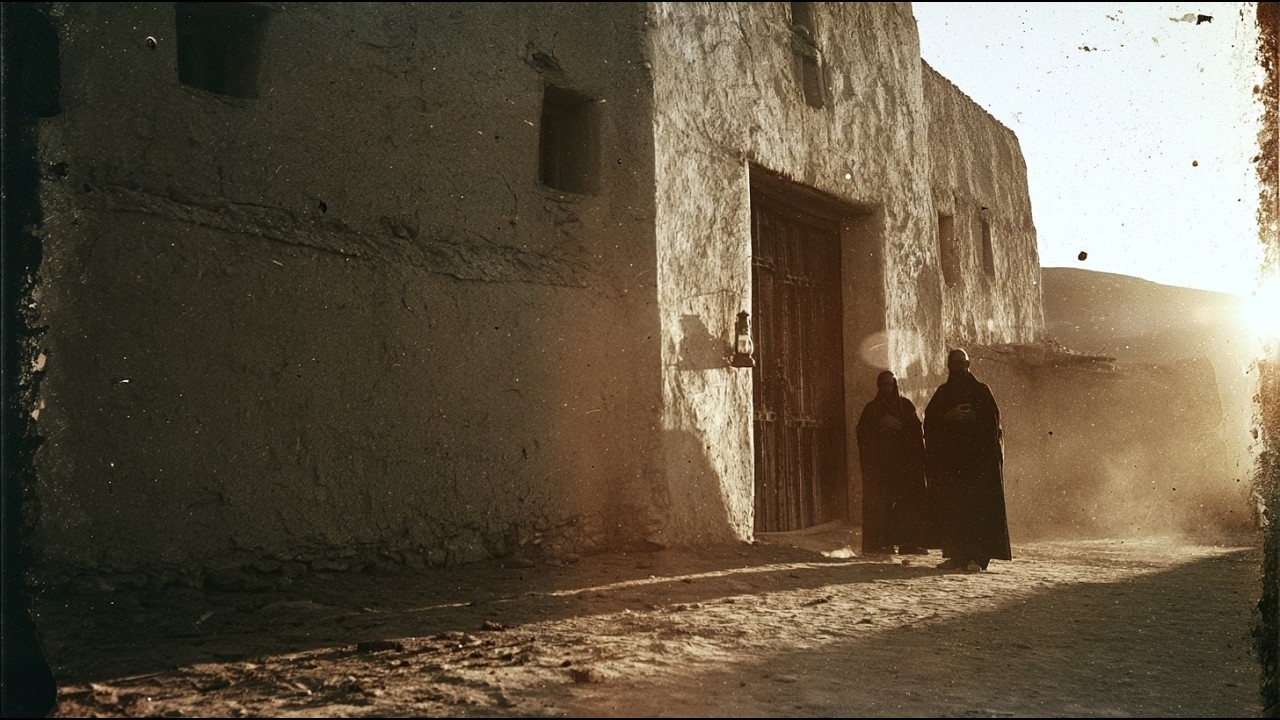
They called it the Monastery of San Onofre, named for a hermit saint said to have lived so long alone in the wilderness that he forgot the sound of any voice but his own. It sat at the end of a valley that had no other reason to exist, a low stone place the color of the dirt around it, with walls too thick for its size and windows too small and too high. From a distance you could almost miss it. It did not rise up.
It hunched, like something that had learned to keep low. Baca stopped the mules a good half mile out while the sun was still high. Voss asked why they were not going the rest of the way in. Baca said he would take him to the gate and wait while the surveyor’s business was done, but he would not be there past dark, not near that place, not for the wage they had agreed on, not for double.
Voss laughed, the way a young man laughs at an old man’s care. He wrote that down too, that he laughed. Later he wished he had not. The gate was answered by a monk named Brother Cassian, a broad man with a gray beard cut square and hands that looked like they had done real labor, not just turned pages.
He did not seem surprised to see a stranger. He seemed, if anything, tired in a settled way, the way a man is tired who has kept the same watch for a very long time and expects to keep it a while yet. He welcomed Voss in the name of the house, offered water and bread and a cell, and was courteous about all of it. Then, almost as an afterthought at the threshold, he told Voss the one thing the house asked of every guest.
When the bar goes across the door at sundown, it stays across until morning. No guest touches it. No guest goes near it after dark. Whatever the guest hears in the night, the guest stays in his cell and lets the brothers keep their watch.
Voss asked, reasonably enough, what a man might hear. Cassian looked at him for a moment, not unkindly, just carefully, the way you look at someone before you decide how much of the truth they can carry. “The wind,” he said finally. “The desert makes strange sounds at night.
New men aren’t used to it. ”
He turned and led the way inside. Voss noted in his book that Cassian had waited half a breath too long before he said the word “wind. ” As if there had been another word first, and he had swallowed it down and picked up a safer one.
Baca did not come in. He camped past the half-mile mark where the ground rose a little and built a fire that Voss could see as a small orange point from the high window of his cell. It comforted him more than he would have admitted. A man out there in the ordinary world, warming his hands, waiting for morning like a sane person.
The monastery ran the way you would expect, and also not. There were nine brothers when Voss counted, plus the man they called Father Otilon, the prior. Otilon was ancient and nearly blind and moved through the halls with a hand on the wall and a stillness about him that made the younger men lower their voices. There was Brother Sabas, thin and quick, who kept the small garden they had coaxed out of the dead soil.
There was Brother Evaristus, who did the cooking and had a laugh he was not supposed to use during the silent hours but used anyway. There was a young one, Brother Peregrine, not long into his vows, still soft in the face, still looking at the older men as if they held some answer he was close to earning. And there was the oldest of all of them after the prior, a brother named Onesimus, who Voss never once heard speak, and whose cell was the one nearest the door. That last detail bothered him before he understood why.
The oldest, quietest, most watchful of them, sleeping closest to the way in. The days were plain. The brothers rose in the dark for prayer, worked through the heat, ate little, spoke less. Voss went out with his instruments and did the work he had come to do, measuring the valley, chaining off distances, sighting the ridgelines.
He liked the labor. It kept his mind on true things. Numbers do not lie to you. A theodolite does not wait half a breath before it tells you an angle.
The first night he heard nothing. He wrote that too. Almost disappointed. Nothing.
Wind, as promised. Slept well. The second night changed everything. When the knocking finally stopped, near dawn, Voss went back to his cell and did not sleep.
In the morning he walked out to the fire and found Baca stiff and cross with a bad night’s sleep, full of complaint about the cold. When Voss asked him carefully whether he had come to the monastery in the night and knocked, the old man went very still. Then he crossed himself and said no. He had not moved from his fire, not once, not for anything, because he knew better.
Any man who had lived in that country knew better. And if the surveyor had a grain of sense, he would finish his measuring and they would be gone from here. Voss did not finish that day. He should have.
He wrote later that he knew even then that he should have packed his chains and his glass and gone. But there is a thing in some men where fear and wanting to know get tangled up until you cannot tell them apart, and the wanting wins. He needed to understand. A man who spends his life measuring the world does not like a thing that will not be measured.
That evening he went to Cassian and asked him plainly, “What is it? What comes to the door? ”
Cassian was mending a sandal by the last of the light. He did not look up.
He said the brothers had a saying for it, an old one, older than the house maybe. He said the desert is empty, and things that are empty want to be filled. And the oldest of the empty things learned a long time ago that the fastest way into a walled place is not the wall, it is the door. And the fastest way through a door is not to break it, it is to be let in.
So it does not push, it does not force. It stands outside in the dark and listens all night, every night, to the men inside. It learns their voices. It learns their griefs.
It learns the names they say in their sleep and the names they never say at all because it hurts too much. Then it wears those things like a coat and comes to the door and asks, politely, in a voice you love. Because a wall it cannot cross, but an invitation, an invitation it can walk right through. Voss asked how long the house had kept this rule.
Cassian said longer than any of them. The walls were built by men whose names were lost, and the rule was already old when the first stone went up on the ones they knew. There had been houses in the desert since the first hermits went out to be alone with God, and the thing that comes to the door was already old when they got there. It had learned patience the way a river learns stone.
It could wait a hundred years for one open door. It had nothing but time. The brothers had only the rule, and each other, and the long habit of not answering. Then Cassian set down his sandal and looked at Voss with something close to pity.
The danger, he said, was never the ones who did not believe, the ones who laughed the way Voss had laughed at the gate. They stayed in their cells and shivered, and in the morning they left and told no one, and were fine. The danger was the ones who loved someone. Because the thing at the door saves its best voice for them.
Voss stayed a third night, and a fourth. The third night, it was a woman. Voss did not know her, but he heard Brother Sabas weeping in his cell like something inside him had come loose. The voice at the door was calling him by a name only one person had ever used, and that person had been in the ground for thirty years.
The brothers prayed him through it. Voss heard the older voices gather around the younger man’s grief like hands cupped around a flame in wind. By morning, Sabas was gray and silent, but he was still inside. Still one of them.
The fourth night it came for Voss. He had braced for a stranger’s voice, or Baca’s again. He had not braced for the voice it chose. It was his brother, Emmett Voss, older by two years, dead by six, taken by a fever in three days while Leland was two hundred miles away on a job he told himself he could not leave, and got home in time only to help carry the box.
He never forgave himself the arithmetic of it. Two hundred miles. Three days. If he had started sooner, if the work had mattered less.
And now Emmett was at the door, not begging. That was the cruelty of it. The thing had learned him. Emmett had never begged for anything in his life, so the voice at the door did not beg either.
It was easy, warm, a little amused, the way Emmett always was, teasing his younger brother for taking the world so seriously. It said, “Lee. Lee, look at you, hiding in a stone box with a bunch of monks. What are you afraid of?
It’s just me. Come, let me in and we’ll talk. There’s things I never got to say to you. There’s things you never got to say to me.
I know you’ve been carrying it. Come to the door, Lee. Let your brother in. ”
Here is the part Voss wrote with a shaking hand days later, because he wanted the truth in the record even though it shamed him.
He was not tricked. Not almost fooled. He knew what it was. Cassian had told him, and he had seen Baca’s fire with his own eyes, and he understood with the front of his mind that the thing at the door was not his brother.
And he wanted to open it anyway. Part of him, the buried part, the part that had done the arithmetic every night for six years, did not care whether it was really Emmett. That part just wanted the door open. Wanted one more minute.
Wanted to hear the end of the sentence his brother had never gotten to finish. It whispered to him that maybe the monks were wrong. Maybe it was Emmett somehow. Maybe love was stronger than their old rule.
What was the harm in just looking? He was in the hallway. He did not remember leaving his cell. He was in the hallway with his hand out toward the dark, and the voice was so close now, so glad, so much his brother, saying, “There you are.
There you are. ” His fingers were reaching for the bar. An old hand closed over his wrist. It was Onesimus.
The silent one. The oldest brother after the prior, the one whose cell was nearest the door. He had been there the whole time. Of course he had.
That was his watch. That was why they put the oldest and most tested of them nearest the way in, because the door needed a guard who had already been to that place in himself and come back. Onesimus did not speak. He only held Voss’s wrist and looked at him.
And Voss looked into that ancient, ruined face and saw plain as morning that this old man had once stood exactly there. Wanting exactly this. Hearing his own beloved voice on the other side of the wood. And had not opened it.
And had spent every night since standing guard so that no one else would. Behind them the whole house was praying. Father Otilon’s cracked old voice leading, all the others under him. The words were not fancy.
They were the plainest words there are, the ones you learn as a small thing and never quite lose. The sound of them filled the hall and pressed against the door like a second wall. Slowly, slowly, Voss’s arm came down. The voice outside changed just for a moment, at the very end, when it understood it had lost him.
The warmth went out of it, and something else came through. Something that was not Emmett and had never been Emmett, and was not sad or cold or lonely at all. It was only hungry. It made a sound at the door that Voss would not describe, that he said in his book he could not describe, that he wrote there were no letters to spell it.
Then it was quiet. The quiet lasted, and the gray light came up the eastern wall, and it was morning, and he was alive and inside. He left that day. Finished nothing.
Packed his glass and his chains with hands that would not hold steady and walked out to where Baca was already saddling the mules without being asked, because the old man had taken one look at his face and known. At the gate, Cassian saw him off. Voss asked the question he had been carrying since the first night. What happened the once?
The time it got in. Because a rule that old and that absolute is never written for a thing that has not happened. Rules like that are written in blood, or in whatever is worse than blood. Cassian was quiet a long time.
Then he said there had been a brother a long way back, before even Onesimus, before the prior. A young one who heard his mother’s voice at the door one winter night and could not bear it. And he opened it. And what came in was not his mother.
Cassian did not say what happened after. He said only that the house had been empty for a long stretch of years following, and that when men came again to live there, they found the door barred from the inside and every cell empty. No bones. No sign.
Nothing at all. Except that someone in that empty house had gone around in the last of whatever time they had, and carved the same words over every doorway, deep, over and over, as if to hold on to them. “Do not open. It wears the ones you love.
”
Then Cassian did something Voss had not expected. He reached out and put his broad, rough hand on the surveyor’s shoulder. He said, “You heard your brother. ”
Voss said, “Yes.
”
“Then here is what you take from this place,” Cassian said, “since you’ll take nothing else. It will follow the voice, not the man. It found your brother’s voice inside you, and it can find you again. Wherever there’s a door and a dark and a grief you haven’t set down, it doesn’t need this valley.
It only likes it here because we’re easy to find and slow to leave. But it goes where the loved dead go. And the loved dead go everywhere. So learn the rule.
Carry it out with you. When the knock comes at the wrong hour and the voice is one you’d give your soul to hear again, you let it knock. ”
Voss rode out. Baca never looked back once.
Voss looked back only at the top of the rise where the fire had been and saw the low stone house hunched down in the valley, the color of the dirt around it, keeping its watch, hunched over its old rule like a man over a candle. Then the trail turned, and it was gone. He went back to his ordinary life. He filed a report on the survey, incomplete, took the loss of pay, and never once explained why.
He married, some years on, a patient woman named Iris, who learned early not to ask about the nights he woke at a certain hour and lay very still and would not say what he was listening for. He grew old in a house with a good stout door, in a town with electric light and streetcars and every ordinary comfort the new century could offer. By every account, he was a quiet, decent, unremarkable man. Except his wife told her sister once, years after Voss was gone, one thing about him she had never understood.
Sometimes, late, there would come a knock at their door. Only ever late, only ever at that certain hour. Three at a time, and then a pause, and then three again. Her husband would wake and sit up in the dark and not move to answer it.
If she stirred to go and see who on earth it was at such an hour, he would take her wrist gently, the way you stop someone from stepping off a curb into traffic they have not seen, and shake his head. They would sit there together in the dark while the knocking went on, three and a pause and three, until at last it stopped. In the morning there would be no one. No tracks in the dust of the step.
Nothing. She asked him about it exactly once, early in their marriage, asked who it was, who kept coming and knocking and never being let in. Her husband, who was such a plain and gentle man, looked at her with an expression she never saw on him any other time in all their years, and said only that it was no one. That it sounded like his brother sometimes.
That it was very good at sounding like his brother. And that she was never, ever, for any reason, to open the door in the night, no matter whose voice she heard on the other side of it. Especially, he said, if it was his. He made her promise.
She promised, and she kept it. She told her sister she was glad she had kept it and would not say why, and changed the subject, and never spoke of it again. Leland Voss’s field book found its way, the long, slow way such things do, into the papers of the territorial survey office, and from there into a box, and from there to the county where the old monastery stood. The house itself was gone by then, fallen in or emptied out, depending on which account you believe.
When men went looking in the early part of the century to settle the question, they found the walls standing and the roof caved, and no sign of the brothers who had kept it. No bodies. No graves. The door lay flat in the dust, off its hinges, thrown down from the inside or the outside.
No one could say which. And carved over every doorway of that ruined place, deep and more than once, worn but still readable, the same handful of words. The county filed the whole matter under a single tidy line, the way the law likes to, a word that closed the box and let everyone sleep. They called it abandonment.
Abandonment, as if those men had simply grown tired of their hard bare lives and walked away one morning into the ordinary world and left the door open behind them. But whatever else is true, one thing is certain. They would never have left the door open. Not those men.
Not for anything. That was the one thing they would never do. The door was open when they found it. And those men would sooner die than open it.
So who opened it? And what walked out?
