On the fourteenth of February 1925, in a house in Washington, a woman of forty-one gave birth to her only child and named the girl Paulina Longworth. The child carried the name of the man who would raise her, but on the weight of the evidence that has survived, that man was almost certainly not her father. Her father, the historians would conclude eight decades later, was a sitting United States senator from Idaho. The husband, a future Speaker of the House, took the child in and raised her as his own, without ever asking anything the world could hear.
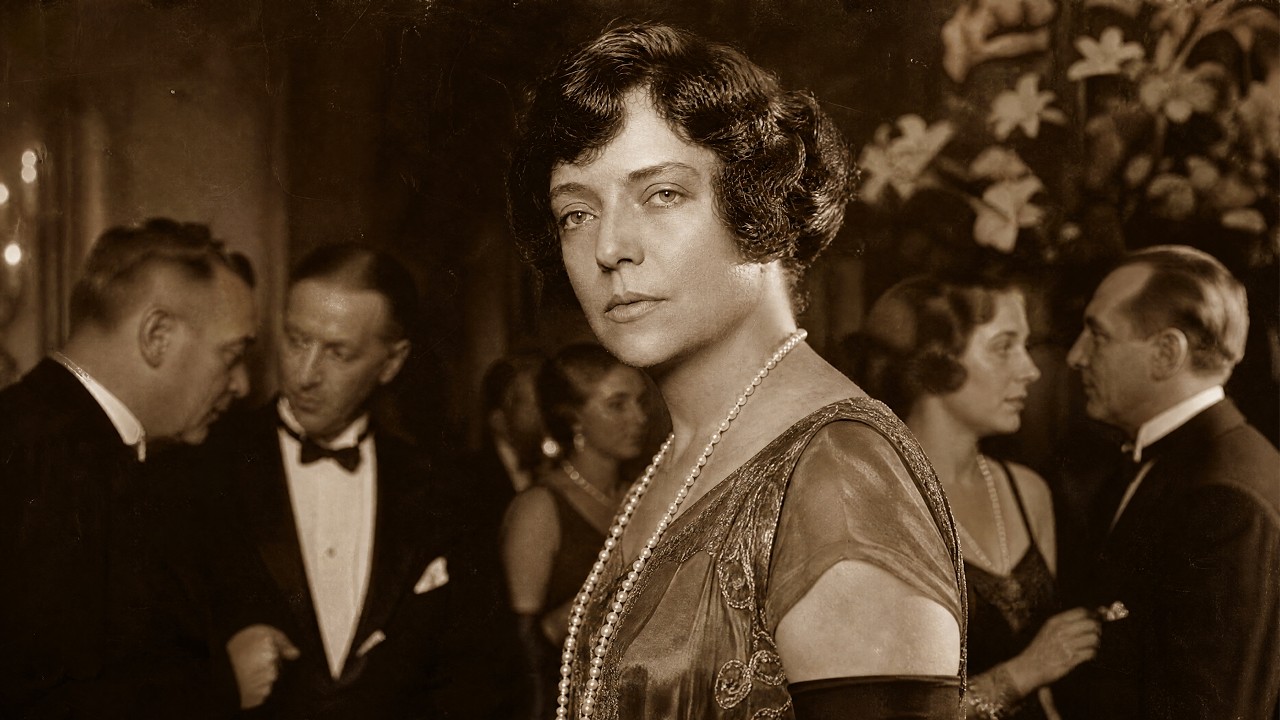
The woman at the center of it was Alice Roosevelt Longworth, daughter of one president, wife to the second most powerful man in the Congress, and intimate of a third. She would hold the truth of that Valentine’s morning for the rest of her long life, and it would take the country eighty years to learn what Washington had only ever whispered. The discipline that allowed her to carry that secret was forged before she could walk. She came into the world on the twelfth of February 1884, and within two days the two women who should have raised her were dead.
Her mother was Alice Hathaway Lee Roosevelt, twenty-two years old, married to a young New York assemblyman named Theodore Roosevelt. The birth went well enough, but hidden behind the ordinary strain of the pregnancy was an illness that was killing the mother even as she delivered her daughter, a disease of the kidneys generally blamed for her death. On the fourteenth of February, in the family house on West Fifty-Seventh Street in Manhattan, the young mother died. In the same house, on the very same day, Theodore Roosevelt’s own mother, Martha Bulloch Roosevelt, died of typhoid fever.
A husband lost his wife and his mother within a single span of hours, and a newborn girl lost in one stroke the entire world she had just entered. Theodore Roosevelt’s response set the emotional weather of his daughter’s whole childhood. In his diary for that day he drew a single large mark across the page, a heavy crossed line, and beneath it he wrote that the light had gone out of his life. Then he did something that would shape the girl far more than any words.
He closed the subject. He essentially refused ever to speak of his first wife again, left her out of the autobiography he would later write, and did not encourage his daughter to ask about the mother whose name she carried. The household followed his lead. The child was called Baby Lee in those first years, and the woman she was named for became the one topic the family would not discuss.
Into that silence stepped the person who actually raised her. Theodore Roosevelt, shattered and restless, handed the infant into the care of his elder sister, Anna Roosevelt, known in the family as By and later as Auntie By. It was By who gave the motherless baby her earliest steadiness, and Alice never forgot it. Late in her life she said that there is always someone in every family who keeps it together, and that in hers it was Auntie By.
The line is affectionate and revealing, because it locates the warmth of her childhood not in her famous father but in the aunt who filled the space he could not. Her father did not stay a widow long. On the second of December 1886, when Alice was two, Theodore Roosevelt married his childhood friend Edith Kermit Carow, and the little girl was brought into a new household that would soon fill with other children. Five half-siblings arrived across the following years: Theodore Junior, Kermit, Ethel, Archibald, and Quentin.
Alice grew up among them at Sagamore Hill on Long Island as the eldest and the different one. Edith asked to be called Mother, and Alice complied. Yet the sense of being the child of a marriage no one discussed never fully left her. The standard reading of those early years is that Alice never felt entirely wanted in her own home.
The eldest child, she belonged to the marriage no one would name. But it would be easy, and wrong, to tell this only as a wound. Alice herself, looking back from old age, was generous about it. She wrote that being the child of another marriage was a simple fact of her life, and that her stepmother coped with it with fairness and charm.
The honesty of her own account matters, because it shows a woman who refused to be only a victim of her beginnings, even when she had every invitation to be. But the fact underneath the grace was real. She was the living reminder of the wife no one would name, and a child learns fast in a house like that. She learns that some truths are kept behind a closed door, that a family can decide together and without a word what will and will not be spoken aloud, and that silence is not the same as absence.
There is one more turn of the knife in those first years, and it is the name. The baby was called Alice, the very name of the mother who had died bearing her, so that the child was a walking reminder of the loss no one would discuss. She grew up as a living memorial to an absence, carrying in her own person the grief her father had sealed away. There was a physical mark on those years as well.
From roughly the age of ten to the age of thirteen she wore braces on her legs, running from ankle to knee to correct a weakness in her feet and legs, and the vigorous outdoor life her father prized could frighten a girl so equipped. She was not the effortless young athlete the Roosevelt name conjured. She was a watchful, clever, slightly set-apart child, learning to manage a world that had handed her a famous name, a dead mother she could not ask about, and a body that did not always cooperate. Out of all of it she assembled the single lesson that would organize her entire life.
She had grown up as the one subject her house would not discuss, and rather than be crushed by that silence she studied it. She came to understand earlier than almost anyone around her that control over what is spoken and what is withheld is a form of power in itself. The girl who was the family’s unspoken fact would grow into the woman who decided what an entire country was permitted to know. By seventeen she was the most photographed young woman in America, and she had already worked out that attention was a currency she could spend.
Her father became president of the United States on the fourteenth of September 1901, when an assassin’s bullet killed William McKinley and lifted Theodore Roosevelt into the White House. The awkward, watchful girl from Sagamore Hill walked into the most watched house in the country at exactly the age when a young woman is most closely scrutinized, and instead of shrinking from the gaze she turned and met it. The press named her Princess Alice, and the country followed her the way a later age would follow film stars, for her personality rather than for any office she held. She gave them a great deal to follow.
She smoked cigarettes in public at a time when respectable women did not, and the story spread that when her father forbade smoking under his roof, she simply climbed onto the roof of the White House and smoked there. She bet on horse races. She carried a pet garter snake she named Emily Spinach, green as spinach and, by the joke of the day, as thin as a certain aunt of hers, and she was known to pull it from her bag at parties. Each of these was a small scandal, and together they made her a national character: the daughter who would not be told what to do.
Her father felt the force of it directly. The line that survives from those years, reported from the White House, has him telling a visitor that he could either run the country or attend to Alice, but that he could not possibly do both. The exact wording has drifted between tellings and should be treated as approximate, but the substance is well attested, and it captures the truth of the situation. A president who bent the nation to his will could not govern his own eldest daughter, and she had discovered at seventeen that being ungovernable was itself a kind of power.
A shade of soft blue-gray associated with her became a national craze known as Alice Blue, fixed in the popular memory by a song called “Alice Blue Gown. ” A young woman had become a color, a fashion, a headline, a habit of the whole country’s attention. Songs were written about her, her clothes copied, her sayings repeated, her movements followed by newspapers that knew their readers wanted her. She was, in the plainest sense, one of the first modern celebrities the United States ever produced, famous for being herself rather than for any office or deed.
And she grasped the nature of that fame from the inside, as a thing she could shape and steer. The girl who had been the unspoken fact of a quiet house had become the most spoken-of young woman in a loud and watching country, and she had done it deliberately, by refusing every instruction to behave. The deeper thing she was learning was that this attention could be put to use. In the year 1905, her father sent a large congressional delegation across the Pacific to Asia, led by his secretary of war, William Howard Taft, and Alice went with it.
The mission traveled to Hawaii, Japan, the Philippines, China, and Korea, and everywhere it went the crowds came less for the officials than for the president’s famous daughter. She served as an informal ambassador, a piece of living goodwill, and she understood the assignment perfectly. The most repeated story from the voyage has her jumping fully clothed into the ship’s swimming pool and coaxing a congressman in after her, a stunt that delighted the newspapers back home. The theatrical details of that scene have the polish of an oft-told tale, but the fact beneath it is solid.
Her celebrity had become an instrument of American statecraft, and she was the one wielding it. Consider the arithmetic of the era, because it makes what she was doing far more remarkable. A woman in 1905 could not vote. The professions were almost entirely shut to her.
A young woman of Alice’s intelligence and ambition had, in the formal sense, no path to power at all, no office to seek, no ballot to cast, no career to climb. The only influence on offer ran through the men she was attached to and through the public’s regard for her, and that second channel, the regard of the public, was the one she had seized with both hands. She had taken the single instrument an ambitious woman of her time was permitted, her own fame, and she had made herself impossible to ignore across an entire nation and useful to the government of it. None of this was accident, and none of it was mere rebellion for its own sake.
The watchful child had become a calculating young woman who understood the machinery of image from the inside because she had grown up inside a president’s household and a former president’s before that. What she needed next was an arena large enough to spend all of it: a marriage and a role that would take everything she had learned about attention and constraint and demand more. The man who would give her that arena was already in the House of Representatives, already watching her, already known for the appetites that would test her for the rest of her life. On the seventeenth of February 1906, she married inside the White House, and the wedding was a coronation in all but name.
The groom was Nicholas Longworth III, a Republican congressman from Ohio, about fourteen years older than she was, and the ceremony in the East Room drew the fascinated attention of the entire country. The most famous young woman in America was marrying from the president’s own house, and the newspapers treated it as the national event it was. For a young woman who had spent her life being watched, it was the most watched day of all, the moment her celebrity and her father’s power met under one roof and were sealed. The man she married was a study in contrasts, and every contrast mattered.
He was born on the fifth of November 1869 into one of the oldest and wealthiest families of Cincinnati, Ohio. The Longworth fortune reached back to his great-grandfather Nicholas Longworth I, who had built it in the first half of the nineteenth century out of Cincinnati real estate and out of Catawba wine, and who was remembered as one of the richest men of his city and as a father of the American wine industry. A precise figure for the family’s wealth has not survived in any reliable form, and it does not need one. What the record establishes is the scale of the thing: an old and dominant fortune in a major American city, the kind of money that had been powerful for three generations before Alice ever met its heir.
Nicholas Longworth himself was cultivated and charming, a gifted violinist, and, by the well-attested reputation that followed him through his whole public life, a heavy drinker and a pursuer of women. The marriage that began in the glow of the East Room would be marked from fairly early by infidelity on both sides and by his drinking. That was the private truth underneath the public splendor. The woman standing at that altar was not a naive girl walking blind into disappointment.
She had grown up watching how public marriages and private conduct were held apart. In 1906, a married woman across much of the country still lived under the long shadow of coverture, the old legal doctrine that folded a wife’s identity, her property, her earnings, and her standing before the law into her husband’s. American women would not win the vote for another fourteen years. A bride, however famous, was marrying into an order that expected her to vanish into her husband’s name and career.
That was the arrangement Alice entered at the age of twenty-two, and the whole of her life afterward would be a steady, deliberate refusal to meet its expectation. She kept her own fame, her own politics, and in time her own secrets inside a marriage the era had built to erase her. They were married for a quarter of a century, and by the accounts that survive, both of them drank and both of them strayed and both of them stayed. This is the hard, unsentimental center of the Longworth marriage, and it has to be stated plainly because the whole later drama grows directly out of it.
Nicholas Longworth’s pursuit of other women ran through the marriage as a settled pattern, an accepted feature of his character among the people who knew him. His drinking was part of the same picture. And Alice over the years was not the passive casualty of any of it. She built a life and in time a relationship of her own alongside the marriage, and the union held together not through fidelity but through a kind of mutual tolerance that let each of them survive the other.
It would be a mistake to read this as simple misery and an equal mistake to read it as a modern arrangement freely chosen. It was something harder than either. Divorce for people of their standing and their moment was close to unthinkable, a public catastrophe that neither the Roosevelt family nor the Longworth position could easily absorb. So the marriage became a structure to be managed rather than a romance to be repaired.
Alice brought to that management the exact skills of her girlhood. She had learned as a child that a household can hold an unspoken truth at its center and go on functioning around it. Now she lived inside such a household as an adult. The strain in the marriage was not only personal; it was political, and the politics cut to the bone.
Alice was her father’s daughter in temperament and in loyalty. When Theodore Roosevelt broke with the Republican Party to lead the insurgent Progressive movement in 1912, the fracture ran straight through her marriage. Her father was now the leader of a rebellion against the sitting Republican president, William Howard Taft, and her husband Nicholas Longworth was a regular Republican who stayed loyal to Taft and to the party. Husband and wife stood on opposite sides of the fiercest political fight of the year, and Alice did not soften her own allegiance to spare the marriage.
She stood with her father. The cost of that stand was immediate and public. In the three-way split that the Progressive revolt produced, Nicholas Longworth lost his seat in the House of Representatives in the election of 1912, going down to a Democrat named Stanley Bowdle by a narrow margin, and Alice had made no secret of standing with her father’s insurgency even as it split the party that had carried her husband. He would regain the seat in 1914 and rebuild his career.
But the episode revealed something permanent about Alice. She would not subordinate her politics to her husband’s convenience, even when the price landed on the household she shared with him. By the middle of the 1920s, her husband stood at the head of the House of Representatives, and Alice stood at the head of Washington. Nicholas Longworth had rebuilt everything the 1912 disaster had cost him.
In 1925 he became Speaker of the House of Representatives, the thirty-eighth man to hold the office, and he would keep it until 1931. The Speaker presides over an entire chamber of the Congress, controls its business, and stands near the very summit of the elected government. The charming, unfaithful violinist Alice had married was now one of the most powerful men in the country. But the title that mattered most in those years was not the one she held by marriage.
It was the position she had built for herself, and it had no official name. Alice Roosevelt Longworth had become the reigning hostess and social power of Washington, the woman whose drawing room mattered, whose approval carried weight, and whose ridicule could wound. Politicians came to her table because being received by Alice meant something, and being cut by her meant something too. In an age when the real business of Washington was still done in drawing rooms and at dinners as much as in committee rooms, the woman who controlled the most desirable table in the city controlled a genuine node of political life.
Alice decided who was brought together and who was kept apart, whose company was sought and whose was quietly declined. She traded in the one commodity that never loses value in a capital: judgment. Her wit was the instrument, sharp, quick, and quotable, and a line from Alice could travel across Washington by nightfall and fix a man’s reputation in place. And it was precisely in these years of her fullest public standing, married to the Speaker, queen of the Washington salon, watched and quoted and deferred to, that the most private and most dangerous chapter of her life was quietly opening.
The same drawing rooms where she reigned held a growing awareness of a particular senator who was very often in her company. The senator was from Idaho, and among the people who watched such things, his name and hers had already begun to travel together. His name was William Edgar Borah, and he was a figure of the first rank in American public life. Born on the twenty-ninth of June 1865, he had come to the Senate from Idaho in 1907 and would hold his seat until his death, the longest-serving senator in the history of his state.
For roughly twenty-five years he chaired the Senate Foreign Relations Committee, one of the most powerful positions in the entire Congress, from which he shaped the foreign policy of the United States. He was the great isolationist of his age, the leading voice against Woodrow Wilson’s League of Nations, and his oratory earned him a title that stuck for life. They called him the Lion of Idaho. This was the man whose life became entangled with Alice Roosevelt Longworth’s.
According to the research of her principal biographer, the relationship probably began sometime after March of 1920, when Alice was in her middle thirties and Borah was in his middle fifties. It was a connection between two people at the very center of Washington power, and it ran for years. Among the insiders of Washington, the political and social circle in which Alice moved, the relationship was widely known. It was talked about, understood, traded as the kind of open secret that a small governing class always seems to carry.
But it did not reach the general public as established fact. And this gap between what the insiders whispered and what the country knew is the exact space in which Alice operated. The evidence of how openly the insiders spoke survives in the jokes, and the jokes are worth handling carefully because they are anecdotes about private wit and never confessions of anything. In Alice’s own circle, the situation was encoded in wordplay.
Friends are said to have referred to it as “Aurora Borah Alice,” folding the senator’s name into the shimmer of the northern lights and her own name into the pun. Alice herself, quick and fearless as ever, is reported to have joked about the coming child that she ought to name the baby Deborah, so that the initiated would hear the senator’s name sitting inside it. These lines are the banter of a woman audacious enough to laugh at the very thing she was concealing. But they prove only that the circle knew and joked.
They are not admissions, and nothing direct from Alice ever settled the matter on the public record. When the baby came, Washington remembered the joke. Paulina Longworth was born on the fourteenth of February 1925. Alice was forty-one years old, and this was her first and only child, arriving after nearly two decades of marriage.
The date carried a weight that no one could have designed. The fourteenth of February was the very calendar day on which, forty-one years earlier, Alice’s own mother and her grandmother had both died. The day that had emptied her own life at its beginning was the day that filled it with a daughter. The child was given the Longworth name, and the world received her as the daughter of Nicholas and Alice Longworth.
That is how it appeared, and that is how it was meant to appear. But the weight of the historical evidence, gathered and published long after everyone in the story was gone, indicates that Paulina’s biological father was not Nicholas Longworth. It was William Borah. At the time, in 1925, the truth of the child’s parentage was not public knowledge.
The affair had been rumored and joked about among the Washington insiders, yes, but the paternity of the baby, the specific claim that the Speaker’s wife had borne the child of the senator from Idaho, was not established public fact. It circulated at most as the kind of thing the knowing few believed, and the country never heard. And there is one detail that proves how completely the truth was held. Paulina herself grew up believing that Nicholas Longworth was her father, and she went on believing it into adulthood.
The person with the very greatest stake in the truth, the child at the center of it, was not told. To keep the truth of her daughter’s birth, Alice had to perform an unbroken discipline in the one city built to trade in exactly this kind of information. Washington ran on who knew what about whom, a place where private facts were currency and where a small class of insiders made it their business to know the things the public did not. Into that city Alice brought the single most exposing fact of her life, and she held it without a visible crack for decades.
The tools she used were the ones she had built across her whole life. The first was silence about the essential fact. Nothing direct from Alice on the truth of Paulina’s paternity exists on the public record. There is no letter of confession made public in her lifetime, no admission, no moment where she set the truth down where the world could read it.
What survives is the private banter, the jokes among the circle, and the arrangement itself: the child raised as a Longworth inside the Longworth marriage. The second tool was the very openness of her personality, which worked, paradoxically, as a kind of cover. Alice was famous for saying the outrageous thing out loud, for the sharp public wit, for a life lived in the newspapers. A woman so visibly candid, so willing to shock, is the last woman anyone suspects of holding the deepest secret of her life in perfect stillness.
The reputation for saying anything concealed the fact that she was, on the one subject that mattered most, saying nothing at all. She could even let her circle joke about the senator, because a joke that everyone shares looks like the whole truth, and no one goes looking behind a secret that seems already told. The hardest theater of all was the daily one, performed at close range in her own house. A public can be managed from a distance with a composed face and a careful word.
A child cannot. Paulina was there every day, watchful in the way children are, and the concealment had to hold not only in the ballrooms of Washington but at the breakfast table, across all the years of a girl growing up and sensing, as children do, the shape of the things adults will not say. That the secret held even there, even against the one witness with the most reason and the most chance to feel the fracture, is the final measure of how completely Alice governed it. The documented fact, the one at the very heart of this story, is that Nicholas Longworth took Paulina in and raised her as his own daughter.
Whatever the truth of her blood, and the evidence points away from him, the Speaker of the House accepted the child, gave her his name, and raised her within his family as his own. This is documented fact, the firm and uncontested center of the whole account. To be raised as Nicholas Longworth’s daughter was to carry one of the old and powerful names of American public life, to hold a place inside a wealthy and established family, and to possess a legitimacy that a child of the other man could not have carried openly in that era. In a time when the circumstances of a child’s birth could shadow an entire life, the Longworth name was a gift of standing, security, and belonging.
Nicholas Longworth extended all of it to Paulina, not for a moment but for the whole of the years he had with her. The question everyone wants answered is whether Nicholas Longworth knew that Paulina was not his biological child. And the honest answer is that no one can say for certain. The claim that he knew is the speculation of Alice’s biographer, a plausible inference from a marriage of mutual knowledge and open secrets, but it is speculation and not established fact.
The record does not contain his certainty. It contains his conduct. What is documented is that he raised Paulina as his own. Whether he did so knowing the truth is a question the historian raises and cannot close, and it must be left as a question, never asserted as an answer.
But notice how the uncertainty, held honestly, makes the act more moving rather than less. If Nicholas Longworth did not know, then he was simply a father raising his daughter. If he did know, as the biographer suspects, then his raising of Paulina becomes one of the quietest and most remarkable acts in the whole story: a man giving his name and his care to a child he had every reason to doubt, inside a marriage that had wounded him as much as he had wounded it, and never making a public word of it. Within nine years, she lost them both: the man who gave her child a name and the man the evidence says gave the child her blood.
The first to go was her husband. Nicholas Longworth died on the ninth of April 1931 in Aiken, South Carolina, of pneumonia, at the age of sixty-one. He had been Speaker of the House until that year. Alice was widowed at forty-seven, and she would remain a widow for the rest of her long life, another forty-nine years.
But the heaviest weight of that death did not fall on Alice. It fell on the child. Paulina was six years old when the man she believed to be her father died, and she lost him without ever knowing the truth of what he had been to her: a man who had chosen to raise her. The second man went nine years later.
William Borah died on the nineteenth of January 1940 of a brain hemorrhage at the age of seventy-four, still a senator, still the Lion of Idaho, having held his seat for thirty-three years. With his death, the other man bound into Paulina’s story was gone, the one whom the later evidence would name as her biological father. Within nine years Alice had lost both of the men at the center of the secret. She said little for the record about either one.
There was no public grief that opened the door to the truth, no confession offered in the license that mourning sometimes grants. The silence that had governed the secret in life governed it in death as well. She buried her husband, and nine years later the other man died, and through both losses Alice held the same discipline she had held for decades, giving the watching world nothing it could use to prove what it had only ever whispered. There is a particular loneliness in a grief that cannot be told, and Alice knew it twice over in that decade.
When a public figure dies, the people bound to him are allowed their mourning in the open. Alice was allowed only the portion the secret permitted. She could grieve Nicholas Longworth as a widow grieves a husband in full view, and she did. But the deeper truth of what the two men had been to her and to her daughter, the thing that would have made sense of her sorrow, was exactly what she could never show.
And so a part of each mourning had to be swallowed whole and carried alone. Paulina grew up believing the Speaker was her father, and her own life would be brief and hard and entirely her own. She was the child the whole secret had been built around. She grew up in a household that the record suggests was not a warm one, the only child of a mother whose genius was for the public performance of composure and whose warmth did not come easily.
She lost the man she believed to be her father when she was six. In the middle of the 1940s she married. Her husband was Alexander McCormick Sturm, born on the twenty-third of June 1923, a young man of real and varied gifts. In 1949 he did something that would outlast him by generations.
He provided the money and the design sense behind a new firearms company, co-founding Sturm, Ruger and Company with a gifted designer named William Batterman Ruger, putting up the startup capital and creating the eagle emblem that the company would carry for the rest of its history. It was a real achievement, and it should have been the beginning of a long life. It was not. Alexander Sturm died on the sixteenth of November 1951 of viral hepatitis at the age of twenty-eight, leaving Paulina a widow with a young daughter.
After her husband’s death, Paulina turned toward a faith her mother’s glittering, skeptical world had little use for, converting to Catholicism and finding in it a structure and a seriousness that the Washington of drawing rooms and sharp verdicts could not offer her. She gave herself to the raising of her small daughter and to volunteer work that asked nothing of celebrity. The best reading of the evidence is that she struggled in these years with depression and with alcohol, though that reading is one biographer’s interpretation and should be held as such rather than asserted as clinical fact. What is clear is that her life was hard and that she carried it with a seriousness of her own.
On the twenty-seventh of January 1957, Paulina died. She was thirty-one years old. The cause was an overdose of sleeping pills, a barbiturate overdose. How that death should be understood is genuinely uncertain.
Some accounts report the overdose without assigning any intent. Others describe it as a suicide. Others treat it as accidental or leave it undetermined. There is no single authoritative public verdict.
The only responsible statement is the careful one: Paulina died of a barbiturate overdose on that January day, and the sources are divided on whether it was intended. In her seventies, Alice took in the granddaughter Paulina had left behind. When Paulina died in 1957, she left a daughter, Joanna Sturm, born in 1946, and Alice, then in her early seventies, took the girl in and raised her. There is a quiet symmetry in this that the whole story has been moving toward.
The woman who had concealed the parentage of one generation spent her old age openly raising the next. Whatever had been hidden about Paulina’s birth, there was nothing hidden about Joanna’s place in Alice’s house. The two had not been close at first, and across the years they grew close, and Joanna became the companion of Alice’s final decades. Around that late domestic fact, Alice built the reign for which she is best remembered.
Freed of her marriage by widowhood and outliving nearly everyone who had shared her secrets, she became the acid-tongued queen of the Washington salon, a power in her own right for decade after decade. Presidents and senators of both parties sought her table across the middle of the twentieth century, because to be received by Alice Roosevelt Longworth was to be recognized, and to be cut by her was to be diminished. The instrument of that reign was the spoken line. She kept in her drawing room a cushion embroidered with the words that if you could not say something good about someone, you should come sit right there beside her.
It was a joke, and it was also a complete philosophy of her power. The span of that late authority is difficult to credit from the outside. Alice had first entered public life in 1901, in the age of horse-drawn carriages and her father’s larger-than-life fame, and she was still a courted power in the Washington of the 1960s and 1970s, in the age of television and the jet. She had been a household name under Theodore Roosevelt and was still being sought out and quoted by figures born long after her own celebrity began.
No office could have given her that. Offices change hands every few years. What Alice held she held for the length of her life because she had built it out of personality and judgment and name, the materials that do not expire with a term of service. And the secret she still carried, the truth of Paulina’s birth, had not surfaced even now.
Paulina was dead. Both men were dead. And still the fact of the child’s parentage stayed where Alice had always kept it, out of the public record. Alice Roosevelt Longworth died on the twentieth of February 1980 in Washington at the age of ninety-six, having outlived her husband by forty-nine years, William Borah by forty, and her only child by more than twenty.
She carried the secret to the grave. It would take the opening of the private papers and a historian willing to read them before the country finally learned what Washington had only ever guessed. In the year 2007, the historian Stacy Cordery published a biography titled Alice: From White House Princess to Washington Power Broker, drawing on family documents and on Alice’s own papers, and in it she established what the insiders had once whispered as documented historical fact. Paulina’s biological father was William Borah, not Nicholas Longworth.
The book that finally spoke it was a serious work of history rather than a whisper repeated. What had lived for generations as the belief of a knowing few became in those pages a conclusion drawn from the record and set down as the standard historical view. The irony sits at the heart of it. The written word, which Alice had governed so carefully in life, releasing only what she chose and holding back the rest, was in the end the thing that told the truth she had withheld, and it did so only after the papers had outlived her, and only when no one who could be wounded by them remained to be wounded.
Paulina was born in 1925. The truth of her parentage was established in 2007. For more than eight decades, across the whole life of the child and the whole long life of the mother and well beyond both, the fact stayed hidden, kept first by Alice’s living discipline and then by the simple silence of the grave. The truth once established reordered the way everyone in the story is remembered.
Nicholas Longworth, long remembered chiefly as a Speaker of the House, is now remembered also as the man who raised a daughter the evidence says was not his own, and that quiet act has become, for many who learn it, the most human thing about him. William Borah, the public moralist and Lion of Idaho, now stands with the private relationship the record documents set beside his rectitude. And Alice herself, long treated as a colorful footnote to her father, a wit and a personality and little more, has been reassessed as something far more serious: a woman who exercised real power in an age that denied women any legitimate form of it, and who kept the largest secret of her life with a mastery that outlasted the century. There is one more thing the papers restored, and it is the thing the whole account has tried to honor.
They restored Paulina to the center of her own story. For as long as the truth was hidden, Paulina was simply the daughter of Nicholas and Alice Longworth, a sad figure at the edge of a famous family. With the truth established, her life takes on its real shape and its real weight: the child born on the anniversary of a double death, given a name that was a kind of shelter, raised on a foundation she was never allowed to see, loved imperfectly, lost too early, and finally understood. The eighty-year silence had kept not only Alice’s secret but Paulina’s true story, and the opening of the papers gave the daughter back the truth of her own life long after she could know it.
The question her life leaves behind is what became possible for the women who came after her. Alice Roosevelt Longworth held no office and could hold none. She commanded no fortune structured in her own name. She cast no vote in any chamber, and for the first thirty-six years of her life American women could not vote at all.
By every formal measure the century used to record power, she should register as powerless. And yet she stood at the crossing point of the executive, the House, and the Senate, ruled the social life of the capital for six decades, and kept a secret so completely that the truth waited eighty years for the papers to open. Her power worked through the one channel her era left open to a woman, and she is the proof of how much that channel could carry. She could not seize an office, so she seized the thing offices depend on: reputation, attention, and the control of what people know.
And here the cost must be set down beside the mastery, because her story will not allow the one without the other. The same control that made her powerful required a child to grow up on a foundation she was never shown. The same silence that defeated the gossip of Washington also meant that Alice could never mourn either man in the full truth of what he had been to her, and that her own daughter lost the father she believed in without ever learning what that father had chosen to be. She proved what a woman denied every office could still command.
She also proved what that command exacts, and the bill for it fell, as such bills so often do, on the child. Return at the last to the fourteenth of February. It was the day her own life had been emptied when a mother and a grandmother died in a single span of hours and a father drew a heavy line across his diary and closed the subject forever. And it was the day, forty-one years later, when Alice gave birth to the daughter who would become the great secret of her life, a secret she would carry for another fifty-five years and take almost to the grave.
The girl who was born into a silence grew into the woman who commanded one, and the same calendar day held both the wound and the concealment, the beginning she could not ask about and the truth she would never tell. She had spent her whole life deciding what the world would be allowed to know, and she kept that authority to the end, longer than any office, longer than any man, longer than her own child. History records the men who held the offices, and it was slow to record the woman who held the story, because a power that works through silence leaves almost no trace, which is exactly why it is so easily missed and exactly why it worked so long. But the truth is in the papers now, and it changes the ledger.
The most powerful person in the room was often the one with no title at all, laughing, watching, and keeping her own counsel. The silence had never been weakness. It had been the strategy all along, and the strategy had won.
