The telegram reached the Berghof in the middle of the afternoon of July 20, 1944. From her room high in the mountain retreat, Eva Braun wrote to Adolf Hitler after hearing that the bomb had failed and that he was alive. The entire political content of her letter fit into a single sentence. She wrote that she lived only for his love, and that was all.
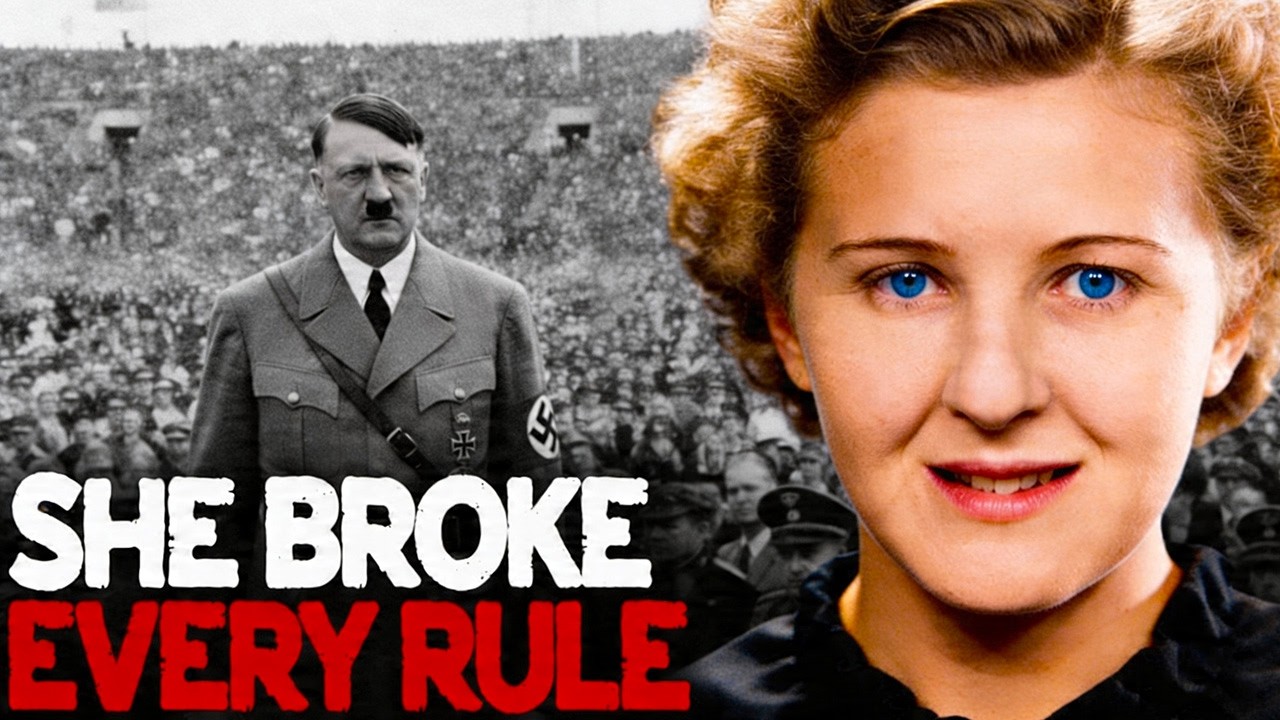
No ideology, no policy, no demand, no push. Just the quiet devotion of a woman who had spent sixteen years waiting for a man who would never give her the public life every other wife at the top of the regime took for granted. To understand how strange Eva Braun really was, you first have to understand what a Nazi wife was supposed to be. The regime was very specific about it.
From 1933 onward, the propaganda model was drilled into millions of German women: be fanatical, be fertile, be visible, obey. The NS-Frauenschaft, the party’s women’s league, preached austere Aryan motherhood through speeches, pamphlets, and newsreels. The ideal German woman carried children, not opinions. She wore simple dresses, not silk stockings.
She worked the land or raised the next generation. She did not sunbathe, she did not dance to jazz, and she certainly did not shop abroad. At the very top of this pyramid sat the wives of Hitler’s inner circle, and they were not decorative. They were load-bearing.
Magda Goebbels appeared on the cover of *Die NS-Frau*, the regime’s flagship women’s magazine, posed like a Madonna with her six children in matching white clothes. Gerda Bormann, married to Hitler’s chief of staff, bore ten children as living proof of the Aryan birthrate the Führer demanded from every German family. Emmy Göring hosted state receptions at Carinhall, the looted palace her husband had filled with stolen art. Henriette von Schirach operated as the consort of Vienna’s Gauleiter.
Annelies Ribbentrop ran the diplomatic calendar of the foreign minister’s household with such ferocity that Hitler himself half-joked she was the one who really ran the foreign ministry. These women were propaganda infrastructure. Their faces, their pregnancies, their dinner parties—all of it was engineered to tell ordinary German women what their own lives should look like. And once you know the canvas, every brush stroke of Eva Braun’s private existence starts to look wrong, because the Führer’s own woman broke every single rule on the poster.
The first rule she broke was the one nobody would ever expect her to break. Lina Heydrich joined the NSDAP in 1929. Her husband Reinhard, the future architect of the Holocaust, did not join until 1931. She was two full years ahead of him.
Annelies von Ribbentrop signed her membership card in December 1932, months before Hitler even took power. Magda Goebbels, Ilse Hess, Gerda Bormann—all of them were committed members, some before their husbands, some alongside. The party card was the entry ticket. Without it, you simply were not a Nazi wife in any meaningful sense.
Eva Braun never had one. For sixteen years, the woman who shared Hitler’s private rooms at the Berghof, who slept in the bedroom next to his, who appeared in hundreds of private films and photographs taken inside his mountain retreat, never once signed her name to a Nazi party membership book. Not in 1932, when she became his lover. Not in 1935, when she moved into his household.
Not in 1939, when the war started. Not ever. Every other woman at the top of the regime had built her identity around party loyalty—visible, documented, permanent. Eva did not even bother with the paperwork.
And Hitler never asked her to. She was not being groomed for a public role. She was being kept for a private one. While the ideological wives were staged as propaganda assets, Eva Braun was engineered into near total invisibility.
Magda Goebbels was a household face, her photograph on newsstands across Germany. Emmy Göring’s weddings and birthdays were national events; when Edda Göring was born, her father Hermann ordered five hundred aircraft to fly over Berlin in tribute. When Annelies von Ribbentrop hosted a diplomatic dinner, the newsreels covered it. Eva Braun appeared in exactly one published newspaper photograph near Hitler, at the 1936 Winter Olympics in Garmisch-Partenkirchen.
Even then, most Germans did not know who she was. The Reich’s press corps had standing orders not to name her, not to caption her, not to draw attention to her. Her face was scrubbed from the public record as aggressively as Magda’s was promoted into it. Albert Speer, who saw her constantly at the Berghof, left one of the starkest descriptions we have.
He said she was banished from the table the moment any cabinet minister or high-ranking official arrived. She would eat in another room or simply disappear for the evening, summoned back only when the guests had gone. She was, in Speer’s later words, the loneliest woman he had ever known. Most Germans only learned Eva Braun existed after Hitler was already dead.
In a regime that obsessed over every detail of its leaders’ public lives, that was not an accident. That was a choice. But while she was invisible in public, she was living a life no other Nazi wife was permitted to live. Eva Braun’s wardrobe at the Berghof ran to Ferragamo shoes ordered direct from Florence.
Her lingerie was monogrammed with the initials EB. She changed outfits up to seven times a day, according to the staff who served her. She chain-smoked—forbidden in Hitler’s presence, so she did it behind his back. She drank champagne.
She sunbathed nude in the mountain meadows around the Berghof, despite Hitler’s well-known public disapproval of female nudity and cosmetics. In 1939, with war about to break out, she took a shopping trip to Florence with her SS bodyguard in tow. She watched films that ordinary Germans were legally barred from seeing. Hollywood imports were restricted throughout the Reich, but the Berghof’s private cinema screened *Gone with the Wind* for her.
She danced to swing records that in any other German household could have triggered a Gestapo visit. Hold that image next to the propaganda. At the same moment Eva was sunbathing in silk and smoking imported cigarettes, the NS-Frauenschaft was preaching to millions of German women that cosmetics were decadent, jazz was degenerate, foreign films corrupted the Aryan soul, and a true German woman wore simple wool and bore as many children as her body could carry. The Führer’s own woman embodied every single vice the regime publicly condemned.
And he did not just tolerate it—he provided it. The shoes, the films, the champagne, the Florence trip, all of it came through him, paid out of his private funds or the party’s coffers. There was one more inversion, the biggest one of all. It had to do with what she did not produce.
The Nazi cult of motherhood was not rhetorical. It was institutional, measured, and rewarded like a military honor. The Cross of Honor of the German Mother—the Mutterkreuz—was awarded to roughly three million German women between 1939 and 1944. Bronze for four children, silver for six, gold for eight.
It was the regime’s domestic answer to the Iron Cross. On Mother’s Day, 1939, the very first recipient in Germany was Magda Goebbels, mother of six, pinned with the gold medal while cameras rolled. The message could not have been louder. Count the children among the wives of Hitler’s inner circle.
Gerda Bormann had ten. Magda Goebbels had six, plus a son from her first marriage. Margarete Speer had six. Annelies von Ribbentrop had five.
Lina Heydrich had four. Almost every top Nazi wife qualified for the silver or gold Mutterkreuz. Eva Braun had zero. What she had instead were two Scottish terriers named Negus and Stasi—a quiet act of rebellion, a deliberate miniature counterpoint to Hitler’s much-photographed Alsatian Blondi.
The Führer had his propaganda dog. Eva had her two small ones. Nobody saw them. Hitler, meanwhile, was godfather to Edda Göring.
He was godfather to Wolf Rüdiger Hess. He was godfather to Adolf Martin Bormann. He served as witness at the lavish 1935 wedding of Hermann and Emmy Göring, the ceremony that had aircraft flying over Berlin in formation. He signed the marriage register for Martin Bormann and Gerda in 1929.
He attended christenings, weddings, and anniversaries across the entire top tier of the regime. He never attended anything for Eva. Not a birthday, not an anniversary, not a public dinner. Nothing until the last forty hours of both their lives.
The ideological wives were not passive. They pushed. In January 1944, as Germany was losing the war, Gerda Bormann wrote her husband Martin a letter proposing a new law. She called it a *Volksnot-Ehe*, an emergency marriage of the people.
The idea was that worthy Aryan men should be permitted multiple wives, who would alternate pregnancies, so that, in her own chilling phrasing, Martin would always have a wife who was serviceable. Martin wrote back and told her the Führer thought exactly the same thing. In June 1943, Henriette von Schirach confronted Hitler directly over the deportation of Jewish women from Amsterdam, which she had witnessed firsthand. Hitler snapped back that she was sentimental, that she had to learn to hate.
She was banished from the Berghof for it, but she had pushed. Lina Heydrich wrote glowingly in her later memoir about the looted Czechoslovak estate her husband had been granted, an estate where she oversaw forced labor and, by multiple accounts, personally abused the prisoners working there. She described the whole arrangement as a fairy tale. Compare any of that to Eva Braun’s one documented political statement—the letter she wrote after the July 20 assassination attempt.
Recent scholarship has dismantled the old assumption that she simply did not know what was happening around her. She knew. She was not ignorant, just silent. And that silence was what made her useful to Hitler in a way none of the fanatics could ever be.
The final inversion played out in the same building on the same day. Berlin, May 1, 1945. The Reich Chancellery was burning above ground. Soviet shells were landing within walking distance of the bunker complex.
In the Vorbunker, one level up from the Führerbunker, where Hitler and Eva had died the previous afternoon, Magda Goebbels dressed her six children in white nightgowns. Helga, Hilde, Helmut, Holda, Hedda, Heide—every name beginning with H, in tribute to Hitler. A doctor was asked to sedate them first with morphine. Then Magda herself, the first recipient of the Mother’s Cross of Honor, the public face of Nazi motherhood, crushed cyanide capsules into each child’s mouth, one at a time.
She had written a farewell letter to her older son Harald, explaining that a world without National Socialism was not worth living in. And so she killed the six children the regime had demanded she produce. One floor below, Eva Braun was already dead. Thirty-three years old, no children, a cyanide capsule bitten the previous afternoon, feet curled up on a small sofa beside the body of the man she had waited sixteen years to marry.
They had been husband and wife for about forty hours. Two women, forty feet apart, one concrete floor between them, the same minute of the same day, embodying the two opposite poles of Nazi womanhood with a clarity no historian could have invented. The propaganda mother killed the children the regime demanded she produce. The apolitical mistress died without producing any.
And death was not the last thing that separated them. Because Eva died at thirty-three, she never faced what every other surviving Nazi wife had to face. Emmy Göring went through denazification and was sentenced to a year in a labor camp. Thirty percent of her remaining property was confiscated.
She was banned from the stage for five years and spent the rest of her life in a small Munich apartment. Magda Himmler was initially classified as a follower, then reclassified category two—incriminated—after evidence surfaced of her ideological commitment. She lost her pension and her voting rights and lived under a false name until her death in 1967. Lina Heydrich fought the West German state for a widow’s pension and won, then wrote a memoir defending her husband that she pointedly titled *A Life Lived with a War Criminal*.
Ilse Hess opened a boarding house in the Alps and spent the rest of her life campaigning for Rudolf’s release from Spandau prison. Their children became their own chapter. Gudrun Himmler, the daughter Heinrich Himmler adored, ran the Nazi aid network Stille Hilfe—Silent Help—for decades until she died in 2018 at eighty-eight, still unrepentant. Edda Göring sued the Bavarian state for restitution of her father’s seized property and continued defending him in interviews until her own death in that same year, 2018.
Wolf Rüdiger Hess campaigned publicly for his father’s release until his own death in 2001. Eva faced none of it. No trial, no memoir, no apartment in Munich, no children to defend her legacy or repudiate it. Her sister Gretl had one daughter, Eva Barbara, who died by suicide in 1971 at just twenty-six.
After that, the direct line was gone. Where the other Nazi wives became the first generation of postwar perpetrators—the ones who defended, denied, and taught their children to defend and deny—Eva became a silence, a vacuum in the historical record, the one woman at the top of the regime who never had to answer for any of it because she chose not to survive it. Every contradiction in this story connects to one truth. Hitler sacralized motherhood in public and kept a childless mistress in private.
He demanded visible loyalty from every German and hid his own woman for sixteen years. He staged elaborate propaganda weddings for his paladins, stood godfather to their children, and signed their marriage registers—and then married Eva Braun in a concrete bunker forty hours before his death, with two shell-shocked witnesses and a civil registrar dragged in from a nearby Volkssturm unit. The historian Heike Görtemaker, whose 2010 biography reshaped how scholars read Eva, put it most sharply. Eva was not an embarrassing deviation from the Nazi ideal of womanhood.
She was the private truth the regime spent twelve years telling ordinary German women was forbidden. The silk, the films, the champagne, the childlessness, the silence, the invisibility—that was what the Führer actually wanted for himself. Everything he demanded from his Volk was the exact opposite. Eva’s cousin Gertraud Weisker, who visited her at the Berghof in late 1944, left behind a single line that captures her better than any biographer has managed since.
She said Eva was the unhappiest woman she had ever met. Her last recorded words were spoken to Hitler’s secretary Traudl Junge, minutes before she bit into the cyanide capsule. She told Junge to try to get out, that she might yet make her way through the Soviet lines. And she asked her to give Bavaria her love.
In Hannah Arendt’s sense of the word, Eva Braun was the banal opposite of every other Nazi wife. Not the fanatic, not the mother, not the propagandist—just the quiet woman in the mountain house who watched American films and waited sixteen years for a man who was never going to love her the way she wanted.
