It was the summer of 1872, in the village of West Auckland, County Durham, in the north of England. The pit villages of that county were strung together like beads along the valley roads, each one alike in its stone terraces, its coal dust, its chapel bells, and its grinding poverty. The men rose before dawn to descend into the earth. The women took in washing, minded children, and stretched sixpence to last a week.
Life was hard and brief, and death was not unusual. Infants perished of fever. Adults succumbed to chest complaints. The doctor who served the district knew every family by name and was long accustomed to signing certificates for the young and the middling-aged alike.
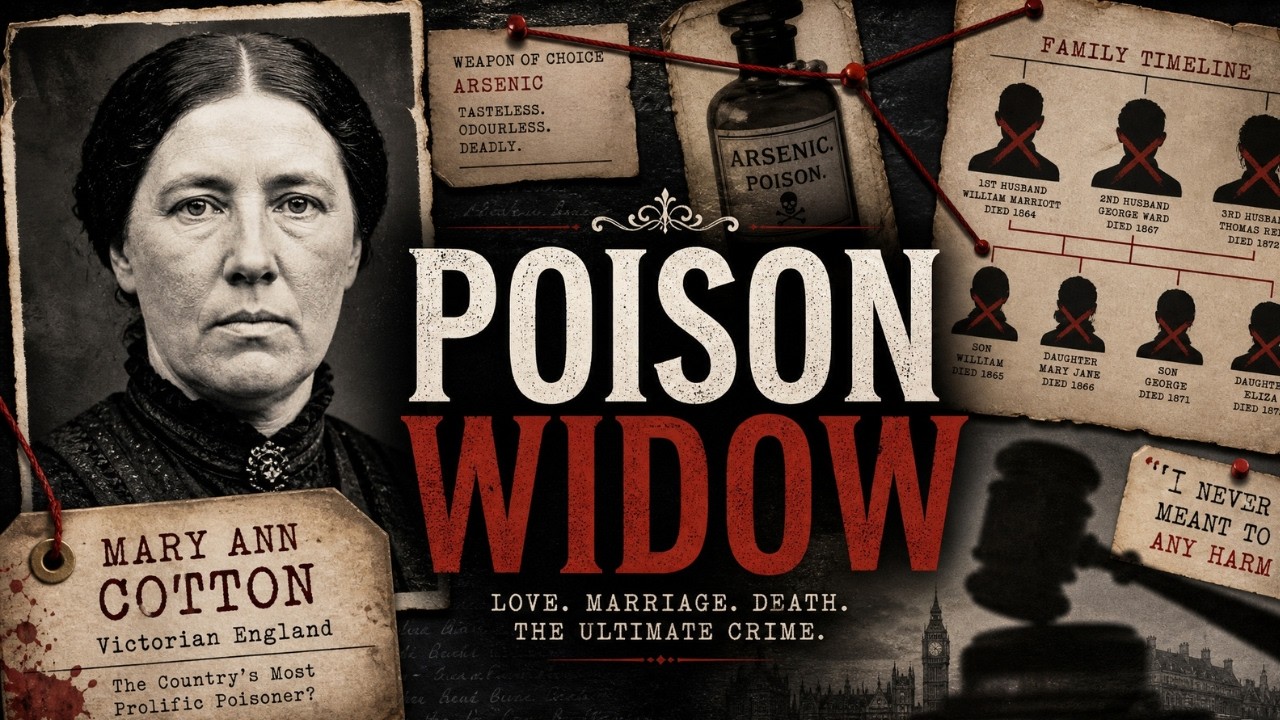
On Front Street, in a terrace of low houses blackened by the smoke of nearby furnaces, there lived a woman named Mary Ann Cotton. She was 39 years of age, stout in build, with dark eyes and a manner described by neighbors as respectable, even pleasant. She had lived in the village for less than two years. In that time, she had buried a husband, a lodger, and several of the children who had come with her from her previous home.
Nothing more had been thought of it. But what the doctor would discover before that summer was out would change everything. Mary Ann Cotton had not always lived in West Auckland. She had been born Mary Ann Robson in the village of Low Moorsley, County Durham, on the 31st of October, 1832, the daughter of a pitman named Michael Robson and his wife Margaret.
She was raised in the Methodist faith, and by all accounts was a capable, industrious girl who received some schooling, and in her early twenties trained as a dressmaker. She was considered handsome in her youth, and in 1852, at the age of nineteen, she married a colliery laborer named William Mowbray. In the years that followed, she bore William Mowbray five children. Four of them died in infancy.
She collected insurance payments on each one. In 1865, William Mowbray himself died of what was recorded as intestinal fever. Mary Ann collected on his policy as well. She remarried within the year, taking as her second husband a man named George Ward, an engineer.
He died in 1866, fourteen months into the marriage. The cause was noted as typhoid fever and paralysis of the bowel. She collected again. By 1866, she had moved to Seaham Harbour, where she found employment as a nurse at the Sunderland Infirmary.
There she met a widower named James Robinson, a shipwright with several young children. She moved into his household, and within weeks, three of his children were dead. His infant son died in February of 1867. His daughter died in April.
Another daughter followed in May. Mary Ann bore Robinson a child, who also died before it reached its first month. She washed, she mourned, she collected. Robinson himself survived only because he refused to take out a life insurance policy, a fact that seemed to frustrate his wife considerably.
She left Robinson in 1870, and eventually made her way north and west into the colliery country of Bishop Auckland. She entered the household of a man named Frederick Cotton as his housekeeper. By January of 1871, she had become his wife. Frederick Cotton had four children by his first marriage.
He was dead by September of that same year. His son, Frederick Jr. , died shortly after. Another son, Charles Edward, survived into 1872.
It was his death that would bring the scrutiny that so many previous deaths had not. In the spring of 1872, Mary Ann Cotton called upon the local assistant poor law overseer, a man named Thomas Riley, at his offices in West Auckland. She wished, she said, to take up a position as a nurse at a fever hospital nearby. She was willing and capable, and the work would suit her.
There was, however, one obstacle. She had in her care a stepson, Charles Edward Cotton, who was seven years of age. She could not take the post while the boy remained with her, and the workhouse would not take him without her also entering the institution. She said to Mr.
Riley, with a composure that he would later recall with some unease, that the boy would not be troubling her for long. She expected, she said, that he would soon go the way of the others. Mr. Riley was sufficiently struck by the remark to make note of it.
He did not, in that moment, alert the authorities. It was not yet clear to him what, precisely, she had meant. Within a fortnight, Charles Edward Cotton was dead. He had fallen ill on the 6th of July.
Mary Ann sent for the local general practitioner, Dr. William Kilburn, who attended the boy and found him suffering from the same gastric symptoms he had observed in the household before: the vomiting, the purging, the severe abdominal pain. The boy lingered for three days. He died on the morning of the 12th of July, 1872.
Dr. Kilburn attended to complete the death certificate, but found himself on this occasion hesitant. He could not satisfactorily account for the symptoms on natural grounds alone. The boy had appeared reasonably healthy just a short time before.
He declined to sign the certificate and instead requested that a postmortem examination be conducted. Mary Ann Cotton expressed to those who observed her no particular agitation at this. She made arrangements for the funeral to proceed and went about her daily business with the same steady, unremarkable manner that her neighbors had always known. It was Thomas Riley who went to the police.
He told Inspector William Henderson of the North Eastern Constabulary what Mary Ann had said to him in the spring, that the boy would go the way of the others. Henderson listened carefully. He took down the statement in full. The investigation had begun.
On the 14th of July, 1872, Dr. Kilburn conducted the postmortem examination of Charles Edward Cotton at the mortuary of West Auckland. He was assisted in this by his partner, Dr. Chalmers.
The boy’s stomach and its contents were removed and sealed in a glass vessel. An initial examination of the organs revealed marked inflammation of the gastric lining, consistent with irritant poisoning, though Dr. Kilburn was careful to note that natural causes could not yet be entirely excluded. The sealed samples were forwarded to Mr.
Thomas Scattergood, a lecturer in forensic medicine and toxicology at Leeds School of Medicine, and one of the most respected analytical chemists in the north of England. He received the materials on the 16th of July and set to his examination without delay. On the same day that the samples were dispatched to Leeds, a sergeant of the West Auckland Constabulary was sent to Front Street to make inquiries. He spoke with neighbors along the terrace.
Several recalled that Mary Ann had recently mentioned the boy’s deteriorating health with what one woman described as a quiet certainty, as though the outcome were already settled in her mind before it arrived. Another neighbor noted that she had never, in the time she had known Mary Ann Cotton, seen her weep for any of those she had lost. The widow herself was spoken to briefly. She received the sergeant in her front room and answered his questions without apparent nervousness.
She said that the child had been sickly, that gastric trouble had plagued the household before, and that she could not account for why this should be so. She expressed a wish for the matter to be resolved quickly, as she had been prevented from burying the boy properly and found the delay distressing. By the evening of the 16th, the house at number 13 Front Street had been placed under informal observation by the constabulary. No order of arrest had yet been made.
The evidence was circumstantial, the forensic findings incomplete. But the statement of Thomas Riley had been formally recorded. The names of Mary Ann Cotton’s previous husbands, children, and lodgers had been gathered from parish and insurance records in Sunderland and the surrounding districts. The list, when set down in sequence, ran to more than fifteen names.
Thomas Scattergood completed his analysis on the 22nd of July, 1872. His report, addressed to the coroner for the district of Southwest Durham, was precise and unambiguous. He had subjected the stomach contents and organ tissues of Charles Edward Cotton to the Reinsch test, a procedure established some thirty years prior for the detection of arsenic and other heavy metals. The results were positive.
Arsenic was present in the stomach, in the intestines, and in the liver of the deceased child. In his formal opinion, the arsenic detected was of a quantity sufficient to have caused death and was consistent with administration over a period of several days rather than in a single dose. He noted that the physical presentation of the boy’s final illness—the vomiting, the purging, the intense abdominal pain, the inflammation of the gastric lining—was entirely consistent with arsenical poisoning of the chronic variety. He stated that in his professional judgment, death had not resulted from natural causes.
The coroner’s inquest was convened on the 24th of July at the King’s Head Inn, West Auckland, before a jury of twelve men. Scattergood presented his findings. Dr. Kilburn testified as to the boy’s symptoms and his own observations.
Thomas Riley gave his account of what Mary Ann Cotton had said to him in the spring, that the boy would soon go the way of the others. The jury retired for a short period and returned a verdict of willful murder against Mary Ann Cotton. A warrant for her arrest was formally issued. Mary Ann Cotton was taken into custody on the afternoon of the 25th of July, 1872.
She was escorted from Front Street by Sergeant Hutchinson and a constable and conveyed to the Bishop Auckland Police Station. She made no statement at the time of her arrest. She was remanded in custody to Durham Jail, where she was to remain until the assizes. The trial of Mary Ann Cotton opened at the Durham assizes on the 5th of March, 1873, before Mr.
Justice Archibald. The proceedings were held in the Great Hall of Durham Castle, a chamber of some solemnity, its stone walls hung with portraits of former judges, its galleries filled to capacity on every day of the hearing. The press had taken considerable interest in the case, and reporters from The Times, the Newcastle Courant, and the Northern Echo were present throughout. The prosecution was led by Mr.
Charles Russell, who would in later years rise to become Lord Chief Justice of England. He presented the case with methodical clarity. He called Thomas Scattergood, who restated his findings regarding the presence of arsenic in the body of Charles Edward Cotton. He called Dr.
Kilburn, who testified as to the boy’s symptoms and the progression of his final illness. He called Thomas Riley, whose account of the conversation with the accused—that the boy would soon go the way of the others—was heard in complete silence by the court. The defense, conducted by Mr. Thomas Campbell Foster, argued that arsenic might have entered the boy’s system through the wallpaper paste then commonly used in older properties, which in certain formulations contained arsenical pigments.
It was a line of argument that had some foundation in scientific knowledge, but it was insufficient to account for the quantities found. Russell rebutted it with the additional testimony of Scattergood, who stated that the levels detected were inconsistent with accidental environmental contamination. The prosecution also drew the court’s attention, by way of evidence of system, to the deaths of Mary Ann’s previous husbands, children, and lodgers, and to the insurance payments she had collected upon their deaths. The defense objected strenuously to this.
The judge permitted certain records to be admitted. The jury retired on the afternoon of the 7th of March. They deliberated for just over one hour. When they returned, the foreman rose and delivered the verdict: guilty of willful murder.
Mr. Justice Archibald placed the black cap upon his head and sentenced Mary Ann Cotton to be hanged by the neck until she was dead. She was to be returned to Durham Jail and there to await the execution. She stood very still as the sentence was read.
She made no sound. The date of execution was set for the 24th of March, 1873. In the days that followed the trial, newspaper coverage of the case was extensive. The Northern Echo, edited at that time by a young journalist named W.
T. Stead, had followed the proceedings with particular thoroughness, and its columns expressed the public revulsion at what had been revealed. The scale of the suspected deaths—for by now the newspapers had counted the names of the dead who had passed through Mary Ann Cotton’s households—was such that the word most frequently employed in the editorial columns was simply staggering. Some journalists estimated that she may have killed as many as twenty-one people over the course of two decades.
The precise number was never conclusively established. Records from the 1850s and sixties were incomplete. Exhumations were conducted on several of the previous victims, among them her first husband William Mowbray, her second husband George Ward, and one of the Robinson children. Arsenic was found in each case.
Additional charges were considered but not pursued, as the conviction on the charge of murdering Charles Edward Cotton was deemed sufficient. In Durham Jail, Mary Ann Cotton made several statements to the prison chaplain and to a reporter who was permitted to visit. She maintained to the last that she had not knowingly administered poison to anyone. She spoke of her faith.
She asked after the welfare of a child she had borne while in custody, a girl who survived. On the morning of the 24th of March, 1873, at eight o’clock, Mary Ann Cotton was led from her cell to the place of execution within the walls of Durham Jail. The executioner was William Calcraft, then in the final years of his long career. He had an imperfect reputation for the work.
The drop was too short. She did not die immediately. Those present reported that she struggled for several minutes before death was confirmed. It was noted in the official record as a regrettable procedural error.
The body was buried within the walls of the jail, as was customary for executed prisoners. In the weeks and months that followed, the case prompted renewed discussion in Parliament about the regulation of the sale of arsenic to the general public. The Arsenic Act of 1851 had imposed certain restrictions on purchase, requiring buyers to sign a register and state their intended use. The Cotton case demonstrated that these measures had been insufficient.
The children’s rhyme attached to her name persisted in the pit villages long after her death. It was sung in the streets of West Auckland and Bishop Auckland well into the twentieth century. The words were simple and known to most: Mary Ann Cotton, she’s dead and she’s rotten. In the village itself, Front Street was eventually renumbered.
The house no longer stands. In its place there is a small car park edged with low concrete curbing, unremarkable in every detail. On winter mornings, when the old mining towns settle under low cloud and the air carries the faint mineral smell of damp earth and stone, it is very quiet there. The files remain in the Durham County Record Office, bound in faded ribbon, their pages browned at the edges.
The names are all written there: each husband, each child, each lodger, each certificate, each payment received. Beyond that, only silence.
