She was the ninth of ten children, born in 1900 into a world of Scottish castles and silent servants, a household where the family was taught from birth that the world existed to serve them. In a room full of people who all believed they were important, she learned early how to get attention. Those who knew her as a young woman did not describe a beauty or a scholar. They described presence.
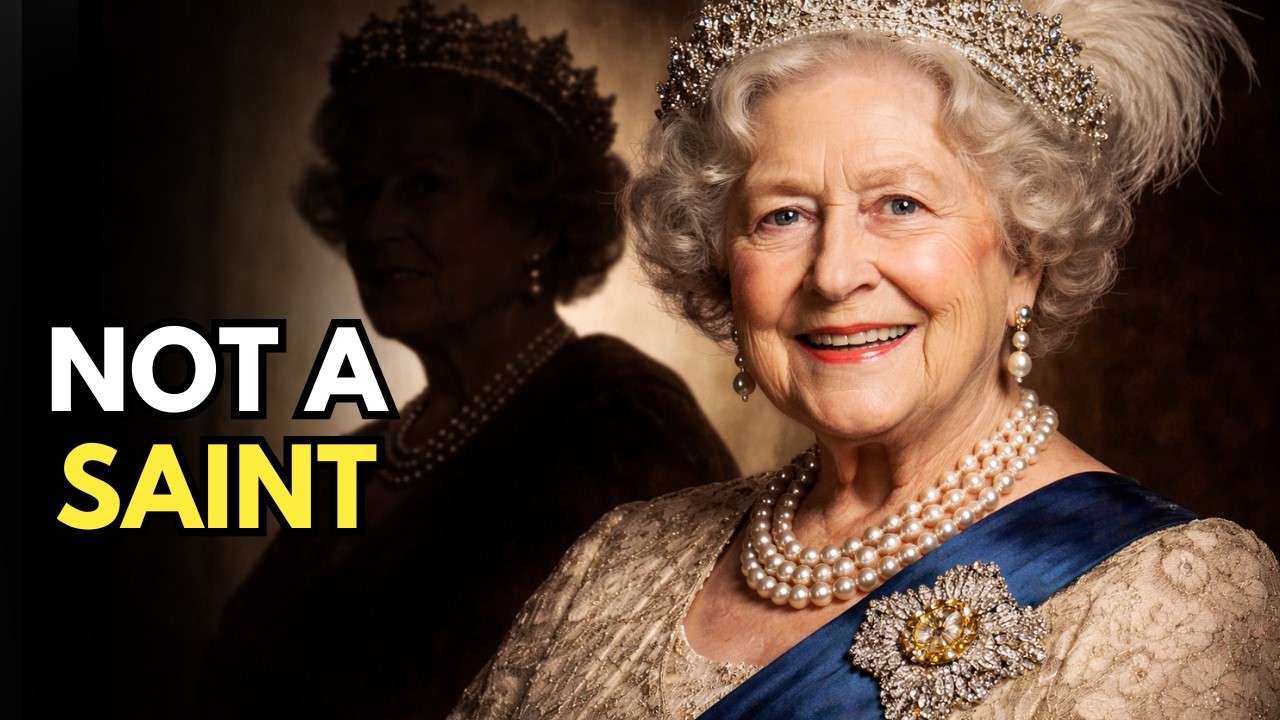
She had the kind of charm that could make whoever she was speaking to feel, for that moment, like the most interesting person she had ever met. And she had it in a way most people never develop at all. What Britain was later told was a love story. The shy, stammering second son of King George V, the one everyone assumed would never be king, came after her.
She refused him, reportedly more than once. The history books dressed this up as hesitation, a young woman unsure whether she could handle royal life. But a refusal does something when a prince is on the other end of it. It makes him more determined, more devoted, more willing to bend.
By the time she said yes in 1923, she had arrived at the altar with a man already dependent on her approval, already measuring himself against her expectations. Whether that was calculated or simply lucky timing is a question the official version never explores. They married, and the public loved her immediately. Behind the gloves and ceremonies of 1920s royal life, people sensed warmth, a real person in there somewhere.
Meanwhile, her husband struggled privately. His stammer was a genuine source of anguish, made worse by a father who had no patience for weakness. He was anxious, shy, and needed someone to stand between him and the weight of his life. She stood there.
The more he needed her, the more central she became. She managed his confidence, smoothed his relationships, translated him to the world. Whatever else it was, that was power. In December 1936, everything was rewritten.
Edward VIII abdicated, walking away from the throne over Wallis Simpson and handing it to the brother nobody had prepared for any of it. Elizabeth became queen. The inherited version says she was devastated, reluctant, dragged into greatness by her brother-in-law’s selfishness. She never forgave Edward, never forgave Wallis.
But what exactly was she so angry about? The question is worth sitting with. The war made her untouchable. When the Luftwaffe bombed Buckingham Palace in September 1940, she was reported to have said she could finally look the East End in the face.
The line became famous immediately. The courage was real, almost certainly, but she also understood symbols the way most people understand language. She knew exactly what staying in London meant, what those photographs would do, how that image of the bombed palace would land in frightened, exhausted living rooms across the country. By the end of the war, she was not just popular.
She was beloved, too woven into the national story to question. But the accounts of people who actually worked inside that world describe something else under the smile. Staff and aides describe exacting standards, the difficulty of someone who had genuinely never been told no, who expected service to be invisible. She could be warm and generous with the people she wanted to charm, and cold in a way that is hard to describe to those who had stopped being useful.
Her spending went well beyond generous. Clothes, art, racehorses, entertaining at a scale that leaned heavily on public money. When she died, the reported debts ran into the millions. In the 1940s it was buried under the war effort.
Everything was about bravery and duty. The actual bills were not part of anyone’s story. By the time the war was over, the image was too solid to touch. Then there was Wallis Simpson.
Her treatment of Edward and Wallis is usually framed as understandable resentment, wounded loyalty, dignified disapproval. But looking at what she actually did, and kept doing for decades, it goes well past that. Wallis was denied the title Her Royal Highness, a structural determination of how you are treated and what rooms you are allowed into. Edward and Wallis never got fully brought back in from exile.
The coldness was maintained through quiet institutional machinery that a well-positioned person can run indefinitely without raising a voice. Edward died in 1972. Wallis lived until 1986. The hostility never softened.
After the constitutional crisis was ancient history, after there was nothing left to protect, it starts to look less like grief and more like a calculated move to keep control over who belonged and who did not. What happened to her own daughter is harder to excuse. Margaret loved Peter Townsend. He was divorced, and the Church of England, which the monarch technically headed, did not allow divorced people to remarry.
Margaret was told that if she married him, she would lose her royal status and her income. She gave him up, then spent years visibly carrying the weight of it. The palace version presents the Queen Mother’s role as reluctant but necessary. The rules were the rules.
But she had watched Edward VIII go through almost exactly this situation. She knew what it cost a person to have the institution close over their personal life. And she enforced the same thing on her own daughter. Whether that was institutional conviction or something else, it was the behavior of someone who had learned very early that the institution was the source of her power, and protecting it came first.
By the time her husband died in 1952, at age 56, the pattern was fully established. She spent the next fifty years as a widow, holding real influence without any formal title. She shaped the institution through longevity, through being the person who had been there longest, through the simple fact that everyone deferred to her because nobody could remember a time when they had not. No formal power.
Never without power. What kept all of this buried was not a cover-up. There was no single person deciding what got hidden. It was a collective decision, never spoken, that some things were not worth the cost of saying out loud.
The press operated for most of her lifetime under a royal deference that is hard to picture now. The people who might have known things mostly said very little. The ones who could have pushed harder chose not to. She was too beloved, too old, too permanent a fixture.
What remained was the image: the smile, the Blitz survivor, the grandmother of the nation. Time had done its work. The question that keeps coming back is why Britain chose the cleaner version. Not by accident, not through ignorance, but through an active ongoing collective decision that the more complicated version was too costly to deal with.
The monarchy was in real trouble in the middle of the twentieth century. The empire was ending, the economy was hollowed out by two world wars, and royal families across Europe were being voted out or fading away. Britain kept its monarchy, largely because it figured out, partly through her, how to stop being about power and start being about feeling. She was the human face of the institution through its most dangerous years.
Once the legend was built, the institution could not afford a more complicated version of her. Her story was doing structural work. Pull it apart and other things start to come loose. And there was the country itself.
Britain in the second half of the twentieth century was managing a loss it had no language for. The empire was gone. What replaced it had to be found at home, in the things that had made it through the catastrophes intact. She was one of those things.
She had been there through everything, the abdication, the war, decades of change, and she had stayed constant. For a country quietly grieving its own story, that was not nothing. Real questions felt like vandalism. The most durable layer of all was that she was a woman.
Her power got hidden through warmth, through being needed, through the language of love and sacrifice and service. Women of her class and era were not supposed to hold power directly. They were supposed to support, to comfort, to give things up gracefully. When a woman in that world did hold real, sustained power, the smart move was to make it look like devotion.
History took the packaging at face value. Devoted wife, brave queen, beloved mother, national grandmother. Every category defines a woman by what she gave, not what she held. The accumulated archival evidence does not produce a single explosive letter, one smoking gun.
What it suggests is something more mundane and more disturbing. She was very, very good at a thing most people never even try to do. She made an institution feel like personal love. She made her own power feel like service.
She made control feel like warmth. And history, needing something to hold on to, chose to remember the warmth. The warmth was the instrument.
The smile was the strategy.
