At 2:38 p. m. on May 17, 1977, Danny Greene walked toward his green Lincoln Continental in the parking lot of the Brainard Place office building in Lyndhurst, Ohio. He had just left a dentist appointment, his girlfriend at his side.
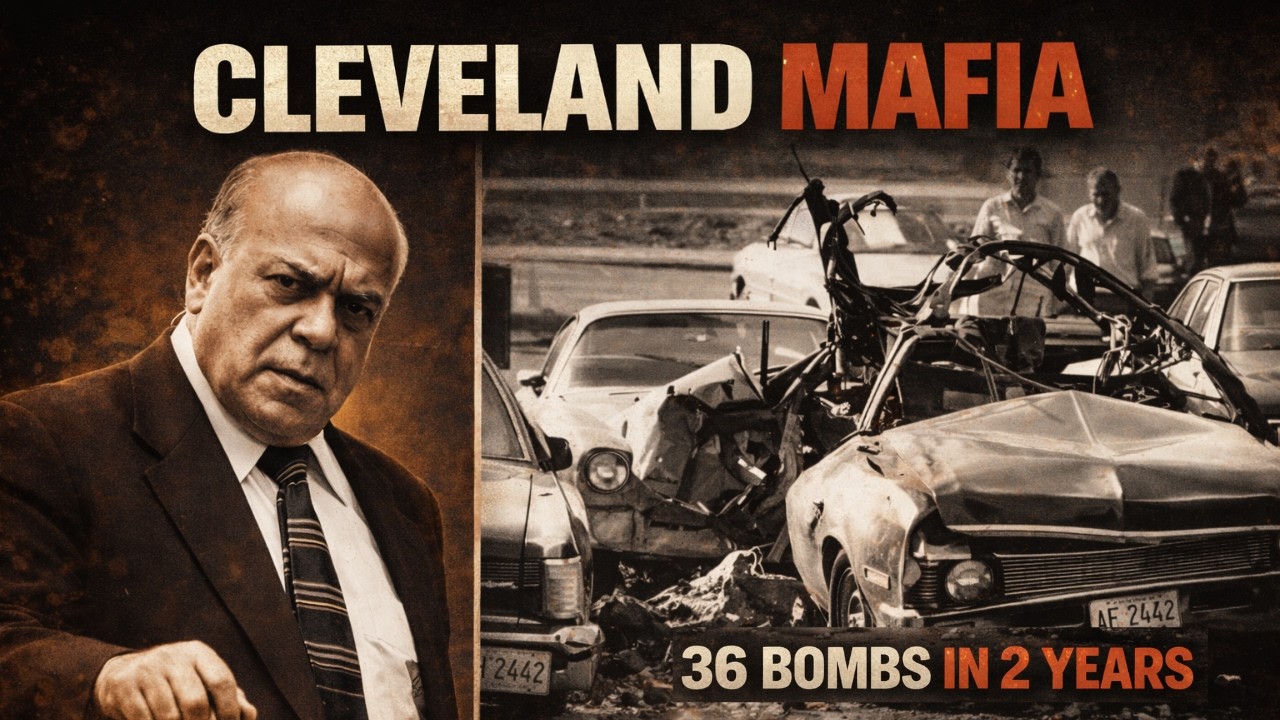
A maroon Chevrolet Nova sat parked nearby. As Greene opened his car door, the Nova erupted. The blast shattered windows three blocks away and tore a five-foot crater in the asphalt. Greene’s body was thrown fifteen feet.
His legs were severed, his torso ripped apart. Metal fragments embedded in nearby buildings. The explosion was so powerful that it registered on seismographs at local universities. Danny Greene, the Irishman who had spent seven years waging open war against the Cleveland mafia, was dead at fifty-three.
The bomb contained an estimated fifteen pounds of military-grade C4 plastic explosive packed with shrapnel, detonated remotely by someone watching from a nearby building with a direct line of sight. The Cleveland mafia had finally eliminated its most persistent enemy. In doing so, they triggered the largest organized crime investigation in FBI history. The war that killed Danny Greene would destroy the entire Cleveland family within four years.
For half a century, the Cleveland mafia had operated in near-total silence. Emerging in the early 1900s when Italian immigrants from Sicily and Calabria settled in the Murray Hill and Little Italy neighborhoods, the organization developed differently from New York’s five families. Cleveland formed a single, unified body under one boss. The first recognized leader was Joseph “Big Joe” Lonardo, who controlled bootlegging during Prohibition.
Court records show Lonardo ran a massive illegal alcohol distribution network across northeastern Ohio. He made millions, kept a low profile, and avoided prosecution. On October 13, 1927, Lonardo was shot and killed in a barbershop on Mayfield Road. The Porrello brothers, rival bootleggers, were suspected but never charged.
The murder set a pattern that would define Cleveland organized crime for decades: leadership changed through violence. After Lonardo’s death, the Porrello brothers briefly took control. But in 1930, Frank Milano emerged as boss and understood something they had not: silence equals survival. Milano banned public displays of wealth, forbade unnecessary violence, and demanded absolute discretion.
FBI surveillance reports from the 1930s and 1940s describe him as a ghost. He owned no property in his name, drove no flashy cars, and communicated through intermediaries. Law enforcement knew he existed but could not prove what he controlled. His underboss, Alfred “Big Al” Polizzi, ran gambling, labor racketeering, and loan sharking operations.
By the 1940s, the Cleveland family was generating millions annually from gambling alone, controlling the wire services that fed horse-racing results to illegal bookmakers across the Midwest. They owned the information, and bookies paid for access. In 1944, Milano made a decision that shocked other mob bosses. He retired voluntarily and moved to Mexico, walking away from millions in annual income.
Polizzi followed the same path in 1948, retiring to Florida. Two bosses in four years had simply quit. Control passed to John T. Scalish, who became boss at age thirty-five in 1944.
He would hold that position for thirty-two years, the longest continuous reign of any mob boss in American history. Under Scalish, the Cleveland family reached its peak power while perfecting absolute silence. He ran the organization like a corporation: no unnecessary violence, no flashy lifestyles, no public attention. Family members held legitimate jobs as cover, paid taxes, and avoided arrest.
FBI wiretaps from the 1960s captured conversations showing the family earned between five and ten million dollars annually from gambling alone. Labor racketeering was another major revenue source. The family controlled several Teamsters Union locals, extorted construction companies, took payoffs from contractors, and skimmed from union pension funds. Court testimony later revealed Scalish’s close relationship with Teamsters president Jimmy Hoffa.
When Hoffa needed support, Scalish provided it; in return, Hoffa allowed access to union resources and pension fund money. Scalish enforced strict rules: no drug dealing, no unauthorized violence, no talking to outsiders, no flashy spending. Violators were expelled or killed. By the late 1960s, the Cleveland mafia was one of the most powerful criminal organizations in America, completely unknown to the public.
But Scalish made a critical mistake. He never named a successor. On May 26, 1976, he died of a heart attack at age sixty-seven, peacefully in bed, having never spent a day in federal prison. His death created a power vacuum, and in the mafia, power vacuums lead to violence.
Underboss James “Jack White” Licavoli assumed control. At seventy-one, Licavoli was old school, ruthless, and violent. He inherited a massive problem: Danny Greene. Greene was born November 14, 1933, in Cleveland.
He was Irish-American, raised in the Collinwood neighborhood, and could never be a made member of La Cosa Nostra. But he wanted power anyway. He started as a longshoreman and in 1961 was elected president of the International Longshoremen’s Association Local 1317. Court records show he immediately began embezzling union funds, and in 1964 he was convicted of embezzlement and sentenced to five years’ probation.
By the late 1960s, Greene was running his own organization called the Celtic Club, controlling loan sharking, labor racketeering, and extortion on Cleveland’s West Side. He painted everything green, drove a green car, wore green clothes, and called himself the Irishman. For years, he paid tribute to the mafia and operated with their permission. After Scalish died, Greene stopped paying.
He declared independence and told Licavoli’s representatives that the Irish did not bow to Italians anymore. Licavoli ordered Greene killed. The first attempt came in 1975, when a bomb was planted in Greene’s car. He survived with minor injuries and held a press conference in front of his blown-up vehicle, laughing.
He told reporters, “I have a message for those guys. They can’t kill me. ” A second attempt in 1976 saw gunmen open fire on him outside his apartment; Greene was not hit and returned fire. Greene then went public.
He appeared on local television, gave interviews, and talked about the mafia, calling them slurs and saying Cleveland belonged to the Irish now. He was violating every rule of organized crime. FBI surveillance picked up panicked conversations among family members. Licavoli was under pressure from New York.
The commission demanded that Cleveland handle the problem. Between 1976 and 1977, thirty-six bombs exploded in Cleveland. Some targeted Greene, others his associates. Some hit innocent people by mistake.
The city descended into chaos. Local media called Cleveland “Bomb City USA,” and national outlets picked up the story. The invisible mafia was suddenly front-page news. Greene survived multiple attempts and seemed invincible, telling reporters he had the luck of the Irish.
Licavoli brought in outside help, reaching out to the Los Angeles family for professional hit men. The commission approved sending Raymond Ferritto, an experienced bomber and killer. Ferritto studied Greene’s patterns, learned about his regular dentist appointments, identified the parking lot, and found a vantage point with direct line of sight. He built a remote-controlled bomb using military-grade explosives.
On May 17, 1977, everything came together. Greene’s death was the Cleveland family’s biggest mistake. Within hours, FBI agents were interviewing witnesses. Forensics teams examined the blast site and determined the device was professionally built with military-grade materials and expert construction.
They traced the Nova to a buyer using a false name, which led to Raymond Ferritto. Ferritto was arrested on July 6, 1977. Offered life in prison or cooperation, he chose cooperation. He became the first Cleveland mafia associate to break omerta and testify.
His testimony was devastating. He named names, described the conspiracy to kill Greene, identified Licavoli as the boss who ordered the hit, and provided details about mob operations, structure, and leadership. The FBI used Ferritto’s information to obtain wiretaps that captured murder plots, extortion schemes, and RICO violations. On May 2, 1978, federal prosecutors indicted Licavoli and nine other family members on racketeering charges detailing decades of murder, extortion, gambling, labor racketeering, and bombings.
On November 23, 1978, the jury returned guilty verdicts. Licavoli, then seventy-three, was sentenced to seventeen years in federal prison. The entire leadership structure was imprisoned simultaneously. Between 1978 and 1982, federal prosecutors indicted over forty Cleveland mafia members and associates.
The convictions destroyed the organization. By 1982, the Cleveland family effectively ceased to exist as a functioning criminal enterprise. Their gambling operations collapsed, their union connections were severed, their political influence evaporated. The family that had operated in silence for fifty years was dismantled in four.
James Licavoli died in prison on November 21, 1985, at age eighty, maintaining omerta until the end. Raymond Ferritto entered witness protection, testified at multiple trials, and lived under a false identity until his death in 2004. Danny Greene became a legend in Cleveland, the subject of books, documentaries, and the 2011 film Kill the Irishman. His grave became a tourist attraction.
The Cleveland mafia attempted to rebuild in the 1980s and 1990s, but only low-level operators claimed leadership, running minor gambling and loan sharking. They never regained their former power. Today, the FBI considers the Cleveland family inactive. A few elderly members remain alive with no influence, no territory, no real organization.
The family that once controlled millions in rackets was not destroyed by brilliant investigation. Law enforcement did not bring them down through RICO prosecutions or informants alone, though those played a role. The mafia destroyed itself through ego and revenge. They could not accept that an Irishman was challenging them, so they started a war.
Wars attract attention. Attention brings investigation. Investigation brings prosecution. Success required invisibility.
Power required discipline. Survival required silence. The moment the Cleveland mafia put ego ahead of strategy, they were finished. Danny Greene understood that too.
He went public, he made noise, and it got him killed. But in dying, he exposed the entire organization and forced them into the open. Both sides lost. Greene died in a parking lot.
The mafia died in prison.
