In the winter of 1838, soldiers moved through the southern mountains gathering Cherokee families into stockade forts, pulling them from cabins hidden in the coves and along the streams. By October the long procession moved west, and it did not reach the far side of the Mississippi until March of the following year, in the coldest part of the season, with the river running full of ice. As many as four thousand people died on that road. It is remembered as the Trail of Tears, one of the heaviest passages in the American record.
But the story told here was already old when that winter came. It was old when the first trader crossed the mountains. It is a story about how the Blue Ridge and the Great Smokies were made, and the Cherokee were telling it long before there was a United States to sign a removal act. It survives because a man wrote it down.
His name was James Mooney, an ethnographer sent by the Smithsonian. Between 1887 and 1890 he lived among the Eastern Cherokee on the Qualla Reservation and listened. In 1900 the government printed his collection as Myths of the Cherokee. Mooney did not invent these stories.
He received them from living keepers of the tradition, and two old men gave him most of what exists. The first was Swimmer, whose Cherokee name was Ayunini. Born around 1835, just before the removal, he was trained by older masters to be a priest, a doctor, and a keeper of the old knowledge. He spoke no English.
No gathering of the band was complete without him. Mooney said nearly three quarters of the whole collection came from this one man. Swimmer died in March 1899 and was buried on the slope of a forested mountain. Mooney wrote that with Swimmer there perished half the tradition of a people.
The second keeper was John Axe, born around 1800, the oldest man of the band. He spoke no English either and was described as one of the last of the old-time Cherokee. Mooney added a warning when he set down the Cherokee account of creation. He said the tradition was already too far broken down to be recovered whole, surviving only in disjointed fragments.
What exists comes from what two old men in the 1890s could still hold in their heads, written down just in time and only just. The thing that nearly finished the tradition was not any single villain. It was time and forgetting and the slow loss of a world in which such stories were told at all. The Cherokee said that in the beginning the earth is a great island floating in a sea of water, suspended at each of the four directions by cords coming down from the sky vault above, and the sky vault is made of solid rock.
The old people said that when the world grows old and worn out, the people will die, the cords will break one by one, and the earth will sink down again into the ocean. Mooney wrote plainly that the Indians are afraid of this. Before the island existed, there was only water, and all the living creatures were above in Galunlati, the world beyond the arch of the sky. It was crowded there, and the creatures wondered what lay beneath the water.
None of the great ones offered to look, but a little water beetle did. Its Cherokee name is dayunisi, meaning beaver’s grandchild, the small darting beetle that skates on the surface of a pond. The beetle came down, darted over the water in every direction, found no place to rest, and then dived. It went down to the bottom and came back up with a dab of soft mud.
That mud began to grow and spread until it became the island that became the earth. Once the island had grown, it was fastened to the sky with four cords. But who tied those cords? Mooney records the answer exactly as the old men gave it.
No one remembers who did this. The tradition names the beetle and the mud and the cords, and then at the moment of the fastening it says the part is not remembered. When the island was first brought up it was flat, soft, and wet. The animals above were impatient to come down, but the earth was not dry enough.
They sent birds down to check, and each time the birds reported there was still nowhere solid to land. At last they sent down the great buzzard, the father of all the buzzards. He flew over the soft earth low down, close to the ground. By the time he reached the country that would become Cherokee country, he was tired.
His great wings were heavy, and as he beat them they struck the soft ground. Every time the wingtips came down they pressed the mud into a valley; every time they swept up they pulled the earth into a mountain. The animals watching from above grew frightened that the whole world would become nothing but mountains, so they called him back. But the shaping was done.
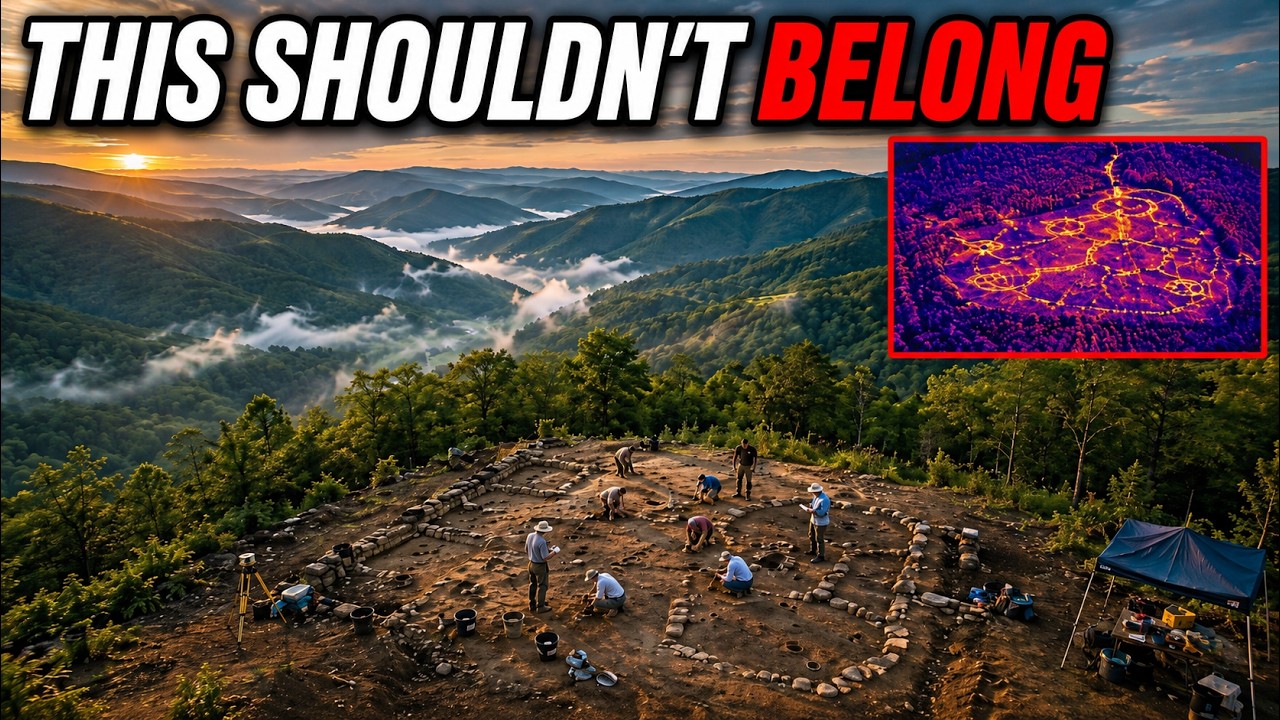
The Cherokee country remains full of mountains to this day. In this telling, the Blue Ridge is the record of that moment, the fossilized wingbeats of the great buzzard. Mooney noted that the neighboring Creek and Yuchi peoples told the same image in their own creation stories. The world was taking shape but was still dark, so the powers set the sun in a track to travel across the island from east to west.
The sun was too low and too hot. The red crawfish had his shell burned bright red by that first too close sun, and to this day the Cherokee will not eat him. The conjurers lifted the sun up a handbreadth higher, still too hot, and again and again until it sat seven handbreadths above the earth, just under the arch of the sky vault. Seven is a sacred number in the tradition, along with four, the number of the directions.
Seven is those four plus above, below, and here in the center, and it is also the number of the old Cherokee clans. The world had light but still no fire. Up in Galunlati, the thunders sent down their lightning, which struck a hollow sycamore tree on an island and set a fire burning in the bottom of it. One after another the animals went to bring it back, and each returned carrying a burn it never lost.
The raven went first and was scorched black. A screech owl nearly had its eyes burned out and has red eyes to this day. Two more owls drew white rings around their eyes that never came off. A black snake was scorched and has darted and doubled on his track ever since.
Then the water spider, the little one with black downy hair and red stripes who can run on top of the water or dive beneath it, spun a thread out of her own body and wove it into a little bowl fastened on her back. She crossed to the island, put a single coal of fire into the bowl, and carried it home. That is how the Cherokee have had fire ever since. There is another world underneath this one, the Cherokee said, like ours in almost everything except its seasons are reversed.
The streams are the way down, and the springs at their heads are the doorways. To go down you must fast and go to water in the ritual way and have one of the people of that lower world come as your guide. The proof offered was that water in a mountain spring is warmer than the air in winter and cooler in summer, the breath of the other world coming up through the doorway. When the animals and plants were first made, they were told to stay awake and keep watch for seven nights.
By the seventh night only a few were still awake, and to those it was given to see in the dark and move about at night. That is why the owl and the panther own the night. The same test was given to the trees. The cedar, pine, spruce, holly, and laurel stayed awake and were given leaves all the year round and the greatest powers for medicine.
The others were told, because you did not last, you will lose your hair every winter. Last came people, and the tradition itself is uncertain here. In the version Mooney sets down first, there was only a single brother and sister, and the human race grew from them. One of his sources, a woman named Ayasta, gave one account; a Western Cherokee man named Wafford said the first man was created blind.
Mooney laid these beside each other without forcing them into one. At first, children came very fast, one every seven days, until it was arranged that a woman would have only one child in a year. The story the Cherokee held most sacred was tied to a mountain you can name. Long ago, soon after the world was made, a hunter and his wife lived with their little boy at a place called Pilot Knob, with the hunter’s country up around the Black Mountain now called Mount Mitchell.
The hunter’s name was Kanati, meaning the lucky hunter, and his wife’s name was Selu, meaning corn. When Kanati went into the mountains he came back with game every time, and Selu went to the storehouse and came back with her basket full of corn and beans. Their boy came home one day and told his parents he had been playing with another boy down by the river, a boy who came out of the water. When Selu washed the blood off the game in the river, that blood had taken shape and become a second, wild boy grown out of the water.
The Cherokee called him the one who grew up wild. It was the wild boy who talked his brother into uncovering their parents’ secrets. Kanati kept all the game of the world shut up behind a great rock in the mountainside, and when he needed meat he lifted the rock and let one animal out. The boys followed him, saw where the cave was, and later raised the rock themselves.
The deer came pouring out, then the raccoons, rabbits, turkeys, and pigeons, all the game of the world escaping at once. One of the boys struck a fleeing deer across the tail with an arrow, and the deer threw its tail up, which is why the deer carries its tail up to this day. That is the reason hunting is hard now. In the first days all the game was behind one rock, and two boys let it loose.
The secret of Selu was stranger. She produced the corn and beans from her own body, rubbing it into the basket. She was the corn itself. The boys spied on her and saw how she made the food, and thinking she must be a witch, they killed their own mother.
Selu told them what to do even so. Clear the ground, she said, and drag my body over it, and stay awake and watch through the night. Where her blood touched the earth, the corn came up. Every field of corn the Cherokee ever planted was, in the telling, her body given back to them.
The story says strangers came from far off, and the boys gave them seven grains to plant on the way home. Each night the seven grains grew into seven ripe ears, so that by the time the strangers reached their own country they had corn enough for all their people. Mooney recorded that this was the most sacred of all Cherokee myths, so sacred that in the old days the hearer had to purify himself and bathe in the running stream before daylight before he could hear it told. All of this was already ancient when the soldiers came in the winter of 1838.
The Cherokee were driven away from the land and from the story that explained the land. You cannot carry a mountain to Oklahoma. One of the soldiers who carried out the removal, a Georgia man who would later fight through the Civil War, said afterward that he had seen men shot to pieces by the thousands and that the Cherokee removal was still the cruelest work he ever knew. Some of them refused to go and hid in the coves, and their descendants are the Eastern Band who live on that land still.
It was among them, fifty years later, that Mooney found Swimmer and John Axe, two old men who had kept the ancient words alive through all of it. If Swimmer had died a few years earlier, before the young ethnographer came to sit with him, we would not have the beetle or the buzzard at all. Half the tradition went into the ground with that one man.
The mountains are still there, and every ridge of the Blue Ridge still holds the shape that the tradition says a tired bird pressed into it at the beginning of the world.






