In the fortified bunker beneath the Reich Chancellery in Berlin, the final days of April 1945 were collapsing into chaos. The Red Army had broken through the German lines and was closing on the capital. Inside, Hitler’s world had shrunk to a few concrete rooms, and on the night of the 28th, a court-martial convicted a senior SS officer of desertion. That officer was Hermann Fegelein, the husband of Gretl Braun, the sister of Eva Braun.
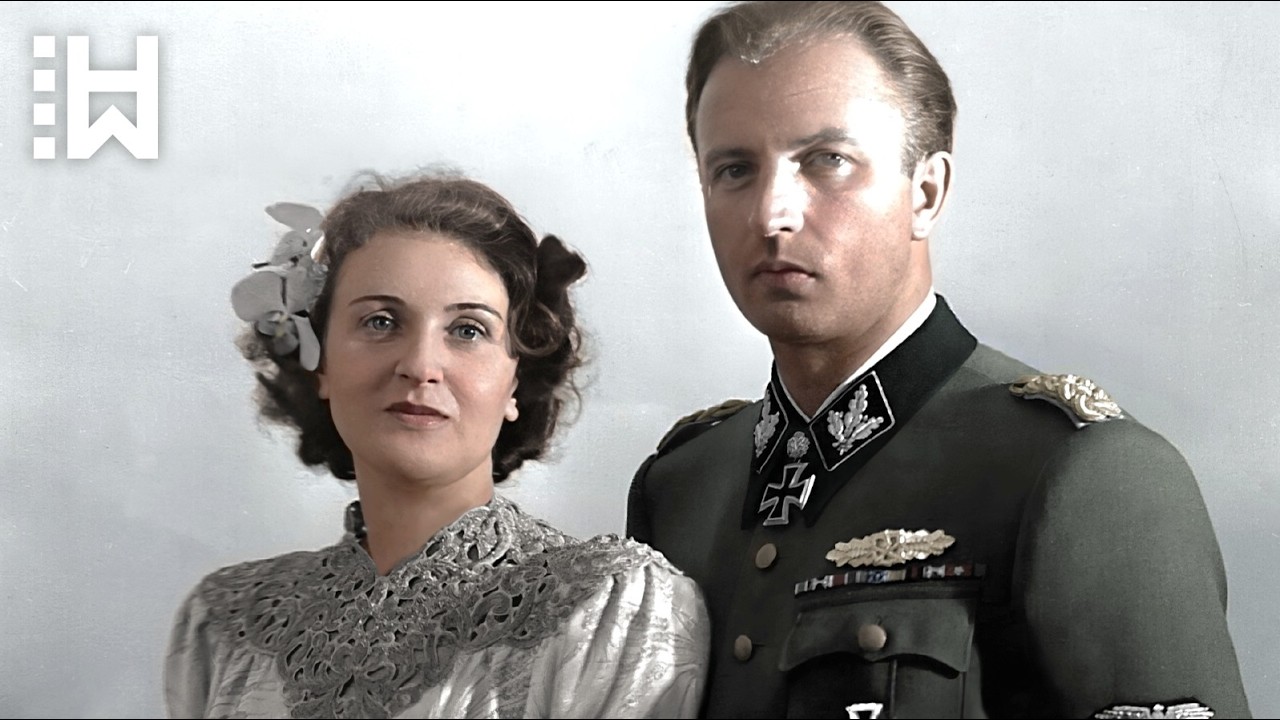
As Fegelein faced execution, Hitler abruptly married Eva Braun in the same bunker. Two days later, the newlyweds took their own lives. None of this seemed possible at the wedding that had taken place less than a year earlier, in the splendor of Mirabell Palace in Salzburg. The 3rd of June, 1944.
The Second World War was in its fifth year, and across Europe, millions had already perished. The Allied invasion of Nazi-occupied Europe was only days away, and yet Adolf Hitler presided over a lavish wedding ceremony before moving to the Eagle’s Nest high in the Bavarian Alps, where the celebration would continue for the next three days. Despite increasingly common food shortages and the bombing of major cities, the newlyweds enjoyed live music, dancing, and champagne. The groom was Hermann Fegelein, a high-ranking SS officer, an opportunistic social climber.
Albert Speer, Hitler’s architect and later minister of armaments, described him as one of the most disgusting people in Hitler’s circle. The bride was Gretl Braun, the younger sister of Eva Braun, Hitler’s long-time mistress. She had spent the war years at the Berghof, Hitler’s private retreat in the Bavarian Alps, flirting with SS officers and enjoying the luxuries of the Nazi elite, seemingly oblivious to the genocide unfolding across Europe. Margarete Berta Gretl Braun was born on the 31st of August, 1915, in Munich, then part of the German Empire.
She was the youngest of three daughters, raised alongside her sisters Eva and Ilse in a middle-class family. Her father, Friedrich, was a school teacher; her mother, Franziska, worked as a seamstress. Gretl dropped out of secondary school at the age of sixteen and found work as a clerk for the photography company of Heinrich Hoffmann, Hitler’s official photographer. Hoffmann also employed her older sister, Eva.
It was through Hoffmann that Eva had first met Adolf Hitler, and Gretl soon found herself introduced to the same inner circle. That job became Gretl’s ticket into Hitler’s world and gave her the chance to develop a shared passion for photography with her sister. Hitler and the Nazi party came to power in January 1933. Two years later, in August 1935, Hitler provided the sisters with a three-bedroom apartment in Munich near the city center, where they entertained senior Nazis in between trips to the Berghof.
In March 1936, Gretl and Eva moved into a small villa at 12 Wasserburger Straße in one of Munich’s most prestigious neighborhoods. Their father was not pleased with the arrangement and wrote to Hitler to protest. Gretl spent much of her time with Eva at the Berghof, where she brightened the formal atmosphere by having fun, smoking, and flirting with SS orderlies. Hitler detested smoking and frequently lectured those around him on its dangers.
He once promised a Swiss gold watch and jewelry to any woman who could go a month without cigarettes. Eva earned her reward, but Gretl did not. Hitler personally tried to persuade her to quit. He told her, “Give up cigarettes and I will offer you a villa.
” Gretl replied, “My Führer, a villa would be a great joy to me, but only one, whereas smoking gives me 20 little satisfactions every day. Satisfactions that last and multiply. ”
Like many of the young women who surrounded the Nazi leader, Gretl Braun was always on the lookout for a suitable and influential husband. Hitler himself encouraged young party officials, military officers, and SS members to court her.
His first choice was Heinrich, the son of his official photographer, Heinrich Hoffmann. Gretl did not find him attractive and instead began a relationship with an American diplomat. When that relationship ended, she turned her attention to Hitler’s adjutant, Fritz Darges. But that relationship also came to an end when Darges was reassigned to the Eastern Front in 1944 following a sarcastic comment made in front of Hitler, which the Führer did not find amusing.
Moreover, rumors circulated that Gretl was pregnant with Darges’s child and that his refusal to marry her had angered the Führer. Hitler also tried to persuade Walter Hewel, a member of his inner circle, to marry Gretl. Hewel served as the liaison between Nazi Foreign Minister Joachim von Ribbentrop and Hitler himself. The Führer once described Hewel as an excellent diplomat, a necessary quality, he added, for anyone serving as an intermediary between himself and Ribbentrop.
Hitler promised Hewel that after marrying Gretl, he would appoint him ambassador to Rome, but Hewel did not fancy the idea. He married someone else instead, and Hitler was so furious that he refused to see him for some time. Eventually, however, he forgave him, and Hewel returned to Hitler’s inner circle. Gretl then became involved with Hermann Fegelein, the SS liaison officer to Hitler.
Between September 1939 and the autumn of 1943, Fegelein and the cavalry units under his command participated in the so-called anti-partisan operations in Poland and the Soviet Union. Operations that in practice often meant the systematic murder of Jews and civilians. Tens of thousands of men, women, and children were killed in areas where his units operated. Despite this violent record, Fegelein cultivated the image of a charming and ambitious officer within Hitler’s inner circle and was accustomed to attracting attention wherever he went.
He had a refreshing, sometimes very dry, wit, and he never minced his words. He would go to the nightly parties hosted by Martin Bormann, Hitler’s private secretary, where he drank with all the important men and had all the women at his feet. On one occasion, he frankly admitted that nothing was as important to him as his career and a good life. Many in Hitler’s inner circle, however, despised him.
Fegelein had worked his way into Heinrich Himmler’s favor through a combination of flattery and manipulation, gaining choice assignments, promotions, and decorations despite horrific casualty rates among the units he commanded. For Gretl, marrying Fegelein meant escaping her sister’s shadow and securing her place in Hitler’s inner circle. On the 3rd of June, 1944, just days before the Allied invasion of Normandy, Gretl Braun married Hermann Fegelein. Eva had arranged the wedding, held at Mirabell Palace in Salzburg, with Hitler in attendance and witnessed by Heinrich Himmler, head of the SS, and Martin Bormann.
Eva insisted that the wedding be perfect, as beautiful as if it were her own, supervising every aspect of the planning. Fegelein was only too happy to marry Gretl, as it cemented his position within the Nazi hierarchy. The marriage also transformed Gretl’s standing, finally bringing her out of her sister’s shadow and greatly increasing her social prestige. Despite the increasingly common food shortages and bombings of major cities, the newlyweds partied for three days while the Nazi leadership turned its attention to the deteriorating situation in France and Italy, where the Allies had just captured Rome.
Gretl Braun and Hermann Fegelein had little time together before the war entered its final, catastrophic stage. Just a week after the wedding, on the 10th of June, 1944, Fegelein was promoted to SS Gruppenführer and Generalleutnant of the Waffen-SS, the military branch of the SS. On the 20th of July, 1944, he was at the Wolf’s Lair in East Prussia when Oberstleutnant Claus von Stauffenberg set off a bomb in a failed bid to kill Hitler. Fegelein survived the blast, and his decision to marry Hitler’s de facto sister-in-law had worked in his favor.
His career was advancing fast. Soon, Gretl became pregnant and was staying at the Berghof, far from the bombing and combat. During the last months of 1944, Fegelein headed the investigation into the 20 July plot while Eva traveled back and forth between Berlin and the Berghof to keep her sister company. In January 1945, Hitler and Eva, along with most of the government and their followers, moved into the fortified Führerbunker complex in central Berlin while Gretl remained at the Berghof.
In April 1945, the Red Army had broken through the German military and was close to capturing the German capital. On the 23rd of April, Eva Braun wrote her final letter to her younger sister, Gretl, asking her to destroy most of her correspondence while preserving and burying a small portion of her personal papers. None of these documents were found after the war. With defeat closing in, Fegelein tried to escape Berlin and flee to Sweden or Switzerland.
When Himmler attempted to negotiate a separate peace with the Western Allies, Hitler flew into a rage and ordered Fegelein’s arrest. The Führer believed that Fegelein had betrayed him. A commando squad found Fegelein at home, reportedly drunk and dressed in civilian clothes. On the night of the 28th of April, 1945, as Fegelein was court-martialed and executed for desertion, Hitler finally married Eva Braun.
Two days later, on the 30th of April 1945, Hitler and Eva Braun took their own lives in the bunker. Less than a week afterward, on the 5th of May 1945, Gretl Braun gave birth to a daughter whom she named Eva Barbara Fegelein in memory of her dead sister. The Second World War in Europe ended on the 8th of May, 1945. After the war, Gretl cut ties with her family.
She hid Eva Braun’s photograph albums, private films, and personal letters in the grounds of her late husband’s mansion. At some point, she met a German refugee whom she came to trust. Out of love or financial desperation, she confided in him about the hidden archive. But the man was not who he seemed.
He turned out to be an agent of the American Counterintelligence Corps. He persuaded her to reveal the hiding place, and the entire archive was sent to Washington, where the photographs were distributed to intelligence services around the world. In February 1954, Gretl married Kurt Balinger in Munich, but the marriage produced no children. Tragically, her only child, Eva Barbara Fegelein, committed suicide in April 1971 at the age of 25 after her boyfriend was killed in a car accident.
In the late 1970s, one of Gretl’s cousins found her in Bavaria, but by then, she had Alzheimer’s disease. Gretl Braun was 72 years old when she died on the 10th of October, 1987, in the small town of Steingaden, West Germany. The secrets of her correspondence with her sister were buried with her.
