Bass Reeves stood in the federal marshal’s office in Muskogee, Indian Territory, in June 1902, holding a murder warrant that named Benjamin Reeves. The suspect was his son. Benjamin had shot and killed his wife, Castella, and fled. The marshal responsible for the district, Leo Bennett, had hesitated to hand the paper to Bass.
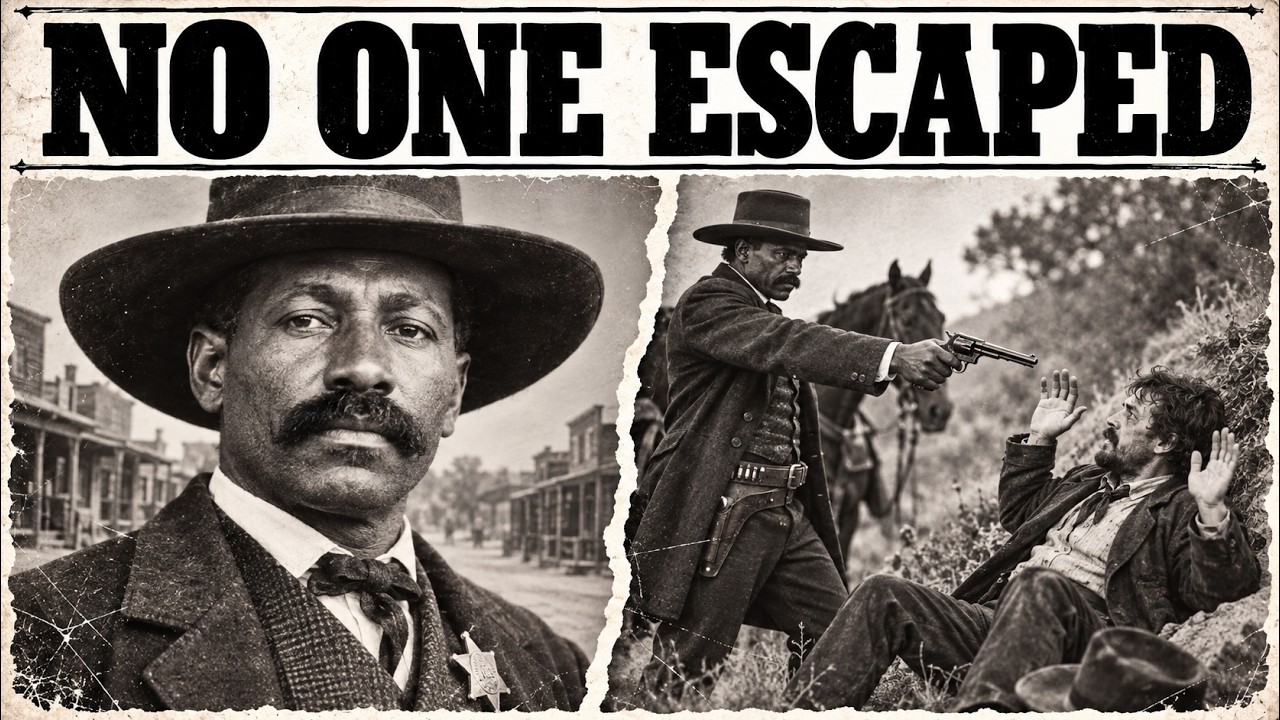
Other deputies could have taken it. Nobody would have blamed a father for stepping aside. Bass took the warrant anyway and went looking for his own son. For nearly three decades, Reeves had built his reputation on a single rule: if a federal warrant carried a name, the person behind that name had to answer for it.
In 1902, he applied that rule to his family. Taking the paper did not make the arrest automatic. He still had to locate Benjamin, approach a murder suspect who knew exactly how his father worked, and bring him into the same court system Bass had served for decades. The badge gave him authority.
It did not remove the personal risk or the family cost. The road to that moment had been long, and it had begun in slavery. Bass Reeves was born enslaved around 1838 in Crawford County, Arkansas. The exact details of his earliest years are incomplete, a common gap for people whose lives began inside bondage.
The Reeves family that held him later moved to Texas. Bass grew into a tall, physically strong man, skilled with horses and firearms. He wanted to read, but the world around him had been designed to keep enslaved people from gaining the tools of independence that white citizens took for granted. The Civil War changed his life.
National Park Service research describes a famous story in which Bass argued with George Reeves during a card game, struck him, and fled, knowing an enslaved man who assaulted a white enslaver could expect brutal punishment. The NPS treats parts of that story as uncertain. What matters more securely is where Reeves went. He disappeared into Indian Territory.
That decision gave him an education no classroom could have provided. Indian Territory was not an empty wilderness. It was home to tribal nations with their own governments, courts, police, towns, farms, roads, languages, and political conflicts. It was also a place where federal jurisdiction could become extremely complicated.
Reeves spent enough time there to learn the country: the routes, the river crossings, the settlements, the hiding places, and the habits of people who moved across the territory. National Park Service accounts also credit him with learning indigenous languages and customs. Those skills would matter far more than a fast draw. After the Civil War and the abolition of slavery, Reeves became a free man.
By 1870, he had settled near Van Buren, Arkansas, with his wife, Jennie, and they raised a large family. He farmed, raised horses, and earned money working as a scout and tracker for federal officers moving into Indian Territory. That work put him close to the men enforcing federal law out of Fort Smith. The jurisdiction was enormous.
Tribal courts handled many matters involving tribal citizens, but they generally could not arrest non-citizens for federal crimes. That created a huge enforcement problem across a region where white, black, and native residents lived under overlapping legal systems. Federal deputy marshals had to ride into that country, find people named on warrants, arrest them, and bring them back to court. It was dangerous, expensive, and slow.
In March 1875, Bass Reeves was approached to serve as a Deputy US Marshal. The Fort Smith court did not have a modern police department spread across the territory. The US Marshal was the administrative head, but the deputies did most of the field work. They served warrants and subpoenas, arrested defendants, guarded prisoners, and carried the authority of a distant federal court into communities that could be days away by horse.
The danger was not theoretical. During Judge Isaac Parker’s tenure, dozens of deputy marshals were killed in the line of duty. A man riding out with warrants knew that every name on the papers could turn into an ambush, a chase, or a long return trip with an angry prisoner watching for a chance to escape. That was the job Reeves entered in 1875.
His value was obvious. He already knew country other deputies had to learn on the move. He understood how to travel through it, how to communicate with people there, and how fugitives used distance as protection. He accepted the position.
At that point, he was around 37 years old, already familiar with the territory, already skilled with horses and firearms, and already known as a tracker. He also could not read. That sounds like an impossible weakness for a man whose job depended on warrants. Reeves found a way around it.
Accounts from Fort Smith say he memorized the names and descriptions on his writs. Someone would read the papers to him, and Reeves carried the information in his head. That required more than memory. It required discipline.
Arrest the wrong man, and the entire job failed. Forget one detail, and a fugitive could walk past you under a different hat. Reeves became known for not making that mistake. His work also looked very different from the clean pursuit scenes in later Westerns.
A deputy marshal did not simply ride out alone with a wanted poster folded into his pocket. He might hire guards or posse men, buy food and ammunition, travel with a wagon, and remain in the field for weeks. Fort Smith records describe deputy outfits moving across the country in search of people already named in warrants. Reeves understood that the hardest part was usually not the arrest itself.
It was getting close enough to make the arrest possible. That is where his knowledge of Indian Territory became an advantage. He knew how people traveled. He knew where they might find food.
He knew which communities connected to which roads. He understood that fugitives had relatives, friends, routines, and needs. And he was willing to use deception. Reeves became famous for disguises.
One later oral history account describes a case in which two brothers were wanted and carrying a large reward. Rather than ride directly toward their home wearing a badge, Reeves camped many miles away and changed his appearance. He reportedly cut holes in his hat, wore worn clothes and shoes, concealed his pistol and handcuffs, then walked roughly 28 miles until he reached the family’s house, looking like a man who had been traveling on foot for days. The brothers’ mother let him in.
According to the story, Reeves convinced her he was another fugitive hiding from the law. He learned that her sons were expected home. When they arrived, they accepted him as one of their own. That night, Reeves waited until they were asleep.
Then he handcuffed them. He marched the brothers back across the same country he had crossed on foot. The details come from a later oral history interview, not a contemporary arrest report, so they deserve that label. But even if every dramatic detail cannot be independently confirmed, the method matches what better documented accounts say about Reeves.
He used disguise, patience, local knowledge, and surprise. He tried to make the shooting unnecessary. The economics pushed deputies toward the same kind of planning. They were not salaried police officers for most of this period.
Under the fee system, a deputy earned money for completed services. An arrest earned a small fixed fee plus mileage. If he spent days looking for a suspect and came home without the arrest, much of that effort produced no arrest fee at all. A bad lead was not merely frustrating.
It could cost money. Riding 50 miles in the wrong direction meant food, horses, time, and risk with nothing to show for it. That gave experienced deputies a strong reason to verify information before committing an outfit to a long chase. Reeves’ reputation for patience makes more sense inside that system.
Waiting for a fugitive to reveal a routine could be cheaper and safer than charging through the countryside after every rumor. That was practical, not sentimental. Every gunfight created risk for the deputy, the prisoner, the posse, and anyone nearby. A dead suspect also created paperwork and expense.
The federal fee system paid deputies for successful service, not for riding around looking heroic. Reeves worked inside that system for decades. Over time, stories about his arrests became enormous. One often repeated figure says Reeves arrested more than 3,000 people during his career.
Older National Park Service material repeats that number and traces it to a 1901 newspaper interview. Newer NPS research is more cautious because complete records of Reeves’ arrests are difficult to reconstruct. The safe point is not the exact total. The safe point is that Reeves served for roughly 32 years across some of the most difficult federal territory in the country and was widely remembered as unusually effective.
He survived work that killed many other deputy marshals. And he did not survive it because every day ended in a shootout. He survived because he usually found another way to control the situation before a gun came out. That did not mean his career was clean.
In the 1880s, Reeves accidentally shot and killed his cook, William Leach. The shooting led to a murder charge. Reeves was arrested and tried. He was acquitted.
That case matters because it prevents the story from turning into worship. Reeves carried federal authority, but he was not outside the law he enforced. A death on his own expedition could put him in the defendant’s chair. The Leach case also shows how thin the margin could be even for an experienced officer.
A marshal’s outfit carried loaded weapons because the work required them. It camped for days or weeks because the territory was huge. Men ate, slept, handled horses, maintained guns, and moved through rough country together. An accidental discharge could turn a law enforcement trip into a homicide investigation in seconds.
Reeves had to stand in court as a defendant and persuade the jury that the shooting had been accidental. He was acquitted and returned to duty, but the event stayed part of his record. It is a useful counterweight to the polished legend because it reminds us that long careers are built not only from celebrated arrests, but from mistakes, danger, and moments when the officer himself becomes subject to the system. After the acquittal, he returned to duty.
His reputation kept growing. He was known as a strong shot, but the stories that last longest tend to be the ones where he avoided the obvious approach. In another case, Reeves and a fellow deputy reportedly disguised themselves as cowboys looking for work so they could get close to wanted men. That is the opposite of the Hollywood bounty hunter who wants his target to know exactly who has arrived.
Real pursuit rewards invisibility. If the fugitive knows a deputy is 10 miles away, he can run. If he thinks the deputy sitting near his campfire is another drifter, he may hand over the information that gets him arrested. Reeves also understood the psychological side of the badge.
A reputation can do work before an officer even arrives. Once outlaws knew Reeves was patient enough to follow a trail for days and willing to use disguises, hiding became harder. You could not assume the stranger asking for food was harmless. You could not assume the man riding without a visible badge was not a marshal.
That uncertainty shifted pressure onto the fugitive. The better Reeves became at the job, the more his reputation made the next job easier. But the hardest warrant of his career may have been the one carrying his son’s name. On June 7, 1902, Benjamin Reeves killed his wife, Castella Brown Reeves, in Muskogee.
Benjamin fled. Marshal Leo Bennett initially hesitated to give Bass the warrant. Bass took it anyway. The surviving accounts do not need invented dialogue to make the moment difficult.
A father who had spent decades bringing strangers to court now had to decide whether his badge ended at his own front door. He decided it did not. Benjamin was arrested and later convicted of murder. He received a life sentence and served about 11 years before his sentence was commuted.
Bass kept working. By then, the territory around him was changing quickly. Railroads, towns, federal courts, tribal governments, and new settlers had transformed the map he first learned while escaping slavery. Oklahoma statehood came in 1907.
Statehood changed more than the name on a map. Federal authority in Indian Territory was reorganized, and the racial order of the new state narrowed opportunities that Reeves had held for decades. A black deputy marshal carrying federal authority over white, black, and native suspects had been unusual in the post-Reconstruction United States. Oklahoma’s new Jim Crow system did not preserve that arrangement.
That makes the end of Reeves’ federal career especially striking. He had spent 32 years enforcing a federal court’s warrants across Indian Territory, but the political system that replaced territorial government had less room for officers like him. Jim Crow restrictions ended the federal marshal career of black officers like Reeves. He was nearly 70.
He did not disappear into retirement immediately. Muskogee hired him as a city police officer. He walked a beat for about two years before poor health forced him to stop. Bass Reeves died on January 12, 1910, from nephritis, then commonly called Bright’s disease.
For decades afterward, his name was not as familiar as Wyatt Earp, Pat Garrett, or Wild Bill Hickok. That has changed. The modern interest in Reeves sometimes creates a new problem, though. Once a forgotten figure is rediscovered, there is a temptation to make every story bigger.
Three thousand arrests becomes unquestionable. Every disguise becomes perfectly documented. Every shootout becomes proof that he was the greatest gunman who ever lived. That is not necessary.
The record we can support is already remarkable. Bass Reeves began life enslaved. He escaped into a territory whose geography and people he learned well enough to turn that knowledge into a profession. After emancipation, he built a farm and family, worked as a scout and tracker, then accepted one of the most dangerous federal jobs in the region.
He memorized warrants because he could not read them. He traveled for weeks. He used disguises. He brought prisoners back through a jurisdiction where many officers died doing the same work.
And when the name on the warrant was Benjamin Reeves, he still went. That is what made him so difficult for fugitives to escape. It was not one trick. It was the combination of patience, memory, terrain knowledge, local relationships, discipline, and a willingness to get close before revealing who he was.
The gun was part of the job. The real advantage was everything Reeves did before he had to use it.
