In October 1834, a half-starved man with infected wounds stumbled into the small settlement of Grafton, barely a dozen buildings clustered where two logging roads met in what would later become West Virginia. He gave his name as Robert Thatcher. According to the local doctor’s notes, he was possessed of a terror so profound that coherent speech was nearly impossible for hours. When Thatcher could finally talk, the locals dismissed his story as fever dreams.
He said he had been traveling through the mountains, taking a shortcut, when he got turned around and ended up at a homestead in a deep hollow. A family there, the Kinszers, had seemed friendly, offering food and shelter. He never left that property for six weeks. What made his account credible was how specific he was about details he could not have known otherwise.
He described the exact location of the property, the family members, and items matching goods reported stolen from traveling merchants over the past decade. He also had scars, circular burns on his forearms that the doctor said came from being restrained with hot metal cuffs. The locals formed an armed group to investigate. There was no real law enforcement in the area yet, just a collection of men who decided someone needed to see if Thatcher was telling the truth.
What they found changed how people thought about what was possible in those mountains. The Kinszer property sat in a hollow called Blackweather Creek, though no map ever labeled it that way. The approach was treacherous, a narrow path along the creek winding between rock faces for almost two miles. No wagon could get in, barely a horse.
The isolation was intentional. Old Jeremiah Kinszer, the family patriarch, had chosen the location because it was naturally defensible and nearly impossible to stumble across by accident. When the men from Grafton arrived, they found a compound of three cabins arranged in a U-shape around a central yard, a barn larger than any of the cabins, and several outbuildings. Everywhere there were bones, not piled dramatically, but present, scattered in the yard, half buried in the mud, used as fence posts.
Mostly animal bones, but some of them looked wrong, too straight, too long. Human femurs. The Kinszers were home, all twelve of them. Jeremiah Kinszer was the patriarch, but he operated more like a warlord whose word was absolute law, enforced not through affection but through calculated brutality.
His wife Martha had died years before. He had four biological sons and two daughters. Then there were the others, people accumulated through marriage, coercion, and circumstances the records only hint at. When the men from Grafton arrived, figuring out who was related to whom proved almost impossible.
The family members gave contradictory accounts, and some seemed genuinely uncertain about their own origins. The youngest daughter, Sarah, could not have been more than sixteen. She was also Jeremiah’s wife, according to Jeremiah, though whether she had been born into the family or acquired later, nobody could say. The Kinszers had built a self-contained economy outside every legal and moral framework.
They sustained themselves through subsistence farming, hunting, and systematic robbery. Family members positioned themselves along the ridges, signaling when someone approached. They were selective, targeting people who would not be missed. Travelers passing alone, seeming lost or weak, might get invited to the property.
The Kinszers offered genuine hospitality, which was expected in the mountains. But once someone accepted and entered the compound, the calculation changed. They assessed what they could extract, money, goods, labor, skills, information about settlements and law enforcement. If someone had nothing to offer, or had already given everything, the bones in the yard had an explanation.
This was not impulsive violence. The Kinszers operated with cold pragmatism, keeping people alive and working as long as it served a purpose. Thatcher survived because he could read and write. They had him transcribing documents, forging papers, handling correspondence.
When he had outlived his usefulness, Jeremiah decided to kill him. Thatcher escaped during a rainstorm that gave him enough cover to reach the ridge before they could track him down. The investigating group from Grafton was overwhelmed by what they found. They could see the bones, the frightened expressions on the younger family members, a shed with heavy locks on the outside and stains on the floor that looked like old blood.
But they could not arrest an entire family, especially when half of them claimed they had done nothing wrong. And the Kinszers had guns, lots of guns, more than a frontier family needed for hunting. The group retreated and sent word to the actual authorities. It took two weeks to organize an official response.
The Kinszers could have run. The mountains were vast, and they knew the terrain. They did not run. Jeremiah Kinszer did not recognize outside authority as legitimate.
He genuinely seemed to believe his household was sovereign territory. When Sheriff Hoskins arrived with a properly deputized group, the Kinszers were waiting, not hostile, not compliant, just indifferent. Jeremiah met them in the yard. They were investigating reports of kidnapping and murder.
Jeremiah’s response was documented. He said a man has a right to protect his property and handle his own affairs, and what happens on his land is his business. The search took three days. In the barn, they found a locked interior room holding three people, two men and a teenage boy, all malnourished and showing signs of long-term captivity.
One was a traveling preacher who had gone missing two years earlier. Another was a merchant from Pennsylvania. The boy could not clearly say who he was. The outbuildings contained stolen goods matching descriptions from dozens of theft reports.
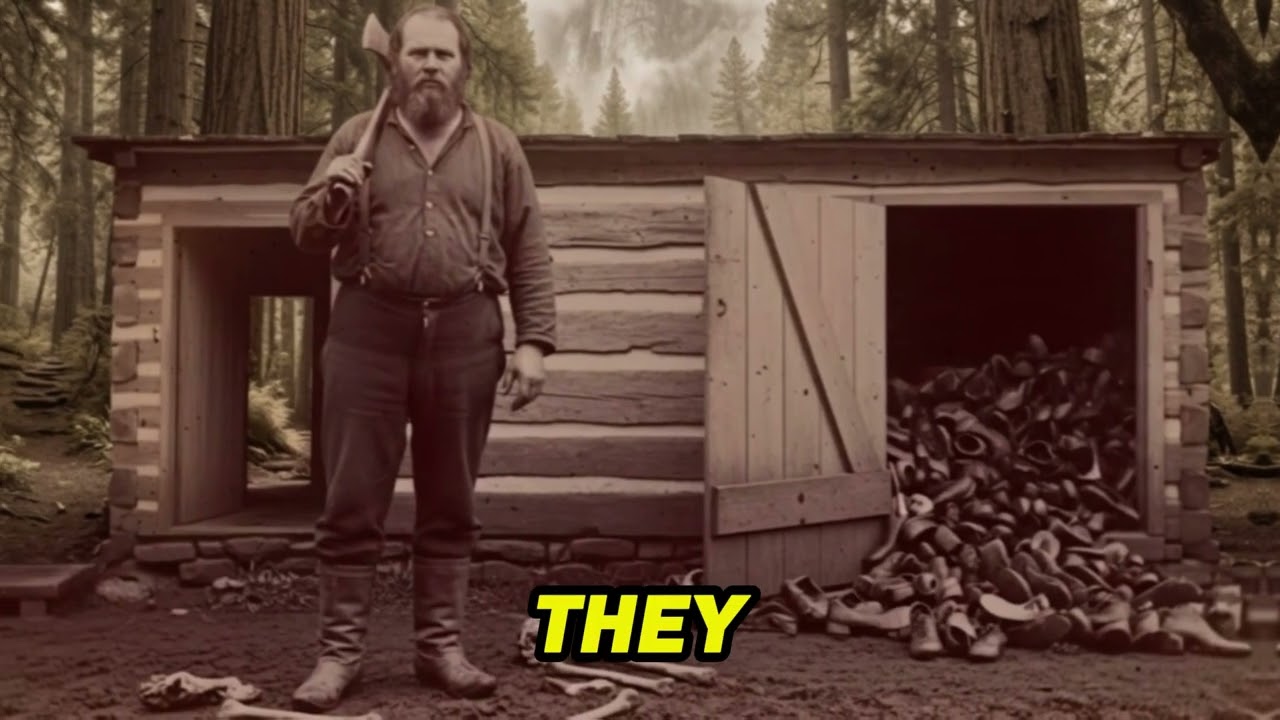
One shed contained nothing but shoes, dozens of pairs of worn shoes stacked against the walls. The house searches revealed records. The Kinszers kept ledgers listing people who had stayed at the property, what they had been carrying, and what had been done with them. Jeremiah’s daughter Sarah described the murders casually, like household chores.
She said her father would decide someone was not useful anymore, and the boys would take them into the woods. Then they would help bury them. No emotion, no sense that this was unusual. They found six graves that could be definitively confirmed as human remains.
Probably more. The bodies they could identify included a land surveyor who went missing in 1829 and a woman who had been traveling with her husband to reach family in Ohio. The husband was one of the men found alive in the barn. His wife had been killed three years earlier, and he had been kept as a laborer since.
Jeremiah acknowledged taking people’s property but characterized it as taxation for passing through his territory. He acknowledged holding people captive but described it as working off debts for hospitality received. As for the deaths, he claimed those people had died naturally or been executed for theft, theft from the Kinszers. He had constructed an entire legal framework in his head where he was the legitimate authority.
The trial took place in spring 1835. People traveled for days to attend. The prosecution’s case was overwhelming, physical evidence, survivors, the Kinszers’ own records. The defense argued diminished capacity based on isolation.
Their lawyer claimed the Kinszers were so removed from civilized society that they could not be held to its standards. The jury deliberated for two full days, unusually long for that era. The sticking point was whether people could be held criminally responsible for violating laws they did not recognize as legitimate. Eventually, Jeremiah and his three oldest sons were found guilty on multiple counts of murder.
The women were convicted as accessories. Jeremiah was sentenced to death by hanging, and his sons received the same. The execution was scheduled for August 1835. Three weeks before the scheduled execution, one of the sons, Thomas, died in custody.
The official report cited natural causes, possibly typhus, but other prisoners later reported he had deliberately ingested poison that had been smuggled into the jail, likely arsenic from preserved animal hides. He killed himself rather than face hanging. That night, Jeremiah and his two remaining sons attempted to escape. They did not make it far.
The commotion woke people in town, and armed citizens responded. In the darkness, all three Kinszer men were shot. Jeremiah died instantly. One son died within hours.
The third survived but was severely wounded. The official report called it a thwarted escape attempt, but rumors circulated immediately that Jeremiah had orchestrated a suicide plan, wanting his sons to die quickly from gunfire rather than suffer public hanging. Thomas’s poisoning had been a trial run. The truth was never established, but Jeremiah Kinszer had spent his entire life refusing to submit to authority he did not recognize.
Even in captivity, he found a way to control his own fate. The surviving son eventually recovered and was hanged as scheduled. The women served prison sentences and were later released, most disappearing into obscurity. The children were placed with families in the settlements.
The younger ones had some chance at adaptation, but the older children, thoroughly indoctrinated into the Kinszer worldview, struggled immensely. Sarah ran away three times, always heading back toward the mountains. The last time, she did not come back. She was found dead two months later, having walked into the wilderness without adequate supplies.
Another daughter, recorded only as Mary Kay, was placed in domestic service in Wheeling. She seemed to adapt, but her employer’s wife reported that Mary had no concept of property rights. She took things without any sense she was stealing. When confronted, she became confused and distressed because she genuinely could not understand what she had done wrong.
The Kinszer case sent shock waves through Appalachian communities. People began looking at isolated families differently. Several other households came under scrutiny. Communities established more regular patrols through remote areas.
County governments started trying to maintain records of who lived where. Traveling merchants began going in groups rather than alone. The Kinszer property was seized by the county. Nobody wanted it.
The hollow had a reputation, and people believed it was cursed. A family desperate for land eventually moved in but did not last two years before abandoning it, claiming the place felt wrong. The cabins fell into disrepair and collapsed.
Today, nothing remains but overgrown foundations and scattered stones.
