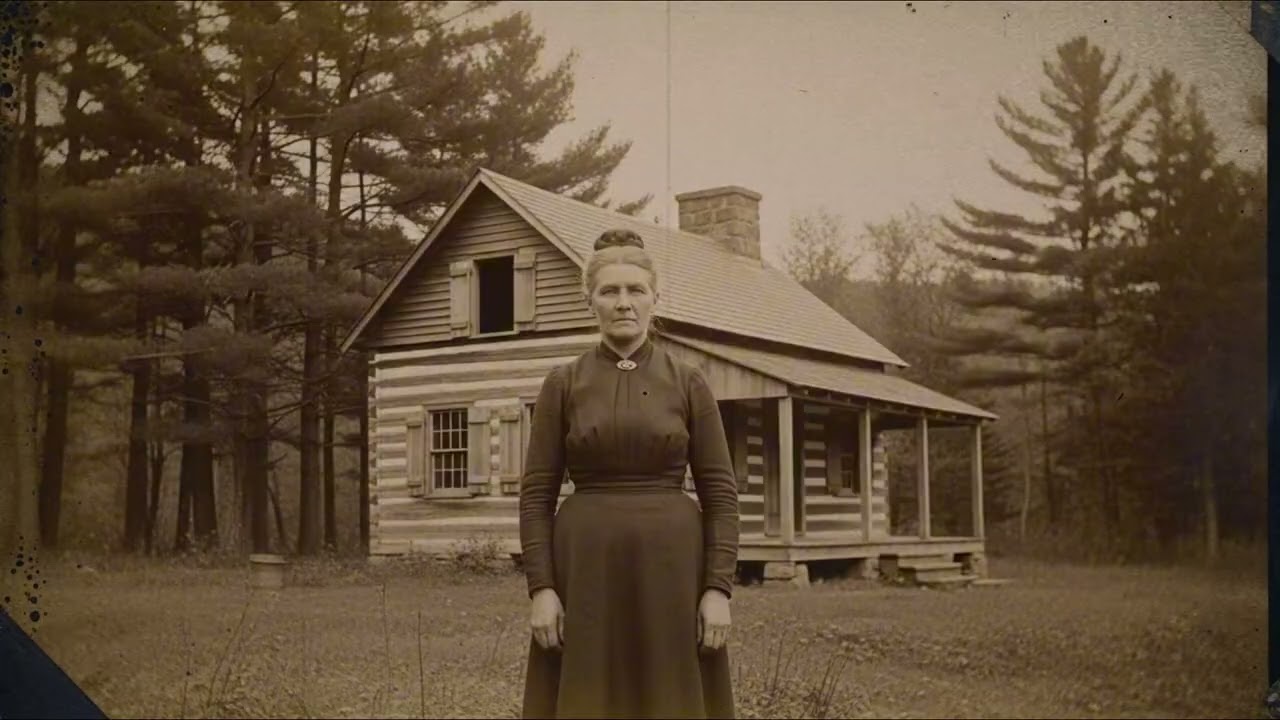
The path to the cabin wound higher into the mountains than the clerk had led Millicent Abernathy to believe. When Augustus finally stopped the borrowed truck in the clearing, the place was smaller than she had imagined, a simple structure of weathered logs with a stone chimney and shuttered windows that gave it a closed, watchful face. A thin stream of smoke rose from the chimney and vanished into the cold October air. “Someone is inside,” Augustus said, though he made no move to leave the truck.
“Impossible,” she replied, though uncertainty had crept into her voice. “The place is mine now. The papers are signed. ”
They sat in silence for a long moment, watching the cabin.
Millicent opened her door first. The porch steps groaned under her weight. She noticed that the shutters, though closed, had been recently oiled. A tidy stack of split firewood stood against the side of the house, and the small garden beside the cabin showed signs of recent care.
She knocked. No answer. She knocked again, harder. Nothing.
She tried the latch and found it unlocked. The single room was dominated by a stone fireplace in which a quiet fire burned. A rough wooden table with one chair stood in the center. A narrow bed occupied a corner, neatly made with a quilt.
Bundles of dried herbs hung from the rafters. Along one wall, shelves held rows of jars with preserved foods and other substances. The cabin was clearly inhabited, but empty, and it was this fact that disturbed Millicent most. She called out a greeting, and her voice sounded thin in the stillness.
Augustus appeared in the doorway, his usual composure replaced by visible unease. “There is something wrong,” he said. “A fire burning, but no one home. Who leaves a fire unattended?
”
Millicent moved deeper into the cabin and noticed the absence of dust or cobwebs. This was no abandoned dwelling. On the table lay an open journal, a pen resting across the page as if the writer had stepped away for a moment. She read the flowing handwriting despite herself.
“The birds were silent today, not a good sign. The forest holds its breath when strangers approach. The barriers must be reinforced before…” The entry ended mid-sentence. “We have to go,” Augustus said from the doorway.
“That clerk sold you an occupied property. But a deed means nothing here in the mountains. We need to talk to the sheriff. ”
A sudden gust through the open door made the fire flare.
The journal’s pages ruffled, and the pen rolled off the table, landing at Millicent’s feet with a click that sounded unnaturally loud. As she bent to pick it up, she saw something carved into the floorboards beneath the table: an intricate circular pattern with strange symbols around its circumference, like a compass from her school days but far more complex, with additional marks she could not decipher. “Let’s go,” Augustus insisted, visibly agitated. “We will settle this properly.
”
Millicent straightened, the pen in her trembling hand. “Yes,” she agreed, suddenly desperate to leave the cabin with its burning fire and absent occupant. “Yes, we should speak to the authorities. ”
As they turned to leave, a faint sound reached them.
Rhythmic knocking coming from somewhere beneath the floorboards. “It’s just the wind,” Millicent whispered, though the air outside was perfectly still. Augustus was already halfway to the truck. Millicent followed quickly, closing the cabin door behind her.
As she did, she could almost swear she felt resistance, as if someone on the other side was pulling the door. The drive to the settlement of Harwick Valley took nearly forty minutes along winding dirt roads. The settlement consisted of a general store, a post office, and a small building that served as both town office and police headquarters. Sheriff Ezekiel Harper was a broad-shouldered man with a weathered face and eyes that looked like they had seen their fair share of foolishness.
He listened to their story with an expression that shifted almost imperceptibly from polite interest to something harder to name. “The cabin up Stillwater Creek road? ” he asked when they finished. “Small place, stone chimney?
”
“Yes,” Millicent confirmed. “The county clerk, Mr. Abernathy, sold it to me. He said it was abandoned.
”
The sheriff exchanged a glance with the postmaster, Oren Wells, who had drifted over from his adjoining office, ostensibly to refill his coffee. “That’s Sophia Simmons’s place,” Oren said in a low voice. “It was never abandoned. Sophia is still there, as far as anyone knows.
”
“But Mr. Abernathy…”
Harper cut her off. “Frederick Abernathy would not set foot in that valley even if his life depended on it. Not after what happened to his brother on that road.
” He sighed, removed his hat, and ran a hand through his graying hair. “Ma’am, I don’t know what Abernathy told you, but that property was not his to sell. The county has no claim on it. ”
“But I have a deed,” Millicent insisted, pulling the paper from her bag.
Harper examined it briefly and handed it back with a grim expression. “The papers look official enough, but they should not exist. That land has belonged to the Simmons family for generations, and Sophia Simmons is alive and living there. ”
Augustus interjected that the cabin was empty, the fire burning but no one home.
Oren cut in, “Sophia comes and goes. She prefers solitude most of the time. Comes to town for supplies every few months. Strange woman, but she doesn’t harm anyone.
”
“Strange how? ” Millicent asked. The two men exchanged another look that lasted too long and communicated something she could not decipher. Harper finally answered.
“People here say she has knowledge of things best left alone. Healing ways, some call it. Others have less kind names. ”
“A witch?
” Millicent asked, unable to hide her astonishment. “Surely you don’t believe that. ”
“What I believe hardly matters,” Harper said. “What matters is that Sophia Simmons has lived in that cabin for thirty years.
And suddenly you show up with papers saying it’s yours. Papers signed by a man who has reason to wish that woman ill. ”
“What reason? ”
Another silence, heavier this time.
“This isn’t Burlington, Mrs. Abernathy,” Harper said at last. “Mountain people have long memories and different ways. Some say Sophia cursed Abernathy’s brother when he tried to court her in 1902.
True or not, he ended up dead a month later, found at the bottom of a ravine, despite knowing those woods better than anyone. Frederick has never forgiven her. ”
“Are you suggesting Mr. Abernathy forged these documents?
”
“I am suggesting you were deceived,” Harper said carefully. “And I advise you to seek lodging elsewhere while we sort this out. ”
“I spent nearly everything I have on that property,” Millicent said, her voice strained. “I have nowhere else to go.
”
Harper’s expression softened slightly. “Widow Packard takes boarders. I can arrange a room for you there, at least for a few days. As for your belongings, they will be safe enough in the truck for now.
”
“What about my property? ” Millicent asked. Harper promised to speak with Abernathy and try to locate Sophia. Until then, it would be best to leave the cabin alone.
Millicent opened her mouth to protest, but Augustus placed a hand on her arm. “Let’s do what the sheriff suggests, Millicent. Just until things are sorted out. ”
She reluctantly agreed, though the thought of draining her remaining funds on lodging filled her with dread.
As they turned to leave, Harper called out, “Mrs. Abernathy, a word of advice. If you do run into Sophia Simmons, be respectful. And whatever you do, do not mention the deed or make any claim on her home.
Mountain folk can be fiercely attached to their land. ”
The warning stayed with Millicent as Augustus drove them to the Widow Packard’s boarding house, a two-story building on the edge of the settlement that had clearly seen better days. The widow herself was a birdlike woman with sharp eyes that seemed to inventory everything Millicent owned as she showed her to a small room on the second floor. The room was clean but spare, with a narrow bed, a washstand, and a single chair beside a window overlooking an untended garden.
“Dinner is at six,” Mrs. Packard informed her. “No cooking in the rooms, no male callers after dark. ” Her gaze drifted toward Augustus, who was carrying Millicent’s single trunk.
Millicent explained he was her late husband’s cousin, kind enough to drive her from Burlington. Mrs. Packard sniffed. “You’re the one who bought the Simmons place.
”
“I thought I was buying an abandoned property,” Millicent replied cautiously. “Nothing is abandoned in these mountains,” the widow said. “Least of all that place. ” With that cryptic remark, she left, her footsteps creaking on the stairs.
Millicent sat on the edge of the bed, suddenly exhausted. Augustus apologized for his inability to do more. “If you need to get back to Burlington,” she reminded him, “I have sold the house. There is nothing left for me to return to.
”
He nodded stiffly. “I should be back before dark. The roads aren’t safe at night. ” He promised to return in a few days.
After he left, Millicent found herself truly alone for perhaps the first time in her life. From her window she could see the mountains rising in the distance, their peaks touched by early snow. Somewhere in those woods was her cabin, the home she had bought, the refuge she had sought, the house which, according to everyone in this strange town, belonged to someone else. Dinner that evening was strained.
Three other boarders sat with her: a traveling salesman who talked ceaselessly about button sales in Montpelier; an elderly man named Professor E. M. T. Blackwood, retired from the university in Burlington; and a quiet young woman named Ruth Bennett, who the Widow Packard whispered rather loudly had come to town to escape trouble in Rutland.
The conversation flowed around Millicent until the inevitable questions turned toward her. When the salesman asked what brought her to their small corner of nowhere, Mrs. Packard answered for her. “She bought the Simmons place.
”
The reaction was immediate. The salesman’s fork froze mid-air. Ruth Bennett’s eyes widened. Only Professor Blackwood showed no surprise, merely a flicker of interest as he regarded Millicent over his spectacles.
“The witch’s cottage? ” the salesman asked at last. “Why in God’s name would you want that place? ”
“I was not aware of its reputation,” Millicent said stiffly.
“Or that it was still occupied. ”
“Oh, it’s occupied all right,” the salesman said, lowering his voice conspiratorially, “though not always by things you would want to meet. That woman is unnatural. The things she does out there in those woods.
”
“Nonsense born of superstition,” Professor Blackwood cut in, his cultured voice slicing through the salesman’s innuendo. “Miss Simmons is simply an herbalist with knowledge of traditional medicine. Knowledge that threatens those who prefer their women ignorant and pliable. ”
“Easy for you to say, Professor,” Finch retorted.
“You haven’t lost livestock to her concoctions or found your well water fouled after she passed by your property. ”
“Post hoc ergo propter hoc,” Blackwood replied mildly. “After this, therefore because of this. It is a logical fallacy, Mr.
Finch. ”
“I don’t need your fancy Latin,” Finch shot back. “I know what I saw. ”
“What exactly did you see?
” Millicent heard herself ask. All eyes turned to her. “Lights,” Finch said after a moment. “Lights in the forest where there should be no lights.
Strange sounds. Animals acting oddly. And anyone who crosses her always meets with bad luck. Just coincidence and imagination.
The human mind seeks patterns and explanations, especially for negative events in our lives. It is far easier to blame a solitary woman than to accept the random cruelty of fate. ”
“My cousin came down with a fever after Sophia refused to sell him ginseng root,” Mrs. Packard added.
“He was delirious for three days before the fever broke. ”
“And did no other child in the area suffer fever that season? ” Blackwood asked. “It is not just fever and bad luck,” Ruth Bennett spoke up, her voice so soft they all leaned in to hear.
“It is the way the birds go silent when she walks through the woods. The way the animals watch her, as if waiting for her orders. ” An uncomfortable silence fell around the table, broken only by the ticking of a grandfather clock in the next room. “Well,” Millicent said at last, “I suppose I will have to form my own impressions, if Sheriff Harper can find Miss Simmons.
”
“Oh, he won’t have to look far,” Ruth said, her eyes fixed on the dark window behind Millicent. “She always knows when someone is talking about her. ”
Despite herself, Millicent turned to look through the window, half expecting to see a face staring back from the darkness. But there was only the reflection of the dining room.
Later that night, a soft knock came at her door. She opened it to find Professor Blackwood holding a leather-bound book. “Forgive the intrusion, Mrs. Abernathy,” he said quietly.
“I thought you might find this of interest given your situation. ” She took the book and read the title. *Folk Practices of the Green Mountains: An Anthropological Study*. “My own work,” he confirmed.
“Twenty years of research into the traditions and beliefs of rural Vermont. There is a chapter on Harwick Valley that might prove illuminating. I have marked the relevant passages. ”
She thanked him, hoping her stay here would be brief.
The sheriff had promised to sort out the misunderstanding regarding her property. Blackwood’s expression grew serious. “Mrs. Abernathy, I feel I must warn you.
Whatever your legal claim to that cabin, it sits on land with a complicated history. The Simmons family has been in this valley since before it had a name. Their connections run far deeper than a paper deed. ”
“You sound as though you believe the rumors about Miss Simmons,” Millicent observed.
“I believe knowledge takes many forms,” Blackwood replied carefully. “Miss Simmons represents a tradition that predates our modern understanding. Whether you call it folk medicine, earth wisdom, or something more sinister depends largely on your perspective. ”
“Then you have met her?
”
“Several times during my research. She was one of my most valuable sources, though she shared only what she chose to share. ” He smiled faintly. “Sophia Simmons is many things, Mrs.
Abernathy, but she is not the monster town gossip would have her be. She is, however, a woman who values her seclusion and independence, and she is deeply connected to that cabin and the land beneath it. ”
“Connected enough to fight for it? ”
“I imagine that depends on you,” Blackwood said enigmatically.
“Good night, Mrs. Abernathy. ” Before she could question him further, he had turned and disappeared down the hall. Sleep was elusive that night.
The unfamiliar sounds of the boarding house kept Millicent on edge, and when she finally drifted off, her dreams were filled with disjointed images: a cabin with windows like watching eyes, a circular pattern carved into wooden floors, a fire that burned but never consumed its fuel. She woke repeatedly, each time convinced that someone was in the room with her, watching from the dark corners. By morning, exhaustion left her with a dull headache and a feeling of unreality. The sheriff had come by the house, Mrs.
Packard told her at breakfast. He wished to see her at his office. The walk took less than five minutes along the single main street. Harper was seated behind his desk, a stack of papers before him and a deeply concerned expression.
He rose when she entered and gestured to the chair opposite. “Mrs. Abernathy,” he began, then seemed unsure how to continue. “I have had occasion to look into your situation.
It is more complicated than it first appeared. Frederick Abernathy admits to selling you the property, but he insists he had the legal right to do so. According to county records, which I reviewed myself this morning, Sophia Simmons has not paid property taxes in three years. The land should have reverted to the county last spring.
”
“So my purchase is valid,” Millicent said, a wave of relief washing over her. “Technically, yes,” Harper conceded. “But there is more. I also tried to find Miss Simmons.
She was not at the cabin, and the few in this valley who would take her in have not seen her. No one has seen her in at least a week. And there is the matter of the fire you found burning. Sophia would never leave a fire unattended.
She is too careful for that. ”
A cold feeling spread through Millicent’s chest. “What are you suggesting, Sheriff? ”
Harper leaned forward, lowering his voice.
“I am suggesting that something is not right. Sophia is missing. Her cabin shows signs of recent habitation but no signs of packing or planned departure. And suddenly you appear with a deed to a property that should never have been for sale.
I have sent word to neighboring towns asking if anyone has seen her, but given her reputation…” He straightened in his chair. “In the meantime, the deed you hold is legal, though questionable in its ethics. The cabin is yours, Mrs. Abernathy, at least until Miss Simmons returns to contest it.
”
“And if she does not return? ”
Harper’s gaze was direct. “Then I suppose you have acquired a mountain cabin. Whatever it is worth.
” She pressed him on what that meant. “It means that cabin has a history, Mrs. Abernathy. A history that does not disappear just because the owner changes.
Sophia Simmons lived there for decades. Her mother before her, her grandmother before that. Locals say the land remembers. ”
“The land remembers?
” Millicent repeated with disbelief. “Sheriff, I expected more scientific thinking from a man of law. ”
“Science explains a lot,” Harper conceded. “But not everything.
Not in these mountains. ” He stood, signaling the meeting was over. “You are free to take possession of the cabin. I can arrange for Jedidiah Stone to drive you up there with your belongings.
”
Millicent agreed, eager to establish herself. Harper promised to send Jedidiah to the boarding house at noon. As she turned to leave, he added, “One more piece of advice, if you will take it. That circular mark you mentioned seeing on the floor.
I would advise you to leave it as it is. Some protections are best not tampered with, whether you believe in them or not. ”
“Protection from what? ” Millicent asked.
Harper’s expression was grim. “If you are lucky, Mrs. Abernathy, you will never have to know. ”
The drive to the cabin was made in near silence.
Jedidiah Stone was a man of few words who seemed disinclined to conversation beyond basic courtesies. Only as they turned onto the rough track leading to the cabin did he finally speak. “You plan on staying up here alone? ”
“Yes,” Millicent said.
“Self-sufficiency has always been my way. ” He grunted. “Self-sufficiency in Burlington is not self-sufficiency in these mountains. Winter is coming.
Do you know how to split wood, keep a fire going through the night, keep your pipes from freezing, keep animals out of your stores? ”
“I imagine I will learn. ”
“Learning is expensive in winter,” Jedidiah observed. “Mistakes cost more than comfort out here.
Could cost you your life. ”
The cabin stood in the clearing as before, its shuttered windows like closed eyelids. But this time there was no smoke rising from the chimney. “Looks like she has truly gone,” Jedidiah commented as he stopped the truck.
“Sophia never let the fire go out, not even in summer. Said it kept things away. ”
“Things? ” Millicent echoed.
He shrugged, already climbing out of the truck. The interior was exactly as she remembered: the neatly made bed, the table with its single chair, the shelves with their jars, the hanging herbs. The only differences were the cold hearth and the absence of the journal that had been open on the table. No sign of the pen either.
While Jedidiah brought in her trunk and supplies, Millicent set about relighting the fire. It had been years since she had performed such a task, but the memory returned as she arranged the wood, struck a match, and tended the small flame until it caught properly. There was something deeply satisfying about the growing warmth. As Jedidiah finished his task and prepared to leave, he stood at the threshold, examining the cabin with an unreadable expression.
“Remember, bank the fire well at night. The chimney needs regular cleaning or you risk burning the place down. Spring water is good, but boil it first anyway. Keep your food hung high or the critters will get to it.
” He hesitated, seeming to argue with himself before continuing. “If you hear anything unusual in the night, do not investigate. Stay inside, keep the fire going, and wait for morning. ”
“What would I hear?
” Millicent asked, unable to hide the tension in her voice. Jedidiah’s expression remained flat. “Wind. Animals.
The stillness of the forest. Nothing to worry about if you stay inside after dark. ” With that cryptic advice, he left, leaving Millicent truly alone for the first time since arriving in Harwick Valley. The afternoon passed quickly as Millicent familiarized herself with her new home.
The cabin was indeed small, but it was solidly built and surprisingly comfortable once the fire had warmed it. The single room contained everything a person might need: a bed, a small wardrobe, a table and chair, storage shelves, and a primitive kitchen area with a cast-iron stove and a dry sink. A hand pump beside the sink brought water from the spring Jedidiah mentioned. The shelves sparked Millicent’s curiosity.
They held dozens of glass containers of various sizes, each labeled in the same flowing handwriting she had seen in the missing journal. Some contained what appeared to be preserved foods: berries, mushrooms, vegetables. Others held dried herbs, powders, or liquids of various colors. Still others contained things Millicent could not immediately identify: twisted roots, small bones, feathers, stones, and what appeared to be dried insects.
One shelf held actual books, cracked and faded with age. Millicent ran her fingers over them, reading titles ranging from the practical to the mysterious. Among them was a volume with no title at all, bound in dark leather and covered with strange symbols. As she explored, Millicent found her curiosity about Sophia Simmons growing.
The woman seemed a contradiction: organized yet eccentric, practical yet perhaps superstitious. During her examination of the bed, Millicent made her first truly disquieting discovery. When she lifted the quilt to inspect the mattress, she found another circular pattern carved into the wooden frame, similar to the one beneath the table but with different symbols around its circumference. This pattern seemed to incorporate what might be letters from an unfamiliar alphabet, interspersed with images that appeared to be phases of the moon.
She replaced the quilt with slightly trembling hands, trying to dismiss it as the strange ornamentation of a reclusive mountain woman. But combined with the circle under the table, it suggested a pattern pointing to deeper beliefs or fears. By evening, Millicent had unpacked her belongings, prepared a simple meal from her supplies, and settled into something approaching comfort. The fire crackled reassuringly in the hearth.
The lamps cast a warm glow over the small space, and for the first time since Victor’s death, Millicent felt something like peace. But as full darkness fell, the cabin’s atmosphere began to change subtly. The corners grew darker with shadows, and the silence outside became more acute. Millicent found herself listening for anything beyond the crackle and hiss of the fire.
When the sound finally came, it startled her so badly she nearly spilled her tea. A sharp metallic knocking, like a small hammer striking an anvil, seemed to come from beneath the floorboards. Knock. Knock.
Knock. Pause. Knock. Knock.
Knock. Millicent froze, Jedidiah’s warnings echoing in her ears. The knocking continued for perhaps a minute, maintaining its steady rhythm, before stopping abruptly. The following silence felt more oppressive than before, charged with anticipation.
She set down her tea with a hand that refused to stay steady, rose, and moved to the nearest window. Drawing back the rough curtain, she peered into the darkness. The moon, just past half-full, cast a silver light over the clearing, revealing only the silent trees and their long shadows stretching toward the cabin like grasping fingers. As she watched, she caught movement at the edge of the forest.
Something pale was moving among the trees, too quick to make out, too deliberate to be a trick of the eye. She pressed closer to the glass, her breath fogging the pane. There it was again: a flash of white, like a garment or perhaps pale hair, disappearing behind a huge pine and emerging moments later from behind another tree, closer now to the cabin. Whatever it was seemed to be circling the clearing, moving with a fluid grace that suggested neither human nor animal but something between.
She let the curtain fall, her heart pounding painfully in her chest. The knocking started again, louder this time, more insistent. Knock. Knock.
Knock. Knock. Pause. Knock.
Knock. Knock. Knock. Millicent moved to the center of the room, staring at the floor, trying to locate the precise source of the sound.
It seemed to emanate from beneath the circular carving under the table, the same one the sheriff had warned her not to disturb. A sudden scratching at the door made her gasp audibly. It was a light sound, like nails being drawn gently across the wood, but in the quiet cabin it seemed to fill the space. Scratch, scratch.
Pause. Scratch, scratch. Pause. Millicent backed away until her legs hit the edge of the bed.
The scratching continued, now accompanied by what sounded like faint whispering, too indistinct to make out words, but its rhythm was unmistakably like speech. “Who is there? ” Millicent called out, trying to keep the tremor from her voice. “Show yourself.
” The scratching stopped abruptly. The whispering ceased. Even the knocking beneath the floor fell silent. For a long, tense moment, nothing happened.
Then the door handle began to turn slowly. Millicent watched, paralyzed, as the handle turned fully. Only the latch, which she had bolted in a fortunate moment of caution, prevented the door from opening. The handle remained turned for several seconds before gradually returning to its original position.
Another silence followed, so complete that Millicent could hear the blood rushing in her ears. Just as she began to think that whoever had been outside had left, a new sound emerged. A faint, melodic humming seemed to come from everywhere around the cabin. It was a tune with no recognizable structure, notes wandering and overlapping in a pattern that defied conventional music, yet possessing a strange, haunting beauty.
Almost against her will, Millicent found herself drawn back to the window. Parting the curtain again, she peered out at the moonlit clearing. Standing at the edge of the forest was a figure: a tall woman, straight-backed despite her apparent age, with long silver hair flowing freely around her shoulders. She wore a simple garment of undyed cloth that seemed almost luminous in the moonlight, and her feet were bare despite the autumn chill.
As if sensing Millicent’s gaze, the woman turned, revealing a face neither young nor old, a face with an ageless sharpness, prominent cheekbones, a strong jaw, and eyes that seemed, even from this distance, to pierce through glass and shadow to fix directly on Millicent’s own. The humming grew louder, though the woman’s lips did not appear to move. She raised one hand, palm outward, and made a complex gesture in the air, a pattern that seemed to leave a momentary trail of light in its wake. The fire in the hearth flared suddenly, sending sparks up the chimney with a roar that made Millicent scream.
When she looked back at the window, the woman was gone, the forest edge empty once more. Millicent spent a restless night, dozing fitfully in the chair rather than the bed. She kept the fire burning higher than necessary, defying Jedidiah’s advice about economy. Every time she drifted toward deeper sleep, some sound, real or imagined, snapped her back to wakefulness: a branch scratching the roof, wind moaning through the chimney, a distant howl that might have been a wolf or perhaps a farmer’s dog.
By morning, exhaustion had left her with burning eyes and a confused mind. The events of the night seemed dreamlike in the bright daylight, and Millicent wondered if she had imagined the knocking and scratching, the figure at the forest edge. After breakfast, she decided to properly explore the property. The clearing was larger than it had seemed at first, extending perhaps fifty yards in every direction before the forest closed in.
At its eastern edge, a well-worn path led into the trees, presumably toward the spring. Millicent followed it, noting the extraordinary care it had received. Someone had recently removed fallen branches and trimmed encroaching shrubs. The spring itself was a stunning discovery.
A clear pool about six feet in diameter, fed by water bubbling up between moss-covered rocks, was sheltered by a simple but effective wooden structure that protected the water from falling leaves and provided a small platform for drawing from it. A wooden bucket and rope were attached, ready for use. Filling the bucket as an experiment, Millicent found the water icy cold and sweet. She could understand why Sophia had chosen this location for her home.
On her way back to the cabin, Millicent noticed something she had missed before. Just beyond the northwestern edge of the clearing, partially hidden behind a cluster of young birch trees, stood what appeared to be a small stone structure. Setting down the bucket, she made her way toward it. The structure was a simple stone hut, perhaps eight feet square, with a low doorway and no windows.
Its walls were built of rough stones fitted together with surprising skill, and its roof was a massive slab of slate that must have required considerable effort to position. The entrance was closed not by a proper door but by an intricate arrangement of woven branches bound together with what appeared to be leather thongs. Hanging from this barrier were dozens of small objects: feathers, bones, stones with holes drilled through the center, small cloth bundles, and metal charms that tinkled faintly in the breeze. The overall impression was simultaneously primitive and artful, creating a barrier that appeared fragile but was in fact more formidable than any solid door.
Millicent hesitated, her hand reaching halfway toward the woven branches. The sheriff’s warning echoed in her mind. Whatever this structure was, it was clearly important to Sophia Simmons, important enough to require protection, whether practical or of the superstitious kind. As she stood there, a soft rustling sound came from the forest behind her.
She turned quickly, expecting to see the silver-haired woman from the previous night. Instead, she found herself facing a huge raven perched on a low branch less than ten feet away. The bird watched her with an intelligence that seemed to exceed ordinary animal awareness. It tilted its head slightly, as if curious or trying to assess the situation.
“Shoo,” Millicent said weakly, making a feeble gesture with her hand. The raven did not move, did not even blink. It continued to stare with unnerving focus. A sudden gust of wind moved the branches overhead, sending a shower of yellow leaves between Millicent and the bird.
When her vision cleared, the raven was gone, the branch empty as if it had never been there. Disturbed, Millicent retreated from the stone hut. She retrieved her bucket and returned to the cabin, unable to shake the feeling that she had narrowly avoided crossing some invisible boundary. Inside, she busied herself with practical tasks: arranging her belongings, inventorying the preserved foods on the shelves, which she decided would supplement her own supplies well through the winter, and planning the additional items she would need to purchase on her next trip to town.
While examining the woodpile, she found the second journal. Unlike the one that had been on the table, which had mysteriously vanished between her first and second visits, this book was older, with a worn, cracked leather cover and pages yellowed with age. It had been carefully tucked between two logs, as if deliberately hidden but with the expectation that someone searching for firewood would find it. Millicent brought it inside and sat by the fire to examine her find.
The journal was filled with the same flowing handwriting she had seen before, but this writing was older. The ink had faded to a rusty brown in places. The earliest entries dated from 1902, more than thirty years before. Most were ordinary records of weather, harvests, herb gathering, and local events.
But interspersed among these mundane records were passages of a very different nature: descriptions of rituals performed at specific phases of the moon, records of dreams filled with symbolic imagery, references to Watchers and those who waited beyond the circle. One entry in particular caught Millicent’s attention. Dated October 12, 1903, it read: “Vernon Prentice came again today. His persistence is wearisome.
I have explained that my path is necessarily solitary, not by choice. But he refuses to understand. What we keep at bay here cannot be left unguarded, not even for the comfort of companionship. Mother was right.
The responsibility passes only through death, and even then, the transition must be accepted willingly. There is no escape through marriage, no relief in sharing the burden. The circle must remain unbroken, the watch never ceasing. ”
Vernon Prentice.
The name struck a chord in Millicent’s memory. Sheriff Harper had mentioned Frederick’s brother, the one who had courted Sophia and then died in the forest under mysterious circumstances. Continuing to read, Millicent found more references to Vernon, each entry showing growing tension. November 5, 1903: “Vernon brought flowers today.
Dead things offered to one who preserves life. He does not understand what haunts these woods, what would emerge if the barriers failed. His brother Frederick watches from a distance, resentment in every line of his body. At least one Prentice has the wisdom to fear what should be feared.
” December 17, 1903: “The winter solstice approaches. The veil grows thin. The knocking beneath the floor grows more insistent each night. Vernon promises to return at Christmas with a gift.
I have warned him to stay away during the dark days of the year. Some warnings should be heeded. ” January 2, 1904: “Vernon is missing. The town blames me, though no one dares say it to my face.
Frederick’s eyes carry accusation and fear in equal measure. If they only knew what truly dwells in the depths of the forest, they would thank me for the protection I provide instead of whispering about curses and vengeance. ” January 18, 1904: “They found Vernon today at the bottom of Black Rock Ravine. Frederick led the search party.
The official report says he lost his way in the dark and fell. Only Frederick suspects otherwise, but even he cannot imagine the truth. It was not my hand that pushed Vernon, but my unheeded warning that led him to the place where other hands could reach. The forest is not safe when the veil is thin.
I would mourn him if I could spare the energy from the work that must never stop. ”
Millicent closed the journal with trembling hands. The implications were disturbing. If she had read the writings correctly, Sophia had warned Vernon Prentice of danger in the forest, a warning he disregarded, leading to his death.
But what was the veil? What were the other hands that could reach through when it grew thin? And most importantly, what was the work Sophia was doing that must never stop? What protections was she maintaining?
The circular patterns carved into the floor and bed frame took on new significance. Not mere superstitious ornamentation, but symbols with purpose and intent. If the journal was to be believed, those circles and their like were all that stood between this quiet spot and an unnamed horror waiting in the depths of the forest. But this was absurd.
Millicent had never been a superstitious woman. The idea that symbols carved into wood could repel supernatural forces belonged to folklore and campfire stories, not reality. And yet, there was the knocking beneath the floor, the scratching at the door, the figure in the moonlight whose gestures left trails of light in the air, the raven that watched with unnerving intelligence, the stone hut with its barrier of woven branches and strange charms. As evening approached once more, Millicent lit the fire and prepared for another night.
She was determined to get a proper rest this time. She moved the bed slightly, positioning it so that the circle carved into its frame aligned with the larger circle beneath the table. Whether this came from genuine belief or merely a desire for any possible protection, she found the arrangement comforting. As darkness fell, she performed her evening rituals and changed into her nightgown.
Perhaps tonight would pass without incident. Perhaps the knocking would not come. It began before she had even extinguished her lamp. Knock.
Knock. Knock. Pause. Knock.
Knock. Knock. Just as it had the previous night, but earlier this time, as if whatever made the sound was eager and impatient. Knock.
Knock. Knock. Knock. Knock.
The rhythm accelerated, becoming more insistent. Millicent stood still, listening. The sound was definitely coming from beneath the floor, specifically from the point where the two circles now intersected. As the knocking quickened, she felt a faint vibration running through the floorboards, as if something was striking the ground beneath the cabin with increasing force.
She moved cautiously to the window and drew back the curtain. The clearing lay bathed in moonlight, but no figure stood at the forest edge this time. Instead, the trees themselves seemed to be in motion, not swaying with wind, the night was still, but rippling with a rhythm that matched the knocking beneath the floor. The knocking stopped suddenly, leaving a profound silence that made Millicent’s ears ring.
Then, from the forest, came a new sound: a sharp howl that began low and rose in pitch until it was nearly unbearable. A sound carrying such desolation and hunger that goosebumps broke out on Millicent’s arms despite the warmth of the cabin. The howl faded, replaced by whispering, the same indistinct murmur she had heard the previous night but now multiplied, as if dozens of voices were speaking at the edge of hearing. The words remained unintelligible, but the tone conveyed urgency and anticipation.
Millicent retreated from the window, her heart hammering against her ribs. “Who is there? ” she called out. “What do you want?
” The whispering stopped abruptly. Then, to Millicent’s horror, a reply came not from outside the cabin but from directly beneath the floor where the circles intersected. “Let us in. ” The words were distorted, as if spoken from behind water or thick cloth.
Each syllable was elongated and somehow mispronounced. “The circle weakens. Let us in. ”
Millicent pressed her hands over her ears, unwilling to hear more.
This could not be happening. It was a trick, a cruel prank by the locals to frighten the city woman away from the witch’s cottage. Or perhaps it was her own imagination, fed by exhaustion and the suggestive passages she had read in Sophia’s journal. Even through her covered ears, she could feel the floorboards vibrating beneath her feet, as if something massive was pressing up from below the cabin.
The wood groaned, and a fine crack appeared in one board directly above the center of the circle. In desperation, Millicent snatched up the journal she had found and opened it, flipping through the pages frantically, searching for anything that might explain what was happening or tell her how to stop it. Near the end of the book, she found an entry that made her blood run cold. “The barrier weakens in my absence.
Three days is the longest I dare to be away. After that, the symbols must be renewed with blood freely given, or what lies below will find a way through. This is the burden of the Simmons women, to maintain the seal that our ancestors helped create to keep the door closed, the door that should never have been opened. The blood must come from the guardian, and be given willingly.
It is a burden passed only through death or willing acceptance. ”
Blood freely given. Millicent looked at the crack in the floor, which was visibly widening now, wood splinters rising as if pushed from below. Without conscious thought, she found herself reaching for the kitchen knife lying on the table.
No. This was madness. She would not wound herself to appease a superstitious delusion. There had to be another explanation, another solution.
The fire in the hearth flared suddenly, exactly as it had the previous night. Sparks erupted upward with a loud whoosh. In its brief flash, Millicent caught sight of something that made her gasp: a small glass vial hanging from one of the rafters, half hidden among the dried herbs. The vial contained a dark liquid that looked black in the firelight but might have been deep red.
Blood. Preserved blood. Whether it was Sophia’s own or from another source, Millicent could not know, but the implication was clear. With trembling hands, Millicent reached up and took down the vial.
Its glass was warm to the touch, as if someone had just held it. The stopper came out with a small pop, releasing a coppery scent that confirmed her suspicions. The crack in the floor had widened enough that Millicent could now see darkness below. Not the expected earthen or stone foundation, but a void of absolute blackness from which emanated an intense cold that seemed to steal the warmth from the air.
Moving quickly, driven by instinct rather than rational thought, Millicent poured the contents of the vial into the widening crack. The liquid seemed to hang in the air for a moment, neither dripping nor spreading, before being suddenly pulled downward as if swallowed by the void. A sound like a gasp came from beneath the floor, followed by a hiss that might have been anger or pain. The pressure on the floorboards ceased abruptly.
The vibration stilled. The crack stopped widening. Millicent stood frozen, the empty vial still in her hand, waiting to see what would happen next. A long, tense minute passed in perfect silence.
Then, from deep beneath the cabin, came a sound like a massive door slamming shut, a deep, resonant boom that she felt in her bones. The fire settled back to normal, its excess brilliance fading to a more ordinary glow. Outside, the trees grew still. The whispering ceased.
Silence prevailed. Millicent collapsed onto the edge of the bed, her legs no longer able to support her weight. What had just happened? Had she truly faced something supernatural, or was she losing her mind?
The evidence was before her: the cracked floorboard, the empty vial. If what had happened was real, then Sophia Simmons was not merely an herbalist with odd beliefs. She was a guardian, maintaining a barrier against something, something that dwelled beneath the cabin, or perhaps beneath the entire mountain, something that wanted to get in. And if Sophia was missing, if she had been absent for more than the three days mentioned in her journal, then the responsibility for maintaining that barrier had passed, however temporarily, to the cabin’s new occupant, to Millicent.
The thought was terrifying and absurd in equal measure. Millicent had come to Harwick Valley seeking a simpler life, a refuge from the difficulties of widowhood and economic hardship. Instead, she had stumbled into something ancient and inexplicable, something that required belief in forces beyond her comprehension. Yet the alternative, dismissing what she had experienced as delusion or trickery, seemed increasingly less plausible.
Whatever had pushed against the floor had been real enough to crack solid wood. Whatever had spoken from below had been clear enough for her to understand its words. Exhaustion overwhelmed her suddenly, a bone-deep weariness that made even fear seem distant and unimportant. Millicent lay down on the bed, not bothering to extinguish the lamp or properly bank the fire.
Her last thought was a simple, desperate hope. Let the morning bring clarity. She dreamed of circles within circles, of symbols that moved and shifted when not directly observed, of a door in the earth and what waited behind it, patient, hunger, ancient, beyond measure. She dreamed of Sophia Simmons, her silver hair flowing like water, her hands weaving patterns in the air that left trails of light behind them.
In the dream, Sophia spoke, but her words were lost beneath the sound of knocking from below, a rhythm that matched the beating of Millicent’s own heart. She woke with a start, disoriented to see sunlight streaming through the cabin’s windows. She had slept through the rest of the night and well into the morning, a deep, dreamless sleep after those first disturbing images. The fire had burned down to embers.
The lamp had consumed its oil and gone out on its own. Yet Millicent felt more rested than she had in days. Rising, she moved immediately to examine the floorboard that had cracked during the night’s strange events. To her astonishment, the board appeared perfectly intact.
No crack, no splinters, no sign that anything had happened at all. Had she imagined it? Had the entire experience been a waking nightmare? But the empty vial sat on the table, its stopper beside it.
And Millicent was certain she had not moved the bed to align with the circle beneath the floor. Yet there it was. Disturbed, Millicent went through her morning routine mechanically, her mind racing with possibilities and implications. If what had happened was real, she needed answers, not just for her peace of mind, but perhaps for her survival.
And there was only one person who could provide those answers. Sophia Simmons. But Sophia was missing. According to Sheriff Harper, no one had seen her in at least a week.
Yet there had been someone in the clearing two nights ago, a figure matching Sophia’s description. Was that Sophia herself, returning to her cabin only to find it occupied by a stranger? Or was it something else, something wearing her shape? Millicent shuddered at the thought.
She needed to speak with someone who knew more about the cabin, about Sophia, about the strange events that seemed to center on this small clearing in the vast forest. Professor Blackwood had mentioned meeting Sophia during his research. He had given Millicent that book on folk practices, clearly anticipating that she might need the information it contained. Perhaps he knew more than he had initially shared.
The decision was made. Millicent dressed quickly and prepared for the walk to town. It was a long walk, several hours at least, but she had no other means of transport. Before leaving, she checked carefully that the cabin was secure, paying particular attention to the circular pattern beneath the table.
It showed no signs of damage or disturbance. But as a precaution, Millicent sprinkled a line of salt around the perimeter of the room, a folk remedy against evil spirits she had read about in her youth and never forgotten. The walk to Harwick Valley was exhausting but not unpleasant. It was a crisp, sunny autumn day, and the forest was alive with the rustle of falling leaves and the occasional chatter of squirrels preparing for winter.
Following the narrow track Jedidiah’s truck had taken, Millicent found herself appreciating the wild beauty of the mountains in a way she never had before. It was early afternoon by the time she reached the outskirts of the small settlement. Her first stop was the boarding house, hoping to find Professor Blackwood still in residence. Mrs.
Packard told her he was still in town but taking his lunch at the small café attached to the general store. She found him there, seated alone at a corner table, an open book beside his plate. He looked up as she approached, his face registering recognition then concern. “Mrs.
Abernathy,” he greeted her, rising. “This is unexpected. Is everything all right at the cabin? ”
“May I join you, Professor?
” Millicent asked, suddenly aware of how she must look, flushed from the long walk, her hair escaping its pins, her dress wrinkled and dusty. “Of course,” he gestured to the empty chair opposite. Once settled with tea and a bowl of hearty soup, Blackwood leaned forward, his expression serious. “Now, what brings you to town on foot?
Has something happened? ”
Millicent hesitated, unsure how to begin, how much to reveal. Would he think her mad if she spoke of knocking beneath the floorboards, voices in the darkness, blood sealing a barrier against unspeakable horrors? “I found a journal,” she said at last.
“Sophia Simmons’s journal. It contains some disturbing entries, references to Watchers and those who wait beyond the circle, to a veil that thins and a seal that must be maintained. ”
Blackwood’s expression remained neutral, but Millicent noticed his hands tightening around his teacup. “I see,” he said after a moment.
“And have you found anything else? Have you experienced anything unusual? ”
Millicent took a deep breath and told him everything: the knocking, the scratching, the figure in the moonlight, the voices, the floorboard that had cracked and somehow repaired itself by morning. She described finding the vial that seemed to contain blood and how instinct had led her to pour it into the widening crack.
Throughout her narration, Blackwood listened with rapt attention, his expression growing increasingly grave. “I know how it sounds,” Millicent concluded. “Like the delirium of an exhausted mind. But I swear to you, Professor, these things truly happened, and I need to understand why.
What was Sophia protecting the place from? What lies beneath that cabin? And where is she now when her presence seems so necessary? ”
Blackwood was silent for a long moment, his gaze distant, as if weighing how much to reveal.
At last, he sighed and closed the book that lay beside his plate. “What I am about to tell you, Mrs. Abernathy, is known to very few outside Harwick Valley, and even here, it has become more legend than history. The full truth has been preserved essentially by two groups: scholars like myself who study folk practices, and the Simmons family, who have carried the burden of guardianship for generations.
” He paused, ensuring no one was listening. The café was nearly empty, the few patrons absorbed in their own conversations far from their corner table. “In 1796, when this valley was first settled, seven families established homesteads along what is now known as Stillwater Creek. Among them was Abraham Simmons, a man with knowledge of certain esoteric practices he had brought with him from the old world.
The winter of 1796-1797 was particularly harsh, and with food running low, tensions rose among the settlers. There are records of strange behaviors: people speaking in languages they had never learned, sleepwalking toward the forest, reporting dreams of an entity promising abundance in exchange for sacrifice. By spring, three of the original families had vanished completely. Their cabins stood empty, their possessions left behind as if they had simply departed.
The remaining settlers, led by Abraham Simmons, conducted searches, but they found no trace of their neighbors: no bodies, no signs of struggle, nothing to indicate what had happened. The following winter brought similar events. Two more families disappeared. The survivors reported hearing voices beneath the frozen ground, knockings that kept them from sleeping at night, shapes glimpsed moving between the trees in the darkness.
By the third winter, only the Simmons family remained. According to Abraham’s journal, which I was permitted to examine briefly during my research, he determined that the settlers had unknowingly built their community atop something ancient, something that had been dormant until human presence awakened it. Something that fed on human life and consciousness, drawing people into the earth through their dreams and desires. Unable to defeat this entity directly, Abraham Simmons devised a seal, a barrier reinforced by symbolic patterns and consecrated with his own blood.
He built his cabin directly over the primary entry point, where the barrier between our world and what lies below was weakest, and bound his family to maintain that seal for as long as was necessary. The responsibility passed through generations of Simmons women, each trained by her predecessor in the rituals and knowledge required to keep the barrier intact. The blood that renews the seal must come from the guardian, and must be freely given. It is a burden passed only through death or willing acceptance.
”
Millicent sat in stunned silence, her soup forgotten. The tale was fantastic, unbelievable, and yet it aligned with everything she had experienced and read in Sophia’s journal. “If what you say is true,” she said at last, “then Sophia’s disappearance puts everyone at risk. The seal must be maintained, or what lies below will breach the barrier.
”
“Yes,” Blackwood agreed. “And that makes her absence all the more concerning. Sophia would never abandon her duty voluntarily, not for any length of time. Something must have happened to prevent her from returning.
”
“Or someone,” Millicent said slowly, a terrible suspicion forming in her mind. “Professor, I bought that cabin from Frederick Abernathy, brother of the man mentioned in Sophia’s journal, the man who died in the forest after courting her. According to Sheriff Harper, Frederick has nursed a grudge against Sophia for decades, believing she was somehow responsible for his brother’s death. What if Frederick did more than sell you an occupied property?
What if he deliberately removed Sophia, knowing what would happen if the seal was left untended? ”
Blackwood’s face darkened. “It is a disturbing possibility, but not an improbable one. Frederick Abernathy has lived his life in these mountains.
He must know the stories, even if he does not believe in their literal truth. And vengeance is a powerful motivator. ”
“We need to find Sophia,” Millicent stated firmly. “Or at least discover what has happened to her.
”
Blackwood nodded. “But first, we must ensure the seal holds. ” He leaned forward, lowering his voice further. “The vial you found and used?
That was likely a reserve store Sophia kept for emergencies. It will strengthen the barrier temporarily, but without regular renewal…” He trailed off. “How long? ” Millicent asked.
“How long will it hold? ” Based on the accounts he had studied, Blackwood estimated a few days at most, less if the entity below continued testing it. “And if it breaks through, what happens then? ” she pressed.
“History will repeat itself,” Blackwood said grimly. “People will disappear. Dreams will become doorways. And the hunger below will grow stronger with every life it consumes.
”
The drive back to the cabin was made in silence. Millicent was lost in thought while Professor Blackwood drove, having insisted on accompanying her, citing concern for her safety and scholarly interest in examining the site himself. Sheriff Harper, informed of their suspicions about Frederick Abernathy, had promised to question the county clerk while they examined the cabin. The sun was sinking toward the horizon as they approached the clearing, long shadows stretching from the trees like grasping fingers.
The cabin appeared as Millicent had left it, still and quiet in the fading light. But now, knowing what lay beneath it, she saw it differently: not as a refuge, but as a prison containing something ancient and malevolent. Inside, everything remained unchanged. The circular pattern beneath the table showed no new signs of pressure or damage.
The fire had died completely, leaving the small space cold. While Millicent attempted to relight it, Blackwood examined the cabin with the careful attention of a scholar cataloging historical artifacts. “Remarkable,” he murmured, studying the symbols carved into the floor. “These are older than I expected, far older than European settlement in this valley.
They seem to blend elements of indigenous symbolism with something else, something I have not encountered in my research before. ” He moved to examine the hanging herbs, the jars on the shelves, the strange unbound book with its dark leather cover. So absorbed was he that he seemed to forget Millicent’s presence entirely, muttering to himself and making notes in a small notebook produced from his pocket. It was nearly dusk when he finally turned to her, his expression a mix of excitement and concern.
“Mrs. Abernathy, this cabin is far more than a simple dwelling. It is a nexus, a place where multiple traditions of protective magic converge. The symbols, the artifacts, even the location itself.
Sophia Simmons was maintaining a system of barriers far more complex than Abraham’s original journal suggested. ” “Does that help us find her? ” Millicent asked. “Or reinforce the seal in her absence?
” Blackwood’s enthusiasm dimmed slightly. “Not directly, no. But it suggests a potential avenue of investigation. ” He hesitated, then continued.
“You mentioned a stone hut at the edge of the clearing with a barrier of woven branches and charms. I believe that structure may be significant. Perhaps it is a secondary containment or a repository for knowledge too dangerous to keep in the main cabin. ”
“I did not enter it,” Millicent admitted.
“It felt somehow forbidden. ”
Blackwood nodded slowly. “A natural reaction. Such places often evoke instinctive caution.
But given our current circumstances, I believe we should investigate. It may hold crucial information for maintaining the seal, or even clues to Sophia’s whereabouts. ” Millicent glanced out the window. The sun was setting, the forest already steeped in shadow.
“Should we wait until morning? Every warning I have received emphasized staying inside after dark. ” “A wise precaution under normal circumstances,” Blackwood agreed. “But if what I suspect about the stone hut is correct, that place may be safer than here once night fully falls.
The structure itself may be a protective stronghold, designed to shelter its occupants from what lies beneath. ”
Reluctantly, Millicent agreed to accompany him. They gathered supplies: a lantern, matches, Blackwood’s notebook, and, at Millicent’s insistence, the kitchen knife that had been on the table the previous night. She could not explain her certainty that it might be needed, but Blackwood did not question her instinct.
The stone hut seemed more forbidding in the fading light, its rough walls blending with the deep shadows, its woven door barrier stirring slightly in a breeze that touched nothing else in the clearing. The charms hanging from the branches tinkled softly as they approached, a sound that seemed both warning and welcome. Blackwood studied the barrier with intense interest, not attempting to touch it. “Remarkable,” he muttered.
“A combination of physical and symbolic protection. The branches are arranged in a pattern that echoes certain elements of the floor circle, but with variations that suggest a different function. ”
“How do we enter? ” Millicent asked pragmatically.
“That is the question, is it not? ” Blackwood replied. “In structures like this, the method of entry is often part of the protection itself. Approaching incorrectly may trigger defenses or simply fail to grant access.
” As they stood contemplating the barrier, a soft rustling came from behind them. Millicent turned to find herself once again facing the huge raven, perched on a fallen log at the edge of the clearing, watching them with the same unsettling intelligence she had noted before. Blackwood stiffened beside her. “A guardian,” he breathed.
“A Watcher. ” Before Millicent could ask what he meant, the raven launched itself from the log, flying directly toward them. She ducked instinctively, but the bird was not aiming at them. Instead, it landed on the woven barrier, its weight causing the branches to shift and part, creating an opening large enough for a person to pass through.
The raven fixed its gaze on Millicent, then stepped deliberately through the opening it had made, disappearing into the darkness beyond. “I believe we have received an invitation,” Blackwood said quietly. “Though I cannot say whether it is a good omen or a bad one. ” Millicent took a deep breath and followed the raven, ducking her head to pass through the gap in the barrier.
Blackwood followed, and the branches closed behind him with a soft rustle that sounded like whispered words. The interior of the hut was unexpectedly spacious, its inner dimensions seeming larger than its outer measurements suggested. The room was circular rather than square, and the walls were lined with shelves bearing an assortment of objects: books, jars, boxes, and things Millicent could not immediately identify. The floor was of hard-packed clean earth, and carved into it was another circular pattern.
This one was far more intricate than those in the cabin, extending from a central point to the edges of the room. The raven landed on a small table in the center of the space, beside what appeared to be a shallow stone basin filled with water so still it reflected the lantern light like a mirror. As they watched, the bird dipped its beak into the water once, twice, three times, then flew to a perch near the ceiling and settled there, watching. “I believe it wants us to look at the basin,” Blackwood suggested, approaching the table.
They came together to the table. The basin was carved from a single piece of dark stone, its interior polished to a high sheen. The water it contained was clear but strangely viscous, moving slowly when Blackwood’s sleeve accidentally touched its surface. As the ripples faded, an image began to form in the water.
It was not a reflection of the hut, but a scene Millicent had never witnessed: a woman she knew to be Sophia Simmons, though younger than the figure she had glimpsed at the forest edge, working at a table inside the cabin. She was measuring something from a jar into a small vial, the very vial Millicent had found hanging from the rafters. The scene shifted. Sophia stood outside the cabin, kneeling before the stone hut.
She pressed her hands against its walls as if listening for something within. Her expression was one of concern, perhaps fear. The scene shifted again. Frederick Abernathy’s clerk, whom they recognized from their brief meeting in the county office, was watching the cabin from behind the trees, his face twisted with hatred.
Millicent realized with a shock that he was holding a document in his hands: a deed. The water rippled again, and the image changed to show Sophia confronting Frederick in what appeared to be his office. They exchanged words, Sophia’s distress growing. Frederick smiled, a cold smile that never reached his eyes.
A final scene: Sophia preparing to leave the cabin, hastily packing a small bag. As she moved toward the door, a shadow fell across the threshold. A human shape, but elongated and somehow wrong in its proportions. Sophia turned, surprise then grim determination on her face.
She reached for something on a shelf, and the image faded. The water in the basin returned to its mirror-like stillness. “She was taken,” Millicent whispered. “Frederick arranged it somehow.
” “Not Frederick directly,” Blackwood corrected, his voice tight with tension. “He could not approach the cabin himself, not with the protections Sophia maintained. But he could create circumstances that forced her to leave. The deed, the threat of legal action.
He needed to get her away from the property, to make her vulnerable. ” “But who took her? What was that shadow? ” Before Blackwood could answer, a new image formed in the basin: a small stone building Millicent did not recognize, partially hidden beneath dense shrubbery.
It appeared to be some kind of root cellar or storage shed built into a hillside. “I know that place,” Blackwood said suddenly. “It is on old Abernathy property about three miles west of town, a storage cellar from the original farmstead. ” The water rippled again, the image shifting to show the interior of the cellar.
There, lying on an earthen floor, was an elderly woman with silver hair spread around her like a fan. Sophia Simmons, unconscious or worse, her pale skin visible in the dim light seeping through a small opening near the roof. “She is alive,” Millicent gasped, relief washing over her. “We must help her.
” “Yes,” Blackwood agreed. “But we must be careful. If Frederick is behind this, he will not have left her unguarded. And there is the matter of the seal.
It must be maintained until Sophia can resume her duties. ” As if in response to his words, the water in the basin began to move on its own, rotating clockwise until it formed a small whirlpool at the center. From it emerged an object: a thin silver needle, its point wickedly sharp. “Blood freely given,” Millicent murmured, remembering the journal entry.
Blackwood looked at her sharply. “Mrs. Abernathy, you cannot be thinking of this. ” “What choice do I have?
” Millicent interrupted. “The vial I found is empty. The seal is weakening, and Sophia cannot tend it while imprisoned. ” “This is not your burden,” Blackwood protested.
“You came here seeking a home, not a sacred duty. ” “I came here seeking purpose,” Millicent corrected him. “All my life I have been defined by others: daughter, wife, widow. Perhaps this is why I was led here, to this cabin, at this time.
Perhaps there are no coincidences. ”
