The port of Dover, on the English coast, in the year 1663. A woman was seized and held there, then transported against her will to the kingdom of Denmark. She was the daughter of a king. Her name was Leonora Christina, Countess Ulfeldt, and she had committed no crime.
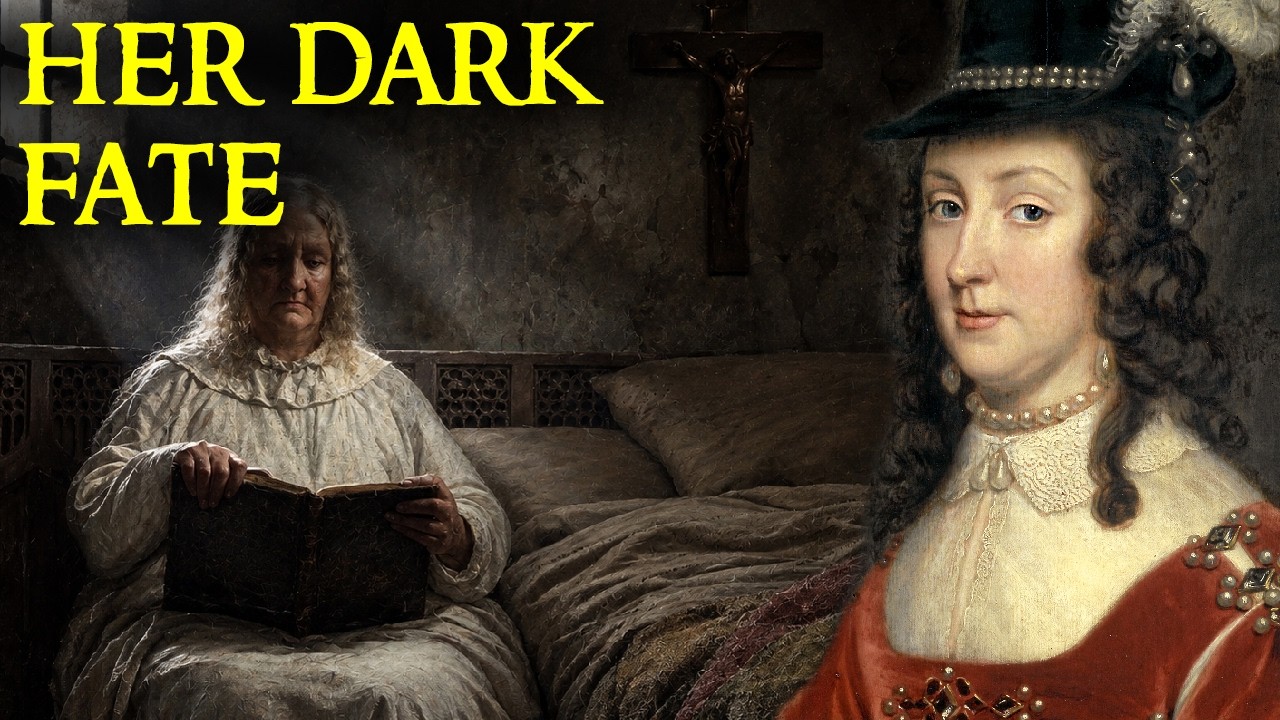
There was no accusation against her, no trial, no judgment. Yet she was taken from English soil and delivered back to her homeland, where the punishment that awaited her was imprisonment for life. For the next twenty-two years, she would be confined within a tower in Copenhagen, shut away from the world, stripped of the freedom she had once taken completely for granted. This is her story.
She had been born Leonora Christina on the eighth of July, 1621, at Frederiksborg Castle in Denmark. Her father was King Christian IV, who had ascended the throne as a child and had ruled since 1588. Her mother was Kirsten Munk, a wealthy Danish noblewoman whom Christian had married in 1615. Unlike Christian’s first wife, Anna Cathrine of Brandenburg, Kirsten belonged to no ruling family and carried no royal title, which by definition made the match a morganatic one.
In fact, Kirsten’s formidable mother, Ellen Marsvin, had secured a promise from Christian to marry her daughter before she would allow the relationship to begin at all. Christian and Kirsten had fifteen children together, although at least three are believed to have been born before the marriage, which made them illegitimate, and only eight survived to adulthood. Leonora was their fifth child after the wedding, and thus a legitimate daughter of the king, in practical terms a princess. But because of her mother’s modest social station, she did not receive the same royal titles as the children Christian had fathered with his first wife.
She was styled instead as a countess. At court, this distinction meant Leonora and her siblings were regarded as socially inferior to the king’s older children. Her father, however, paid little attention to such differences. He loved Leonora deeply and treated her as the equal of his other children.
Much of what is known about her childhood comes from her own later memoirs, which may not be entirely accurate. She seems to have spent her earliest years with her parents at the royal palace in Copenhagen, growing up in close familiarity with her three half-siblings, including the future King Frederick III, the sons of Christian’s first wife, Anna Cathrine of Brandenburg. But her childhood was not confined to Denmark alone. At some point she was sent to live with relatives in the Netherlands, and the journey itself was a catastrophe: the ship carrying her was caught in a violent storm and nearly sank.
Then, while abroad, she fell ill with smallpox, the most feared disease of the age. She survived it, but a young boy she loved came to visit her during her sickness, contracted the illness from her, and died. This childhood tragedy clearly left deep psychological scars on her, wounds she would describe decades later. In 1630, Leonora’s family life was thrown into turmoil when Christian accused his wife Kirsten Munk of infidelity and divorced her.
Despite the scandal surrounding her mother, Leonora’s position at court remained fortunately secure, and she continued to enjoy her father’s goodwill. Around the same time, at only nine years old, word came that she was to be married to Corfitz Ulfeldt, a man from the king’s own inner circle who was twenty-four years of age. Because of her youth, the marriage was not officially concluded until October 1636, when she had turned fifteen. There had been many other suitors before the wedding finally took place.
The ceremony in Copenhagen appears to have been more lavish than any of her sisters had received, an extravagant display that reflected how much her father treasured her. Yet the marriage had an ominous beginning in other respects. Leonora soon discovered that her new husband was drowning in enormous debts. She had to sell some of her gold and jewelry to help pay them off.
At the time, she could hardly have known that this was only the start, and that her husband’s actions would eventually drag her into a catastrophe from which she would never recover. Corfitz Ulfeldt had an unusual connection to the wolf. His surname, Ulfeldt, literally meant wolf. In 1647, a painting was made of Leonora with a small dog at her side, symbolizing her wifely loyalty, while a wolf stood beside her, representing her husband and his family.
Perhaps the symbolism was intended to indicate that the Ulfeldts remained inferior to the royal family, but as Leonora would soon discover, the wolf was not tame at all. The marriage in 1636 marked the beginning of Ulfeldt’s rise. And tragically, in the end, it would mark the fall of everyone involved, especially Leonora. Her husband was intelligent and well-educated, fluent in several languages, and possessed of immense ambition.
His marriage to the king’s daughter helped push him to the top of the Danish government at a critical moment in European history. Both Denmark and Sweden had been drawn into the Thirty Years’ War then raging across central Europe. In time, the count became governor of Copenhagen and head of the Danish treasury. Then, in 1643, he reached the peak of his political career when he was appointed Lord High Steward, the highest political office in the kingdom of Denmark.
By this stage, Leonora was, in many respects, the first lady of a Danish court that had no queen. Her marriage to Ulfeldt appears to have been happy as well, at least compared to those of her sisters. But behind their privileged life, Ulfeldt was exploiting his powerful positions to enrich himself on a staggering scale. He manipulated the Danish currency, acquired vast tracts of land, and used his influence to extort money from officials and nobles.
Worse still, his corruption reached into the military: funds meant for the Danish army and navy were diverted into his own coffers. The consequences became clear when Sweden attacked Denmark in December 1643. The Danish forces were completely unprepared, and when the resulting Torstenson War ended in 1645, Denmark was forced to cede several territories, including Gotland, while Sweden emerged as the dominant power in the Baltic. Yet despite the catastrophe, Ulfeldt kept his office, for the time being.
His spectacular fall, however, was imminent. The war with Sweden had been a disaster for Ulfeldt’s faction at the Danish court. Moreover, the death of Christian IV in February 1648 deprived Leonora’s husband of his most important patron and reduced her own standing in the royal establishment, given her mother’s lesser status. The new king, Leonora’s half-brother Frederick III, detested Ulfeldt and had no inclination to show much sympathy toward his half-sister and her husband.
Worse, Frederick’s wife, the new queen Sophie Amalie, came to despise Leonora. The exact reason for her hostility is unknown, though it may have stemmed from Leonora’s refusal to give up her place at court, or from petty slights Leonora was said to have directed at the queen. Whatever the cause, Sophie Amalie’s hatred carried consequences that would pursue Leonora for decades to come. The immediate effect was an investigation into Ulfeldt’s time at the head of government, and the crown began stripping him of his estates and assets.
Then a bizarre accusation made things considerably worse. A woman named Dina Vinhofvers approached the queen and claimed that Leonora and her husband were plotting to poison the king. An investigation followed, and it soon revealed numerous contradictions in her testimony; Leonora and Ulfeldt were convicted of nothing. Even so, the scandal further damaged their reputations at a moment when they could least afford to lose them.
Then, in July 1651, they made a catastrophic decision. They fled Copenhagen without royal permission. It was a decision they would soon regret. After leaving Copenhagen, Leonora, at bottom a royal princess, spent twelve weeks wearing men’s breeches and sleeping in peasant beds and barns as she made her way in secret with her husband to northern Germany.
She may well have embellished these later adventures. For example, at a garrison near the town of Stade, she claimed to have won a handsome sum of money by gambling with some drunken soldiers at cards. Eventually they settled in Swedish Pomerania, in what is now northern Germany and northwestern Poland, and Leonora began to write for the first time. Finally, in 1656, Count Ulfeldt judged that the tensions over his role in the Danish government during the 1640s had cooled enough for Leonora to return to Copenhagen.
He sent her back to negotiate with her half-brother and secure their return home. But she never reached her brother, King Frederick. At Korsør, she met another of her half-brothers, Ulrik Christian Gyldenløve, who ordered her to leave Danish territory. It was a betrayal that pushed Ulfeldt beyond the point of no return.
When war broke out between Sweden and Denmark again in 1657, he openly sided with the Swedes, helping to negotiate the humiliating terms that forced Denmark to cede even more territory in 1658. That victory did not last for the disgraced couple, however. The attitude of the count’s Swedish patron toward him changed within a year, and Ulfeldt was arrested at Malmö in 1659. He suffered a stroke that left him unable to speak, and Leonora found herself playing the role of his chief defender for months afterward.
Eventually, during their trial, they decided to flee Sweden. By that time the count was healthy enough to take a ship to the city of Lübeck in northern Germany, while Leonora headed once more toward Copenhagen. Neither journey went according to plan. Instead, they were detained and shipped to Hammershus on Bornholm, a fortress standing on the cliffs overlooking the Baltic, where the governor, a major general named Fuchs, systematically robbed and starved them.
They were finally able to escape in April 1661, with Leonora said to have climbed down a rope of seventy-two feet toward freedom, while one of their servants had to be rescued from a ravine. People later claimed that this daring escape was so extraordinary that Leonora must be a witch. Afterward, an agreement was reached that allowed the couple to live quietly at an estate at Ellensborg. But that arrangement did not last long.
The Ulfeldts were soon fleeing again. They managed to live quietly at Ellensborg for only a little over a year before the situation shifted once more. In 1662, Leonora’s husband traveled abroad, having received permission on the pretext that the warmer air of southern Europe would improve his health. In reality, he began conspiring to win allies against the Danish crown and to secure power there again at some future time.
When the Elector of Brandenburg, a relative of King Frederick of Denmark, reported the count’s activities to Copenhagen, Frederick decided that the cup had run over. Ulfeldt was tried in absentia, and an effigy of him was symbolically beheaded. In any event, he died near Basel in the Swiss Confederacy in early 1664, while fleeing from bounty hunters. By the time of her husband’s death, Leonora’s grim fate was already sealed.
At the height of their power in the 1640s, the Ulfeldts had lent money to numerous foreign monarchs and nobles. Among their debtors was the House of Stuart, in exile as a result of the English Civil Wars. Leonora now went to England to seek repayment from King Charles II, who had been restored as ruler of England in 1660. Instead, while she was in England, the Danish government asked the English authorities to detain her because of her husband’s actions on the continent.
In 1663, she was arrested and deported from Dover back to Denmark. For Charles II, this had the convenient side effect of getting rid of a woman pressing a substantial debt his family owed her. For Leonora, the consequences were devastating. She returned to Denmark not as a princess, but as a prisoner, and she would remain one for a large part of the rest of her life.
At home, Leonora was sent to the Blue Tower, a square tower with a blue roof in the courtyard of Copenhagen Castle, where she was first imprisoned on the eighth of August, 1663. Ironically, it stood only a stone’s throw from the place where she had grown up. Leonora was never formally charged with any crime. Six months later, her husband’s death removed any need for the Danish crown to pursue further legal action against the family.
Yet she remained imprisoned, not because she had been convicted of anything, but because her stepmother despised her, and her half-brother, the king, had little reason to trust her after two decades of scandals and intrigues. In the end, Leonora spent an astonishing twenty-two years behind bars. Her first cell in the Blue Tower was said to be a windowless room she later called the “dark church. ” Leonora later described her imprisonment as a miserable and degrading life.
She claimed her cell was filthy, filled with fleas, and overrun with rats, so numerous that they nibbled at her candle while it burned. She also remembered having almost nothing to write with, forced to improvise ink from candle soot and to use the sugar wrappers she received as writing material. It is hard to know how accurate her account was, but there is no doubt her conditions were extremely harsh. As time passed, she adapted and gained greater access to books and the ability to write, turning her years of imprisonment into the unexpected beginning of her greatest literary work.
She began composing “Jammers Minde,” a memoir whose title can be roughly translated as “Remembrance of Woe. ” To be fair to Leonora, while it is difficult to separate fact from fiction in her memoir, she was a skilled storyteller, and her memoir was not an exercise in self-pity. It contained entertaining anecdotes about her life as a prisoner and the misjudgments of her youth. Elsewhere, the book contained unusually frank passages, such as her detailed description of passing a gallstone in 1682.
The work was often biblical in tone, with Leonora casting herself as a kind of modern-day Jacob, who suffered innumerable misfortunes, often at the hands of others. Her greatest sin, as she portrayed it, was that she had been an obedient Christian wife who refused to abandon her husband despite his flaws and failures. In 1670, Frederick III died and was succeeded by her step-nephew, Christian V. Her treatment improved somewhat under the new king, who sent his ministers to ask the dowager queen, Sophie Amalie, to agree to her release.
But if we believe Leonora’s account, the dowager queen refused their entreaties. Leonora’s imprisonment finally ended with the death of Sophie Amalie in February 1685. On the morning of the nineteenth of May, Leonora was told that a royal order for her release had been issued. The news spread quickly, and crowds of the curious gathered in the courtyard below the Blue Tower, while the queen and her ladies-in-waiting watched from a palace balcony, hoping to catch a glimpse of the mysterious royal prisoner.
But Leonora refused to leave until darkness fell. At around ten o’clock, after nearly twenty-two years of captivity, she finally emerged from the Blue Tower under cover of night, wearing a veil that hid her face from the waiting crowds. At sixty-three years of age, Leonora Christina was finally free. In her final years, she was granted the former convent of Maribo as a residence and assigned a pension.
There she spent her last thirteen years writing and embroidering, carefully tending to her own legacy. She died on the sixteenth of March, 1698, at the age of seventy-six. Strangely, when her family’s burial vault was opened in the nineteenth century, her coffin was missing. Her son Leo had moved it to Vienna after her death.
She and her husband had had children during their many adventures, ten in all, seven of whom survived to adulthood. One of her daughters took care to send the manuscript of “Jammers Minde” to Vienna. It remained there in the archives for two centuries, until one of her descendants, Count Johann Waldstein, arranged for its publication in Copenhagen in 1869. By then, of course, the scandalous deeds of the Count and Countess Ulfeldt were no longer as politically sensitive as they had once been.
In the process, Leonora became a national heroine overnight. Some of her descendants, however, claimed she was a traitor who had colluded with the Swedes during a vital period of Danish history. Whatever one’s viewpoint, this remains an extraordinary testimony to a remarkable life filled with some rises and very, very many falls.






