The door closed behind him, and for a moment the silence in Kensington Palace was absolute. Dr. James Colthurst set his medical bag on the polished table, opened it, and removed not a stethoscope but a standard cassette recorder. He pressed record.
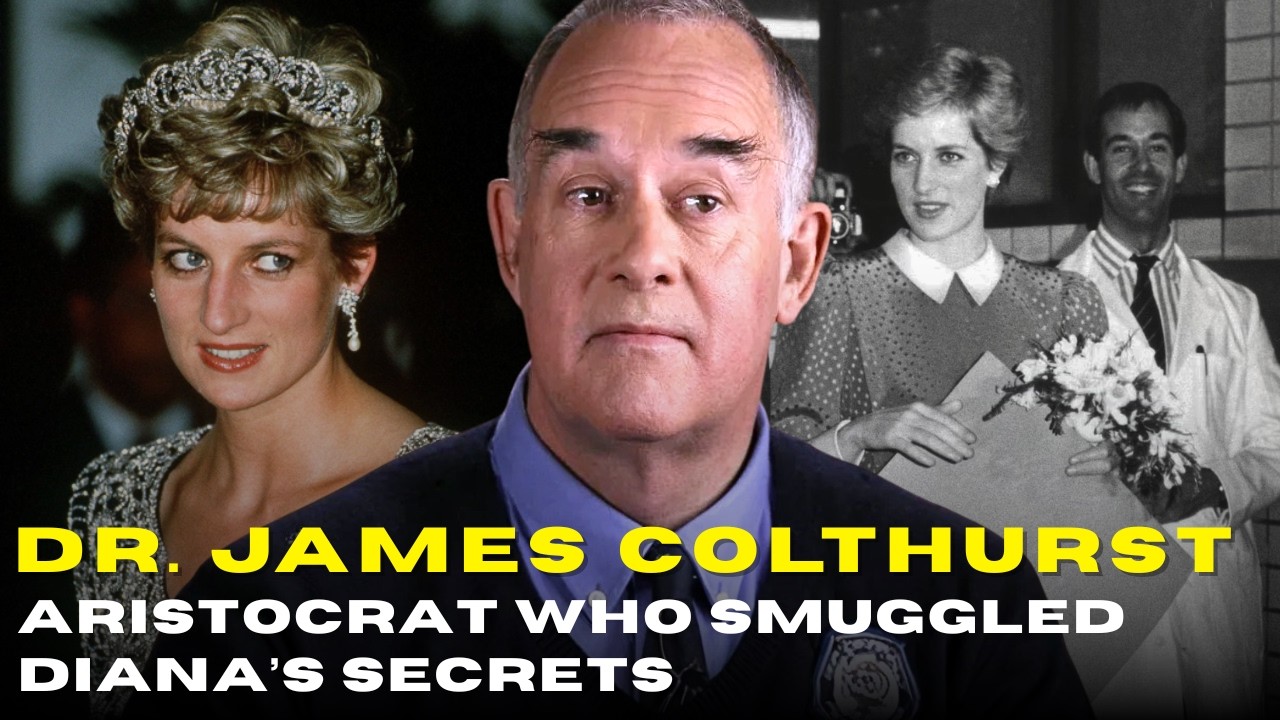
Across from him sat the Princess of Wales, her eyes carrying the exhaustion of a decade spent inside a gilded cage. He began to read from the typed sheets in his hand—blunt, forensic questions prepared by a journalist who had never once been allowed through these gates. And Diana began to speak. The man who had once been cursed by the royal elite as a traitor who stabbed the throne in the back is now recognized by history as the only knight who dared to risk his life to save a princess.
From a quiet nobleman with a flawless career, he transformed himself into a target of Britain’s most notorious security machine. Why would a man with every privilege choose to confront the Windsor empire simply to protect the tearful whispers of Princess Diana? Born in 1957, James Colthurst was not a commoner staring through the gates of the palace. He was born into the same elite social stratum as the royal family itself—the son of Sir Richard Colthurst, the ninth baronet, whose ancestral seat was the famous Blarney Castle in Ireland.
Educated at Eton College, the premier training ground for the British ruling class, he understood the aristocracy because he was a product of it. He knew their codes, their arrogance, and their fundamental ruthlessness. But Colthurst made a crucial deviation from the standard aristocratic playbook. Instead of managing a country estate or shuffling into a comfortable inherited position in finance or politics, he chose to work.
He enrolled at St. Thomas’s Hospital in London to undergo the grueling training required to become a medical surgeon. This decision became the master key to his character and his ultimate role in Diana’s life. Medical training does not care about your father’s title.
It strips away social pretense. It forces a person to deal with blood, pain, fear, and human fragility on a daily basis. By choosing medicine, Colthurst anchored himself in the real world—and secured his own absolute financial and professional independence. He did not need a grace-and-favor home from the Queen.
He did not need an invitation to a royal garden party to validate his existence. He was a baronet’s son with a scalpel and his own paycheck. This rendered him structurally immune to the leverage that the palace traditionally used to control people. Diana Spencer, on the other hand, was born into an entirely different kind of aristocratic trauma.
The Spencer family was one of the oldest and most prominent in England, but behind closed doors, Diana’s childhood was defined by a profound, agonizing sense of abandonment. Her mother, Frances Shand Kydd, left the family when Diana was just seven years old, following a bitter, highly publicized divorce from John Spencer, the 8th Earl Spencer. In the 1960s, aristocratic divorces were scandalous, and the children were often treated as collateral damage. John Spencer won custody, but he was a distant, emotionally closed-off patriarch.
Diana grew up in massive echoing houses feeling fundamentally unwanted—a child who internalized the belief that love was conditional, fragile, and easily withdrawn. The Spencer family, like most of the high aristocracy, operated on transactional terms. Children were raised by nannies, sent away to boarding schools, and expected to eventually marry well to secure the family’s proximity to power. Diana was not nurtured.
She was warehoused. This was the psychological baseline of the seventeen-year-old girl who stepped onto a snowy ski slope in Val Claret, France, in the winter of 1978. She was a teenager carrying the invisible scars of parental abandonment, with no university prospects and no clear path in life—simply trying to find her footing. During the ski trip, she suffered a minor accident, twisting her ankle.
James Colthurst, then a twenty-one-year-old medical student, happened to be on the same trip. He stepped in to examine the injury. What blossomed on that freezing mountain was not a sweeping, dramatic romance. It was something far rarer and ultimately far more dangerous to the British monarchy: an uncomplicated, purely platonic, and deeply equal friendship.
Colthurst did not look at Diana and see the daughter of an earl. He did not see a strategic social alliance. He just saw a slightly clumsy, incredibly funny teenager with a sharp wit and a tendency to pull practical jokes. They bonded over an immediate, shared sense of mischief, laughing at the absurdities of the upper class.
Colthurst, grounded by his medical training, treated her with a straightforward, unpretentious warmth that Diana had been starved of her entire life. The timing was critical. Colthurst knew Diana before the machine got hold of her—before the cameras, before the title, before she became a globally traded commodity. He established a baseline of trust entirely free of ulterior motives.
He liked her for her. In the circles they moved in, a relationship free of transactional value was an anomaly. For Diana, James Colthurst became a human anchor. As the 1970s bled into the 1980s, the dark machinery of the British establishment began to turn its gaze toward the Spencer family.
The royal family had a severe problem. Prince Charles, the heir to the throne, was passing thirty. He was deeply and inextricably in love with Camilla Shand, later Parker Bowles. But the palace had deemed her unacceptable.
She had a past. She was not aristocratic enough, and she was not a virgin. The monarchy, operating on an archaic and deeply misogynistic set of rules, required a very specific type of bride to secure the succession. They did not want a modern woman with her own opinions, her own history, and her own agency.
They wanted a blank slate—a girl with an impeccable aristocratic pedigree, no scandalous past, and a malleable personality. They needed a vessel to carry the next generation of Windsors. A quiet girl who would smile for the cameras, cut the ribbons, and look the other way when her husband inevitably returned to his mistress. They looked at nineteen-year-old Diana Spencer—shy, inexperienced, desperate for affection, heavily conditioned to obey authority—and decided she was the perfect candidate.
The courtship was not a romance. It was a corporate acquisition. Diana, carrying the deep trauma of her parents’ divorce, desperately wanted a family. She wanted to belong.
When the Prince of Wales offered her the ultimate fairy tale, she grabbed it completely unaware that she was walking into a psychological meat grinder. Throughout 1980, as the press began to hound her and the immense terrifying gravity of the royal family began to pull her in, Diana’s social circle was systematically stripped away. The palace courtiers—the men in gray suits—began to isolate her. They preferred her to have no independent support system, to be entirely reliant on the crown.
But they could not get rid of James Colthurst. He remained firmly planted on the perimeter, watching his bright, funny friend being swallowed whole by an institution that had absolutely no intention of protecting her. He saw the warning signs that the rest of the world ignored in their frenzy for a royal wedding. He recognized the terror in her eyes as the trap closed.
He did not interfere because he respected her agency, but he made a silent, steadfast commitment. He made sure Diana knew that no matter what happened behind the iron gates of Buckingham Palace, his telephone line would always be open. He remained the singular uncompromised safe zone in her rapidly shrinking world—the aristocrat who stood outside the castle holding his medical bag, waiting for the inevitable moment when the fairy tale would shatter and the bleeding would begin. When the heavy doors of Buckingham Palace closed behind Diana Spencer on July 29th, 1981, the public fairy tale ended and the psychological autopsy began.
The world had just witnessed the wedding of the century. Millions of people cheered for a radiant twenty-year-old princess. But inside the walls of the royal residences, the atmosphere instantly shifted from celebration to a suffocating clinical reality. Diana had served her primary purpose.
She had provided the visual spectacle the monarchy required to boost its popularity. Now she was expected to transition smoothly into her secondary role: a silent, compliant incubator for the next generation of the Windsor bloodline. The absolute cruelty of the environment Diana entered was rooted in the fundamental architecture of the British royal system. The monarchy is not a family.
It is a constitutional utility—an ancient, sprawling corporation designed solely for its own preservation. The people who operate this corporation—the private secretaries, the equerries, the senior courtiers known as the men in gray suits—are bureaucrats of bloodline. They do not deal in human emotion. They deal in public relations, operational efficiency, and risk management.
Their system is built on stoicism. The Windsor operational manual dictates that trauma must be buried, marital infidelity must be ignored, and public duty must supersede personal suffering at all times. Into this freezing, rigid machinery stepped Diana. She was young, emotionally shattered by her parents’ divorce, and desperately craving validation and affection.
She did not need a schedule; she needed a husband. But Prince Charles was emotionally unavailable and fundamentally incapable of providing the reassurance she required. More devastatingly, he was still deeply embedded in his relationship with Camilla Parker Bowles. Diana realized the truth almost immediately.
She found the customized bracelets, intercepted the phone calls, and noticed the cufflinks Charles wore on their honeymoon—gifts from his mistress. She was trapped in a crowded marriage, geographically isolated in royal palaces, and surrounded by staff who answered directly to the establishment that was actively gaslighting her. When Diana reacted to this trauma with tears, anger, and despair, the palace machinery did not offer empathy. They offered contempt.
The courtiers viewed her emotional distress as a systemic failure. To them, she was not a suffering twenty-year-old girl. She was a malfunctioning asset. They labeled her unstable.
They whispered that she was hysterical. The royal family’s response to her pain was simply to withdraw further, creating a vacuum of isolation around her. They expected her to eventually tire herself out and accept the bleak transactional reality of her position. This environment of absolute powerlessness triggered a severe psychological collapse.
Diana developed bulimia nervosa. In this context, bulimia must not be viewed as a trivial vanity issue. It was a desperate, violent coping mechanism. In Kensington Palace, Diana had no control over her life.
The courtiers dictated her schedule, her wardrobe, her public appearances, her housing. Her husband controlled her social standing while openly maintaining an affair. The media owned her image. The state owned her future children.
The only thing in the entire world that Diana could exert absolute control over was her own physical body. The binging was a physical response to profound emotional starvation. The purging was a literal and psychological rejection of the poison she was being fed by the royal system. It was a silent scream for help executed behind the locked doors of her private bathrooms.
As the illness ravaged her body, her paranoia grew—and her paranoia was completely justified. Kensington Palace was a gilded fortress, but it was also a panopticon. The walls had ears. The switchboards were monitored.
The police officers standing outside her door were elite members of the royal protection squad, but their ultimate loyalty was sworn to the crown, not to the Princess of Wales. If Diana made a phone call, she had to assume it was recorded. If she confided in a lady in waiting, she had to assume the conversation would be briefed to the Queen’s private secretary by the end of the day. She was drowning.
The men in gray suits were watching her drown, actively calculating how to manage the public relations fallout if she went completely under. She needed a lifeline that the palace could not tap, intercept, or manipulate. She picked up the phone and called Dr. James Colthurst.
A chance reunion in the late 1980s brought Colthurst back into her inner circle. By this time, he was a highly respected medical professional. When they reconnected, he did not see the Princess of Wales. He saw the terrified, isolated girl from the ski slopes.
And Colthurst possessed a singular, devastating advantage that allowed him to bypass the entire Windsor security apparatus: his medical degree. The royal establishment was deeply class conscious and highly deferential to professional titles. When James Colthurst pulled up to the gates of Kensington Palace, the guards did not see a threat. They saw an aristocratic doctor carrying a medical bag.
They assumed he was there to treat a physical ailment—perhaps to prescribe medication for a headache or check a minor injury. They waved him right through. The security machine designed to detect journalists, spies, and unauthorized guests possessed a massive blind spot for a physician making a house call. Colthurst used his medical credentials as an impenetrable alibi.
He walked straight past the royal protection officers, navigated the silent, heavily carpeted hallways of apartments eight and nine, and entered Diana’s private drawing room. Inside that room, he transitioned from a surgeon into a reluctant emergency trauma therapist. The scenes that played out in those private quarters were stark. Diana would pace the room frantically, oscillating between severe depression and sheer panic.
She would detail the coldness of her husband, the calculated cruelty of the courtiers, and the physical toll of her eating disorder. She recounted throwing herself down a flight of stairs while pregnant with Prince William—a desperate, theatrical attempt to force her husband to simply look at her. She described the agonizing reality of knowing exactly where Charles was when he was not with her. Colthurst did not offer empty platitudes.
He did not tell her to keep a stiff upper lip, the standard royal response to tragedy. He applied clinical logic to institutional madness. He listened. He let her vent the toxic build-up of secrets that the palace demanded she swallow.
When she hyperventilated, his medical training took over. He grounded her, lowering her heart rate, speaking in calm, measured tones. But his most vital contribution was psychological validation. The most destructive weapon the royal family deployed against Diana was gaslighting.
They constantly told her that her suspicions about Camilla were imaginary. They told her that her unhappiness was her own fault. They tried to convince her that she was crazy. James Colthurst sat in her drawing room, looked her in the eye, and told her she was entirely sane.
He provided an objective external reality check, confirming that the environment she was living in was profoundly unnatural and deeply abusive. He validated her pain. By simply acknowledging the reality of her situation, he prevented the Windsor machine from entirely destroying her grip on reality. However, as the years dragged on, Colthurst came to a chilling clinical realization.
He could visit her every week. He could calm her panic attacks. He could monitor her physical decline resulting from the bulimia. But he could not cure her.
In medical terms, you cannot cure a patient of a respiratory disease if you leave them locked inside a room filled with toxic smoke. The pathogen destroying Diana was not a virus. It was the institution itself. It was the marriage.
It was the crushing weight of the crown. Colthurst realized that his house calls were essentially palliative care—applying bandages to a woman who was bleeding out from systemic institutional trauma. By the end of the 1980s, the dynamic within Kensington Palace reached a critical threshold. Diana was approaching her thirties.
The bulimia had stripped her down, but she had survived the worst of the psychological barrage. The terrified, naive twenty-year-old was gone. In her place stood a deeply wounded, highly observant, and increasingly angry woman. She realized that the royal family was never going to protect her.
They were never going to stop the affair. They were simply waiting for her to break so they could quietly institutionalize her or push her entirely out of the public eye while retaining control of her children. If she stayed silent, she would die in that palace—either by her own hand or from the physical ravages of her illness. The strategy of endurance had failed.
Survival was no longer enough. Diana realized she had to go on the offensive. She had to strike at the only thing the men in gray suits actually cared about: the public image of the British monarchy. She had to tell the world the truth.
But she was trapped inside a fortress, watched by guards, cut off from the press. She needed a smuggler. She needed a man who could walk past the police, take the explosive truth from her hands, and carry it safely into the outside world. She looked at the doctor sitting across from her.
By the dawn of the 1990s, the Cold War inside the House of Windsor had escalated into a desperate hostage situation. Diana was no longer just suffering; she was actively suffocating under a carefully managed campaign of institutional erasure. The palace machinery had recognized that she was too popular to discard publicly, so they opted for a strategy of slow psychological containment. Prince Charles had retreated entirely into his parallel life with Camilla Parker Bowles.
The courtiers tightened their grip on Diana’s schedule, monitoring her movements, intercepting her communications, and systematically isolating her from anyone who might offer her an independent platform. Diana realized that the traditional avenues of grievance were completely sealed off. She could not appeal to the Queen, who fundamentally detested emotional confrontation and viewed Diana’s distress as an unseemly lack of discipline. She could not speak to the established royal correspondents, as they were deeply embedded in the palace’s patronage system, relying on the courtiers for access and feeding the public a sanitized narrative.
If she stayed within the rules of the system, she would be quietly neutralized—branded as mentally unstable, eventually locked away in a country estate while the monarchy retained absolute control over her children. To survive, she had to detonate the entire narrative. She had to bypass the establishment and speak directly to the public. She needed to weaponize the truth.
Enter Andrew Morton. Morton was a freelance royal journalist operating outside the strict control of the Buckingham Palace press office. He was sharp, ambitious, and had already begun to piece together the terrifying discrepancies between the public fairy tale and the private nightmare. Through a network of peripheral contacts, Morton knew that the marriage was a sham and that Diana was deeply unwell.
But knowing the truth and proving the truth are two entirely different legal realities in the United Kingdom. To publish a book exposing the future king of England as a callous adulterer and the royal institution as a psychological meat grinder, Morton needed irrefutable proof—straight from the princess herself. The logistical hurdle was absolute. Kensington Palace was a fortress.
Andrew Morton could not simply walk through the front gates. The Royal Protection Squad logged every visitor. The perimeter was heavily guarded. Surveillance cameras covered the entrances.
If Morton was spotted meeting with the Princess of Wales, the men in gray suits would instantly shut the operation down. Morton’s career would be destroyed by the royal legal apparatus, and Diana would face severe permanent lockdown. They needed a ghost—a middleman who could move freely between the gritty reality of Fleet Street journalism and the hyper-secure inner sanctum of the royal apartments without triggering a single alarm. Diana looked to the only man who possessed the access, the intellect, and the absolute unshakeable loyalty required to execute a high-stakes espionage operation: Dr.
James Colthurst. When Diana approached Colthurst with the plan, she was not asking him for a medical favor. She was asking him to commit an act of institutional treason. Colthurst understood the stakes immediately.
If he was caught smuggling information out of the palace to a tabloid journalist, the blowback would be catastrophic. The British establishment is merciless to class traitors. He would be excommunicated from high society. His medical career could be sabotaged.
He could face severe legal repercussions, intense police harassment, and public ruin. Yet Colthurst agreed. He did not agree because he harbored a political vendetta against the monarchy. He did not agree for financial compensation—he refused to take a single penny for his role.
He agreed because his clinical assessment of Diana’s situation had reached a terrifying conclusion. As a doctor, he recognized that his patient was standing on the absolute edge of the abyss. The bulimia, the depression, and the despair were reaching critical mass. He believed, quite literally, that if Diana did not get this poison out of her system and take back control of her life, she was going to die.
Smuggling the tapes was no longer a PR strategy. It was an emergency medical intervention. The mechanics of the operation were brilliantly primitive. In an era before encrypted digital communication, they relied on analog hardware and human nerve.
Andrew Morton would sit in his office and type out highly sensitive, brutally direct questions. These were not soft, PR-friendly inquiries. They were forensic probes into the darkest corners of the Windsor marriage—questions about suicide attempts, about Camilla Parker Bowles, about the royal family’s reaction to her eating disorder, and about the sheer isolating terror of living inside the palace. Morton handed these sheets to Colthurst.
Colthurst folded them, slid them into the bottom of his medical briefcase, and drove to Kensington Palace. The genius of James Colthurst lay in his ability to weaponize his own normalcy. When he arrived at the security checkpoints, he did not project the nervous energy of a smuggler. He projected the bored, polite authority of an aristocratic physician making a routine house call.
The police officers knew him. They respected his title. They did not search his medical bag. The security grid of Kensington Palace was designed to stop physical threats and unauthorized journalists.
It was entirely unequipped to defend against an inside man armed with a stethoscope and a tape recorder. Once inside Diana’s private sitting room, with the doors closed, the true gravity of the operation took hold. Colthurst would take a standard, inexpensive cassette recorder out of his bag and place it on the table between them. He pressed record.
Then, reading from Morton’s typed pages, the aristocratic doctor became the interrogator. The atmosphere in that room was incredibly tense. They both knew that if a courtier or an unsympathetic staff member walked in, the game was over. Against the backdrop of this ticking clock, Diana began to speak.
Colthurst sat perfectly still, holding the microphone, absorbing the full, raw, unfiltered horror of her existence. He listened as she recounted the sheer desperation of throwing herself down a staircase while pregnant, hoping her husband would finally show a shred of empathy. He listened as she described the exact humiliating moment she confronted Camilla at a party, only to be met with cold arrogance. He heard the exhaustion in her voice as she detailed the grueling cycle of binging and purging—a physical manifestation of the rot at the core of her life.
These recording sessions were not clean, polished interviews. They were the traumatic purging of a decade of suppressed agony. Diana wept. She hesitated.
She raged. And James Colthurst simply sat there turning the tapes over, providing the safe, non-judgmental space she needed to finally bleed out the truth. When a session concluded, the most dangerous phase of the operation began: exfiltration. Recording the confessions was only half the battle.
Colthurst now possessed physical cassette tapes containing the most explosive, highly classified personal secrets of the British Crown. He had to get them out of the palace and into the hands of Andrew Morton. If Colthurst drove his car out of the gates, there was always a fractional risk of a random security search, an accident, or being followed by the paparazzi who permanently camped outside the palace. If he walked, he was a static target.
He needed a method of transport that was completely invisible, entirely unassuming, and fluid enough to slip through the dense London traffic. He chose a battered, unremarkable bicycle. This detail is not merely a quirky historical footnote. It is a profound illustration of how the rigid, arrogant systems of power can be defeated by simple, pragmatic audacity.
The Royal Protection Squad was trained to look for sophisticated threats—surveillance vans, hidden cameras. They were completely blind to a man in a tweed jacket pedaling a rusty bicycle. Colthurst took the explosive cassette tapes, wrapped them casually, and dropped them into the wire basket on the front of his bike. He walked out of the royal apartments, smiled at the police officers, unlocked his bicycle, and rode straight through the heavy iron gates of Kensington Palace.
He pedaled down the wealthy streets of West London, weaving through traffic, carrying the detonation codes for the British monarchy in a wire basket. The contrast was staggering. Inside the palace, the men in gray suits were meticulously plotting the next decade of royal tours and public relations strategies, entirely confident in their absolute control over the princess. Outside the palace, an aristocratic doctor on a push bike was calmly carrying the weapon that would reduce their entire carefully constructed empire to ash.
Colthurst would ride to a prearranged neutral location—often a quiet café or a busy London street corner. There he would meet Andrew Morton. The handover was quick, silent, and deeply consequential. A plastic cassette tape would pass from the doctor’s hands into the journalist’s bag.
This clandestine cycle—the typed questions, the smuggled papers, the tearful recordings, the bicycle transport—was repeated over the course of several tense months in 1991. Six full cassette tapes were successfully smuggled out of Kensington Palace. Colthurst had executed the operation flawlessly. He had bypassed the cameras, outsmarted the guards, and secured the raw data of Diana’s survival.
He had done his job. Now the burden of the truth transferred to the printing presses. The bomb had been successfully built, armed, and placed directly beneath the throne. All that was left was to wait for the blast.
The Windsor establishment had spent millions of pounds and decades of structural engineering to ensure that no one could breach their walls or expose their internal rot. They relied on fear, class deference, and an elite security apparatus to maintain the silence. But they fundamentally misunderstood the nature of the threat. The system was defeated because it could not comprehend a man who operated entirely outside the currency of power.
Colthurst did not want a knighthood. He did not want money. He did not fear their wrath. He simply saw a patient bleeding to death, and he applied the tourniquet.
As the final tapes were handed over to Andrew Morton in the winter of 1991, the silent phase of the war concluded. The words of the princess had escaped the fortress. The men in gray suits were still sleeping soundly in Buckingham Palace, entirely unaware that the aristocratic doctor on the rusty bicycle had just signed the death warrant of their public illusion. The bomb detonated on a Sunday.
On June 7th, 1992, The Sunday Times published the first serialized extracts of Andrew Morton’s book, Diana: Her True Story. The impact was not merely a scandal. It was a constitutional earthquake. The British public woke up, opened their newspapers, and watched the central myth of their national identity disintegrate over breakfast.
The carefully curated billion-dollar illusion of the happy royal family was ripped to shreds. The text was undeniable because the voice was undeniable. Although Morton was the author, the phrasing, the emotional depth, and the specific granular details of the misery were distinctly Diana’s. The world learned about the suicide attempts.
They learned about the bulimia. They learned the name Camilla Parker Bowles, definitively moving her from the realm of high society gossip into the glaring light of historical fact. The public realized that they had not been watching a fairy tale for the past eleven years. They had been watching a psychological hostage situation.
Inside Buckingham Palace, the reaction was absolute, unparalleled panic. The Windsor establishment operates on the principle of image. The British monarchy survives because it demands deference, projecting an aura of divine right and flawless morality. Morton’s book stripped away the velvet and exposed the rusty, cruel machinery underneath.
The men in gray suits were entirely unequipped to handle this level of public exposure. Their immediate instinct was not self-reflection, nor was it empathy for the Princess of Wales. Their instinct was extermination. They needed to destroy the credibility of the book—and to do that, they needed to find and crush the leak.
The royal security apparatus immediately pivoted from protecting the family to hunting the traitor. They knew Andrew Morton did not have the access to gather this information on his own. They knew there was a mole. The system initiated a ruthless forensic witch hunt.
They scrutinized the visitor logs at Kensington Palace. They interrogated the staff. They examined the phone records. The net was cast wide, but the mechanics of elimination are brutally efficient.
They looked for the anomaly—the person who had frequent unmonitored access to the princess, who did not report directly to the royal household, and who possessed the intellect to pull off an espionage operation. The spotlight inevitably swung toward Dr. James Colthurst. What followed was not a public arrest or a formal legal proceeding.
The British establishment prefers to handle class traitors in the dark. Colthurst found himself targeted by a quiet, invisible, and deeply terrifying shadow war. He was a civilian surgeon—a man trained to save lives in operating theaters—suddenly plunged into the crosshairs of the state security apparatus. The intimidation tactics were classic, textbook psychological warfare.
The goal was not to assassinate him. The goal was to paralyze him with paranoia. The establishment wanted Colthurst to panic, to run to the press to complain, or to break down and confess, thereby providing the palace with the leverage they needed to discredit the entire Morton book. It started with the telephones.
When Colthurst picked up the receiver in his home or his office, he began to hear the distinct hollow clicks and echoes that signal a tapped line. He was being monitored. The men who protected the crown were listening to his conversations, cataloging his contacts, and waiting for him to make a mistake. Then came the physical breach.
Colthurst returned to his private residence to find that the sanctity of his home had been violated. The property had been entered. Drawers were opened. Personal files were rifled through.
Furniture was slightly displaced. But the most chilling detail was what remained. His valuables—the silver, the electronics, the money—none of it was stolen. This was not a burglary.
This was a message. In the language of intelligence agencies, a black bag job where nothing of financial value is taken is designed to instill absolute terror. It is the state communicating its reach. The message was unmistakable: We can bypass your locks.
We can read your private papers. We are inside your life. Keep your mouth shut, or the next consequence will not be a warning. For a normal citizen, this level of state-sponsored intimidation is psychologically crushing.
The natural human instinct is to fold. The royal establishment fully expected Colthurst to break. Historically, men of his social class capitulated immediately when threatened with the wrath of the crown. They valued their club memberships, their social standing, and their quiet, comfortable lives far more than they valued the truth.
But the men in gray suits had fatally miscalculated the psychological resilience of Dr. James Colthurst. They tried to intimidate a trauma surgeon with moved furniture. Colthurst dealt with life-and-death crises on a daily basis.
He possessed a clinical, objective detachment that rendered their psychological warfare entirely ineffective. He looked at the tapped phones and the ransacked apartment not with terror, but with cold diagnostic clarity. He recognized these tactics as the desperate flailing symptoms of a diseased institution trying to protect itself. Colthurst’s response to the intimidation was absolute, unyielding silence.
He did not call the police, knowing they were part of the same system. He did not call the tabloid newspapers to complain about harassment. He did not confront the palace. He simply absorbed the pressure like a brick wall.
By refusing to react, he starved the royal security apparatus of the leverage they desperately needed. He gave them nothing. He continued to go to work. He continued to treat his patients.
He acted as if the most powerful institution in the country was nothing more than a minor annoyance. This silent resilience provided Diana with the ultimate protective shield. Because Colthurst refused to crack, the palace could not definitively prove his role in smuggling the tapes. Because they could not prove it, they could not publicly destroy him.
And because they could not destroy him, they could not stop the momentum of the truth. The publication of the book forced the hand of the British government. In December 1992, Prime Minister John Major stood up in the House of Commons and formally announced the separation of the Prince and Princess of Wales. Diana had won her immediate physical freedom.
She was no longer required to pretend. The establishment had been forced to concede defeat on the public stage. But the separation did not end the war. It merely changed the battlefield.
Diana was now a rogue operator living outside the protection of the crown, but still highly visible, highly vulnerable, and viewed by the royal family as a massive, unpredictable threat. During these turbulent mid-1990s, the dynamic between Diana and Colthurst shifted. The smuggling operation was over. The tapes had done their job.
But Diana’s need for an uncompromised ally was greater than ever. The palace stripped her of her royal titles, reduced her security detail, and continued to brief the press against her. She was navigating a minefield of treacherous advisers, opportunistic journalists, and former friends who were actively selling her secrets for cash. Through all of this, James Colthurst remained firmly anchored in her life.
He transitioned from the role of the bicycle smuggler back to the role he had played on the ski slopes in 1978: the true friend. He was the man who had seen the absolute worst of the royal machinery, who had looked the security state in the eye, and who had not blinked. He remained the singular constant in a life defined by betrayal. The shadow war waged against Dr.
James Colthurst exposes the brutal authoritarian reflex of the British establishment when its core illusions are threatened. The system deployed surveillance, psychological intimidation, and the threat of total ruin to crush a civilian doctor. They failed because they encountered a man who operated on a completely different moral axis. Colthurst understood that true power is not the ability to inflict fear.
It is the ability to withstand it. By refusing to break, refusing to speak, and refusing to betray his patient, Colthurst effectively neutralized the wrath of the crown. He held the line while Diana secured her freedom. But the victory of the separation was a fragile one.
The princess had escaped the immediate confines of the palace, but she was now operating without a safety net in a world deeply obsessed with her every move. The aristocratic doctor had helped her break the cage, but neither of them could foresee the terrifying velocity of the tragedy that was accelerating toward them in the darkness of a Parisian tunnel. The war for Diana’s survival ended not in a courtroom or a palace, but against a concrete pillar in a Parisian tunnel. On August 31st, 1997, the physical reality of Diana, Princess of Wales, ended violently.
For the British monarchy, her death triggered an unprecedented constitutional crisis and a massive wave of public hostility. For the global public, it was the shocking conclusion of a relentless media soap opera. But for Dr. James Colthurst, sitting in his quiet home in England, the news did not represent a political crisis or a cultural watershed.
It represented the abrupt, permanent loss of the funny, deeply wounded teenager he had met on a ski slope twenty years earlier. The tragic irony of Diana’s death was that it occurred just as she had finally secured her operational independence. The tapes had worked. The divorce was finalized in 1996.
She had lost the HRH title, but she had gained ownership of her own physical movements and her own voice. She was no longer a royal hostage. Yet the machinery of surveillance and obsession that the palace and the press had built around her had gained too much momentum. It pursued her into the Pont de l’Alma tunnel, and it killed her.
In the immediate aftermath of her death, the world witnessed an outpouring of public grief. But behind the scenes, in the cynical, transaction-driven corridors of Fleet Street and the British upper class, a very different phenomenon emerged. Diana’s death created a multi-million pound vacuum. The tabloids could no longer photograph her, so they needed to dissect her memory.
To do this, they needed access to her private world. This is the moment when the fundamental cruelty of the royal system was fully exposed. The Buckingham Palace employment model is built on a specific socio-economic trap. The royal household employs staff—butlers, bodyguards, private secretaries—and pays them remarkably low wages.
The compensation is not financial. It is the prestige of proximity to the crown. The system demands absolute, subservient loyalty, but it offers no real security in return. When Diana died, this poorly compensated, highly resentful network of former employees realized they were sitting on a goldmine.
The prestige was gone, but the secrets were highly liquid assets. A grotesque cottage industry of betrayal sprang up overnight. The men who had been sworn to protect her rushed to cash in. Her former butler, Paul Burrell, who famously described himself as her rock, published a highly lucrative, deeply invasive tell-all book exposing her private letters and vulnerable moments.
Her former riding instructor and lover, James Hewitt, attempted to sell her most intimate, desperate love letters to the highest bidder on the international market. Former bodyguards and aides lined up at the doors of television networks, trading their proximity to the late princess for massive publishing advances. The people who had been inside her inner circle treated her memory as a commodity to be liquidated. The system had taught them that human relationships were transactional, and they applied that lesson with ruthless efficiency.
In the midst of this feeding frenzy, the global media realized there was one man who held the most valuable secrets of all. Dr. James Colthurst was the architect of the Morton tapes. He was the man who had sat across from her during her darkest psychological crises.
He had the unedited, raw memories of her confessions. He knew exactly what she had said about Prince Charles, about the Queen, and about the sheer terror of living inside Kensington Palace—details that were too explosive even for the published book. The British tabloids and international television networks aggressively pursued him. They offered him blank checks.
They offered him the kind of wealth that could buy estates and secure generational fortunes. He could have written a definitive multi-volume memoir. He could have positioned himself as the ultimate authority on Diana’s psychological state. The market was ravenous, and Colthurst possessed the prime supply.
His response to this unprecedented financial temptation defines his historical legacy. He closed his door. James Colthurst refused the money. He refused the interviews.
He refused the television specials. He did not hire a literary agent, and he did not attempt to monetize his proximity to the tragedy. He simply stepped back out of the spotlight and returned to his surgical practice. Against the backdrop of corrosive human greed, Colthurst’s silence is profound.
It requires an immense, almost superhuman level of psychological discipline to turn down massive, life-altering wealth, especially when everyone around you is taking the money and justifying it. But Colthurst understood something the opportunistic butlers and former lovers did not. He understood the power of refusal. By refusing to take a single penny for his role in Diana’s life or in the aftermath of her death, Colthurst achieved two monumental victories.
First, he permanently immunized himself against the revenge of the Buckingham Palace machine. The royal establishment’s primary method of destroying its critics is character assassination. If Colthurst had taken the money, the men in gray suits would have deployed their media proxies to brand him a grifter. They would have painted him as an opportunistic fraud who manipulated a vulnerable princess for his own financial gain.
They would have used his greed to invalidate the truth of the Morton tapes. Because he took nothing, they could say nothing. His financial independence and his absolute refusal to profit stripped the establishment of its most effective weapon. They could not question his motives because his motives were demonstrably pure.
He acted out of clinical necessity and human empathy, and his post-1997 silence was the irrefutable proof. Second, and more importantly, he honored the sacred medical and personal trust that Diana had placed in him. Diana had spent her entire adult life surrounded by people who viewed her as a stepping stone. Colthurst was the one man who had entered her life without an agenda and left it without a payout.
He proved that her faith in him was entirely justified. He took the darkest, most terrifying secrets of her institutional abuse, locked them away in his mind, and carried them into the quiet anonymity of his private life. When we evaluate the life and actions of Dr. James Colthurst through the cold, unforgiving lens of historical power dynamics, he emerges as a terrifying anomaly to the British establishment.
The House of Windsor’s empire of leverage, built on titles, access, and financial patronage, failed completely when it encountered James Colthurst. They could not buy him, outrank him, or intimidate him. And they could not control him with fear, because he possessed the clinical detachment of a trauma surgeon who refused to be intimidated by displaced furniture and tapped phone lines. The story of James Colthurst is not a romantic fairy tale.
It is a hard clinical study of institutional cruelty and the mechanics of resistance. It explains why a massive billion-dollar security apparatus backed by the authority of the British state was ultimately defeated by a doctor on a battered bicycle. Colthurst recognized that Kensington Palace was not a home. It was a psychological hazard zone.
He treated Diana not as a royal icon but as a patient suffering from systemic institutional abuse. When he smuggled those cassette tapes out of the palace gates, he performed a radical emergency extraction. History is filled with powerful institutions that crush the individuals trapped inside them. The story of Princess Diana almost ended that way.
Without the intervention of James Colthurst, the agonizing truths of her life would have been permanently smothered beneath the heavy velvet curtains of the monarchy. The public would have been fed a sanitized narrative of a fragile woman who simply could not handle the pressure. And the men who drove her to the brink would have maintained their flawless reputations. Instead, the truth survived.
James Colthurst bypassed the guards, detonated the illusion, and then quietly returned to the shadows demanding absolutely nothing in return. He remains a stark, unyielding reminder to the architects of power: no matter how high the walls, no matter how tight the security, a corrupt system can always be dismantled by the quiet courage of a single, uncompromisable friend.






