Evelyn Chase zoomed in on the bride’s hands, and her breath stopped. The high-resolution scan had revealed what 156 years of distance and the limitations of the original print had concealed. The hands she had first thought graceful, delicate, positioned with the careful propriety of Victorian wedding photography, were covered in scars. Deep, textured scars that created a landscape of damaged tissue across the palms, the fingers, the wrists.
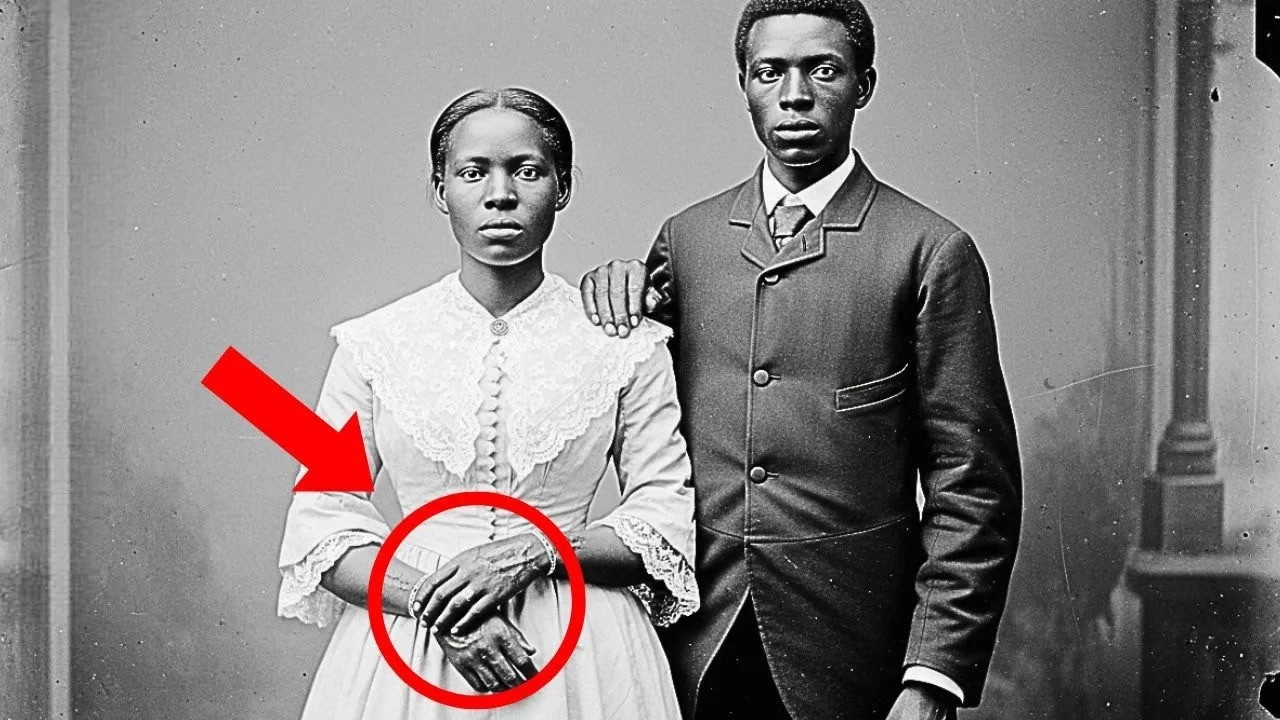
These were not the fine lines of age or the small marks of kitchen accidents. These were the kind of scars that came from severe burns, repeated trauma, and untreated healing. The bride had positioned her hands very deliberately, Evelyn now understood, showing only the backs and sides where the scarring was least visible, concealing her palms and the worst of the damage. But the scan revealed everything.
The puckered skin, the contracted fingers, the evidence of pain that no amount of careful posing could completely hide. It was February 2024, a cold morning in Washington, D. C. , and Evelyn, a medical historian at the Smithsonian’s National Museum of African-American History and Culture, had examined countless wedding photographs from the post-Civil War era.
But this particular image had made her pause the moment she first saw it. The photograph had arrived as part of a donated collection from a church in Charleston, South Carolina. It showed a young Black couple on their wedding day, dated on the back in faded ink: June 14th, 1868. The image was remarkably well preserved for its age, printed on heavy card stock that had been carefully stored in a family Bible for over a century and a half.
The bride stood on the left, wearing a simple but elegant dress of light-colored fabric, probably her best dress, repurposed for the occasion with added lace at the collar and cuffs. Her hair was pulled back severely from her face, revealing high cheekbones and eyes that stared directly at the camera with an intensity that transcended the decades. The groom stood beside her, his hand resting formally on her shoulder, wearing a dark suit that appeared slightly too large, likely borrowed for the occasion. His expression was solemn, dignified, carrying the weight of a moment he clearly understood as historically significant.
This was 1868. Just three years after the end of slavery. Just months after the ratification of the Fourteenth Amendment that had granted citizenship to formerly enslaved people. Evelyn sat back in her chair, her mind racing.
This wasn’t just a wedding photograph. This was evidence. A record of violence, of labor, of survival. And the bride had known exactly what she was doing when she positioned her hands for this photograph, creating an image of grace and dignity while carrying the permanent marks of what she had endured.
She spent the next hour examining every detail of the magnified image. The scarring was extensive and clearly old. The tissue had the settled, healed appearance of injuries sustained years before the photograph was taken. The scars concentrated on her palms and the pads of her fingers, with additional marking visible on her wrists where the high-resolution scan could see beneath the lace cuffs of her dress.
The pattern told a story. These weren’t random burns. The concentration on the palms and fingers suggested repeated contact with hot surfaces. The kind of injuries someone would sustain from handling hot metal, working near open flames, or being forced to touch heated objects as punishment.
The scarring on the wrists showed a different pattern. Linear marks that suggested restraints, rope burns, or shackles that had cut into the skin during struggle. Evelyn had studied the documentation of slavery extensively during her years as a medical historian. She had read firsthand accounts of the punishments inflicted on enslaved people: branding, whipping, burning, mutilation.
She had examined photographs of formerly enslaved people taken by photographers in the 1860s and 1870s, images that documented the physical evidence of their suffering, scarred backs, missing fingers, branded skin. But those photographs had been taken specifically to document abuse, to create evidence for abolition advocacy, to shock northern audiences into understanding the reality of slavery. This wedding photograph was different. This was a woman choosing to be photographed on what should have been the happiest day of her life, carrying scars she could never fully hide, but positioning herself to present dignity rather than damage.
Evelyn picked up the phone and called Dr. Marcus Webb at the Atlanta Historical Society. Marcus had become her closest colleague over years of collaborative research, and his expertise in post-Civil War African-American history was unmatched. “Marcus,” she said when he answered, “I need you to look at something.
I have a wedding photograph from Charleston, 1868. A Black couple just three years after emancipation. And the bride, Marcus, her hands are covered in burn scars. Severe, extensive scarring that she’s trying to hide in the photograph.
”
“Send me the image,” Marcus said immediately, his voice tight with interest. Evelyn emailed the high-resolution scan, then waited while Marcus opened it on his end. She heard his sharp intake of breath when he zoomed in on the bride’s hands. “Jesus Christ,” he whispered.
“What did they do to her? ”
“That’s what we need to find out. The photograph came from a church in Charleston, Mount Zion. It was stored in a family Bible donated to the church’s historical collection.
There’s a date on the back, June 14th, 1868, but no names. ”
“Charleston in 1868,” Marcus said slowly. “Three years after the war ended. The city was occupied by Union troops.
The Freedmen’s Bureau was active. Black people were voting, getting married legally for the first time, registering their families. ”
“This couple, they would have been enslaved just three years before this photograph was taken. ”
“And those scars,” Evelyn said, “they’re old.
At least several years healed. Whatever happened to her hands, it happened during slavery. ”
They were both silent for a moment, looking at the image of the young bride, her scarred hands carefully positioned, her eyes staring across more than a century and a half with an expression that now seemed less like simple dignity and more like defiance. “We need to find out who she was,” Marcus said finally.
“We need to tell her story. ”
Marcus arrived in Washington two days later, bringing boxes of documents from Charleston archives: marriage registers, Freedmen’s Bureau records, church membership rolls, and newspaper clippings from the turbulent years following the Civil War. He spread them across Evelyn’s office table, creating a timeline of Black life in Charleston during the late 1860s. Charleston in 1868 was a city in transition.
The war had devastated the economy. The planter class had lost everything. And suddenly, four years after emancipation, Black people were citizens. They were voting, holding office, starting businesses, and most importantly, getting married.
Marcus pushed forward a document from the Freedmen’s Bureau: Register of Marriages of Freed People, Charleston District, 1865–1869. The ledger contained hundreds of entries, formerly enslaved couples formalizing relationships that had never been legally recognized during slavery. “Marriage was one of the first things people did after emancipation,” Marcus explained. “During slavery, marriages between enslaved people had no legal standing.
Families could be separated at any moment. But after 1865, marriage meant something. Legal protection, inheritance rights, the ability to claim your children as your own. It was a declaration of humanity.
”
Evelyn scanned the marriage register, looking for entries from June 14th, 1868. She found seventeen marriages recorded on that date alone. A popular wedding day, probably because it fell on a Sunday. Most entries listed only first names, or names that had clearly been adopted after freedom.
The enslaved had often been denied surnames or had been forced to use their owners’ names. One entry made her pause: Thomas Freeman and Patience, both formerly enslaved, married June 14th, 1868, Mount Zion Church, Charleston. Witnesses: Reverend Samuel Green, Mary Freeman. “Freeman,” Evelyn said aloud.
“That was a common surname for formerly enslaved people to adopt. ”
“It was a declaration,” Marcus confirmed. “Taking the name Freeman meant you were no longer anyone’s property. And look, they were married at Mount Zion, the same church where the photograph was donated.
”
Evelyn felt a surge of hope. Thomas Freeman and Patience. That could be them. “But we need more evidence.
”
Marcus pulled out another document. “The 1870 federal census for Charleston. I’ve already searched this. There’s a Thomas Freeman, Black, age 28, listed as a carpenter living on Society Street, and living with him, Patience Freeman, Black, age 24, listed as keeping house.
”
“That’s them,” Evelyn breathed. “It has to be. ”
But Marcus’s expression was troubled. “There’s something else in the census record.
A notation beside Patience’s name. ” He pointed to faint handwriting in the margin: “Hands damaged, unable to perform fine work. ”
The room fell silent. That single notation, a census taker’s observation recorded in 1870, confirmed what the photograph had revealed.
Patience Freeman’s hands had been so severely damaged that it was visible to a stranger, notable enough to record in an official government document. “What kind of work damages hands like that? ” Evelyn asked, though she suspected she already knew the answer. Marcus pulled out a thick folder of documents he’d compiled on Charleston’s antebellum economy.
Charleston’s wealth came from several sources: rice plantations in the low country, cotton plantations inland, and in the city itself, iron works, foundries, and turpentine distilleries. Enslaved people worked in all of these. “But the work that would cause burns like what we see in that photograph—” He opened the folder to reveal an 1850s business directory. “There were three major iron works in Charleston before the war.
The Charleston Iron Works, the Palmetto Iron Works, and Bennett’s Foundry. All three used enslaved labor. ”
Evelyn understood immediately. Iron works meant handling hot metal, working near blast furnaces, pouring molten iron into molds.
The work was brutal and dangerous, causing severe burns and injuries that often went untreated. “We need to find out if Patience worked at one of these iron works,” she said. “We need to know what happened to her hands. ”
The Charleston Iron Works had been one of the largest industrial operations in the antebellum South, employing over two hundred workers, most of them enslaved, in the production of tools, machinery, and munitions.
The facility had been partially destroyed during the Civil War, but its business records had survived, preserved in the collections of the South Carolina Historical Society. Marcus spent three days in Charleston going through those records while Evelyn continued researching in Washington. The iron works had kept meticulous records: production logs, inventory sheets, and disturbingly, a ledger of enslaved workers hired from their owners to work in the facility. He called Evelyn on a Thursday evening, his voice shaking.
“I found her. Patience. She’s listed in the Charleston Iron Works hiring records from 1859 to 1864. ”
“What do the records say?
”
“She was hired out by her owner, a man named Robert Middleton, who owned a rice plantation outside Charleston, but also hired out his enslaved workers to the city’s industrial operations for additional income. Patience was listed as working in the mold pouring section. That’s where molten iron was poured into casts to create finished products. It was one of the most dangerous jobs in the iron works.
”
Evelyn closed her eyes, imagining a young girl. Patience would have been only thirteen in 1859, forced to work near furnaces that reached temperatures over two thousand degrees, handling tools and materials that could cause devastating burns with a single mistake. “There’s more,” Marcus continued, his voice tight. “The iron works kept injury records.
I found multiple entries for Patience between 1860 and 1863. February 1860: Patience burned hands from splashed iron, treated with lard, three days recovery. August 1860: Patience burned right palm from hot tongs, no treatment, return to work. November 1861: Patience, severe burns both hands from spilled molten metal, treated by Dr.
Simons, two weeks recovery before return to work. ”
“They kept burning her,” Evelyn said, horror and rage mixing in her voice. “And they kept sending her back. ”
“The last entry is from March 1863.
It says, ‘Patience, extensive burns to hands and wrists from accident at furnace. Hands permanently damaged, reassigned to cleaning and sorting work. ’ After that, she disappears from the hiring records. Middleton probably stopped hiring her out because her hands were too damaged for industrial work.
”
Evelyn thought of the wedding photograph taken just five years after that final injury. Patience had been twenty-one years old when she married Thomas Freeman, her hands carrying the permanent evidence of four years of brutal labor that had started when she was barely a teenager. “We need to find out more about her life,” Evelyn said. “Not just what was done to her, but who she became afterward.
She survived those injuries. She lived through slavery and emancipation. She got married and built a life. That’s the story we need to tell.
”
Finding Patience Freeman’s own voice proved unexpectedly possible through a source Evelyn had not anticipated: the testimonies collected by the Freedmen’s Bureau in the years following emancipation. The bureau had documented thousands of cases involving formerly enslaved people seeking compensation for unpaid wages, family reunification, or legal recognition of their marriages and children. In the National Archives, Evelyn found a testimony given by Patience Freeman in November 1868, just five months after her wedding. She had filed a claim seeking compensation for her years of labor at the Charleston Iron Works.
The testimony was recorded by a bureau agent named Jonathan Webster and preserved in remarkable detail. “Testimony of Patience Freeman, colored, formerly enslaved by Robert Middleton of Charleston District, given November 18th, 1868. I am 22 years old. I was born on Mr.
Middleton’s plantation, but when I was 13, he hired me to the Charleston Iron Works. I worked there from 1859 until 1863. My job was to help pour the melted iron into molds. It was hot work and dangerous.
Many people got burned. I was burned many times. The first time was just a splash on my hand. It hurt terrible, but they put grease on it and made me go back to work the next day.
After that, well, I got burned more times. Small burns and then bigger ones. The masters didn’t care much about burns unless you couldn’t work. In 1863, there was an accident.
A crucible of melted iron tipped over and splashed on my hands and arms. I screamed and fell down. They took me to the doctor who said my hands were ruined. The skin came off in sheets, and when it grew back, it was hard and tight.
I couldn’t open my fingers all the way anymore. I couldn’t hold small things. My hands hurt all the time for two years. Mr.
Middleton was angry because I couldn’t work at the iron works anymore. He put me to cleaning rice and sorting bowls, but I wasn’t worth as much money to him with damaged hands. When freedom came, I was glad because I thought I wouldn’t have to work at hot iron anymore. I am married now to Thomas Freeman, who is a carpenter.
I keep house for him, but my hands make it hard to do fine cooking or sewing. I am filing this claim because I worked for four years at the Charleston Iron Works and never got paid one cent. All the money went to Mr. Middleton.
I think I should get something for my labor and for my hands that got ruined in his service. ”
Signed with her mark, as Patience cannot write due to hand injuries. Evelyn read the testimony three times, tears streaming down her face. Patience’s voice came through across 156 years with heartbreaking clarity, matter-of-fact about the horror she had endured, seeking not sympathy but compensation, describing her damaged hands with the practical acceptance of someone who had learned to live with permanent injury.
The phrase “signed with her mark” particularly struck her. Patience couldn’t write, whether because she had never been taught or because her scarred hands couldn’t hold a pen. The testimony didn’t specify. But she had made sure her story was recorded.
She had pursued a legal claim for justice, even though she must have known the chances of receiving compensation were slim. Marcus found the outcome of the claim in the bureau’s resolution records. Claim denied. No legal obligation to compensate for labor performed during slavery.
Petitioner advised to seek redress through civil courts if desired. Patience had received nothing. The hands that had been ruined in Robert Middleton’s service, the years of brutal labor, the permanent disability, none of it entitled her to compensation under the legal framework of 1868 America. But she had tried.
She had stood before a Freedmen’s Bureau agent and told her story, had it recorded in official documents, made herself visible in the historical record as more than just a nameless victim. And six months before that testimony, she had stood before a photographer with Thomas Freeman and created another kind of record: a wedding photograph that showed her not as a damaged worker seeking compensation, but as a bride, a woman building a new life, someone who had survived and was claiming her right to dignity, love, and legal recognition of her marriage. While Evelyn focused on Patience’s testimony, Marcus traced Thomas Freeman’s story through carpentry records and city directories. What he found added crucial context to the wedding photograph and helped explain how Patience had found not just a husband but a partner who understood the weight of what she carried.
Thomas appeared in Freedmen’s Bureau records from 1865, immediately after Charleston’s liberation. He had filed for a certificate of freedom and registered his name: Thomas Freeman, age 25, formerly enslaved by the estate of Charles Morrison. The records noted his occupation as skilled carpenter, trained in furniture making and construction. But it was Thomas’s own testimony, given in 1867 when he petitioned to establish a carpentry workshop, that revealed his connection to Patience’s experience.
“I learned carpentry working at Morrison’s furniture workshop in Charleston. I was trained from age 12 to make fine furniture for white families. Morrison hired me out to other carpenters and kept all my wages. In 1861, when the war started, Morrison contracted my labor to the Confederate government.
I was sent to build fortifications and gun carriages. For three years, I worked building war machines. I saw terrible things. Many men died building those fortifications.
Shot by Union guns, killed in accidents, worked to death. I survived because I had a skill they needed. In 1864, I was assigned to work at the Charleston Iron Works, making wooden molds and patterns for the foundry. That is where I met Patience.
She worked pouring the melted iron into the molds I built. I saw what that work did to people’s hands and bodies. I saw Patience get burned badly. I saw them make her keep working even when her hands were wrapped in bandages.
When freedom came in 1865, I promised myself I would use my carpentry skill to build a good life. I also promised that if Patience survived the war, I would find her and ask her to marry me, because I saw her courage every day at that iron works. I saw her keep working even with damaged hands. I saw her help other workers, teaching them how to avoid burns, how to handle the hot metal safely.
She was the bravest person I ever knew. ”
Marcus called Evelyn as soon as he found this testimony. “They knew each other during slavery,” he said, his voice thick with emotion. “Thomas watched Patience suffer those injuries.
He witnessed what the iron works did to her. And he spent three years after emancipation searching for her so he could marry her. ”
Evelyn understood immediately what this meant for the wedding photograph. Thomas’s hand on Patience’s shoulder wasn’t just a formal pose.
It was a gesture of protection and support from someone who understood exactly what her scarred hands represented. He had seen her burned. He had watched her suffer. And he had chosen to build a life with her anyway.
Not despite her damaged hands, but in full knowledge of the courage it had taken to survive. “The photograph takes on completely new meaning,” Evelyn said. “This isn’t just a wedding portrait. It’s a reunion.
Two people who survived slavery together, found each other in freedom, and chose to create a legal, recognized marriage. Thomas knew about her hands. He testified about seeing her burned. And he married her and built a life with her.
”
“There’s more,” Marcus said. “I found Thomas’s business records from his carpentry workshop. Between 1868 and 1890, he employed over thirty people, all formerly enslaved, many of them disabled or injured. There are notes in his account books.
James, missing right hand, trained for one-handed planing. Samuel, burned arms, assigned to sanding and finishing. Thomas created a workshop specifically designed to employ people whose injuries made them supposedly unemployable. ”
“He was building the world he wished had existed for Patience,” Evelyn said softly.
“Exactly. And Patience worked with him. I found references to her in his business correspondence. She couldn’t do fine carpentry with her damaged hands, but she managed the workshop’s finances, negotiated contracts, and handled customer relations.
They were partners in every sense. ”
The 1870 census that had first confirmed Thomas and Patience Freeman’s identities also revealed another crucial detail that Marcus had initially overlooked. Thomas Freeman, head, age 28, carpenter. Patience Freeman, wife, age 24, keeping house.
Clara Freeman, daughter, age 1. They had a daughter. Born in 1869, just one year after their wedding. Clara Freeman represented the first generation of her family born into legal freedom.
Born to parents whose marriage was recognized by law. Born into a household headed by a skilled craftsman and managed by a woman who had survived the worst of slavery’s cruelties. Evelyn traced Clara Freeman through subsequent census records and city directories. In 1880, at age eleven, she was listed as attending school: a simple notation that carried enormous weight.
Patience, who had been forced into iron works labor at age thirteen, had ensured her daughter received education instead. By 1900, Clara Freeman had married a teacher named James Stevens and was living in Philadelphia, part of the Great Migration of Black southerners seeking better opportunities in northern cities. The census listed her occupation as seamstress, fine work: a job that required the precise hand coordination her mother’s scarred hands could no longer manage. Marcus found Clara’s name in another unexpected place: the records of the Philadelphia chapter of the National Association of Colored Women, an organization founded in 1896 to advocate for Black women’s rights and social welfare.
Clara had joined in 1901 and served on the committee for industrial education, advocating for job training programs for young Black women. In 1908, Clara gave a speech at the organization’s annual convention. The speech was preserved in the organization’s archives, and one passage made both researchers stop breathing. “My mother’s hands were destroyed by slavery.
She worked in an iron works in Charleston, pouring molten metal, and the work burned her hands so severely that she carries the scars to this day. She cannot sew fine seams or write letters or do many tasks that require delicate finger work. But she raised me to value education and skill. She made sure I learned to do the work her damaged hands prevented her from doing.
And she taught me that survival is not enough. We must build lives of dignity and purpose. We must create opportunities for the next generation that were denied to us. My mother’s scarred hands built my future.
I carry your courage with me every day. ”
Evelyn and Marcus sat in silence after reading that passage. The wedding photograph taken in 1868, when Clara was not yet born, had captured the moment when Patience and Thomas had chosen to create that future: to build a family, to establish a legal marriage, to claim their right to raise children in freedom. “We need to keep tracing the family line,” Evelyn said.
“We need to find out if any descendants are still alive. They deserve to know this story. They deserve to see that photograph and understand what it represents. ”
Marcus nodded and began the painstaking work of genealogical research, following the Freeman-Stevens family through the twentieth century.
Clara had four children, all of whom attended college: an extraordinary achievement for the grandchildren of enslaved people. Her youngest daughter, Dorothy, became a social worker in Philadelphia and was active in the civil rights movement during the 1950s and 1960s. Dorothy’s daughter, Patricia Morrison, was still alive at age seventy-eight, living in Silver Spring, Maryland, just fifteen miles from where Evelyn sat in her Washington office. Marcus found her through modern genealogy databases and public records.
“We found Patience Freeman’s great-great-granddaughter,” he told Evelyn. “And she lives right here in the DC area. I think it’s time to make a call. ”
Evelyn spent an hour preparing what she would say before calling Patricia Morrison.
How do you tell someone that you’ve discovered their great-great-grandmother’s wedding photograph, and that it reveals evidence of trauma and survival that has never been fully documented? How do you explain that a simple image of a bride and groom from 1868 carries a story of suffering, resilience, and triumph that deserves to be told? Patricia answered on the second ring, her voice warm and curious. Evelyn introduced herself, explained her work with the Smithsonian, and asked if Patricia had time to discuss her family history.
“I’ve been researching my family tree for twenty years,” Patricia said immediately. “I’ve traced back to my great-great-grandparents, Thomas and Patience Freeman, in Charleston, but I keep hitting walls trying to find out about their lives during slavery. I know they were enslaved, and I know they married in 1868, but I don’t know much beyond that. ”
Evelyn took a breath.
“I found their wedding photograph. June 14th, 1868. Mount Zion Church in Charleston. And Patricia, the photograph reveals something about your great-great-grandmother that I don’t think the family knew.
”
She heard Patricia’s sharp intake of breath. “You found a photograph of their wedding? ”
“I’m sending it to you now,” Evelyn said, emailing the high-resolution scan. “Look at the image first, then I’ll tell you what we discovered.
”
She waited while Patricia opened the file. She heard a soft gasp, then silence that stretched for nearly a minute. “That’s them,” Patricia finally whispered. “That’s really them.
I’ve never seen a picture of either of them. The family lost almost everything in a fire in the 1920s. We have stories passed down, but no photographs from that generation. This is—this is extraordinary.
”
“Now, I need you to look closely at Patience’s hands,” Evelyn said gently. “We used high-resolution scanning technology that can reveal details not visible in the original print. Zoom in on her hands, Patricia. Tell me what you see.
”
Another long silence, then Patricia’s voice, tight with emotion. “Scars. Her hands are covered in scars. Oh my god.
What happened to her? ”
Over the next hour, Evelyn told Patricia everything they had discovered. The Charleston Iron Works hiring records, the injury logs, Patience’s testimony to the Freedmen’s Bureau, Thomas’s witnessing of her suffering, Clara’s speech about her mother’s damaged hands. She explained how Patience had positioned her hands in the wedding photograph to conceal the worst of the scarring, how she had built a life despite permanent disability, how she had raised a daughter who became an advocate for industrial education.
Patricia cried through much of the conversation, but they weren’t tears of simple sadness. “I knew there was trauma in our family history,” she said. “We all knew our ancestors had been enslaved, but we didn’t know the details. We didn’t know what specifically had been done to them.
My grandmother, Dorothy, Patience’s great-granddaughter, used to say, ‘Our people survived the unsurvivable. ’ I never fully understood what she meant until now. ”
“There’s something else,” Evelyn said. “Your great-great-grandmother’s hands were damaged, but look at what she built anyway.
She raised Clara. She helped Thomas run his carpentry workshop. She managed finances and negotiated contracts despite not being able to write. She survived, Patricia.
And she made sure her daughter and granddaughter had opportunities she never had. ”
“The wedding photograph,” Patricia said slowly. “She’s not hiding in that picture. She’s standing there with Thomas, looking straight at the camera.
She knew her hands were scarred. She knew the photographer would see. But she posed for that picture anyway, because she wanted a record of her marriage, her freedom, her new life. ”
“Exactly,” Evelyn confirmed.
“That photograph is an act of courage. Your great-great-grandmother was claiming her right to be seen, to be documented, to be remembered as a bride and a wife and a free woman. Not just as someone who had been damaged by slavery. ”
Patricia was quiet for a moment.
“When can I see the photograph in person? And what happens to it now? ”
“That’s what I’d like to discuss with you,” Evelyn said. Four months later, Evelyn stood in the exhibition hall of the Smithsonian’s National Museum of African-American History and Culture, watching as visitors gathered around a new installation titled “Hands That Built Freedom: The Story of Patience Freeman.
”
The 1868 wedding photograph occupied the center of the display, enormously enlarged to show both the formal beauty of the image and the devastating detail of Patience’s scarred hands. But the photograph wasn’t presented alone. Evelyn and Marcus had assembled the complete documentary record of Patience and Thomas Freeman’s lives: the Charleston Iron Works injury logs, Patience’s testimony to the Freedmen’s Bureau, Thomas’s petition to establish his carpentry workshop, census records showing their growing family, Clara’s speech about her mother’s courage, and photographs of the Freeman-Stevens descendants through five generations. The centerpiece of the extended display was a second photograph taken by Evelyn just two months earlier.
It showed Patricia Morrison and fifteen members of the Freeman family, descendants spanning four generations, gathered at Mount Zion Church in Charleston, standing in the same spot where Patience and Thomas had married 156 years earlier. In the photograph, Patricia held a framed copy of the 1868 wedding portrait, completing the circle across more than a century and a half. The exhibition text told Patience’s story without minimizing the brutality she had endured, but also without reducing her to merely a victim. Patience Freeman was thirteen years old when she was forced to work at the Charleston Iron Works, one of the most dangerous industrial operations in the antebellum South.
For four years, she handled molten iron and worked near furnaces that reached over two thousand degrees. She was burned repeatedly. In 1863, a catastrophic accident left her hands permanently scarred and disabled. Three years later, she was free.
In 1868, she married Thomas Freeman, a skilled carpenter who had witnessed her suffering at the iron works and had promised to find her after emancipation. This wedding photograph, taken on June 14th, 1868, shows Patience carefully positioning her scarred hands to present dignity rather than damage. But high-resolution technology reveals what she could not completely hide: the permanent evidence of slavery’s cruelty. Patience Freeman lived until 1891.
She raised a daughter who attended school and became a seamstress. She helped Thomas run a carpentry workshop that employed formerly enslaved people whose disabilities made them unemployable elsewhere. She managed finances, negotiated contracts, and built a life of purpose despite hands that could no longer perform fine work. This photograph is many things: evidence of trauma, a record of survival, a celebration of love and legal marriage, and a declaration that damaged hands could not destroy human dignity.
Patience Freeman stood before this camera knowing her scars would be visible. And she posed anyway, because she had earned the right to be photographed as a bride, a wife, a free woman building a future. Her hands built that future. Five generations of her descendants carry her courage forward.
Patricia attended the exhibition opening with twelve family members, including her own granddaughter, seven-year-old Patience Morrison, named after her great-great-great-grandmother. The child stood transfixed before the enlarged photograph, studying the face of the woman whose name she carried. “Why are her hands like that? ” young Patience asked her great-grandmother.
Patricia knelt beside her namesake. “Bad people hurt her when she was young. They made her do dangerous work and she got burned. But she survived.
And she got married and she had a family. And because she was so brave and strong, you’re here today. ”
The little girl reached out and touched the glass covering the photograph, her small unmarked hand resting over the image of Patience Freeman’s scarred palm. “I’m glad she didn’t give up,” she said simply.
In the months following the exhibition opening, the story of Patience Freeman’s wedding photograph spread beyond the museum walls. Journalists wrote about the hidden scars revealed by technology. Medical historians analyzed the injury patterns to better understand the physical toll of industrial slavery. Genealogists used the Freeman family records as a model for tracing other formerly enslaved families through scattered archives.
But the most profound impact came from other families who saw themselves in Patience’s story. The museum received dozens of letters and emails from descendants of enslaved people who had their own fragments of family history: a name in a ledger, a notation in a census, a story passed down through generations but never fully documented. One letter came from a woman in Atlanta whose great-great-grandfather had worked at the same Charleston Iron Works as Patience. She sent a photograph of him taken in the 1870s, and when Evelyn scanned it with high-resolution technology, it revealed similar scarring on his hands.
Another letter came from a family in Baltimore whose ancestor had been hired out to a turpentine distillery and had lost three fingers in an accident. They had the employment records, but had never understood the full context until seeing Patience’s story. Evelyn began a new project, the Scarred Hands Archive: a collection of photographs, documents, and testimonies documenting the physical evidence of slavery’s violence. She partnered with Patricia Morrison, who brought the perspective of a descendant navigating the emotional complexity of this history.
“People ask me if I’m traumatized by learning what happened to my great-great-grandmother,” Patricia said during a public panel discussion six months after the exhibition opened. “But I’m not traumatized. I’m empowered. Yes, it’s painful to see evidence of what she suffered.
But it’s also powerful to see that she survived, that she built a family, that she made sure her daughter had opportunities she never had. That’s not a story of victimhood. That’s a story of triumph. ”
She gestured to the wedding photograph projected on the screen behind her.
“Look at how she’s standing in that picture. She’s not cowering. She’s not hiding. She’s looking straight at the camera with her husband’s hand on her shoulder and her own scarred hands clasped at her waist.
She’s saying, ‘This is who I am. This is what I survived. And I’m here to build a future. ’ That’s the story I want my grandchildren to know.
”
Evelyn returned to her office late that evening, after the panel discussion had ended and the museum had closed. The wedding photograph remained on her desk. She had kept a high-quality print as a reminder of why this work mattered. Patience Freeman’s eyes stared out across 156 years.
And Evelyn understood now what that gaze represented. It was defiance. It was survival. It was a refusal to be erased or reduced to the scars on her hands.
Patience had stood before that photographer in 1868, knowing that the image would last longer than she would, knowing that it would be evidence of her existence, her marriage, her claim to dignity and legal recognition as a free woman. And she had been right. The photograph had lasted. It had survived more than a century and a half, had been preserved in a family Bible and donated to a church, eventually found its way to a museum where technology could reveal what the original viewers could not see.
The scars that Patience had tried to conceal had become, through the work of historians and the power of high-resolution imaging, not evidence of her victimization, but evidence of her extraordinary courage. Evelyn opened her file of unexamined photographs from the post-Civil War era. Dozens of images waiting to be scanned, analyzed, and understood. Somewhere in these images, other Patiences were waiting to be found.
Other hands carried other scars. Other faces stared across the decades with stories that deserve to be told. She began scanning the next photograph, watching as the high-resolution image appeared on her screen, searching for the hidden details, the concealed evidence, the stories that had been waiting more than a century to be recognized and honored. Patience Freeman’s wedding photograph remained on her desk.
Those scarred hands, visible in extraordinary detail. Hands that had been burned by molten iron. Hands that had been denied compensation for years of labor. Hands that had raised a daughter and managed a business and built a life of dignity despite permanent disability.
Hands that had built freedom, one scarred finger at a time, one day at a time, one generation at a time. Until five generations later, a little girl named Patience Morrison could stand before a museum display and say, “I’m glad she didn’t give up. ”
She never gave up.
And her hands, those scarred, damaged, resilient hands, proved it.






