In December 1952, a mail carrier named Thomas Whitley made his routine delivery to a farmhouse in McDowell County, West Virginia, and found the Blackwood sisters’ mailbox overflowing with nearly two weeks of uncollected mail. The sisters, Eleanor and Margaret, aged 32 and 29, had lived alone on the property since their parents’ deaths five years earlier. They were known to be meticulous, and Whitley, who had known the family since childhood, understood immediately that something was wrong. The front door stood partially open in the bitter cold.
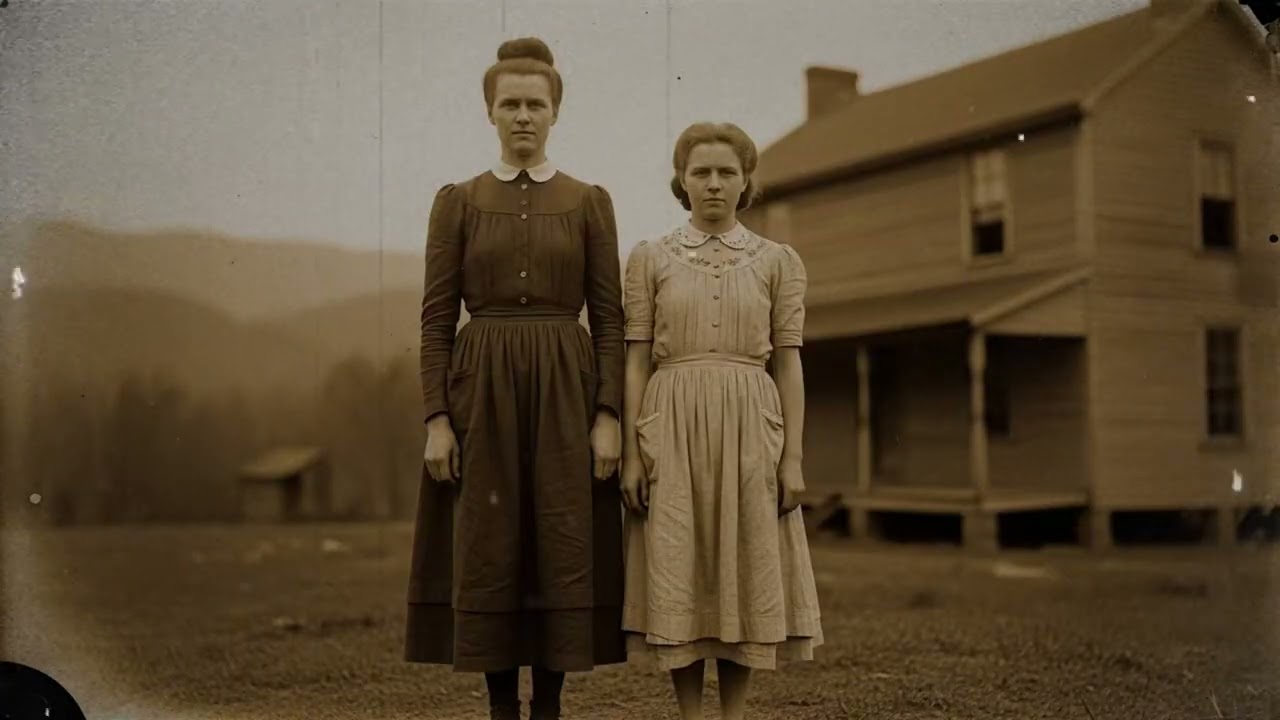
A kettle sat on the wood-burning stove, long since boiled dry. On the kitchen table, two cups of tea sat untouched, the liquid frozen solid. There was no sign of forced entry, no struggle, no blood, and no bodies. It appeared, as Whitley later told investigators, as if the sisters had simply stepped out for a moment and intended to return.
They never did. Sheriff James Harden, a practical man with nearly twenty years in law enforcement, led the initial investigation. A heavy snowfall beginning the night before the sisters’ absence was discovered had obscured any footprints or other potential evidence on the property. The sisters’ wardrobes appeared intact, and $47 was found in a tin box in Eleanor’s bedroom.
A hunting rifle remained mounted above the fireplace. Nothing suggested the women had planned to leave. The sisters had been raised in near isolation. Their mother, Vivien, a former schoolteacher, had homeschooled them.
Eleanor had briefly attended the local high school but withdrew after less than a year to help care for her ailing father. Teachers remembered her as an exceptional student with a remarkable memory. Margaret, the younger sister, had never attended formal schooling. Those who knew the family described them as having an unusually close bond, with Eleanor reserved and analytical, and Margaret more outgoing and expressive.
After their parents’ deaths, neighbors noted a change in the sisters’ behavior. They became increasingly vigilant and withdrawn. A local store owner recalled that months before their disappearance, Margaret had asked whether anyone unusual had been seen in town, saying the house felt different lately, like it was breathing when they were not looking. The hardware store operator reported that Eleanor had purchased an unusual number of locks and door reinforcements in the months leading up to their disappearance.
The initial search of the property revealed little beyond what Whitley had already observed. In the basement, investigators found a locked wooden chest containing fragmentary journal entries in Margaret’s handwriting. One entry, dated roughly three months before the disappearance, described sounds like breathing at night. Another, dated two weeks before they vanished, mentioned marks appearing on the back porch: straight lines grouped in sets of five.
The final entry, dated December 5th, said the sisters had agreed to take turns sleeping, one always awake, one always watching. A search of the surrounding forest found nothing, though half a mile from the house searchers discovered unusual markings on trees, straight lines in sets of five, made with a sharp implement. With no evidence of foul play, investigators considered the possibility that the sisters had left voluntarily. A bus station attendant in Charleston claimed he might have seen two women matching their descriptions, but bus company records showed no tickets under the Blackwood name, and without photographs of the sisters, positive identification was impossible.
The investigation gradually stalled. But in the summer of 1953, a geology student from West Virginia University exploring abandoned mining tunnels in the region made a discovery that would reignite the case. Robert Caldwell had entered a tunnel that had been closed since 1945, part of the same mining operation where the sisters’ father, Howard Blackwood, had once worked. Approximately 800 meters in, he found a small side chamber that had been deliberately sealed with mining debris.
Inside were items later confirmed to belong to the Blackwood family: a woman’s shoe matching footwear known to belong to Eleanor, a silver locket containing a photograph of the sisters as young girls with their parents, and a leather-bound ledger written in Howard Blackwood’s handwriting. The ledger, spanning the years 1939 to 1947, began around the time of Howard’s mining accident and continued until just before his death. While many entries were mundane, others were troubling. An entry from 1942 described Howard’s wife urging him to stop telling their daughters about what happened down there.
Another from 1944 mentioned Margaret finding one of the artifacts near the old east tunnel entrance. An entry dated one week before Howard’s death in 1947 said they were watching the house and that he knew where all the bodies were buried. Sheriff Harden requested assistance from the state police, and Lieutenant Samuel Crawford, an outsider to McDowell County, was assigned to review the case. Crawford’s investigation revealed that in 1939, the year of Howard’s accident, a major collapse had occurred in one of the mine’s primary tunnels.
Official records listed three miners dead, but Crawford uncovered newspaper accounts suggesting the death toll may have been far higher, possibly as many as fifteen men. Many of the unaccounted for were itinerant workers with no local connections, men whose disappearances would go unnoticed. Vivien Blackwood, the sisters’ mother, had consulted a lawyer in Charleston regarding potential legal action against the mining company before her death. The lawyer’s widow recalled that Vivien had been genuinely terrified, and that her husband had described it as one of the strangest situations in thirty years of practice.
In January 1954, Crawford arranged a public meeting at the Welch courthouse to appeal for information. Attendance was sparse, and a local man warned him that he was digging into things that had been put to rest a long time ago. Crawford organized a thorough exploration of the tunnel where Caldwell had found the artifacts and discovered a narrow passage, deliberately concealed behind boards painted to match the surrounding rock, leading to a natural cave system extending beneath the Blackwood property. Inside the cave system, Crawford’s team found a disturbing tableau.
The chamber contained remnants of a living space: a cot with moldering blankets, shelves holding canned goods and water containers, and a wooden chair facing a far wall covered with dozens, perhaps hundreds, of photographs spanning decades. The images depicted various locations throughout the county, with faces circled in red ink. Several photographs showed the Blackwood sisters at various ages, their faces marked with a distinct X. The most recent, showing the sisters standing on the porch of their home, was dated November 1952, just weeks before their disappearance.
The chamber also contained a desk with newspaper clippings related to unexplained disappearances throughout the county dating back to 1940. Many of these cases involved itinerant workers, solitary hunters, and isolated elderly residents. None had ever been solved. A renewed search of the Blackwood property revealed a trap door in the tool shed floor, concealed beneath heavy equipment and ingeniously disguised with a layer of soil on its upper surface.
It led to a narrow passage connecting directly to the cave system. Whoever had created this space had been accessing the Blackwood property from below, potentially for years, without the sisters’ knowledge. The general store owner, Martha Connelly, then came forward with information she had initially withheld. Approximately one month before their disappearance, Margaret Blackwood had come to the store alone, something she had never done.
She had appeared distressed and whispered, if something happens to us, look in the mining records from 39. Look for the names that aren’t there. Connelly admitted she had been afraid to come forward because her late husband had worked for the mining company. Crawford compared employment records from before and after the 1939 collapse.
Approximately twenty men on the company payroll before the accident no longer appeared afterward. Only three were listed as deceased. The rest, all outsiders with few local connections, had simply vanished from the records. In April 1954, the tool shed on the Blackwood property was destroyed in a deliberately set fire, collapsing the entrance to the tunnel.
Crawford received anonymous threats, one left on his windshield warning that outsiders who dig too deep get buried too. Crawford obtained a court order to access sealed company records stored in a Charleston law firm’s archives. These documents revealed that in the weeks before the collapse, miners had reported unusual geological formations in the eastern tunnels. The company had brought in outside specialists who spent weeks conducting undisclosed research before the collapse occurred.
A partial transcript of a meeting shortly after the collapse referenced artifacts secured and transported for further study, and noted that the three casualties provided sufficient cover for operations. Remaining personnel had accepted financial incentives for cooperation and relocation. In August 1954, a former miner named Joseph Reeves, who had been part of the rescue team alongside Howard Blackwood, contacted Crawford. Reeves described entering a large natural cavity in the collapsed tunnel that contained stone tablets with unknown markings and carved figures described as humanlike but wrong somehow.
In the center of the chamber was a perfectly circular pit that seemed to go down forever. A lantern lowered on a hundred feet of rope never hit bottom. Reeves said the original rescue team was replaced by company officials and unknown men in suits, forced to sign non-disclosure agreements, and given bonuses to keep quiet. Howard Blackwood had been troubled by what they found, insisting the artifacts should be studied by scientists.
Reeves, dying of cancer, said he could not take the secret to his grave. A more thorough examination of the underground chamber revealed a second, smaller chamber where investigators found a journal belonging to someone who identified himself only as the keeper. The writer described a self-imposed mission to guard what lies below, claiming to be one of several assigned to maintain surveillance over potential access points. The final entry, dated December 6th, 1952, read simply: It is done.
They have made their choice. The secret remains protected for another generation. There was no physical evidence of violence against the sisters. In November 1954, Crawford was ordered to conclude the investigation within thirty days.
He submitted his final report classifying the disappearance as unresolved due to insufficient evidence, recommending the case remain open but inactive. Much of his findings regarding the 1939 incident were subsequently classified by state authorities. Before submitting his report, Crawford made copies of key documents and sealed them in a waterproof container at a location known only to him. The Blackwood property was reclaimed by the county for unpaid taxes.
The house fell into disrepair and was demolished in the early 1960s. The cave entrance was permanently sealed during highway construction in 1965. Crawford left law enforcement to pursue graduate studies in archaeology. In September 1968, he failed to return from a solo expedition near the former Blackwood property.
His vehicle was found on a forest service road, his equipment laid out methodically beside it. Footprints led into the woods, but Crawford was never found. In his vehicle was a sealed envelope containing a hand-drawn map of cave systems with a specific area circled in red, and a note reading: I believe I’ve found the original chamber. If I’m not back by nightfall, seal the entrance at these coordinates.
Some secrets should remain buried. In 1972, a geological survey team found a waterlogged metal container hidden in a hollow tree near where Crawford’s vehicle had been discovered. One partially readable document contained a letter signed by Crawford referring to finding them alive, a community of keepers and willing participants in something larger than any of us understood. More than seven decades after Eleanor and Margaret Blackwood vanished, the case remains unsolved.
Local residents speak of hearing women’s voices on cold winter nights in the hollow where the house once stood, and a stretch of highway cutting through the former property is said to cause frequent mechanical failures and electronic malfunctions. The persistent local warning remains: some things are buried for a reason, and some secrets belong to the mountains alone.






