In the spring of 1898, Olaf Erickson hired on with a bridge gang at Selleck, Washington. He was twenty-eight years old, born in Småland, Sweden, into a family of timbermen who had cut spruce for the Swedish Navy for three generations. He had come to America in 1893, worked the Wisconsin North Woods for two years, then followed the work west like everyone else. His pay was $3.
25 a day, which was high-end bridge wages, because he could climb. The foreman’s notes described him as quick, sober, and almost silent. He spoke little English, but he had been a steeplejack in the old country, which meant he knew how to work with one hand on a rope, a foot on a cap timber, and his eyes on the next pin. He could set drift pins faster than any man on the crew.
On September 17th, 1899, Erickson was working the upper bent of a trestle over Boxley Creek, 176 feet above the canyon floor. The bent had been hoisted into place that morning, and he climbed up to seat the cap pins. He was using a four-pound, short-handled maul, the standard tool for this work. He wore wool trousers, hobnailed boots, a denim coat, and a leather belt of pins around his waist.
A cap timber the crew had positioned was slightly out of plumb. Erickson reached out with his left hand to brace himself against the brace of the bent behind him so he could swing the maul with his right. The brace had been pinned the night before by another man, and the pin had not been driven flush. When Erickson put his weight on it, the brace gave half an inch.
He fell. The bridge boss on the deck below saw him drop straight, not tumbling, just falling, until he hit the canyon floor 176 feet down. The coroner’s report listed the cause of death as multiple compound fractures and severance of the spinal cord. Erickson had been on the line for 412 days.
He had been planning to send for a younger brother in Sweden once he had saved enough for passage. The brother never came. The contractor paid Erickson’s last week of wages, $22. 75, to a Lutheran church in Tacoma that buried him.
That was one man. The Pacific Northwest bridge records that survived list at least 470 bridge monkeys killed on trestle work between 1885 and 1915. The actual number was probably above a thousand. Records burned, camps moved, names were misspelled or simply unrecorded.
The men who did this work were building something that should not have stood. In 1880, the United States was running out of accessible timber east of the Mississippi. The great pine forests of Michigan and Wisconsin had been cut. The hardwood ridges of Pennsylvania and New York were stumps.
The country needed wood for railroad ties, mine timbers, ship hulls, house frames, and for cities doubling in size every decade. What was left was the Pacific Northwest. Washington, Oregon, and a sliver of northern California held the largest standing softwood forest on the planet: Douglas fir three hundred feet tall, western red cedar eight feet across at the base, Sitka spruce that had been growing since the time of Christopher Columbus. The lumber companies looked at that forest and saw money.
The problem was getting it out. The timber did not stand on flat ground. It stood on the western slopes of the Cascades, the Olympics, and the Coast Range, on ridges and in canyons and creek-cut valleys so steep that a man on foot could not walk a straight mile in any direction. There were no roads.
There were no rivers wide enough to float the great logs down. A wagon could not haul a thirty-ton log out of a Cascade canyon. A river could not carry it. The only thing that could move that timber was a railroad.
And the railroads could not be built on the canyon floors, because the canyon floors were vertical-walled and choked with windfall. The railroads had to be built across the canyons, on the air. That is what a logging trestle is. It is a railroad floating two hundred feet above an empty canyon, held up by stacked timber and the engineering judgment of a man who learned his trade by climbing.
The man who designed most of these trestles in the Pacific Northwest was named Frank Hewitt. He was born in 1864 in Wisconsin, the son of a Methodist circuit rider. He apprenticed at fourteen on a logging spur outside Eau Claire, learned to dress timber with a broad axe and an adze, and by his early twenties he was running his own bridge gang in the Michigan North Woods. When the Eastern pine ran out, he went west with the work.
By 1895, he was the chief bridge engineer for the Northern Pacific’s logging subsidiaries in Washington state. He had no formal engineering degree. He could not have passed a college entrance exam. What he had was twenty years of climbing.
Hewitt designed by sketch on the back of brown paper torn from store receipts. His working drawings survive in the archive at Forest Grove: clean lines, dimensions in his own handwriting, load calculations done in pencil in the margins. The handwriting is small and tight, the way a man writes when the men above him are waiting on every line. The basic unit of every trestle Hewitt built, and of every wooden trestle built anywhere in America between 1870 and 1930, was something called a bent.
A bent is a single vertical frame: two timber posts standing upright, leaning slightly inward toward each other, joined at the top by a crossbeam called a cap, with diagonal braces between the posts forming an X. That is one bent, sixteen to twenty feet tall. The whole structure was made of squared timber, hand-hewn or mill-sawn from the same forest the trestle was being built to harvest. Now stack the bents.
A second goes directly on top of the first, locked into the cap with drift pins. A third on top of that. A fourth. The bents narrow as they rise, because the load above is lighter than the load below.
By the time you reach two hundred feet, you have stacked ten or twelve bents, each one slightly smaller than the one beneath it, all tied together with diagonal cross-bracing that runs the full height of the structure on both faces. The whole thing weighs perhaps a thousand tons. It carries a steam locomotive of eighty tons across a gap of three hundred feet. It is held in place by drift pins, tree nails, and the weight of itself.
And the bridge gangs that put these things up did it without scaffolding. There was no scaffolding. The men who built a two-hundred-foot trestle stood on the trestle they were building. The first bent went up on the canyon floor or on a stone footing carved into the wall, with pile drivers if the floor was soft, dry-stacked rubble piers if it was rock.
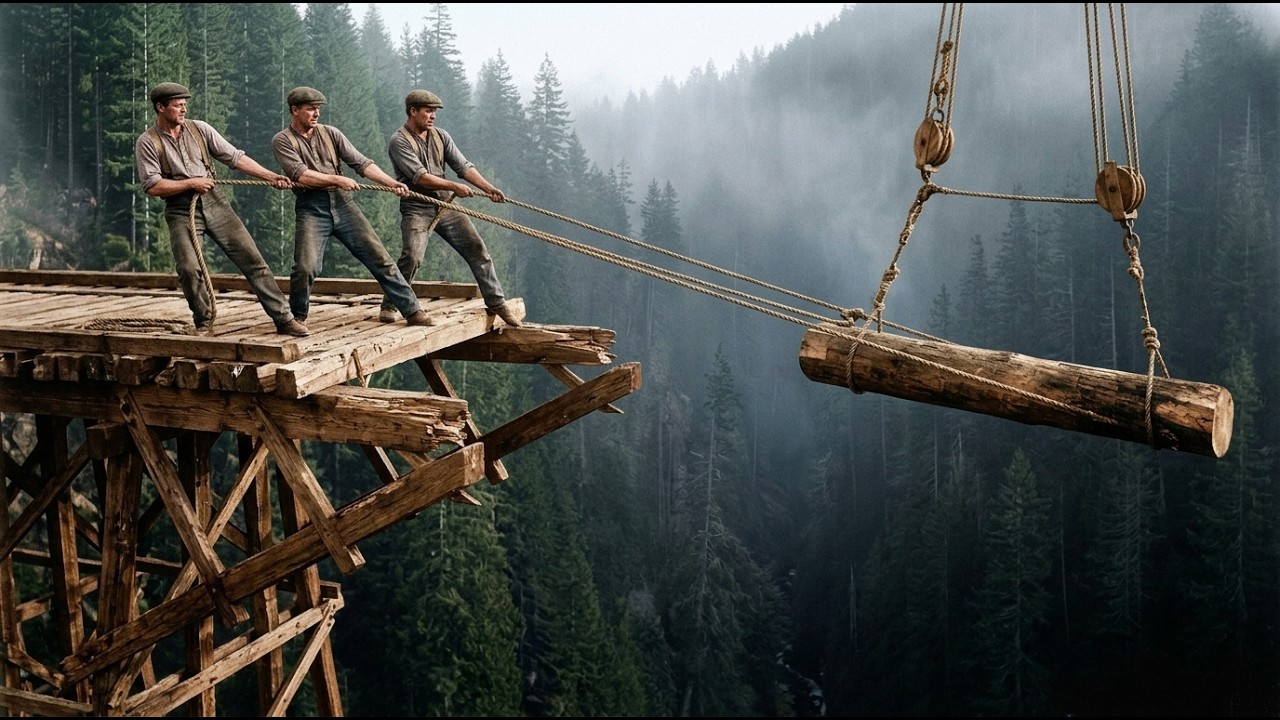
Once the first bent was vertical and braced, the next bent was hoisted up and seated on top of it, and a man climbed up to set the pins. He stood on the cap of the first bent, sixteen feet in the air, and worked. Then the second bent went up. He climbed thirty-two feet.
Then the third, sixty. By the time the trestle was at full height, the men were working two hundred feet above empty air, balanced on a cap timber eight inches wide, driving pins with a four-pound maul, with no rope tying them off and no net beneath them. They were called bridge monkeys. The name was not affectionate.
It was the description of a job that required a man to climb like an animal, because there was no other way to do the work. The danger was not only the height. The danger was the way a wooden trestle moves under load. A trestle is not a rigid structure.
It is a controlled compression frame designed to absorb the load of a passing locomotive by sway, by deflection, by the bracing distributing the weight across dozens of joints that give a fraction of an inch each. When a logging train crossed a tall trestle at speed, the entire structure rocked. Eyewitness accounts describe the upper bents visibly swaying side to side, sometimes by as much as a foot, as a fully loaded log train passed over. To a bystander on the canyon floor, it looked like the trestle was about to fall.
To Frank Hewitt, who designed it, the sway was the structure working as intended. A rigid trestle would have shattered at the joints within months. The trestle that swayed lived. The men who maintained the trestles, called bridge inspectors, walked the length of the structure once a week with a small hammer.
They tapped each cap timber, each brace, each pin. A clear note meant the timber was sound. A dull thud meant rot inside. A rotted timber was replaced in place, with train traffic continuing across the structure during repair.
Inspectors died, too. Sometimes a tapped timber was rotten enough to give way under the inspector’s own weight, and the man would go through the deck before he had time to step backward. Henri Beaupre was a pile driver man. He was born in 1871 in Trois-Rivières, Quebec, and came to Washington state in the fall of 1893 with the wave of French Canadian loggers who poured into the Pacific Northwest after the eastern timber gave out.
He could read and write in French, but not in English. The bridge boss who hired him on at the Cedar River trestle wrote his name as Henry Beaupre in the payroll, and that is how it appears in the records. The pile driver was a vertical steam engine bolted to a barge or a wooden frame at the base of the trestle, lifting a hammer of 1,500 pounds eight to ten feet up a vertical track and dropping it onto the head of a piling. The piling was a Douglas fir log forty feet long, driven into the canyon floor to anchor the lowest bent.
A single piling might take two hundred drops to seat fully. A trestle of any size required forty to sixty pilings. The danger of the pile driver was the timing. The hammer was lifted by a steam-driven cable on a clutch.
When the operator released the clutch, the hammer dropped under gravity. If a man on the deck was adjusting the piling head, or freeing a tangled cable, or simply standing too close, and the clutch slipped, the hammer fell early. Fifteen hundred pounds of cast iron falling eight feet does not give a man on the deck time to step back. The records of the Cedar River project alone list eleven men killed by pile driver drops in a single eighteen-month period.
Beaupre survived three years on pile driver crews before he was killed on August 4th, 1901. The clutch on the hammer cable failed during a routine drop. He had been signaling the operator to hold the hammer at the top of the track while he repositioned a piling head. The hammer let go on its own.
He was crushed at the chest. He was thirty years old. He left a wife in Trois-Rivières named Marie and a son he had never met, born the previous winter. The contractor paid Marie the equivalent of $42 in Canadian funds and a return passage steamship ticket she did not use.
John Tahoma lived. He was born around 1875 on the Skokomish reservation on the Hood Canal of Western Washington. The Skokomish and several other Coast Salish peoples had been working as climbers and bridge monkeys for the Pacific Northwest logging railroad since the 1880s. The bridge bosses preferred them for the upper work because, as one foreman wrote in 1896, they appeared to have no fear of falling.
The reality was that Skokomish boys grew up climbing cedars to gather bark for canoes and rope making. They were trained climbers from age six. Tahoma worked as a high bent man on at least nine major trestles between 1895 and 1912: the Cedar River, Boxley Creek, the Snoqualmie Falls Spur, a trestle outside Forks that was rebuilt three times after fires. He was paid the same wage as a white bridge monkey, which was unusual for the era.
The bridge gangs operated on a kind of meritocracy of risk. The men who did the work paid the same price, so they got the same wage. Tahoma retired from bridge work in 1912 at the age of thirty-seven with nothing more dramatic than worn-out knees. He went home to Hood Canal.
He fished. He raised three children. He told one of his grandsons in the 1940s that he had stopped climbing the day he realized he had to think before he reached for the next handhold. Before that day, the next move had always come without thought.
After it, he could feel his body asking whether it would hold. He climbed down the trestle he was working on that morning, walked to the rail station, and never set foot on a bridge crew again. He died in 1961, at eighty-six, having outlived every other bridge monkey in the gang he had started with. The trestles themselves are mostly gone.
They peaked in number around 1910. By one Forest Service estimate, there were more than 30,000 miles of logging spur railroad in Washington and Oregon at that peak, and along those miles stood somewhere between fifteen and twenty thousand wooden trestles of varying heights. The largest concentration was in the western Cascades and on the Olympic Peninsula. The tallest stood near 220 feet.
The longest ran over a third of a mile. They were not built to last. A wooden trestle exposed to Pacific Northwest rain had a working lifespan of twenty to forty years before the bottom bents rotted out from ground contact. The upper bents could last longer if they stayed dry, but the joints worked themselves loose under decades of train sway and weather.
Most trestles were torn down or burned in place once the spur they served had exhausted its timber. A logging company that had cut out a watershed had no reason to maintain the railroad that had served it. They pulled the rails for scrap and let the wood collapse on its own schedule. Fires from coal-fired locomotives ignited the dry creosoted decking and ran the length of a trestle in minutes.
The famous Tillamook Burn in 1933 destroyed multiple major trestles in the Coast Range in a single afternoon. The Selkirk Trestle in Washington went down in 1927 when an inspector missed a rotten cap timber and a string of loaded log cars dropped through the upper deck. Eleven men died, including the inspector. A handful survived.
A few remain. The Goat Canyon Trestle, in the desert mountains east of San Diego, completed in 1933 at 633 feet long and 185 feet tall, still stands in the Anza-Borrego Desert, abandoned but largely intact, because the dry climate has preserved the wood. The Kinsol Trestle on Vancouver Island, 614 feet long and 145 feet high, was restored in 2011 and now carries a hiking trail. A few smaller trestles survive in the Tillamook State Forest in Oregon and along the old logging grades north of Mount St.
Helens. But most of what was built is gone. The cuts are still there. If you hike the abandoned logging grades through the Cascade foothills, you can read the ghost of where the trestles ran: a flat shelf of dirt cut into a hillside, then a gap of empty air, then the same flat shelf continuing on the other side of a canyon.
In the canyon below, if you scramble down, you can sometimes find the stone footings of the lower piers, hand-cut blocks of native rock set in dry-stacked courses. Sometimes a section of bent pins still rusts in place between two stones. Sometimes a wooden cap timber, fallen and half buried in moss, still shows the adze marks of the man who dressed it more than a century ago. Frank Hewitt died in 1931, at sixty-seven.
He had spent the last decade of his life writing letters to forestry students at Oregon Agricultural College, explaining how a bent worked, why the diagonal bracing mattered, what the early bridge gangs had learned the hard way. His estate was small. He left his drawings and his transit to the college library, where they are still cataloged. There is no plaque in the Cascades for Olaf Erickson.
No marker for Henri Beaupre. The few headstones that exist for bridge monkeys in the small cemeteries of King County, Snohomish County, and Clackamas County are often illegible now. Most of the Swedish, French Canadian, and Skokomish men who built the trestles were buried where they fell, or in pauper’s graves at the edges of logging towns that no longer exist.
Just the canyons they crossed, and the cuts they left in the hillside, and the country that was built because they figured out how to balance a railroad two hundred feet in the air on stacked timber.






