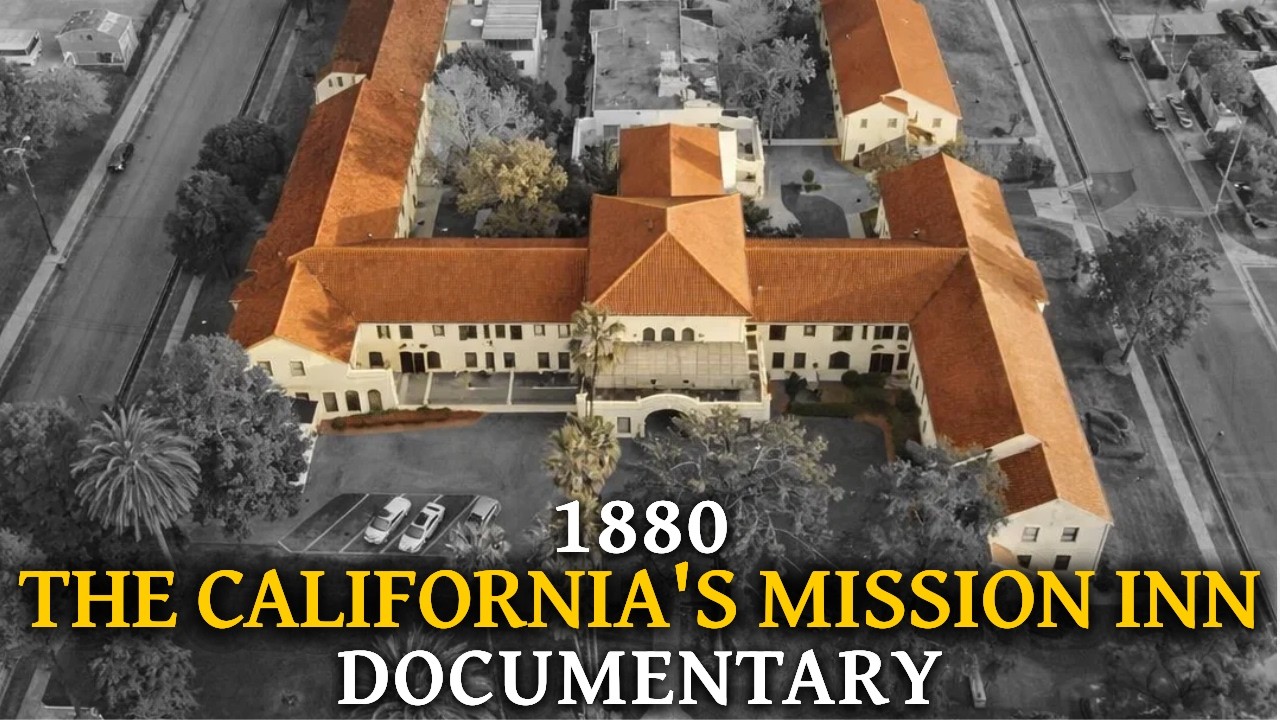
In the heart of Riverside, California, stands a building that occupies an entire city block, its rooftops crowded with domes, bell towers, gargoyles, and turrets drawn from five different centuries and six different countries. Beneath its floors lie catacombs. Inside its chapel, a golden altar shipped from Mexico in 32 pieces sits reassembled like a giant jigsaw puzzle. More than 800 bells hang from its walls and courtyards, including one dating to 1247, believed to be the oldest bell in Christendom.
Presidents have slept there. Movie stars have married there. Aviators are honored on its walls. Yet this extraordinary structure began as nothing more than a 12-room adobe boarding house on a dusty road in a town that barely existed.
This is the Mission Inn, and the man who built it was not an architect, not a millionaire by birth, and not anyone expected to create one of the most remarkable buildings in American history. His name was Frank Augustus Miller, and his obsession nearly destroyed him. The story begins with the land. In 1874, a civil engineer named Christopher Columbus Miller arrived in the tiny settlement of Riverside, California.
He had come west from Wisconsin to survey canals for a new agricultural colony. The town was barely four years old, its streets unpaved and its population small, but the soil was rich and water from the Santa Ana River promised prosperity. C. C.
Miller bought an entire city block in the center of town and built a modest adobe home, sending for his wife Mary and their four children, including a seventeen-year-old boy named Frank. In 1876, the Millers began taking in boarders. Travelers were passing through more frequently, drawn by the emerging citrus industry transforming Southern California. The adobe had twelve bedrooms, and Mary Miller filled them with guests.
Two years later, the family added a small wooden wing and called the operation the Glenwood Cottage, a simple family-run boarding house. But young Frank Miller saw something more. In 1880, at just twenty-two years old, his father sold him the property and business for $5,000. Frank had no formal education in architecture or business.
He had begged his parents to let him stay in Riverside instead of attending college in Ohio, promising to live an exemplary life. They agreed on one condition: he would be tutored by the town’s only teacher, a boarder at the Glenwood named Isabella Hardenbergh. During months of study, Frank and Isabella fell in love. They married that same year, and Frank Miller began the work that would consume him for the rest of his life.
At first, the changes were modest. Frank added rooms, improved the grounds, and renamed the place the Glenwood Tavern in 1888. But Riverside was transforming around him. The citrus industry was exploding, and wealthy Easterners and Europeans were arriving by train, drawn by orange groves and warm winters.
Riverside was becoming one of the richest cities per capita in the United States. Frank understood what these visitors needed: not just a place to sleep, but an experience, a destination that made them feel they had entered another world. By the late 1890s, Frank’s vision extended far beyond a country tavern. He dreamed of a grand hotel that captured the romance of California’s Spanish mission past.
The Mission Revival movement sweeping the state had deeply influenced him, inspired by the old Franciscan missions along the coast. Frank felt a spiritual connection to the Franciscans and their tradition of hospitality. He saw his hotel as a secular mission, a place of beauty, culture, and welcome. In 1902, he secured financing, with his largest investor being Henry Huntington, the railroad tycoon who owned the Pacific Electric Company.
The architect he chose was Arthur Burnett Benton, a founder of the Landmarks Club dedicated to preserving California’s historic missions. Benton designed a U-shaped Mission Revival structure with 84 new rooms, arched walkways, clay tile roofs, and a bell tower patterned after the one at San Gabriel Mission. The building opened in January 1903 as the Glenwood Mission Inn, later shortened to the Mission Inn. Then Frank kept building.
One of the first famous guests was President Theodore Roosevelt, who arrived by train on May 7, 1903. Before departing the next morning, Roosevelt planted one of Riverside’s two original navel orange trees in the hotel courtyard. The navel orange was the foundation of the city’s economy, launched by two trees brought from Brazil in the 1870s. Frank sent the president a box of oranges every Christmas for the rest of Roosevelt’s life, a small gesture that captured who he was: a showman, a host, and a man who understood that personal connections mattered more than marble and stone.
But Frank was never satisfied. No sooner would one wing be finished than he began sketching plans for the next. He traveled the world obsessively, visiting Europe, Asia, and Latin America, absorbing architecture and art wherever he went. He walked through Moorish palaces in Spain, Buddhist temples in Japan, Gothic cathedrals in France, and churches in Mexico.
Everything that moved him, he brought back to Riverside. The Mission Inn became a living museum of his obsessions. He collected bells from churches across the globe, eventually amassing more than 800. He acquired the Reyes altar, a massive Mexican baroque altar carved from cedar and covered in 18-karat gold leaf, standing 25 feet tall and 16 feet wide, delivered in 32 interlocking pieces with no assembly instructions.
He purchased stained glass windows created by Louis Comfort Tiffany in 1906, rescued from New York’s demolished Madison Square Presbyterian Church. To house these treasures, he hired architect G. Stanley Wilson to design the Saint Francis Chapel, which became the spiritual heart of the hotel. Over the next three decades, Frank added wing after wing.
The Cloister Wing, designed by Arthur Benton and completed around 1911, featured a soaring music room, the Carmel Tower and dome rising from the corner of Sixth and Orange streets, and massive buttresses inspired by San Gabriel Mission. Beneath it, Frank built catacombs, dark winding passageways lined with artifacts and religious iconography. The Spanish Wing, designed by Myron Hunt, added guest rooms, an outdoor courtyard, and Author’s Row, where writers and intellectuals stayed. The final addition, the Rotunda Wing designed by G.
Stanley Wilson, was completed in 1931, featuring a six-story rotunda with a spectacular circular staircase and the Saint Francis Chapel. The rotunda was inspired by Frank’s dedication to world peace, its walls decorated with the insignia of nations from around the globe. By the time it was finished, the Mission Inn filled an entire block with more than 200 guest rooms and one of the most eclectic collections of art and architectural curiosities in the Western United States. The guest list read like a history book.
Presidents Benjamin Harrison, William McKinley, Theodore Roosevelt, William Howard Taft, and Herbert Hoover all visited. When Taft arrived in 1909, the hotel reportedly built a special oversized chair to accommodate his three-hundred-pound frame; the president was not amused. Entertainers like Lillian Russell, Sarah Bernhardt, and Harry Houdini came in the early years, followed by Hollywood stars including Clark Gable, Bette Davis, Cary Grant, and Ginger Rogers. Bette Davis married in the Saint Francis Chapel in 1945.
Richard Nixon married Pat Ryan at the Mission Inn. Ronald and Nancy Reagan spent their honeymoon there. The building was not just a hotel; it was a stage for American power, glamour, and romance. But behind the grandeur, Frank Miller was struggling.
The Mission Inn was never a conventional business. Frank treated it more like a civic institution, pouring every dollar back into construction, collections, and community projects. He helped establish the Citrus Testing Station that became the University of California, Riverside. He co-founded the local trolley system.
He donated land for a YMCA. He organized Easter sunrise services on nearby Mount Rubidoux that drew thousands. He launched the Institute of World Affairs for the study of international peace. He was, in many ways, the heart of Riverside itself.
But hearts and souls do not balance ledgers. The Mission Inn was perpetually in financial difficulty, and Frank borrowed heavily to fund each new wing and collection. The Great Depression of the 1930s hit Riverside hard. Tourism slowed, revenue dropped, and the endless construction became an impossible burden.
Yet he kept going, building the rotunda wing between 1929 and 1931 in the teeth of the worst economic crisis in American history. Frank Miller’s first wife, Isabella, had passed away years earlier, and he later married Marion Clark. By the 1930s, his health was failing. On June 15, 1935, Frank Augustus Miller died just before his seventy-eighth birthday.
When news reached Riverside, the entire city stopped. For fifteen minutes, everything fell silent in tribute. He was buried at Evergreen Cemetery, not far from the hotel that had consumed his life. After Frank’s death, his daughter Alice and her husband DeWitt Hutchings took over management, but the hotel’s financial troubles only deepened.
When both died in the early 1950s, their children sold the Mission Inn in 1956 to Benjamin Swig, a San Francisco hotelier. What followed was a slow, agonizing decline. Swig, desperate to modernize and compete with flashier destinations like Palm Springs, sold off nearly 1,000 pieces from Frank Miller’s collection. Priceless paintings, antique furniture, and religious relics auctioned to strangers.
He redecorated the interior in mid-century modern style, covering arches and replacing handcrafted fixtures. He tried to make the Mission Inn look like every other hotel in California. It did not work. The soul of the building had been gutted, and travelers could feel it.
The hotel continued to lose money, changing ownership multiple times. Some rooms were converted into apartments and student dormitories. By the 1970s, there was serious talk of demolition. But a group of concerned citizens refused to allow it.
In 1969, they formed the Friends of the Mission Inn, dedicated to protecting the hotel’s history. Their advocacy helped secure a crucial designation: on May 5, 1977, the Mission Inn was declared a National Historic Landmark. The city of Riverside eventually purchased the hotel to prevent its destruction. In 1985, it was sold to a private development firm that closed the building for a massive restoration, but the developers went bankrupt before completing the $55 million project.
The Mission Inn sat empty, locked, and silent for years. In 1992, a man named Duane Roberts stepped in. Roberts was a Riverside native who had grown up in awe of the Mission Inn, remembering as a boy driving past its towers and arches with his family. He had made his fortune in the frozen food business, building a company that produced a million burritos a day and generated $80 million in annual sales before he sold it in 1980.
When the Mission Inn became available, he saw it as a rescue mission. Roberts purchased the hotel and completed the restoration. In the fall of 1992, the Mission Inn reopened its doors for the first time in seven years. Under Roberts and his wife Kelly, the hotel was reborn.
Kelly developed new traditions, including the annual Festival of Lights, which draws hundreds of thousands of visitors each holiday season. Today, the Mission Inn Hotel and Spa stands as one of the most celebrated historic hotels in the United States. It has been named the number one historic hotel in the nation by USA Today. It has 265 rooms, each one different from the next.
The bells still ring in the courtyards. The Tiffany windows still glow in the Saint Francis Chapel. The golden Reyes altar still gleams in the candlelight. The Flyers Wall still honors 151 aviators, their signatures etched onto copper wings, including Amelia Earhart’s, dedicated as the International Shrine of Aviators in 1932.
Three hundred weddings take place there every year, and staff and guests claim the ghost of Frank Miller still walks its halls. The Mission Inn is too large, too strange, too many things at once, Spanish and Gothic and Moorish and Asian and American, tangled together in a sprawl of domes and arches and hidden staircases. It was built by a man who never went to architecture school, who started with a twelve-room adobe and ended with a city-block-sized fantasy that nearly bankrupted him.
Standing in its courtyard today, you can still feel it: the weight of 800 bells, the warmth of California sun on old tile, the echo of presidents and movie stars and aviators who passed through these arches, and somewhere beneath it all, the quiet, relentless heartbeat of a man who believed that beauty was worth any price, even if that price was everything he ever owned.






